

Quantum Cryptography Market
Quantum Cryptography Market Size, Share, Trends, Growth, and Industry Analysis, By Component (Hardware, Software, Services), By Application (Network Security, Application Security, Database Encryption), By End-User (BFSI, Government andamp; Defense, Healthcare, IT andamp; Telecom, Others), Regional Analysis and Forecast Period 2026-2035
Quantum Cryptography Market Overview
As per Econ Market Research analysis, the Global Quantum Cryptography Market was valued at US$ 0.82 Billion in 2026 and is expected to reach US$ 3.73 Billion by 2035, registering a CAGR of 18.3% during the forecast period 2026–2035. The base year considered is 2025.
Quantum Cryptography Market Size 2025-2035 (USD Billion)

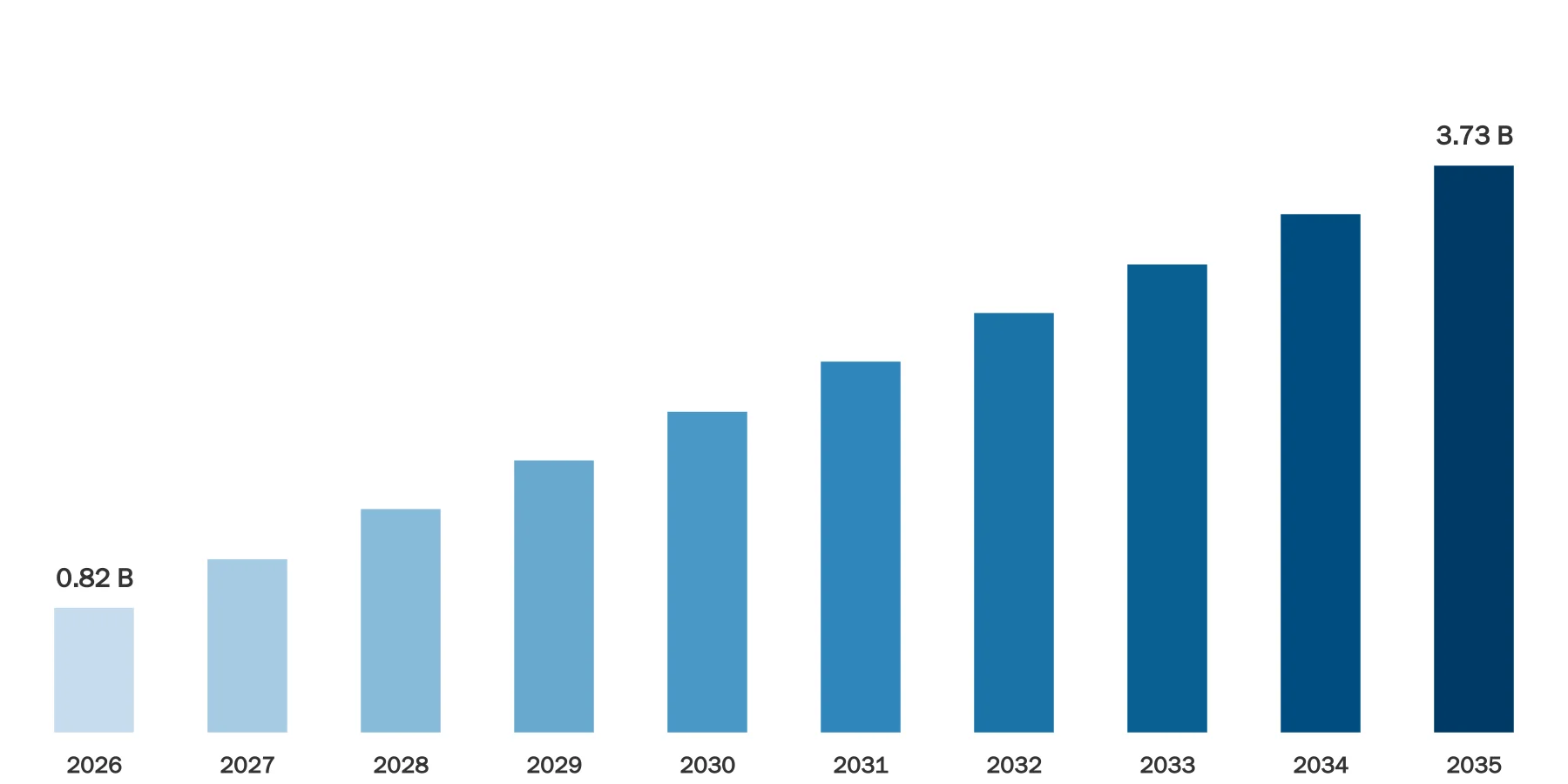
Source: Econ Market Research
In quantum cryptography, the principles of quantum mechanics are used to create an unbreakable system for secure communication. It depends on quantum algorithms, quantum key distribution, and other quantum properties to ensure the security of the transmitted data. The encryption and decryption of messages relies on quantum bits (qubits) instead of classical bits (cubits). This form of communication is highly secure and addresses vulnerabilities in classical systems. Its applications are wide-ranging, including banking, military and government communication. The increasing adoption of the Internet of Things (IoT) and Cloud Computing technologies is also driving the growth of the quantum cryptography market. Additionally, the advancements in Quantum Computing and the increasing investment in research and development activities to enhance the security infrastructure further fuel the market growth.
Market Drivers
The global quantum cryptography market has been increasing due to factors such as the rise in Cyber Security threats and the growing demand for secure communication channels. The market is also anticipated to continue expanding due to the increasing investments in quantum cryptography research and development by private and public organizations. Additionally, the rising trend of digitization and the need to safeguard sensitive data are further expected to drive the growth of the quantum cryptography market.
Significant advancements in quantum technology such as the development of reliable quantum key distribution (QKD) systems and quantum random number generators (QRNG). These technological advancements have made quantum cryptography more practical and commercially viable, further fueling market growth. Also organizations and individuals are becoming more educated about the benefits of quantum cryptography as awareness about the vulnerabilities of traditional cryptographic methods increases. This growing awareness is driving the demand for quantum cryptography solutions.
Market Restraints
Quantum cryptography technology is not yet widely available and they frequently require specialized hardware and infrastructure. This technology can be costly to adopt, making them inaccessible to smaller organizations or those with limited budgets. The high entrance cost can be a significant restraint for wider adoption. Also, quantum cryptography systems are complex, requiring specialized knowledge to deploy and manage properly. Integrating these solutions with current IT infrastructure, particularly legacy systems, can be difficult. Compatibility concerns and the necessity for specialized skill sets can hinder the adoption of quantum cryptography solutions.
Segments Analysis
On the basis of components
The quantum cryptography market has been segmented into solutions and services. However, the services segment seems to dominate the market. This service provider's staff is dedicated to assisting organisations in increasing their efficiency and productivity while maintaining long-term data security.
By security type
The network security segment dominates the quantum cryptography market and is projected to be the fastest-growing segment during the forecast period. The primary objective of network security is to protect network infrastructure, devices, and communications from unauthorized access, data breaches, and malicious activity.
Based on end users
The global quantum cryptography market segmentation includes BFSI, defence, e-commerce, government, healthcare, and retail. Quantum cryptography is widely used by governments and the defence industry. To protect sensitive information, communications, and key infrastructure, they require high levels of security. Quantum cryptography can help improve national security by providing secure communication channels, key distribution, and encryption mechanisms.
Regional Analysis
The North America region is expected to continue leading the global quantum cryptography market. Several leading universities, research institutions, and companies in the region are actively involved in the advancement of quantum technologies, including quantum cryptography. The rise in cyber-attacks in various countries such as Canada and Mexico is one of the key factors driving the market',s expansion in this area. Government agencies in the United States is also leading factor to create and standardize quantum-resistant cryptographic algorithms. The region is a leading center for quantum cryptography due to its strong ecosystem of quantum startups and collaborations between academics, industry, and government.
In the upcoming years, the market for quantum cryptography is anticipated to grow at the highest rate in Asia Pacific. This is due to the rising regional demand for secure communications, the increasing regional threat from cyberattacks, and the rising regional investment in quantum computing research and development.
Competitive Landscape
The global quantum cryptography market is fragmented, with many small and medium-sized businesses competing against a few large companies. The market is characterized by rapid technological innovation and a high level of competition.
Some of the key players in the quantum cryptography market include:
Cambridge Quantum Computing
Fujitsu
IBM
ID Quantique
MagiQ Technologies
NEC Corp.
QuantumCTek
QuintessenceLabs
SeQureNet
Toshiba
Recent Development
In Feb 2023, ID Quantique, KCS, and SK Telecom will unveil their latest quantum-enhanced cryptographic chip at MWC23. This advanced technology will provide unparalleled security for connected devices and IoT systems.
In April 2023, Using Red Hat open-source technologies, QuSecure collaborated with Red Hat to create improved Post-Quantum Cryptography modernisation and a more quickly deployable crypto-agile cybersecurity solution.
In May 2023, SK Telecom created the first heterogeneous quantum cryptography communication network integration technology in the world for quantum cryptography communication networks of diverse manufacturers, mobile operators, and nations to be interconnected and cooperate.
Quantum Cryptography Market Report Scope & Segmentation
| Attributes | Details |
|---|---|
Market Size (Current) | US$ 0.82 Billion in 2026 |
Market Size (Forecast) | US$ 3.73 Billion in 2035 |
Growth Rate | CAGR of 18.3% from 2026 to 2035 |
Forecast Period | 2026 – 2035 |
Base Year | 2025 |
Historical Data Available | Yes |
Regional Scope | Global |
Segments Covered | By Component
By Application
By End-User
|
Frequently Asked Questions
Common questions about this report
The study period covers historical insights and forecast projections for the period 2026-2035.
About the Author
Market research expert with years of industry experience

Related Reports
Explore more market insights from the same category