

Data Center Infrastructure Market
Data Center Infrastructure Market by Component Type (Hardware, Software, and Services), by Deployment Type (On-premise, and Cloud), by Organization size (Small & medium enterprise, and large enterprise) and by End Users (BFSI, Retail, IT Telecom, Healthcare, Energy, Government, Manufacturing, and Others): Global Opportunity Analysis and Industry Forecast
Market Overview
As per Econ Market Research analysis, the Global Data Center Infrastructure Market valuation stood at US$ 13.56 Billion in 2026 and is expected to reach US$ 49.11 Billion by 2035, growing at a steady CAGR of 15.2% from 2026 to 2035. 2025 serves as the base year.
Data Center Infrastructure Market Size 2025-2035 (USD Billion)

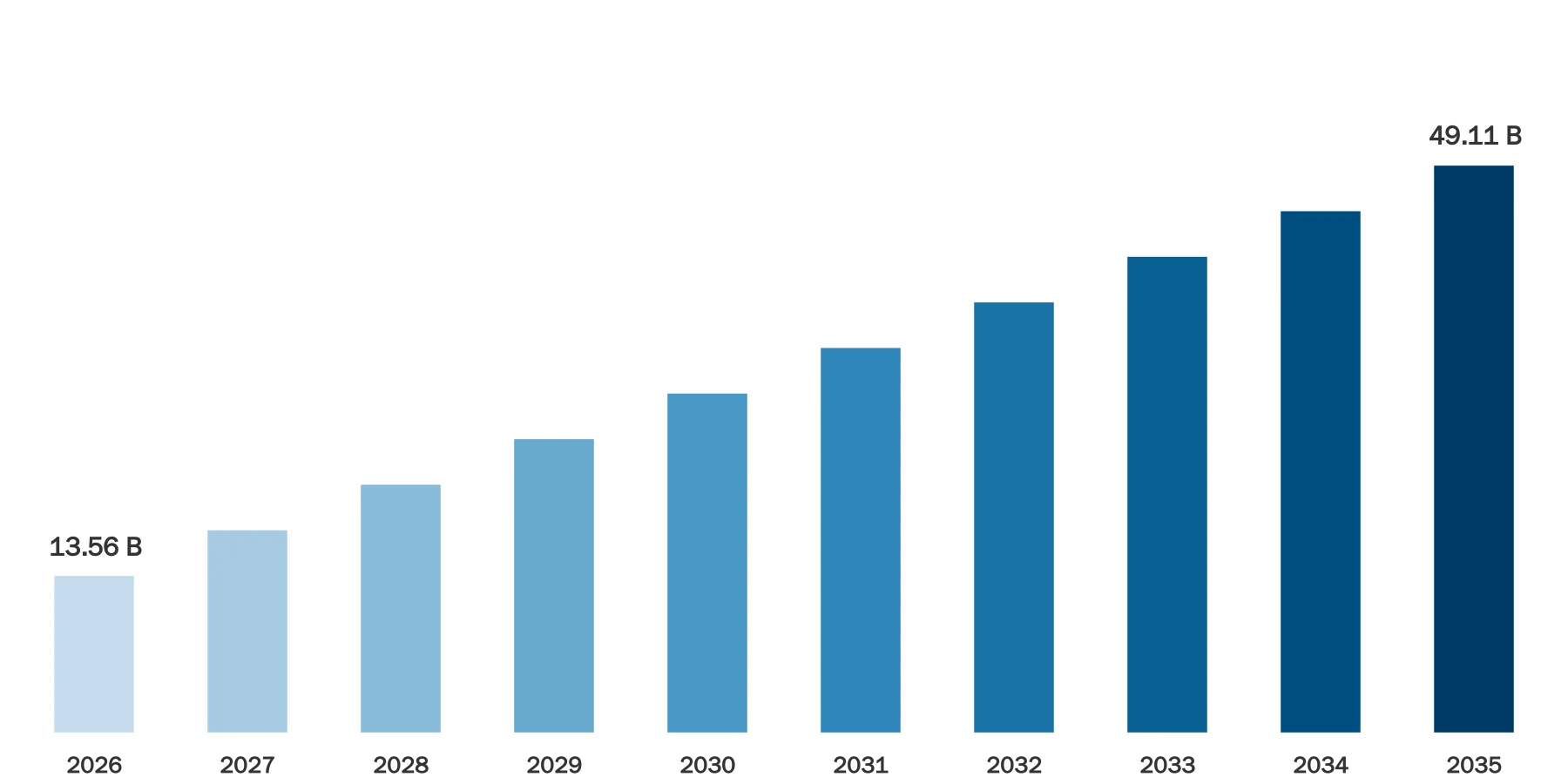
Source: Econ Market Research
Data Center infrastructure refers to the physical and hardware components that are required to run a data center. It includes all the facilities, equipment, and systems needed to support data processing, transmission, and archiving inside a data center. Servers, power infrastructure, cooling and environmental controls, fire suppression systems, etc. are some of the key elements of data center infrastructure. Data center infrastructure also provides security, which protects business and data.
The growth rate for small and medium-sized data centers and the rapidly expanding array of smaller data centers are the growth factors of data center infrastructure market. This is partly due to the rise of computing at the edge, which requires data processing closer to the end user. Smaller data centers are also more flexible and easier to manage than large ones. They can also be more cost-effective in terms of energy consumption and maintenance. In some cases, companies choose to establish microdata centers in unconventional locations, such as inside shipping containers or modular units. This trend is expected to continue as more data is generated and processed at the edge. However, there is still a significant need for larger data centers to support cloud computing and other centralized computing needs.
Market Drivers
One of the primary drivers of the data center infrastructure market is the growing demand for cloud computing services. Cloud computing providers need to build and operate large data in order to store and process data for their customers. Cloud computing is expected to expand further in the upcoming years. Because cloud computing can help businesses save money on IT expenses.
Businesses are not required to buy and maintain their own hardware and software, and they can scale their cloud usage up or down as needed. Cloud computing is more flexible than traditional IT solutions. Businesses can access cloud services from any location and quickly add and remove services as needed. Also cloud providers offer a high level of security, which is important for businesses that handle sensitive data. According to the InfoWorld survey conducted in June 2020, it has been concluded that currently around 24% of IT applications are hosted on Cloud, but in the next 18 months it is about to grow by 36%, which is a huge rise, and these shifts are going to impact the data center infrastructure.
Market Restraints
The high cost of developing and operating data centers is a significant barrier to the market for data center infrastructure. Smaller businesses can find it more difficult to invest in their own data centers. Another issue is the lack of skilled IT professionals who can plan, build, and manage these complex facilities. The increasing adoption of cloud computing and edge computing solutions can also pose a threat to the data center infrastructure market. Environmental concerns, such as the energy consumption and carbon footprint of data centers, can also limit growth in the industry. Security concerns regarding cyber-attacks and data breaches are also a major challenge, as they can damage a company's reputation and compromise important data.
Market Opportunities
Data center infrastructure providers are developing new technologies to more efficiently and reliably store &, process big data. These technologies include new types of storage hardware, data analysis software, and networking solutions. To accommodate the increased demand for big data and AI, data center infrastructure providers are building new data centers. These data centers are typically located in areas with low power costs and cool climates.
Data center infrastructure providers are partnering with cloud computing providers to offer big data and AI solutions to businesses. These solutions enable businesses to access big data and artificial intelligence capabilities without having to build and operate their own data centers. Therefore, the rise of big data and artificial intelligence represents a good opportunity for data center infrastructure providers. By developing new technologies and partnering with cloud computing providers.
Segments Analysis
Component Insights
The global data center infrastructure market segmentation by component includes hardware, software, and service. The market is dominated by the hardware segment, and demand for high-quality hardware equipment will fuel market expansion. The rising popularity of micro, cloud, and edge data centers has increased the requirement for high-quality IT infrastructure that can adapt to changing end-user demands.
Deployment Insights
Deployment insights include on-premise, and cloud. The on-premises segment accounted for the largest share in 2022 and is expected to continue to dominate over the forecast period. On-premises are based on the physical environment and are important for the organization. On-premises deployment makes it possible to monitoring data on power consumption, humidity, airflow, and other aspects of data centers operations. Monitor each of these variables is essential for organizations to avoid downtime, loss of revenue, or loss of data.
End Users Insights
Based on end users, the global data center infrastructure market segmentation includes BFSI, Retail, IT &, telecom, healthcare, energy, government, and manufacturing. The IT &, telecom category generated the most income because they are essential for the operation of data centers. IT &, telecom includes servers, storage devices, networking equipment, and power &, cooling systems. Also they provide the foundation on which all other components are built. Without IT and telecom, data centers would not be able to function.
Regional Analysis
North America held more than 40% of the worldwide market for data center infrastructure. The rising use of cloud computing, big data, and artificial intelligence are the growth factors of data centers infrastructure expansion in North America. The United States is the largest market for data center infrastructure in North America, followed by Canada.
Also, Europe is the second-largest market for data center infrastructure. The growth of the market in Europe is driven by the increasing adoption of cloud computing, big data, and artificial intelligence. The United Kingdom is the largest market for data center infrastructure in Europe, followed by Germany and France.
Competitive Landscape
The data center infrastructure market is fragmented, with many small and large players offering a range of products and services. Dell EMC, Hewlett Packard Enterprise, IBM, and Cisco are some of the major players in this sector. However, there are many smaller companies that specialize in specific parts of data center infrastructure, such as data storage, server hardware, and networking equipment. Due to the rapid growth in demand for data center services, the market is expected to remain highly competitive.
Key Market Players
Dell Technologies
Hewlett Packard Enterprise
IBM
Oracle Fujitsu
Arista Networks
Sunbird Software Inc.
Schneider Electric
Siemens
IBM
Huawei Technologies Co., Ltd
EATON
Cisco Systems Inc.
ABB
FNT GmbH
Recent Development
Amazon Web Services (AWS) will invest USD 12.7 billion into cloud infrastructure in India by 2030 as it looks to meet growing customer demand for cloud services in the country.
In May 2023, IBM has announced that it has acquired Polar Security, an innovator in technology that helps companies discover, continuously monitor and secure cloud and software-as-a-service (SaaS) application data &ndash, and addresses the growing shadow data problem.
In Oct 2021, data center infrastructure management (DCIM) software provider, Sunbird announced the release of the latest version of dcTrack. The latest version brings enhanced scalability, with its capability to support the largest organizations up to 300,000 cabinets and thousands of sites in a single system. The company also expanded the scope of web service APIs and business rules to be able to provide automation.
Data Center Infrastructure Market Report Scope & Segmentation
| Attributes | Details |
|---|---|
Market Size (Current) | US$ 13.56 Billion in 2026 |
Market Size (Forecast) | US$ 49.11 Billion in 2035 |
Growth Rate | CAGR of 15.2% from 2026 to 2035 |
Forecast Period | 2026 – 2035 |
Base Year | 2025 |
Historical Data Available | Yes |
Regional Scope | Global |
Segments Covered | By Component
By Type
By Application
|
Frequently Asked Questions
Common questions about this report
The study period covers historical insights and forecast projections for the period 2026-2035.
About the Author
Market research expert with years of industry experience

Dipali Bhingare serves as the Market Research Director at Econ Market Research. With a focus on translating complex global economic shifts into actionable business intelligence, she oversees the strategic direction of comprehensive market studies. Her work empowers organizations to navigate volatile industries through data-driven forecasting and deep-dive competitive analysis.
Related Reports
Explore more market insights from the same category