

Remote Sensing Technology Market
Remote Sensing Technology Market Size, Share, Trends, Growth, and Industry Analysis, By Technology (Active Remote Sensing, Passive Remote Sensing), By Application (Agriculture and Living Resources, Military and Intelligence, Disaster Management, Infrastructure, Weather, Others), By Platform (Satellite, Aerial Systems), Regional Analysis and Forecast Period 2026-2035
Remote Sensing Technology Market Overview
As per Econ Market Research analysis, the Global Remote Sensing Technology Market size amounted to US$ 28.36 Billion in 2026 and is anticipated to grow to US$ 75.97 Billion by 2035, recording a CAGR of 11.59% during 2026–2035. The base year taken for analysis is 2025.
Remote Sensing Technology Market Size 2025-2035 (USD Billion)

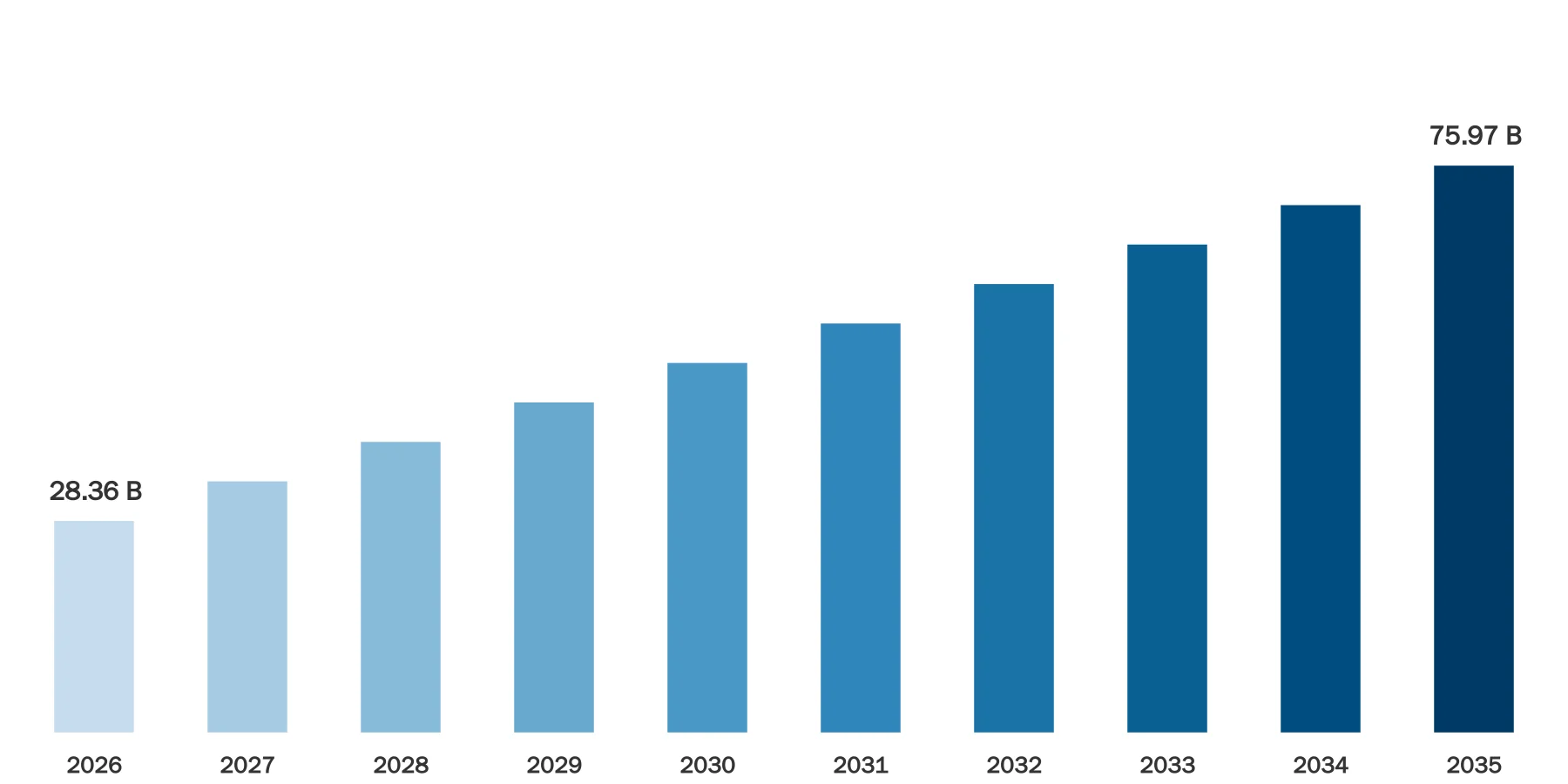
Source: Econ Market Research
Remote sensing technology has various applications in different fields, and it has proven to be useful in improving crop management, monitoring forest cover and health, and identifying natural resources. In addition to what you mentioned, remote sensing technology is also used in many other areas. For example, it is used to monitor and predict weather patterns, which is critical for aviation, shipping, and other industries. Remote sensing can also be used to monitor air quality and detect pollutants, which is important for public health and environmental protection. Furthermore, remote sensing technology is used for mapping and monitoring coastal areas, including changes in sea levels, ocean temperatures, and the spread of harmful algal blooms. This information is essential for understanding and mitigating the impacts of climate change.
Market Growth Factors
The global market for remote sensing technology is expected to grow significantly in the coming years. One of the key drivers of this growth is the increasing demand for earth observation solutions, particularly from government agencies and organizations. Remote sensing technology has become an essential tool for various government applications, such as weather forecasting, disaster management, and environmental monitoring. Another factor driving the growth of the remote sensing technology market is the growing emphasis on solving end-to-end remote sensing problems through a science and engineering approach. This approach involves integrating multiple data sources and applying advanced Data Analytics and machine learning algorithms to extract meaningful insights from the data.
Researchers at the Resilient Infrastructure and Disaster Response (RIDER) Center of the FAMU-FSU College of Engineering are working to develop better ways to predict areas for road-clogging after tropical cyclones using remote sensing data. This research is particularly relevant as remote sensing technology can provide valuable information for hurricane response and disaster management efforts. By using remote sensing data to identify areas that are most susceptible to road-clogging after a tropical cyclone, emergency responders and disaster management teams can be better prepared to address the impact of the storm and minimize its effects on communities and infrastructure.
Market Dynamics
Market Drivers
The use of remote sensing and geographic information systems (GIS) in environmental risk management is expanding rapidly. Remote sensing technology and GIS are powerful tools for spatial data analysis, mapping, and distribution. Recent advances in sensor design are revolutionizing the use of these technologies, making it possible to extract precise spatial data from satellite or aircraft images and analyze and manage this data using GIS. Remote sensing data can be used to measure a wide range of environmental variables, including land use, vegetation cover, water quality, and climate patterns. By integrating this data with other geospatial and demographic information, it is possible to create a comprehensive environmental database that can be used to monitor and manage natural resources and other critical systems.
Advanced image processing methods and algorithms are also making it possible to create these databases more quickly and efficiently than ever before, enabling faster and more accurate analysis of environmental data. This has the potential to revolutionize the way we understand and manage the Earth',s natural systems, and to help us address some of the most pressing environmental challenges facing our planet today. Remote sensing has the ability to enhance the resilience of the agriculture productions system. Modern agriculture is facing significant challenges that threaten the long-term economic and environmental sustainability of the food supply system. These challenges include the depletion of water and land resources, climate change, and high production costs, which have been exacerbated by the COVID-19 crisis. To address these challenges, scientific and technological advancements are needed to improve the efficiency and sustainability of agricultural practices.
One promising area of innovation is the use of Artificial Intelligence (AI) and remote sensing technology to measure and analyze field-scaled phenotypic data. Remote sensing technology can provide farmers with detailed information about crop health, soil moisture, and other environmental variables that affect crop growth and yield. This information can then be combined with AI-powered analytics to create more prescriptive and predictive management tools. By using these tools, farmers can make more informed decisions about planting, fertilization, irrigation, and other key aspects of agricultural management, which can lead to increased yields, improved resource efficiency, and reduced environmental impact.Overall, the combination of remote sensing and AI has the potential to revolutionize modern agriculture, enabling farmers to make more informed decisions and improve the sustainability and efficiency of the food supply system.
Market Challenges
While the remote sensing technology market has experienced significant growth in recent years, there are several challenges that need to be addressed to sustain this growth in the future. Here are some of the major challenges:
Some of these challenges include
High cost
The high cost is one of the major challenges in sustaining the growth of the remote sensing technology market. The initial investment required for developing and deploying remote sensing technology can be substantial, making it difficult for many organizations, especially small and medium-sized enterprises, to afford it.
Technical complexity
The technical complexity of remote sensing technology can be a challenge for non-experts who want to use the technology. This is because the technology requires expertise in areas such as data analysis, image processing, and GIS. To overcome this challenge, there is a need for user-friendly interfaces and tools that can simplify the technical complexity of remote sensing technology.
Data availability
In developing countries, limited infrastructure and funding can make it challenging to access and acquire remote sensing data. In addition, many developing countries may lack the technical expertise and resources required to process and analyze the data. This can create a significant barrier to entry for these countries, hindering their ability to fully utilize remote sensing technology for various applications such as disaster management, agriculture, and natural resource management.
Market Opportunities
Precision agriculture, urban planning, disaster response, and climate monitoring are just a few of the new applications for remote sensing technology. As technology advances, new opportunities for growth in the market emerge. Governments are investing more in remote sensing technology to support a variety of applications, including natural resource management, disaster response, and infrastructure planning. This investment opens up new avenues for remote sensing technology providers to provide services to government agencies.
Integration with AI and big data
By combining remote sensing technology with artificial intelligence and big data analytics, data processing and analysis can be improved, resulting in more accurate and timely insights. This opens up opportunities for providers of remote sensing technology to create new solutions that leverage AI and big data.
Segments Analysis
Technology Insights
Active remote sensing uses its own source of energy (such as radar or lidar) to detect and measure the properties of targets on the Earth',s surface. This allows for measurements to be made at any time of day or night, and in all weather conditions, which is particularly useful for applications such as monitoring changes in sea ice or detecting forest fires at night.
Application Insights
It's worth noting that while the military and intelligence sectors have traditionally been major users of remote sensing technology, the market is also seeing significant growth in other industries such as agriculture, forestry, mining, and environmental monitoring. These sectors are increasingly using remote sensing technology to improve their operations and decision-making processes. Additionally, there is a growing trend towards the use of commercial satellite imagery in industries such as insurance, finance, and Real Estate, which is expected to further drive the growth of the remote sensing technology market.
Platform Insights
The growing demand for drones in various applications, such as agriculture, mining, and construction, is also driving the growth of the aerial systems segment in the remote sensing technology market. The satellite systems segment also holds a significant share in the market, and it is expected to continue to grow due to the increasing demand for high-resolution satellite images for various applications such as urban planning, disaster management, and defense.
Regional Analysis
North America has a well-established market for remote sensing technology, and the presence of major players in this region is expected to drive the growth of the market. The use of remote sensing technology in precision agriculture is a significant factor contributing to the growth of the market in North America. With the increasing need for sustainable agriculture practices, the adoption of remote sensing technology can help water resource managers and farmers to make informed decisions and optimize crop yields while conserving water resources. This, in turn, is likely to drive the demand for remote sensing technology in the region.
The Asia-Pacific region has been witnessing significant growth in the adoption of remote sensing technology for various applications, including agriculture, environmental monitoring, and disaster management. The region has also been investing in satellite technology and earth observation capabilities to support infrastructure development and achieve sustainable growth. The increasing demand for accurate and timely geospatial data in the region is expected to drive the growth of the remote sensing technology market over the next decade.
Competitive Landscape
The Global Remote Sensing Technology Market Some of the major companies include: -
Key Market Players
Airbus SE
BlackSky Global LLC
Harris Corporation
ImageSat International N.V.
L3Harris Technologies, Inc.
Lockheed Martin Corporation
Maxar Technologies Inc.
Mitsubishi Electric Corporation
Raytheon Technologies Corporation
The Boeing Company
Remote Sensing Technology Market Report Scope & Segmentation
| Attributes | Details |
|---|---|
Market Size (Current) | US$ 28.36 Billion in 2026 |
Market Size (Forecast) | US$ 75.97 Billion in 2035 |
Growth Rate | CAGR of 11.59% from 2026 to 2035 |
Forecast Period | 2026 – 2035 |
Base Year | 2025 |
Historical Data Available | Yes |
Regional Scope | Global |
Segments Covered | By Technology
By Application
By Platform
|
Frequently Asked Questions
Common questions about this report
The study period covers historical insights and forecast projections for the period 2026-2035.
About the Author
Market research expert with years of industry experience

Dipali Bhingare serves as the Market Research Director at Econ Market Research. With a focus on translating complex global economic shifts into actionable business intelligence, she oversees the strategic direction of comprehensive market studies. Her work empowers organizations to navigate volatile industries through data-driven forecasting and deep-dive competitive analysis.
Related Reports
Explore more market insights from the same category