

Cloud Computing Market
Cloud Computing Market Size, Share, Trends, Growth, and Industry Analysis, By Service Model (Infrastructure as a Service (IaaS), Platform as a Service (PaaS), Software as a Service (SaaS)), By Deployment Model (Public Cloud, Private Cloud, Hybrid Cloud), By Industry Vertical (BFSI, IT andamp; Telecom, Retail andamp; Consumer Goods, Healthcare), Regional Analysis and Forecast Period 2026-2035
Cloud Computing Market Overview
As per Econ Market Research analysis, the Global Cloud Computing Market was valued at approximately US$ 878 Billion in 2026 and is predicted to reach US$ 3500 Billion by 2035, expanding at a CAGR of 14.62% over the forecast duration. The base year is 2025.
Cloud Computing Market Size 2025-2035 (USD Billion)

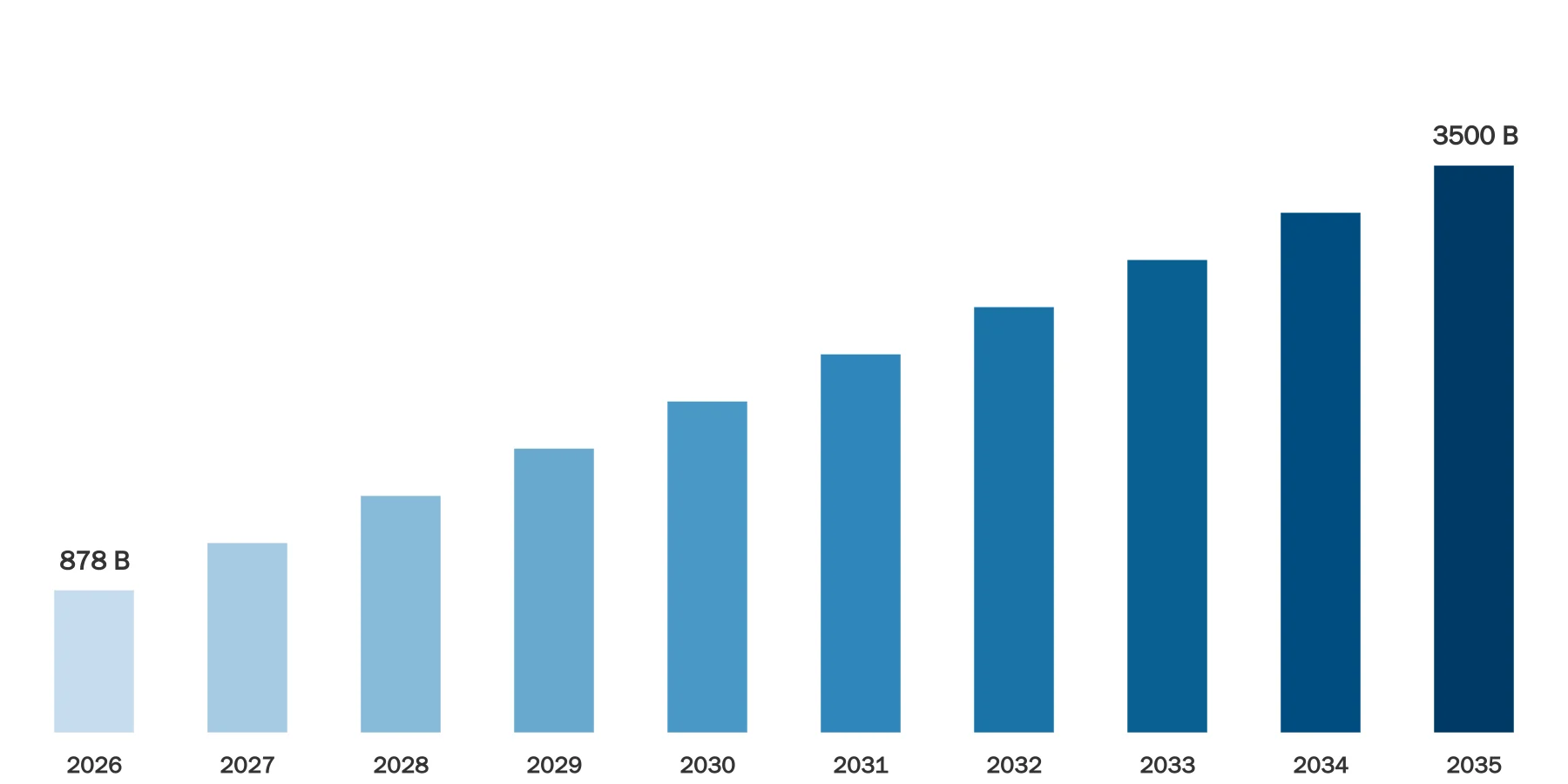
Source: Econ Market Research
Cloud Computing include storage, databases, networking, software, and more, allowing users to access and use resources on-demand without the need for extensive infrastructure. Cloud computing provides scalability, flexibility, and cost-effectiveness, making it a popular choice for businesses of all sizes. It enables organizations to innovate quickly, scale their operations efficiently, and gain access to advanced technologies like Artificial Intelligence and machine learning without requiring a significant upfront investment.
The market is expanding rapidly, propelled by rising digitalization, remote work trends, and the demand for agile IT solutions. Major industry players, such as Amazon Web Services (AWS), Microsoft Azure, and Google Cloud Platform, are constantly innovating and expanding their offerings to meet the diverse needs of customers worldwide. However, businesses adopting cloud computing solutions continue to face significant challenges such as data security, compliance, and vendor lock-in.
Cloud Computing Dynamics
Businesses are using cloud computing to improve agility, scalability, and cost-efficiency, thereby speeding up digital transformation efforts. Second, the increasing volume of data and the need for advanced analytics capabilities are driving demand for cloud-based storage and processing solutions. This trend is especially noticeable in industries like healthcare, finance, and e-commerce, where massive amounts of data are generated and analysed for insights and decision-making.
Third, the rise of edge computing and the Internet of Things (IoT) is driving the expansion of cloud infrastructure to the network edge, allowing real-time data processing and low-latency applications. Additionally, the increasing focus on Cyber Security and regulatory compliance is driving demand for cloud security solutions, including Identity And Access Management, encryption, and threat detection.
Moreover, the competitive landscape of the cloud computing market is characterized by intense rivalry among major players such as Amazon Web Services (AWS), Microsoft Azure, and Google Cloud Platform. These companies continue to invest in research and development to innovate and differentiate their offerings, while also expanding their global footprint through strategic partnerships and acquisitions.
Cloud Computing Drivers
Digital Transformation Initiatives
The growing adoption of digital transformation initiatives by businesses across multiple industries is a significant driver of the cloud computing market. Companies are adopting cloud computing to modernize their IT infrastructure, increase operational efficiency, and remain competitive in today',s digital economy. Cloud services provide scalability, flexibility, and cost-effectiveness, allowing businesses to streamline processes, improve collaboration, and deliver innovative products and services to their customers. As businesses prioritize digitalization, demand for cloud computing solutions is expected to surge, driving market growth.
Remote Work Trends
Another key driver for the cloud computing market is the widespread adoption of remote working practices, which has been accelerated by the COVID-19 pandemic. With the rise of remote work, organizations are increasingly relying on cloud-based tools and platforms to facilitate remote collaboration, communication, and productivity. Cloud computing enables employees to access critical business applications and data from any location, allowing for seamless remote work experiences. Furthermore, cloud-based infrastructure enables businesses to rapidly scale resources to meet fluctuating demands and support remote workforce requirements. As remote work becomes a permanent fixture in the modern workplace, the demand for cloud computing solutions is expected to continue growing, driving market expansion.
Cloud Computing Restraints:
Data Security Concerns
The growing concern about data security and privacy is a significant restraint on the cloud computing market. With the rise of cyber threats and regulatory requirements, businesses are becoming more cautious about storing sensitive data in the cloud. Security breaches and data leaks can cause financial losses, reputational damage, and legal ramifications for businesses. Furthermore, the complexity of cloud environments and shared responsibility models can make it difficult for businesses to provide comprehensive data protection. As a result, some businesses may hesitate to fully embrace cloud computing or may choose hybrid or private cloud solutions to maintain greater control over their data.
Vendor Lock-in
Another obstacle to the cloud computing market is the risk of vendor lock-in, in which businesses become overly reliant on a single cloud service provider for their infrastructure and services. Vendor lock-in can reduce flexibility, raise costs, and stifle innovation by making it difficult for organizations to migrate workloads or switch providers. Furthermore, proprietary technologies and differentiated service offerings may exacerbate vendor lock-in issues, making it difficult for businesses to switch to alternative solutions. To reduce the risk of vendor lock-in, organizations should carefully evaluate cloud service providers, negotiate flexible contracts, and implement multi-cloud or hybrid cloud strategies to maintain agility and avoid dependency on a single vendor.
Cloud Computing Opportunities:
Hybrid Cloud Adoption
A significant potential in the cloud computing market is the growing use of hybrid cloud architectures, which combine public cloud services with on-premises infrastructure or private cloud environments. Hybrid cloud allows you to benefit from the scalability and agility of public cloud resources while maintaining control over sensitive data and critical workloads in private environments. Organizations are embracing hybrid cloud to get the best of both worlds, balancing cost, performance, and security based on their specific needs. Cloud providers can take advantage of this trend by providing hybrid cloud solutions, management tools, and integration services that simplify hybrid cloud deployments and provide seamless connectivity between on-premises and cloud environments.
Segment Overview
By Service
Cloud computing services are divided into three categories: Infrastructure as a Service (IaaS), Platform as a Service (PaaS), and Software as a Service (SaaS). IaaS offers virtualized computing resources via the internet, such as servers, storage, and networking infrastructure, enabling users to create and manage their own IT environments. PaaS provides a platform for developers to build, deploy, and manage applications without having to worry about underlying infrastructure. It also provides tools and frameworks for application development and deployment. SaaS is a subscription-based software delivery model that allows users to access and use cloud-hosted applications without the need for installation or maintenance.
By Deployment
Cloud deployments can be either public, private, or hybrid. Third-party providers host and manage public cloud services, allowing organizations of all sizes to benefit from scalability, accessibility, and cost effectiveness. Private clouds are dedicated environments managed by a single organization that offer increased control, security, and customization for sensitive workloads and regulatory compliance requirements. Hybrid clouds combine public and private cloud environments, allowing organizations to benefit from both models and seamlessly integrate on-premises infrastructure with cloud services.
By Workload
Cloud workloads include a variety of tasks and operations, such as application development and testing, data storage and backup, resource management, orchestration services, and more. Application development and testing entails creating, deploying, and testing software applications in cloud environments to enable rapid iteration, collaboration, and scalability. Data storage and backup services offer secure and scalable storage solutions for storing and protecting data assets while ensuring data availability, integrity, and compliance. Resource management and orchestration services automate and optimize cloud resources, allowing for efficient allocation, provisioning, and scaling computing resources based on workload demands and performance requirements.
By Enterprise Size
Cloud adoption varies across large enterprises and small &, medium enterprises (SMEs). Large enterprises typically have complex IT infrastructures and diverse workloads, making them ideal candidates for cloud migration to improve agility, scalability, and cost-efficiency. SMEs, on the other hand, often lack extensive IT resources and infrastructure, making cloud services an attractive option for accessing advanced technologies, reducing upfront costs, and scaling operations according to business needs.
By End-use
Cloud computing serves a wide range of industries and sectors, including BFSI (Banking, Financial Services, and Insurance), IT &, Telecom, Retail &, Consumer Goods, Manufacturing, Energy &, Utilities, Healthcare, Media &, Entertainment, Government &, Public Sector, and others. Each industry has its own set of requirements and challenges, which drives the demand for specialized cloud solutions that are tailored to specific use cases, regulatory compliance, and industrial standards. Cloud providers provide industry-specific solutions and services to meet the diverse needs of customers across various sectors, allowing organizations to innovate, compete, and thrive in the digital age.
Cloud Computing Overview by Region
North America dominates the market, owing to the presence of major cloud providers such as Amazon Web Services (AWS), Microsoft Azure, and Google Cloud Platform, as well as a strong ecosystem of technology companies and enterprises implementing cloud-first strategies. The region benefits from advanced infrastructure, strong internet connectivity, and a mature regulatory environment, which encourages widespread cloud adoption in industries such as BFSI, healthcare, and IT &, Telecom.
Europe is following closely, propelled by initiatives promoting digitalization, data privacy, and cloud sovereignty. Countries like the United Kingdom, Germany, and France are leading in cloud adoption, with increasing investments in hybrid and multi-cloud deployments to balance data localization requirements and business agility. In the Asia-Pacific region, cloud computing is experiencing rapid growth, fuelled by emerging economies, digital transformation initiatives, and increasing internet penetration.
China, India, Japan, and Australia are key markets driving cloud adoption, with a focus on leveraging cloud technologies to support e-commerce, IoT, and smart city initiatives. Latin America and the Middle East &, Africa regions are witnessing steady growth in cloud adoption, supported by improving infrastructure, rising smartphone penetration, and government initiatives to promote digital inclusion and economic development. However, challenges such as data sovereignty, connectivity limitations, and cybersecurity concerns remain prevalent in these regions, influencing cloud adoption strategies and investment priorities.
Cloud Computing Market Competitive Landscape
Amazon Web Services (AWS) maintains its leadership position by providing a comprehensive suite of cloud services, global infrastructure, and industry-specific solutions to meet the diverse needs of enterprises. Microsoft Azure is a formidable competitor, leveraging its large enterprise footprint, hybrid cloud capabilities, and integration with Microsoft productivity tools to drive cloud adoption across industries.
Google Cloud Platform (GCP) is gaining market share as it focuses on data analytics, machine learning, and innovative cloud-native technologies, attracting customers looking for advanced capabilities and developer-friendly solutions. Other prominent players include IBM Cloud, Oracle Cloud, and Alibaba Cloud, each with their own strengths and market focus. Additionally, niche players and regional providers contribute to market diversity by providing specialized services, vertical expertise, and localized support to meet specific customer needs.
Partnerships, alliances, and acquisitions continue to shape the competitive landscape as cloud providers seek to expand their offerings, enter new markets, and differentiate themselves in an increasingly crowded market. System integrators and managed service providers play critical roles in the ecosystem, assisting organizations in overcoming cloud adoption challenges, optimizing cloud deployments, and maximizing the value of cloud investments. As competition increases, cloud providers are innovating across infrastructure, platforms, and applications, driving industry consolidation, pricing pressure, and continuous advancements in cloud technologies to stay ahead of the rapidly evolving market.
Cloud Computing Key Players:
DigitalOcean
VMware LLC
Rackspace Technology, Inc.
CloudHesive
GroundCloud
IBM
Google
Amazon Web Services, Inc.
Alibaba Cloud
Tencent
Oracle Cloud
Salesforce, Inc.
Coastal Cloud
The Descartes Systems Group Inc.
Microsoft Azure
Cloud Computing Recent Developments
Dec 2022, LSEG and Microsoft launch 10-year strategic partnership for next-generation data and analytics and cloud infrastructure solutions, Microsoft to make equity investment in LSEG through acquisition of shares.
May 2024, IBM and SAP SE unveiled their joint vision for advancing collaboration, introducing fresh generative AI capabilities and tailored cloud solutions for specific industries aimed at enhancing business value.
Cloud Computing Report Segmentation
Cloud Computing Market Report Scope & Segmentation
| Attributes | Details |
|---|---|
Market Size (Current) | US$ 878 Billion in 2026 |
Market Size (Forecast) | US$ 3500 Billion in 2035 |
Growth Rate | CAGR of 14.62% from 2026 to 2035 |
Forecast Period | 2026 – 2035 |
Base Year | 2025 |
Historical Data Available | Yes |
Regional Scope | Global |
Segments Covered | By Service Model
By Deployment Model
By Industry Vertical
|
Frequently Asked Questions
Common questions about this report
The study period covers historical insights and forecast projections for the period 2026-2035.
About the Author
Market research expert with years of industry experience

Dipali Bhingare serves as the Market Research Director at Econ Market Research. With a focus on translating complex global economic shifts into actionable business intelligence, she oversees the strategic direction of comprehensive market studies. Her work empowers organizations to navigate volatile industries through data-driven forecasting and deep-dive competitive analysis.
Related Reports
Explore more market insights from the same category