

Quantum Computing Market
Quantum Computing Market Size, Share, Trends, Growth, and Industry Analysis, By Deployment (On-Premise, Cloud), By Offering (Systems, Services), By Application (Optimization, Simulation, Machine Learning, Sampling), By End-User (BFSI, Aerospace andamp; Defense, Healthcare andamp; Life Sciences, Energy andamp; Utilities, Transportation, IT andamp; Telecom), Regional Analysis and Forecast Period 2026-2035
Quantum Computing Market Overview
As per Econ Market Research analysis, the Global Quantum Computing Market reached a valuation of US$ 2.97 Billion in 2026 and is anticipated to grow to US$ 16.28 Billion by 2035, at a CAGR of 20.8% during the forecast timeline 2026–2035. The base year considered is 2025.
Quantum Computing Market Size 2025-2035 (USD Billion)

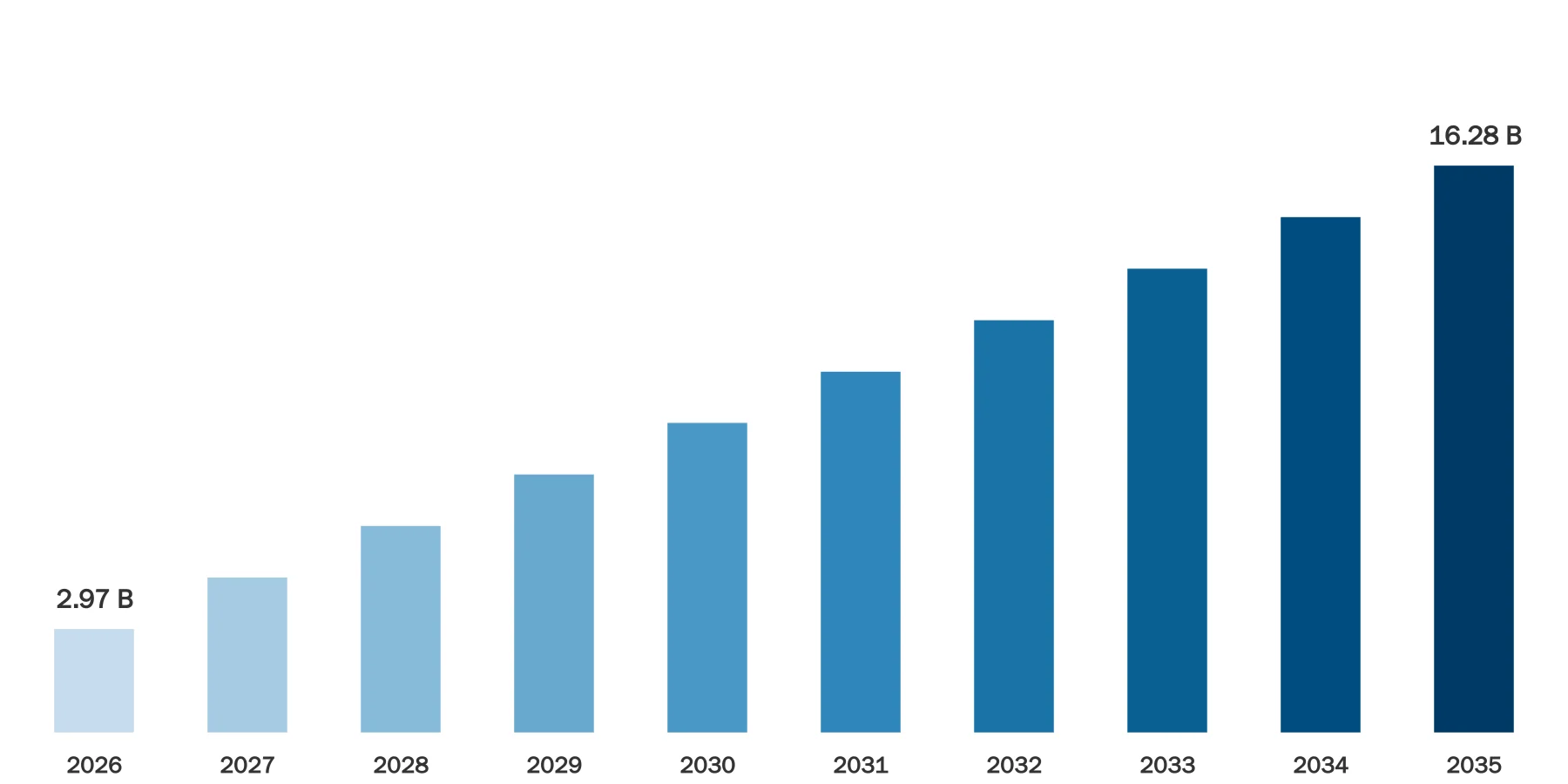
Source: Econ Market Research
Quantum computing, a burgeoning discipline, employs the principles of quantum mechanics to carry out intricate computations. In contrast to classical computers that rely on bits to represent information as either 0 or 1, quantum computers employ quantum bits or qubits, which can concurrently exist in multiple states owing to superposition and entanglement. This extraordinary capability empowers quantum computers to solve specific problems at an exponentially accelerated rate compared to classical computers. Quantum computing possesses the potential to fundamentally transform numerous domains, encompassing cryptography, drug discovery, optimization, and machine learning. Nonetheless, constructing practical and scalable quantum computers remains a substantial challenge due to hurdles such as quantum decoherence and error correction.
Quantum Computing Market Dynamics
The escalating need for advanced computational power to address intricate challenges in fields such as cryptography, optimization, and simulation serves as a primary motivator. Furthermore, the expanding landscape of quantum technologies, encompassing enhanced qubit designs, error correction methods, and quantum algorithms, propels advancements and opens up novel possibilities. Moreover, strategic collaborations among academia, industry, and government entities nurture innovation and the exchange of knowledge within the field. As a result, the intense competition among major tech companies and nations in the pursuit of quantum supremacy fuels vigorous rivalry, ultimately accelerating the growth of the quantum computing market over the forecast period.
Quantum Computing Market Drivers
Increasing Demand for Advanced Computing Power
The need to tackle complex problems in areas such as cryptography, optimization, and simulation drives the demand for quantum computing. Traditional computing approaches struggle to efficiently solve these problems, leading to a growing interest in quantum solutions.
Restraints:
Lack of Technical Infrastructure
Building practical and scalable quantum computers faces obstacles such as quantum decoherence and error correction. These technical hurdles limit the stability and reliability of quantum systems, hindering their widespread adoption.
Opportunities:
Market Growth and Commercialization
The growing demand for quantum computing creates opportunities for market players, including hardware manufacturers, software developers, and service providers. This market expansion is driven by the race for quantum supremacy among major tech companies and nations, generating fierce competition.
Segment Overview
By Application
Based on the application, the global quantum computing market is segmented into optimization, simulation, machine learning, sampling, and others. The optimization segment is dominating the market with the largest revenue share of around 37.4% in 2022. Optimization challenges are prevalent in diverse sectors like logistics, supply chain management, financial modeling, and energy optimization. Quantum computing has attracted considerable interest due to its superior capability in efficiently solving complex optimization problems compared to classical approaches. Industries are actively seeking avenues to enhance operational efficiency, cut costs, and enhance decision-making processes, thus stimulating the demand for optimization solutions.
By Deployment
Based on the deployment, the global quantum computing market is segmented into on-premises and cloud. The on-premises segment is dominating the market with the largest revenue share of around 27.6% in 2022. Certain industries, especially those involved in handling sensitive data or intellectual property, must adhere to strict security and compliance requirements. On-premises solutions also offer enhanced flexibility and customization options, allowing organizations to tailor their quantum computing infrastructure to meet their specific needs. This customization enables seamless integration with existing systems, optimizing performance based on their workloads.
By Component
Based on component, the global quantum computing market is segmented into software. The software segment is anticipated to grow at a higher CAGR of 28.5% during the forecast period. The growth of the segment can be attributed to several factors. With the continuous advancement of quantum computing technology, there is a growing need for effective software solutions that can harness its power and capabilities. These solutions include quantum software frameworks, programming languages, and development tools, which are essential for researchers, developers, and businesses to design and implement quantum algorithms and applications. The software segment plays a crucial role in facilitating the seamless integration of quantum computing with existing classical computing systems and workflows.
By End-User
Based on end-user, the global quantum computing market is segmented into BFSI, aerospace &, defense, automotive, government, energy, chemical, and others. The BFSI segment is anticipated to grow at a higher CAGR of 28.6% during the forecast period. The growth in the quantum computing market within the BFSI (Banking, Financial Services, and Insurance) industry can be attributed to various factors such as intricate optimization problems, risk modeling, portfolio management, and cryptography, all of which can greatly benefit from the exceptional computational power offered by quantum computing.
Quantum Computing Market Overview by Region
By Region, the global Quantum Computing Market has been divided into North America, Europe, Asia-Pacific, and the Rest of the World. North America held 42.8% market share in 2022 and is expected to grow at significant CAGR during the forecast period. The region benefits from a thriving ecosystem that encompasses prominent technology firms, research institutions, and government initiatives aimed at propelling quantum technologies forward. Notably, North America hosts leading companies and startups dedicated to quantum computing, and substantial investments in research and development have fostered a culture of innovation in the region.
Quantum Computing Market Competitive Landscape
In the global quantum computing market, a small number of prominent players hold significant market dominance and have established a strong regional presence. These key participants are committed to ongoing research and development initiatives. Additionally, they actively engage in strategic growth endeavors such as product development, product launches, joint ventures, and partnerships. By pursuing these strategies, these companies aim to strengthen their market position and expand their customer base to capture a substantial share of the market.
Key Players
Accenture
Cambridge Quantum Computing (Quantinuum)
Amazon Web Services (AWS)
Fujitsu
Google
Huawei
1QBIT
IBM
Microsoft
Rigetti Computing
Riverlane
D-Wave Systems
Zapata Computing
Honeywell (Quantinuum)
Intel Corporation
Quantum Computing Market Recent Developments
In April 2023, Quantum Computing Inc., a firm specializing in full-stack photonic-based quantum computing and solutions, recently announced a product extension. They debuted their proprietary Quantum Random Number Generator (QRNG) technology, which allows for the generation of unique number sequences.
Quantum Computing Market Report Scope & Segmentation
| Attributes | Details |
|---|---|
Market Size (Current) | US$ 2.97 Billion in 2026 |
Market Size (Forecast) | US$ 16.28 Billion in 2035 |
Growth Rate | CAGR of 20.8% from 2026 to 2035 |
Forecast Period | 2026 – 2035 |
Base Year | 2025 |
Historical Data Available | Yes |
Regional Scope | Global |
Segments Covered | By Deployment
By Offering
By Application
By End-User
|
Frequently Asked Questions
Common questions about this report
The study period covers historical insights and forecast projections for the period 2026-2035.
About the Author
Market research expert with years of industry experience

Related Reports
Explore more market insights from the same category