

Data Center Market
Data Center Market Size, Share, Trends, Growth, and Industry Analysis, By Component (Hardware, Software, Services), By Type (Enterprise Data Center, Colocation Data Center, Edge Data Center, Hyperscale Data Center), By Tier Standard (Tier I andamp; II, Tier III, Tier IV), By End-User (BFSI, IT andamp; Telecom, Government, Energy, Manufacturing, Healthcare), Regional Analysis and Forecast Period 2026-2035
Market Overview
As per Econ Market Research analysis, the Global Data Center Market size amounted to US$ 430.18 Billion in 2026 and is anticipated to grow to US$ 1103.7 Billion by 2035, recording a CAGR of 11.06% during 2026–2035. The base year taken for analysis is 2025.
Data Center Market Size 2025-2035 (USD Billion)

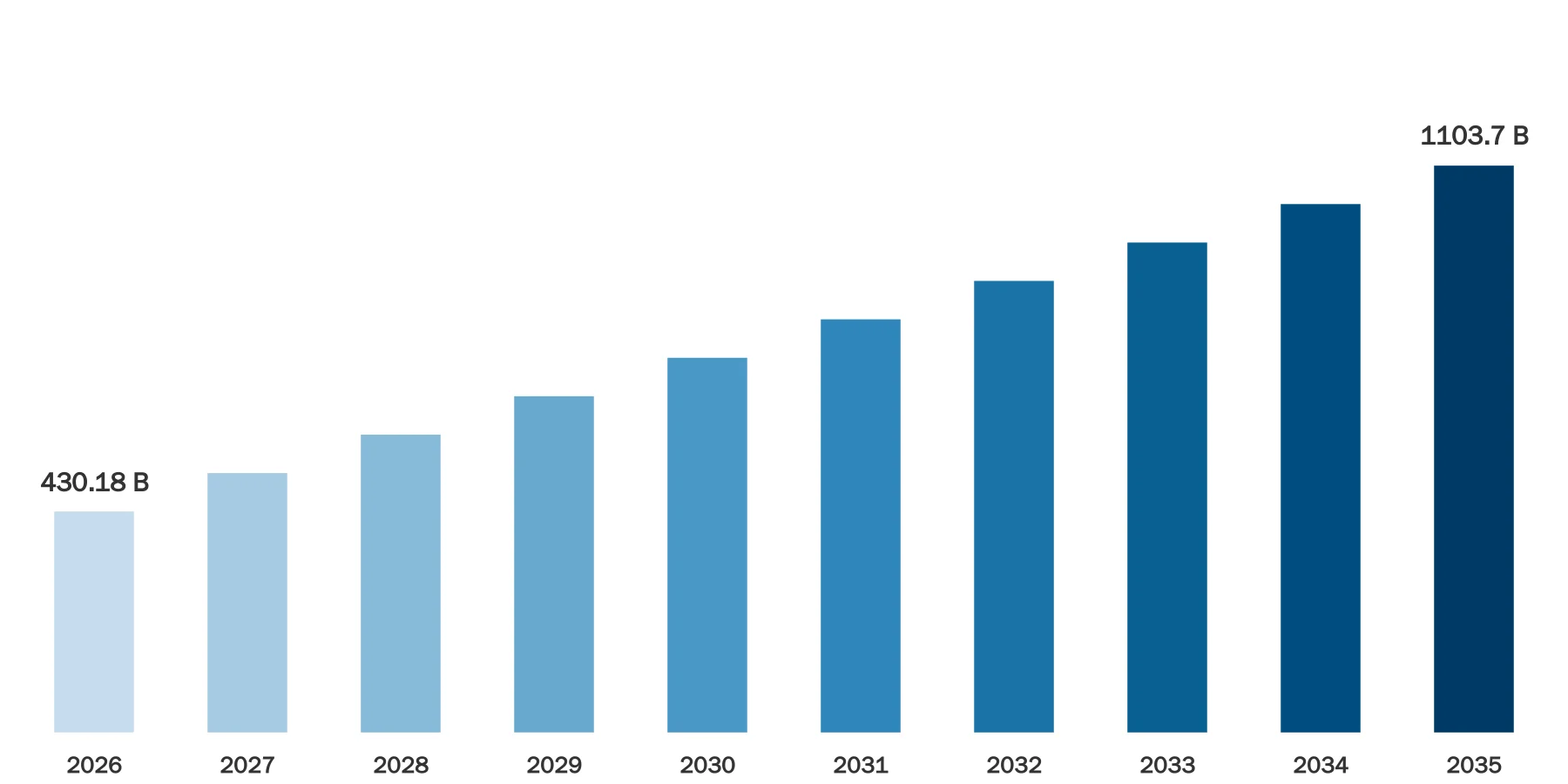
Source: Econ Market Research
Data centers are specialized facilities designed to house computer systems, storage, and telecommunications infrastructure. Their primary function is to ensure uninterrupted operations for critical applications and services. This is achieved through the implementation of redundant power supplies, environmental controls, and comprehensive security measures. Data centers play a vital role for organizations by providing a centralized location to store, process, and manage large volumes of data while enabling access for users and applications. With the rapid growth of cloud computing and big data analytics, data centers have become essential components of modern IT infrastructure. They serve as the backbone for a wide range of digital services and online businesses, supporting their smooth and reliable operation.
Data Center Market Dynamics
The data center market is witnessing rapid growth due to several factors. The increasing demand for cloud computing services, advancements in big data analytics, and the proliferation of the internet of things (IoT) are key drivers behind this expansion. Businesses recognize the importance of efficient data management and storage solutions in today's digital landscape, leading to a surge in demand for data centers. Furthermore, the adoption of virtualization and software-defined infrastructure, along with the emphasis on data security and compliance, are contributing to the market's growth. The emergence of edge computing and hybrid cloud architectures is also shaping the data center landscape, providing more flexibility and scalability to meet evolving business needs.
Data Center Market Drivers
Growing Demand for Cloud Computing Services
The growing demand for cloud computing services is driving the need for data centers. Businesses and organizations are increasingly relying on cloud computing to store, process, and access data, leading to an increased requirement for robust Data Center Infrastructure. Cloud computing offers scalability, flexibility, and cost-effectiveness, making it a preferred choice for many enterprises. This surge in demand for cloud services is a key driver behind the growth of the data center market.
Restraints
High Capital Investment
High capital investment is a significant restraint in the data center market. Establishing and maintaining data centers require substantial upfront financial resources. The costs include building infrastructure, purchasing equipment, implementing security measures, and ensuring redundancy for uninterrupted operations. The capital investment can act as a barrier to entry for some organizations, limiting their ability to establish or expand data center facilities. The need for substantial financial resources is a challenge that potential investors and businesses face in the data center industry.
Opportunities
Rising Demand for Edge Computing
The rising demand for edge computing presents an opportunity in the data center market. Edge computing involves processing data closer to the source, reducing latency, and improving real-time decision-making. This trend creates a need for smaller, distributed data centers located in close proximity to end users and connected devices. Edge computing enables faster and more efficient data processing for applications such as IoT, Autonomous Vehicles, and smart cities. Data center providers can tap into this demand by offering edge computing infrastructure and services.
Segment Overview
By Infrastructure
The global data center market is divided into several segments based on infrastructure, including IT infrastructure, electrical infrastructure, mechanical infrastructure, support infrastructure, and others. Among these segments, the IT infrastructure segment holds the largest market share, accounting for approximately 35.2% of the revenue in 2022. The dominance of the IT infrastructure segment can be attributed to the increasing demand for high-performance computing, big data analytics, and Artificial Intelligence (AI) applications. These advanced technologies require robust and scalable IT infrastructure solutions, including servers, storage systems, and networking hardware. As businesses strive to leverage the power of data and AI, the need for reliable and efficient IT infrastructure becomes paramount.
By Data Center Type
Based on the data center type, the global data center market is segmented into colocation, hyper-scale, edge, and others. The hyper-scale segment is dominating the market with the largest revenue share of around 42.7% in 2022, due to increased demand for cloud-based services and the widespread use of technologies such as big data analytics, artificial intelligence (AI), and machine learning, which need vast quantities of computer power and storage space. Hyper-scale data centers are designed to satisfy the requirements of these new technologies by providing a highly scalable, adaptable, and cost-effective infrastructure.
By End-Use Industry
Based on the end-use industry, the global data center market is segmented into BFSI, IT &, telecommunication, government, healthcare, retail, manufacturing, and others. In 2022, the IT & telecommunication category emerged as the dominant segment in the data center market, capturing the largest market share with around 24.8%. This is because the sector makes considerable use of data center infrastructure to serve a wide range of applications and services, such as cloud computing, big data analytics, and Internet of Things (IoT) devices. The industry demands a strong and scalable infrastructure to accommodate the fast expansion of data and the growing demand for high-speed connections.
Data Center Market Overview by Region
By Region, the global Data Center Market has been divided into North America, Europe, Asia-Pacific, and the Rest of the World. North America emerged as the largest market, capturing a significant share of approximately 42.5% in 2022, due to several key factors. The region boasts a concentration of major technological businesses and cloud service providers such as Amazon, Google, and Microsoft, who have a substantial demand for large-scale data center equipment to support their operations. The well-established telecommunications and IT infrastructure in North America, along with its excellent research and development capabilities and solid regulatory framework, further contribute to the growth of the data center market.
Data Center Market Competitive Landscape
In the competitive landscape of the global data center market, a small number of prominent players hold significant market dominance and have established a strong regional presence. These key participants are deeply committed to ongoing research and development initiatives to drive innovation and stay ahead in the market. Additionally, they actively engage in strategic growth endeavors, including product development, product launches, joint ventures, and partnerships. By pursuing these strategies, these companies aim to strengthen their market position and expand their customer base, capturing a substantial share of the market.
Key Players
Amazon Web Services
Microsoft Corporation
Google LLC
IBM Corporation
Equinix, Inc.
Digital Realty Trust, Inc.
NTT Communications Corporation
Cisco Systems, Inc.
Hewlett Packard Enterprise Development LP
Dell Technologies Inc.
Oracle Corporation
Intel Corporation
Fujitsu Ltd.
Schneider Electric SE
Data Center Market Recent Developments
In April 2022, Phison Electronics Corp., a global leader in NAND flash controller and storage solutions, and Seagate Technology Holdings PLC, a leading provider of mass-data storage infrastructure solutions, announced plans to expand their portfolio of high-density enterprise NVMe SSDs. These new SSDs will help organizations reduce their total cost of ownership by boosting storage density, lowering power consumption, and offering greater performance.
Data Center Market Report Scope & Segmentation
| Attributes | Details |
|---|---|
Market Size (Current) | US$ 430.18 Billion in 2026 |
Market Size (Forecast) | US$ 1103.7 Billion in 2035 |
Growth Rate | CAGR of 11.06% from 2026 to 2035 |
Forecast Period | 2026 – 2035 |
Base Year | 2025 |
Historical Data Available | Yes |
Regional Scope | Global |
Segments Covered | By Component
By Type
By Tier Standard
By End-User
|
Frequently Asked Questions
Common questions about this report
The study period covers historical insights and forecast projections for the period 2026-2035.
About the Author
Market research expert with years of industry experience

Dipali Bhingare serves as the Market Research Director at Econ Market Research. With a focus on translating complex global economic shifts into actionable business intelligence, she oversees the strategic direction of comprehensive market studies. Her work empowers organizations to navigate volatile industries through data-driven forecasting and deep-dive competitive analysis.
Related Reports
Explore more market insights from the same category