

Large Scale Battery Storage Market
Large Scale Battery Storage Market Size, Share, Trends, Growth, and Industry Analysis, By Battery Type (Lithium-ion, Lead-acid, Flow Battery, Others), By Connection Type (On-Grid, Off-Grid), By Application (Peak Shaving, Grid Stabilization, Renewable Integration, Frequency Regulation), Regional Analysis and Forecast Period 2026-2035
Large Scale Battery Storage Market Overview
As per Econ Market Research analysis, the Global Large Scale Battery Storage Market was valued at US$ 14.5 Billion in 2026 and is expected to reach US$ 96 Billion by 2035, registering a CAGR of 26.6% during the forecast period 2026–2035. The base year considered is 2025.
Large Scale Battery Storage Market Size 2025-2035 (USD Billion)

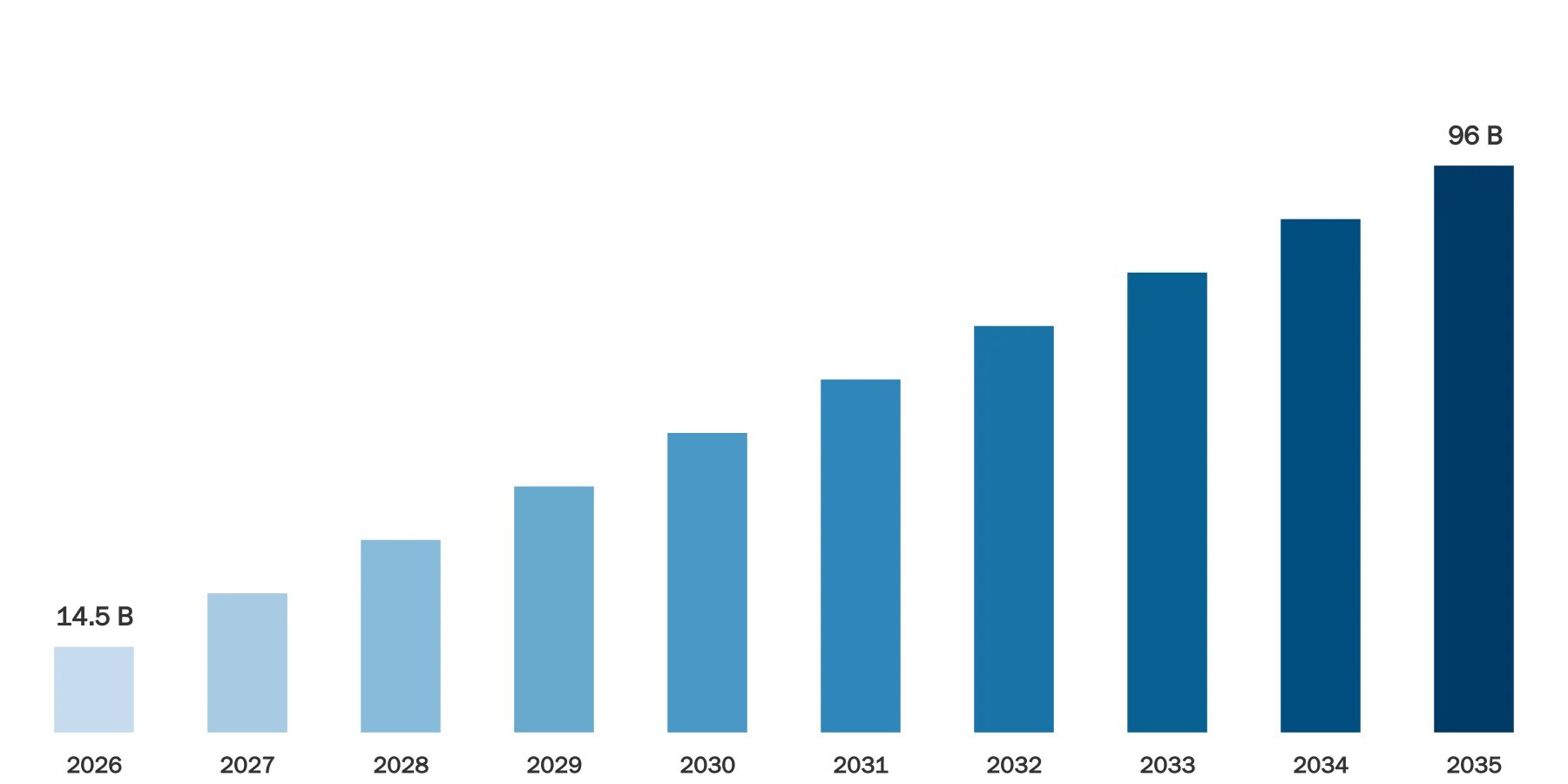
Source: Econ Market Research
Large scale battery storage systems play a pivotal role in stabilizing electrical grids, optimizing energy distribution, and facilitating the integration of renewable energy sources like solar and wind into existing power networks. As the demand for sustainable energy solutions intensifies and the necessity to reduce greenhouse gas emissions becomes increasingly urgent, large scale battery storage emerges as a critical component in achieving energy resilience and sustainability goals worldwide.
The Global Large Scale Battery Storage market, which is defined as the deployment of battery systems with capacities typically ranging from several megawatt-hours to gigawatt-hours, is experiencing a surge in adoption due to a number of factors, including advancements in battery technology, falling costs of lithium-ion batteries, and supportive government policies that promote the integration of renewable energy sources. Moreover, effective energy storage solutions are required to address grid stability issues and guarantee a consistent supply of power due to the growing prevalence of intermittent renewable energy sources. Large-scale battery storage systems improve grid stability and reliability while providing opportunities for ancillary services, load shifting, and peak shaving. These benefits optimise energy management and raise the overall efficiency of power networks.
Large Scale Battery Storage Dynamics
An important factor driving market growth is the growing emphasis on decarbonisation and integration of renewable energy sources on a worldwide scale. Large-scale battery storage solutions are required to address intermittency concerns and guarantee grid stability as a result of the ambitious renewable energy targets being implemented by governments and organisations globally. Furthermore, large-scale battery storage is becoming more and more cost-competitive when compared to conventional fossil fuel-based power generation and storage options due to the decreasing costs of lithium-ion batteries, which are being driven by technological advancements and economies of scale.
The market is expanding due to the growing need for energy storage solutions to facilitate the electrification of transportation and the spread of electric vehicles (EVs). Enabling EV Charging Infrastructure and controlling peak electricity demand are critical functions of large-scale battery storage systems, which also improve overall energy efficiency and lessen grid stress. Furthermore, the market is expanding across a variety of sectors, including utility-scale projects, commercial and industrial applications, and residential energy storage, as a result of the increased awareness of the value proposition provided by large-scale battery storage, which includes its capacity to provide ancillary services, frequency regulation, and backup power during outages.
Large Scale Battery Storage Drivers
Renewable Energy Integration
One major factor propelling the large-scale battery storage market is the growing use of renewable energy sources like solar and wind power. Because renewable energy is by its very nature intermittent, grid stability and reliability are challenged. Large-scale battery storage systems offer a solution by holding onto extra energy during high-generation times and releasing it during low-renewable energy production or high-demand periods. The need for large-scale battery storage solutions is anticipated to surge as nations and regions throughout the world commit to aggressive renewable energy targets to combat climate change, spurring market growth and innovation.
Technological Advancements and Cost Reductions
Large-scale battery storage solutions are becoming more affordable due to technological developments in battery chemistry, manufacturing techniques, and energy management systems. The extensive use of lithium-ion battery technology, in particular, has greatly lowered costs and increased energy density, increasing the economic viability of large-scale battery storage for a variety of applications. Large-scale battery storage systems are becoming more affordable and scalable as energy storage capacities rise and battery prices continue to drop, encouraging additional market deployment and investment.
Restraints:
Regulatory and Policy Uncertainty
Regulatory frameworks governing large scale battery storage vary significantly across different jurisdictions, leading to uncertainty and complexity for market participants. Inconsistent policies related to grid connection, permitting, and revenue streams for battery storage projects can hinder investment and deployment. Moreover, evolving regulatory landscapes and policy changes pose risks for project developers and investors, potentially delaying or deterring investment in large scale battery storage infrastructure.
Technological Limitations and Environmental Concerns
Despite significant advancements, large scale battery storage technologies still face limitations in terms of energy density, cycle life, and environmental sustainability. The reliance on materials such as lithium, cobalt, and nickel raises concerns about resource availability, supply chain sustainability, and environmental impacts associated with mining and battery disposal. Additionally, safety risks related to battery fires and thermal runaway events remain a concern, particularly for large scale installations in densely populated areas. Addressing these technological and environmental challenges is crucial to ensuring the long-term viability and acceptance of large scale battery storage solutions.
Opportunities:
Electric Vehicle Integration and V2G Services
The rapid electrification of transportation and the proliferation of electric vehicles (EVs) present opportunities for large scale battery storage to support EV charging infrastructure and provide vehicle-to-grid (V2G) services. By leveraging bi-directional charging capabilities, EV batteries can serve as distributed energy storage resources, helping to balance supply and demand on the grid and optimize energy usage.
V2G services enable EV owners to monetize their vehicle batteries by participating in demand response programs, ancillary services markets, and energy arbitrage opportunities, creating new revenue streams and incentives for EV adoption. As EV penetration rates continue to rise and V2G technology matures, the synergies between large scale battery storage and electric transportation offer promising opportunities for market growth and innovation.
Segment Overview
By Product Type
By connectivity, the market is divided into two primary categories: On-Grid and Off-Grid systems. On-Grid systems are connected to the main electrical grid infrastructure and play a crucial role in stabilizing grid operations, managing peak demand, and integrating renewable energy sources. Off-Grid systems, on the other hand, operate independently of the main grid and are commonly deployed in remote areas or in emergency backup scenarios where grid connection is not feasible or reliable.
By Battery Type
In terms of battery type, the market encompasses a variety of technologies, including Lead-acid batteries, Lithium-ion batteries, Flow batteries, and other emerging battery chemistries. Lead-acid batteries, while being one of the oldest and most established technologies, are gradually being supplanted by more advanced and efficient solutions such as Lithium-ion batteries, which offer higher energy density, longer cycle life, and faster charging capabilities. Flow batteries, characterized by their ability to store large amounts of energy for extended durations, are gaining traction for grid-scale applications due to their scalability and longevity.
By Application
The market is segmented by application into Non-Residential, Residential, Utility, and other specialized applications. Non-Residential applications encompass a wide range of commercial and industrial settings, where large scale battery storage systems are utilized for demand management, backup power, and energy arbitrage purposes. Residential applications involve the integration of battery storage systems into homes and residential communities to enhance energy independence, optimize self-consumption of solar energy, and provide backup power during outages.
By Ownership
Ownership models in the large scale battery storage market include Third Party Owned, Customer-Owned, and Utility-Owned systems. Third-party owned models involve independent developers or energy service providers owning and operating battery storage assets, while customer-owned models enable end-users to own and control their energy storage systems, either individually or collectively. Utility-owned models involve electric utilities deploying and managing large scale battery storage infrastructure to improve grid reliability, support renewable energy integration, and provide grid services.
By Capacity
Capacity segmentation distinguishes between Small Scale (Less than 1 MW) and Large Scale (Greater than 1 MW) battery storage systems. Small scale systems are typically deployed for residential, commercial, or community-scale applications, whereas large scale systems are designed for utility-scale projects and grid-level applications requiring significant energy storage capacity and power output. These segmentation criteria provide a comprehensive framework for analyzing the diverse landscape of the large scale battery storage market and understanding the unique opportunities and challenges associated with each segment.
Large Scale Battery Storage Overview by Region
In regions such as North America and Europe, stringent environmental regulations, ambitious renewable energy targets, and government incentives drive significant investments in large scale battery storage infrastructure. The United States, in particular, leads the market with a robust pipeline of utility-scale projects, driven by state-level renewable portfolio standards, federal tax incentives, and grid modernization initiatives.
Europe, spearheaded by countries like Germany, the UK, and France, is witnessing rapid deployment of large scale battery storage systems to support renewable energy integration, enhance grid stability, and facilitate the transition to a low-carbon energy future. Asia Pacific emerges as a key growth market for large scale battery storage, fuelled by the region',s rapid industrialization, urbanization, and increasing electricity demand.
China, Japan, South Korea, and Australia are among the leading markets, driven by government initiatives to reduce dependence on fossil fuels, improve air quality, and enhance energy security. China, in particular, dominates the market with its massive investments in renewable energy and electric vehicle infrastructure, supported by favourable policies, subsidies, and ambitious targets for renewable energy deployment and energy storage capacity.
Large Scale Battery Storage Market Competitive Landscape
Leading companies such as Tesla, LG Chem, BYD Company, and Samsung SDI dominate the market with their diversified product portfolios, extensive manufacturing capabilities, and strong track records in delivering innovative battery storage solutions for various applications, including utility-scale projects, commercial installations, and residential deployments. These market leaders leverage their economies of scale, technological expertise, and global distribution networks to maintain competitive advantages and expand their presence across key regions and market segments.
In addition to established players, the market also features a growing number of startups and new entrants specializing in advanced battery chemistries, energy management software, and system integration services. Companies like Fluence Energy, NEC Energy Solutions, and Powin Energy are among the emerging players gaining traction in the market with their innovative solutions tailored to meet the evolving needs of grid operators, utilities, and end-users. These companies differentiate themselves through product differentiation, customized solutions, and strategic partnerships with utilities, renewable energy developers, and technology providers.
Large Scale Battery Storage Market Leading Companies:
Contemporary Amperex Technology Co., Limited (CATL)
BYD Company Limited
Tesla, Inc.
LG Energy Solution
Samsung SDI Co., Ltd.
Panasonic Corporation
NextEra Energy Resources
Enphase Energy
Siemens AG
General Electric (GE)
Large Scale Battery Storage Recent Developments
June 2023, Leyline Renewable Capital, a prominent provider of adaptable financial solutions for developers in the renewable energy sector, has revealed a new collaboration with Grid Connected Infrastructure, LLC (GCI), a developer specializing in utility-scale battery storage. Through this partnership, Leyline will support GCI in advancing extensive standalone Battery Energy Storage System (BESS) projects throughout the United States.
Dec 2023, Octopus Energy',s generation division reveals the initiation of a fresh collaborative venture with Nexta Capital Partners aimed at energizing Italy',s battery storage sector, capitalizing on abundant, eco-friendly energy during periods of sunshine and wind.
Global Large Scale Battery Storage Report Segmentation
Large Scale Battery Storage Market Report Scope & Segmentation
| Attributes | Details |
|---|---|
Market Size (Current) | US$ 14.5 Billion in 2026 |
Market Size (Forecast) | US$ 96 Billion in 2035 |
Growth Rate | CAGR of 26.6% from 2026 to 2035 |
Forecast Period | 2026 – 2035 |
Base Year | 2025 |
Historical Data Available | Yes |
Regional Scope | Global |
Segments Covered | By Battery Type
By Connection Type
By Application
|
Frequently Asked Questions
Common questions about this report
The study period covers historical insights and forecast projections for the period 2026-2035.
About the Author
Market research expert with years of industry experience

Dipali Bhingare serves as the Market Research Director at Econ Market Research. With a focus on translating complex global economic shifts into actionable business intelligence, she oversees the strategic direction of comprehensive market studies. Her work empowers organizations to navigate volatile industries through data-driven forecasting and deep-dive competitive analysis.
Related Reports
Explore more market insights from the same category