

EV Charging Infrastructure Market
EV Charging Infrastructure Market Size, Share, Trends, Growth, and Industry Analysis, By Charger Type (Slow Charger, Fast Charger), By Connector (Chademo, CCS, Others), By Application (Commercial, Residential), Regional Analysis and Forecast Period 2026-2035
EV Charging Infrastructure Market Overview
As per Econ Market Research analysis, the Global EV Charging Infrastructure Market accounted for US$ 50.22 Billion in 2026 and is expected to surpass US$ 457.06 Billion by 2035, witnessing a CAGR of 27.5% throughout 2026–2035. The analysis is based on 2025 as the base year.
EV Charging Infrastructure Market Size 2025-2035 (USD Billion)

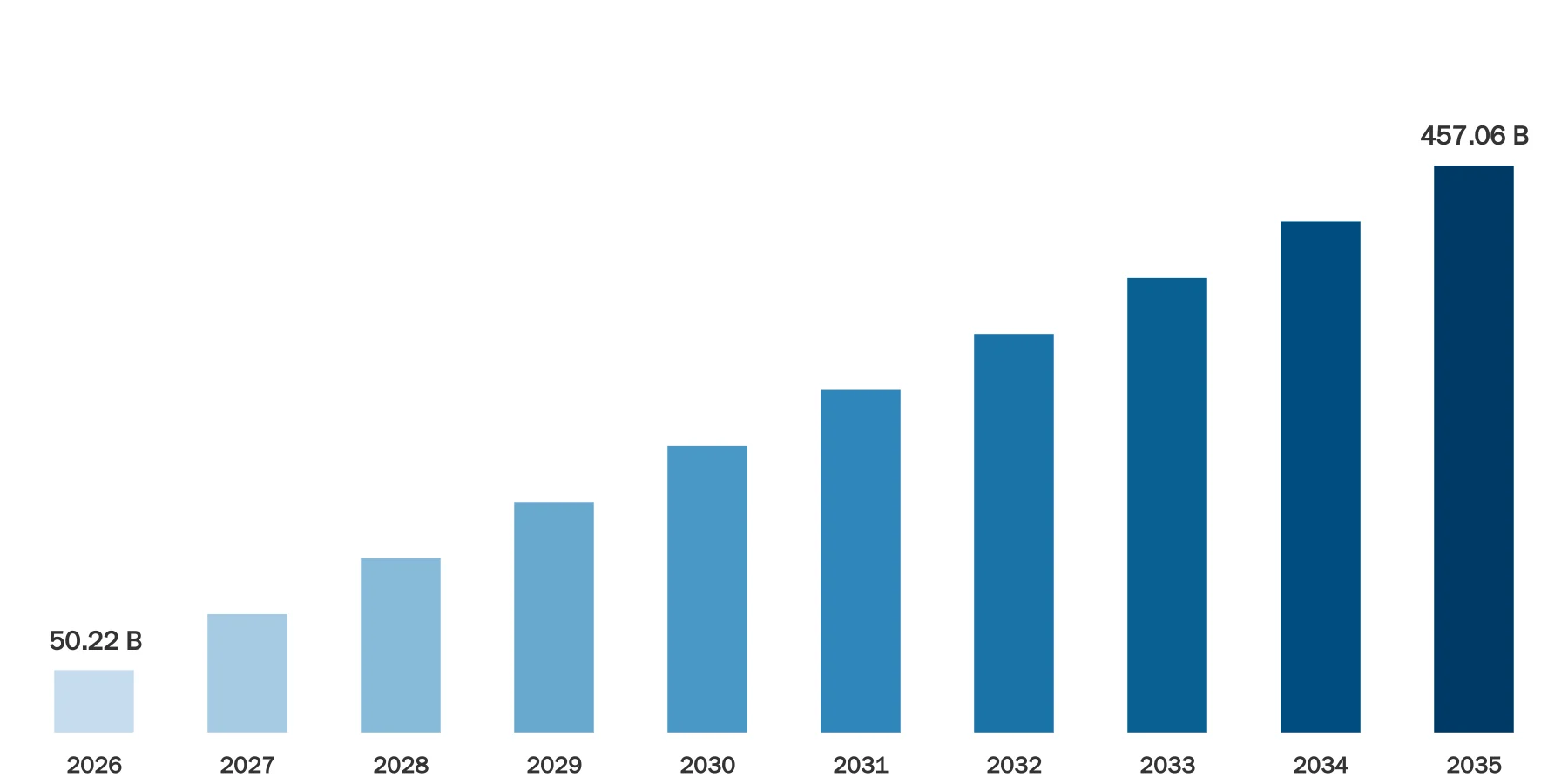
Source: Econ Market Research
The global Electric Vehicle Charging Infrastructure market expanded rapidly in 2025, with more than 5 million public charging points installed worldwide. China accounted for nearly 65% of the global charging network, while Europe crossed 1 million public chargers in 2024. More than 1.3 million new public chargers were added globally during 2024 alone. Fast chargers represented nearly 2 million units worldwide, and ultra-fast chargers above 150 kW increased by over 50% during 2024. Around 25% of all new vehicles sold globally in 2024 were electric vehicles. Public charging density improved significantly, with Europe averaging 2.6 kW charging capacity per electric vehicle and China exceeding 3 kW per electric vehicle.
The USA EV Charging Infrastructure Market recorded strong deployment activity with public charging points reaching nearly 200,000 units in 2024. More than 18,000 new DC fast-charging ports were added during 2025, bringing the total US fast-charging network above 70,000 ports. Level 2 chargers exceeded 64,000 publicly accessible installations. Nearly 30% of urban public chargers in the United States were classified as fast chargers above 22 kW. Federal corridor programs targeted charging stations every 80 kilometers along major highways. Tesla’s network surpassed 73,800 connectors globally in 2025, with the United States remaining its largest deployment region. Average utilization of fast-charging stations increased because rideshare fleets and commercial operators expanded EV adoption in urban areas.
The European EV Charging Infrastructure Market crossed 1 million public charging points in 2024, supported by strict transportation electrification policies. The Netherlands led Europe with more than 180,000 public charging points, followed by Germany with 160,000 and France with 155,000 chargers. Ultra-fast charging stations above 150 kW increased by 60% in 2024, exceeding 77,000 units across the European Union. Approximately 20% of Europe’s ultra-fast chargers delivered more than 350 kW. Nearly 79% of public chargers in Europe remained AC chargers, while 21% were DC chargers. Eleven EU countries reported charging infrastructure growth above 50% during 2024. AFIR regulations mandated fast-charging stations every 60 kilometers along major transport corridors.
EV Charging Infrastructure Market Latest Trends
The EV Charging Infrastructure Market Trends indicate rapid expansion of ultra-fast charging systems, smart grid integration, and interoperability solutions. Ultra-fast chargers above 150 kW represented nearly 10% of all fast chargers globally in 2024, compared with significantly lower penetration in 2022. Europe recorded a 60% increase in ultra-fast charging deployment during 2024, while China expanded fast charger installations from 1.2 million units in 2023 to 1.6 million units in 2024. The average cost of ultra-fast chargers declined by approximately 20% between 2022 and 2024, supporting wider commercial adoption. In the United States, more than 70,000 fast-charging ports became operational by 2025, improving long-distance travel reliability.
Another major EV Charging Infrastructure Market Analysis trend involves standardization of connectors and charging software. Combined Charging System technology gained dominant adoption across Europe and North America, supported by ISO 15118 plug-and-charge protocols. However, security research identified that only 12% of analyzed CCS chargers implemented advanced TLS Cyber Security protocols, increasing focus on secure charging ecosystems. Fleet electrification also accelerated infrastructure demand, with commercial charging hubs expanding near logistics centers and highways. Smart charging systems capable of load balancing and renewable energy integration became critical as global public charging electricity demand increased sharply. Highway charging stations delivering 350 kW or more expanded rapidly across Germany, France, Denmark, and China.
EV Charging Infrastructure Market Dynamics
The EV Charging Infrastructure Market Outlook remains strongly linked to electric vehicle penetration, government mandates, battery technology improvements, and charging accessibility. More than 1.3 million public chargers were added globally during 2024, while EV sales accounted for nearly 25% of global vehicle sales. Public charging infrastructure deployment increased in urban corridors, highways, residential complexes, and commercial fleets. Countries including China, Germany, the United States, India, and the Netherlands significantly expanded charging density. Fast chargers above 22 kW represented the fastest-growing installation category because they reduce charging times from 8 hours to less than 30 minutes in many passenger EVs.
DRIVER
Increasing Global Electric Vehicle Adoption
Electric vehicle adoption remains the strongest driver for the EV Charging Infrastructure Industry Analysis. Global EV penetration reached approximately 25% of total new vehicle sales in 2024. China alone operated more than 4.4 million cumulative chargers by the end of 2025, while Europe surpassed 1 million public charging points. Governments introduced stricter emission regulations, zero-emission vehicle mandates, and urban low-emission zones. India installed approximately 40,000 new public chargers during 2024, focusing on urban mobility and highway electrification. Public charging demand increased as urban apartment residents lacked private home charging access. Commercial fleet electrification also accelerated charging deployment, especially for delivery vans, buses, and taxi fleets. Fast charging infrastructure expanded by nearly 50% in several European countries during 2024.
RESTRAINT
Grid Capacity and High Installation Complexity
Grid limitations remain a major restraint within the EV Charging Infrastructure Market Growth landscape. Ultra-fast charging stations above 350 kW require high-capacity transformers, upgraded substations, and advanced energy management systems. Urban centers often experience transformer overload risks because fast chargers demand significantly higher electricity loads. Studies showed that many cities lacked sufficient grid readiness for large-scale DC fast charger deployment. Installation timelines in several European countries exceeded 12 months due to permitting and utility connection delays. Approximately 35% of chargers in some developing regions reported maintenance or operational inefficiencies. In India, charger-to-EV ratios remained close to 1:235 despite a fivefold increase in charging infrastructure over three years, highlighting deployment imbalance and grid limitations.
OPPORTUNITY
Expansion of Ultra-Fast Highway Charging Networks
The EV Charging Infrastructure Market Opportunities are strongly connected to highway electrification and long-distance EV travel. Governments increasingly target charging corridors every 60 to 150 kilometers. Europe mandated 150 kW fast-charging stations every 60 kilometers under AFIR regulations. Australia planned nationwide highway charger deployment every 150 kilometers by 2026. Ultra-fast chargers above 350 kW nearly doubled across several European countries during 2024. Logistics fleets, electric trucks, and intercity transportation require megawatt charging systems capable of charging heavy-duty vehicles within 30 minutes. Commercial charging hubs near highways, airports, and retail centers are emerging as high-utilization assets. Vehicle-to-grid technology and renewable-powered charging stations also present substantial opportunities for operators focused on energy optimization and grid balancing.
CHALLENGES
Reliability, Cybersecurity, and Interoperability Issues
Reliability and cybersecurity challenges continue affecting the EV Charging Infrastructure Market Report landscape. Research across 325 CCS chargers in Europe showed only 12% implemented modern TLS security protocols. Several public chargers used outdated firmware vulnerable to cyberattacks. Reliability concerns also affected consumer confidence, particularly when chargers experienced software communication failures or payment processing errors. Independent UK testing found that 31.5% of inspected chargers inaccurately measured delivered electricity. Interoperability remains difficult because networks operate multiple connector standards, software platforms, and authentication systems. Rural charging coverage also remains insufficient in several regions, especially Africa, Southeast Asia, and parts of Latin America. Grid congestion, transformer shortages, and delayed utility approvals continue increasing deployment complexity for charging operators globally.
SWOT Analysis
Strengths
More than 5 million public charging points were installed globally by 2024.
China accounted for nearly 65% of global charging infrastructure deployment.
Europe crossed 1 million public chargers, with 77,000 ultra-fast chargers operational.
Fast charger installations above 22 kW reached nearly 2 million globally.
Public charging points increased by more than 30% globally during 2024.
EV sales represented approximately 25% of global new vehicle sales in 2024.
Weaknesses
Grid capacity shortages delay charger installations in dense urban regions.
Approximately 31.5% of tested public chargers in one UK assessment showed billing inaccuracies.
Only 12% of analyzed CCS chargers supported advanced TLS security protocols.
Rural charging infrastructure remains underdeveloped in many emerging economies.
India still maintained a charger-to-EV ratio near 1:235 despite infrastructure expansion.
Opportunities
Ultra-fast chargers above 350 kW are expanding rapidly across Europe and Asia.
Highway charging corridors every 60 kilometers are mandated in Europe.
Heavy-duty truck charging networks require megawatt-scale charging systems.
Smart charging and vehicle-to-grid systems are improving grid balancing efficiency.
Fleet electrification increases demand for depot charging and commercial charging hubs.
Threats
Cybersecurity vulnerabilities expose charging networks to operational risks.
Transformer shortages and utility delays can extend deployment timelines beyond 12 months.
High installation costs for ultra-fast charging stations limit small operator participation.
Fragmented payment systems and connector standards reduce consumer convenience.
Policy uncertainty in several countries affects long-term infrastructure planning.
Segmentation Analysis
The EV Charging Infrastructure Market Segmentation is categorized by charger type, connector type, application, and installation method. Commercial charging installations represented a dominant share because fleet operators, retail centers, and public parking facilities increasingly deployed high-capacity charging systems. Residential charging continued expanding through Level 2 home chargers, especially in North America and Europe. Fast chargers above 22 kW gained stronger deployment momentum because they reduce charging duration to below 30 minutes for many EV models. Connector standardization also became critical, with CCS emerging as the dominant fast-charging technology in Europe and North America, while CHAdeMO retained presence in Japan and selected Asian markets.
By Charger Type
Slow chargers, generally operating at 3 kW to 22 kW, accounted for nearly 70% of global public charging installations because of lower installation complexity and lower grid demand. AC charging dominated urban residential locations, apartment complexes, and workplace charging. Europe reported that nearly 79% of charging points were AC chargers. However, fast chargers above 22 kW represented the fastest-growing charger segment because commercial operators prioritized reduced charging time and higher station throughput. Global fast charger installations reached nearly 2 million units in 2024.
Ultra-fast chargers above 150 kW expanded rapidly in Europe, China, and the United States. Europe surpassed 77,000 ultra-fast chargers during 2024, while China increased fast charger deployment from 1.2 million to 1.6 million units in one year. Fast chargers are increasingly deployed across highways, logistics hubs, and public transit corridors. Approximately 20% of Europe’s ultra-fast chargers delivered 350 kW or higher power capacity, supporting next-generation passenger EVs and electric truck charging requirements.
By Connector
Combined Charging System technology held the dominant share in Europe and North America because major automotive manufacturers standardized CCS compatibility across passenger EV platforms. CCS deployment accelerated due to support for DC fast charging, plug-and-charge capability, and interoperability with multiple charging networks. Security assessments analyzed 325 CCS chargers across four European countries and found widespread deployment between 2013 and 2024. CCS became the leading technology for chargers above 50 kW across Europe and the United States.
CHAdeMO maintained a significant share in Japan and selected Asian markets, particularly for legacy EV fleets and Japanese automotive brands. However, CCS installations outpaced CHAdeMO deployment due to broader international adoption. Tesla’s proprietary charging connector also gained wider acceptance after opening portions of its charging network to non-Tesla vehicles. Other connectors, including GB/T in China, continued dominating the Chinese charging ecosystem, where over 4.4 million cumulative chargers operated by the end of 2025. Standardization initiatives increasingly focus on reducing interoperability challenges between charging networks and EV platforms.
By Application
Commercial charging infrastructure represented the largest market share because public transportation systems, logistics fleets, taxis, and workplace charging networks require large-scale deployment. More than 70,000 fast-charging ports operated in the United States during 2025, primarily targeting highway corridors, retail centers, and fleet operations. Commercial charging stations increasingly use ultra-fast charging systems above 150 kW to maximize vehicle turnover and reduce waiting times. Public charging represented a crucial solution for urban residents without private parking spaces.
Residential charging remained essential for daily EV charging behavior, with approximately 80% of EV charging globally occurring at home. Level 2 residential chargers expanded across North America and Europe because home charging provides overnight convenience and lower electricity costs. Apartment charging deployment also accelerated in dense urban environments. Smart residential charging systems integrated with solar panels and Home Energy Management systems became increasingly common. Governments introduced building codes requiring EV-ready parking infrastructure in new residential developments to support long-term charging demand growth.
Regional Analysis
Global EV charging infrastructure deployment exceeded 5 million public chargers in 2024.
Asia-Pacific dominated charger installations with nearly 65% market share.
Europe crossed 1 million charging points with strong ultra-fast charger expansion.
North America improved highway charging coverage with over 70,000 fast ports.
Middle East & Africa accelerated pilot charging projects across urban mobility corridors.

North America
North America represented a significant share of the EV Charging Infrastructure Market Size because of strong EV adoption and highway charging investments.
The United States operated nearly 200,000 public charging points during 2024.
Fast-charging ports exceeded 70,000 units by 2025.
Approximately 30% of urban public chargers in the United States were fast chargers above 22 kW.
Federal infrastructure programs targeted nationwide corridor charging deployment every 80 kilometers along major routes.
Tesla maintained one of the largest charging networks globally with more than 73,800 connectors in 2025.
Canada accelerated charging deployment across Ontario, Quebec, and British Columbia, especially near urban transit corridors.
Fleet electrification among delivery companies and rideshare operators increased commercial charging demand.
Workplace charging installations expanded across metropolitan regions including California, Texas, and New York.
Level 2 charging remained widely deployed in residential neighborhoods and office complexes.
Charging reliability improved because operators increased redundant connectors and predictive maintenance systems.
Public-private partnerships accelerated rural charging deployment across interstate highway networks.
Europe
Europe maintained one of the highest charging densities globally with more than 1 million public chargers.
The Netherlands led regional deployment with over 180,000 charging points.
Germany and France operated approximately 160,000 and 155,000 chargers respectively.
Ultra-fast charger deployment above 150 kW increased by 60% in 2024.
Europe accounted for more than 77,000 ultra-fast charging stations.
Approximately 79% of public chargers in Europe remained AC chargers, while 21% were DC chargers.
Eleven European Union countries recorded charging infrastructure growth above 50% during 2024.
AFIR regulations required charging stations every 60 kilometers along TEN-T transport corridors.
Denmark, Belgium, and Austria reported some of the fastest DC charger growth rates in Europe.
Around 20% of Europe’s ultra-fast chargers delivered power above 350 kW.
Commercial fleet charging expanded rapidly for buses, logistics vans, and electric taxis.
Apartment charging infrastructure became a priority because urban EV ownership increased significantly across Western Europe.
Asia-Pacific
Asia-Pacific dominated the EV Charging Infrastructure Industry Report landscape with approximately 65% of global charging infrastructure.
China operated over 4.4 million cumulative chargers by the end of 2025.
Fast charger installations in China increased from 1.2 million in 2023 to 1.6 million in 2024.
India installed around 40,000 new public chargers during 2024.
South Korea increased fast charger deployment from 34,000 to 47,000 units between 2023 and 2024.
Japan continued supporting CHAdeMO connector infrastructure while also expanding CCS-compatible chargers.
Australia planned highway charging stations every 150 kilometers under national EV strategies.
Public charging capacity per electric vehicle exceeded 3 kW in China, among the highest globally.
Urban megacities including Shanghai, Beijing, Seoul, Tokyo, and Delhi accelerated deployment of smart charging systems.
Highway charging growth in India increased by approximately 68% year over year.
Commercial depot charging expanded rapidly for electric buses and logistics fleets throughout Asia-Pacific markets.
Middle East & Africa
The Middle East & Africa EV Charging Infrastructure Market Insights segment remained smaller but demonstrated increasing deployment activity.
Gulf countries expanded EV charging corridors near airports, business districts, and tourism hubs.
The United Arab Emirates accelerated deployment of DC fast chargers across Dubai and Abu Dhabi.
Saudi Arabia increased charging station installations under transportation electrification initiatives linked to smart city projects.
South Africa remained one of the leading African charging infrastructure markets with highway charger deployment between Johannesburg, Cape Town, and Durban.
Public charging penetration remained lower than Europe and North America because EV adoption rates remained below 5% in many countries.
Solar-powered charging stations gained traction in regions with unstable electricity grids.
Commercial charging demand increased among electric bus operators and logistics providers.
Several African countries prioritized fleet electrification projects for urban public transportation.
Charging operators increasingly adopted battery storage systems to manage grid instability and peak electricity demand.
Government pilot projects and foreign infrastructure partnerships accelerated deployment in metropolitan areas.
Competitive Landscape
The EV Charging Infrastructure Market Share remains highly competitive, with technology providers, utilities, oil companies, automotive manufacturers, and charging network operators expanding aggressively. Tesla maintained one of the world’s largest fast-charging ecosystems with more than 73,800 connectors globally during 2025. ABB, ChargePoint, Shell Recharge, EVBox, and regional charging operators increased deployment of ultra-fast charging systems above 150 kW. Chinese manufacturers dominated charger production volumes because China accounted for approximately 65% of global charging infrastructure installations.
Competition intensified around charging speed, software integration, uptime reliability, and interoperability. Companies increasingly integrated AI-based energy management systems, predictive maintenance platforms, and vehicle-to-grid functionality. Public-private partnerships became a major competitive strategy as governments mandated corridor charging deployment. Commercial fleet charging emerged as a critical competitive segment because logistics companies and rideshare operators required high-capacity depot charging systems. Operators also focused on charger utilization rates, payment integration, and renewable electricity sourcing. Several firms expanded battery-buffered charging stations to reduce grid dependency and installation timelines. Ultra-fast charging deployment above 350 kW became a key differentiator for premium highway charging networks.
List of Top EV Charging Infrastructure Companies
Tesla
ABB
ChargePoint
EVBox
Shell Recharge
Tata Power
Exicom
Charge Zone
Servotech
Jio-bp Pulse
Leading Companies by Market Share
Tesla operated more than 7,753 supercharging stations and approximately 73,817 connectors globally during 2025. The company expanded V4 superchargers capable of delivering up to 500 kW for passenger EVs and 1.2 MW for heavy-duty vehicles. Tesla maintained one of the highest charger utilization rates globally with approximately 54 million charging sessions in one quarter.
ChargePoint maintained one of the largest independently operated charging networks across North America and Europe. The company expanded AC and DC charging deployment across commercial fleets, workplaces, retail centers, and residential applications. ChargePoint focused heavily on software integration, network interoperability, and energy management solutions supporting thousands of charging locations globally.
Market Investment Outlook
The EV Charging Infrastructure Market Forecast indicates continued investment expansion across highway charging, fleet electrification, urban charging hubs, and renewable-integrated charging systems. Governments worldwide increased infrastructure funding allocations to support transportation electrification targets. India allocated INR 20 billion toward charging infrastructure development under national EV programs. South Korea increased charging infrastructure budgets by approximately 40% in 2025 to deploy 4,400 additional fast chargers. Europe prioritized ultra-fast corridor charging stations delivering at least 150 kW every 60 kilometers.
Private investments accelerated in commercial charging hubs located near logistics centers, airports, retail parks, and highways. Fleet electrification among delivery operators, buses, and heavy-duty transport increased demand for depot charging systems. Investors increasingly targeted battery-buffered charging stations because they reduce transformer upgrade requirements and improve installation flexibility. Renewable-powered charging stations integrated with solar and battery storage systems also gained investment momentum. Charging software platforms supporting smart load balancing, predictive maintenance, and dynamic pricing attracted strong enterprise interest. Megawatt charging systems for electric trucks and industrial fleets are expected to become one of the most significant investment areas across Europe, North America, and Asia-Pacific.
New Product Development
Innovation in the EV Charging Infrastructure Market Research Report landscape increasingly focuses on charging speed, interoperability, cybersecurity, and smart energy management. Tesla introduced V4 superchargers capable of 500 kW charging for passenger EVs and 1.2 MW charging for electric trucks. European operators expanded 350 kW charging stations capable of adding hundreds of kilometers of range within 15 minutes. Smart charging software integrated AI-based predictive maintenance systems to reduce downtime and improve charger uptime.
Battery-buffered charging stations emerged as a major innovation because they minimize grid upgrade requirements and support rapid deployment in urban areas. Vehicle-to-grid systems gained attention as charging networks evolved into distributed energy resources capable of grid balancing. Wireless EV charging pilot programs expanded in selected commercial fleet operations and public transportation systems. Plug-and-charge technology based on ISO 15118 protocols improved charging convenience by eliminating separate authentication procedures. Charging stations integrated renewable electricity generation and battery storage to reduce electricity demand peaks. Mobile charging robots and modular charging systems also entered pilot deployment across airports, logistics depots, and automated parking facilities.
Recent Developments
China increased cumulative EV charger installations above 4.4 million units by the end of 2025, including more than 1 million charger installations during 2025 alone.
Europe expanded ultra-fast charging infrastructure above 150 kW by 60% during 2024, surpassing 77,000 ultra-fast charging points.
The United States added over 18,000 new DC fast-charging ports during 2025, increasing total fast-charging ports above 70,000 nationwide.
Tesla expanded its supercharging network to 7,753 stations and 73,817 connectors globally by Q3 2025 while launching V4 superchargers supporting 500 kW charging.
India installed approximately 40,000 new public chargers during 2024 and expanded highway charging infrastructure by nearly 68% year over year.
Report Coverage of EV Charging Infrastructure Market
The EV Charging Infrastructure Market Report covers global charging deployment trends, charger technology evolution, connector standardization, application analysis, and regional infrastructure expansion. The report evaluates public charging networks, residential charging systems, commercial fleet charging, and highway corridor deployment across North America, Europe, Asia-Pacific, and the Middle East & Africa. It includes analysis of more than 5 million public charging points globally and assesses fast charger deployment trends above 22 kW and ultra-fast charging systems above 150 kW.
The report also examines connector technologies including CCS, CHAdeMO, GB/T, and proprietary charging systems. Installation trends for AC slow chargers and DC fast chargers are analyzed alongside urban charging density, highway corridor development, and smart charging integration. The study evaluates cybersecurity risks, interoperability standards, charger uptime performance, and grid integration challenges. Commercial charging hubs, fleet electrification infrastructure, renewable-powered charging stations, and vehicle-to-grid systems are also included. The report further assesses competitive benchmarking, investment strategies, policy frameworks, and technology innovation shaping the global EV Charging Infrastructure Industry Analysis landscape.
EV Charging Infrastructure Market Report Scope & Segmentation
| Attributes | Details |
|---|---|
Market Size (Current) | US$ 50.22 Billion in 2026 |
Market Size (Forecast) | US$ 457.06 Billion in 2035 |
Growth Rate | CAGR of 27.5% from 2026 to 2035 |
Forecast Period | 2026 – 2035 |
Base Year | 2025 |
Historical Data Available | Yes |
Regional Scope | Global |
Segments Covered | By Charger Type
By Connector
By Application
|
Frequently Asked Questions
Common questions about this report
The study period covers historical insights and forecast projections for the period 2026-2035.
About the Author
Market research expert with years of industry experience

Dipali Bhingare serves as the Market Research Director at Econ Market Research. With a focus on translating complex global economic shifts into actionable business intelligence, she oversees the strategic direction of comprehensive market studies. Her work empowers organizations to navigate volatile industries through data-driven forecasting and deep-dive competitive analysis.
Related Reports
Explore more market insights from the same category