


Top Companies in Edge AI Hardware Driving Intelligent Computing
The top Edge AI hardware companies are advancing processors, AI accelerators, robotics platforms, and intelligent computing systems for real-time applications.
Introduction
Overview of the Global Edge AI Hardware Industry
The global Edge AI hardware industry is shifting artificial intelligence from centralized computing facilities into cameras, vehicles, industrial machines, medical devices, retail systems, robots, smartphones, and personal computers. Edge AI hardware processes information close to the point where data is created, enabling response times measured in milliseconds instead of relying on continuous cloud communication. The addressable deployment base is expanding rapidly, with 542,076 industrial robots installed during 2024 and 4,663,698 industrial robots operating worldwide at the end of that year. Edge AI hardware now spans entry-level accelerators delivering 13 TOPS, mainstream processors delivering 26 TOPS to 50 TOPS, and advanced robotic computing platforms exceeding 2,000 FP4 TFLOPS.
Market Evolution and Growth Drivers
The Edge AI hardware market has evolved through 3 major technology phases: fixed-function vision accelerators, heterogeneous system-on-chip platforms, and generative AI processors capable of handling language, vision, audio, and sensor data. Early edge devices usually executed 1 computer-vision model, whereas advanced platforms can now coordinate object detection, speech recognition, depth estimation, motion planning, and language reasoning simultaneously. Global 5G connections passed 2 billion at the end of 2024, while monthly mobile data consumption per connection is expected to rise from 12.8 GB in 2023 to 47.9 GB in 2030. These developments strengthen demand for Edge AI hardware that reduces network traffic, improves privacy, supports offline operation, and delivers real-time decisions within strict power limits.
Top 5 Latest Trends in the Edge AI Hardware
1. On-Device Generative AI Processing
On-device generative AI is changing Edge AI hardware from a computer-vision component into a multipurpose intelligence platform. New processors can run large language models, vision-language models, speech engines, image generators, and AI assistants without transmitting every prompt to a remote server. Hailo-10H delivers 40 TOPS at INT4 precision and includes a direct DDR interface designed to support larger language and multimodal models. At the higher end, Jetson AGX Thor provides up to 2,070 FP4 TFLOPS, 128 GB of memory, and a power envelope reaching 130 W. These specifications allow robots, vehicles, medical systems, and industrial workstations to interpret natural-language commands, analyze images, summarize documents, and generate responses locally. The trend also reduces cloud dependency for devices operating 24 hours per day in factories, hospitals, warehouses, and transport systems.
2. Heterogeneous CPU, GPU, and NPU Architectures
Modern Edge AI hardware increasingly combines 3 computing engines: a CPU for operating-system and control functions, a GPU for parallel graphics and general-purpose acceleration, and an NPU for power-efficient neural-network inference. Intel Core Ultra 200V processors incorporate an NPU delivering up to 48 TOPS, while selected processor configurations provide 8 CPU cores and overall AI performance reaching 115 INT8 TOPS across available engines. Qualcomm’s QCS6490 combines an 8-core CPU operating at up to 2.7 GHz with an integrated GPU and an NPU delivering up to 12 dense TOPS. Heterogeneous architectures allow software to assign each workload to the most efficient computing block, reducing unnecessary energy use. This capability is increasingly important in Edge AI hardware for notebooks, kiosks, smart displays, autonomous machines, and battery-powered equipment expected to operate for 8, 12, or 24 hours between charging cycles.
3. Physical AI and Autonomous Robotics
Physical AI represents one of the strongest growth drivers for Edge AI hardware because intelligent machines must perceive their surroundings and act within milliseconds. A modern autonomous robot can use 4 or more cameras alongside lidar, radar, microphones, force sensors, encoders, and inertial measurement units. Global factories installed 542,076 industrial robots in 2024, while the operational stock reached 4,663,698 units. Electronics manufacturing accounted for 24% of installations, automotive production held a 23% share, and metal and machinery applications represented 16%. These deployments create demand for Edge AI hardware capable of sensor fusion, obstacle detection, route planning, quality inspection, and motor control. Advanced robotic processors now combine generative AI with real-time perception, enabling autonomous mobile robots, robotic arms, delivery machines, agricultural equipment, and humanoid platforms to understand 1 spoken instruction and translate it into multiple physical actions.
4. Energy-Efficient and Rugged Industrial Hardware
Industrial customers are evaluating Edge AI hardware through performance per watt, operating temperature, product longevity, and reliability rather than peak TOPS alone. Qualcomm’s Dragonwing IQ-9075 delivers up to 100 dense TOPS or 200 equivalent sparse TOPS through 2 neural-processing units. The processor supports ambient temperatures from −40°C to 85°C and junction temperatures reaching 115°C, making it suitable for outdoor equipment, autonomous mobile robots, utilities, and manufacturing systems. AMD Versal AI Edge Series Gen 2 devices target up to 3 times the TOPS-per-watt performance of the previous architecture and up to 10 times greater scalar computing capability than first-generation devices. Rugged Edge AI hardware may remain deployed for 5 to 10 years, so buyers also require stable software, long-term security updates, industrial interfaces, deterministic latency, and protection from vibration, heat, dust, and electrical fluctuations.
5. Multimodal Sensor Fusion and Unified Software
The fifth major Edge AI hardware trend is the integration of multiple sensors and development tools into 1 coordinated platform. A smart machine may simultaneously analyze 4K video, audio, temperature readings, radar signals, machine telemetry, and language commands. Qualcomm’s IQ9 architecture includes an 8-core CPU, 2 neural-processing units, integrated graphics, real-time processing capabilities, and high-speed peripheral support. AMD’s adaptive architecture combines programmable logic, Arm-based processing, and AI engines so that preprocessing, neural inference, and postprocessing can occur within a single device. Software is becoming equally important because deploying 1 model across 5 processor configurations can require model conversion, quantization, testing, profiling, and security validation. Unified Edge AI hardware ecosystems reduce this complexity through optimized libraries, pretrained models, runtime environments, and development kits, helping manufacturers shorten deployment schedules from several years to 12 or 18 months.
Top 5 Companies in the Edge AI Hardware
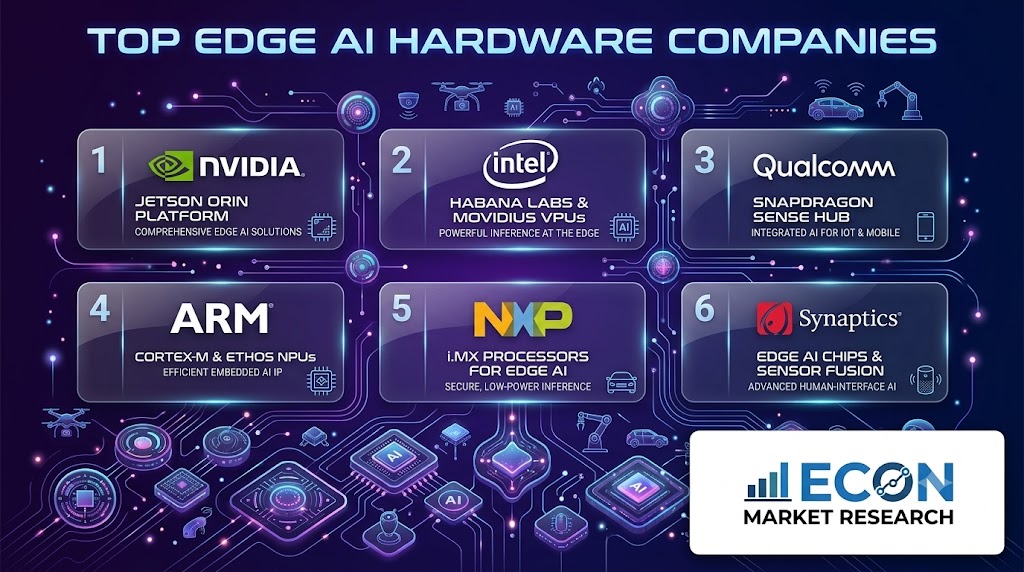
The following 5 companies were selected using 5 practical criteria: Edge AI hardware performance, product range, software maturity, industrial applicability, and support for real-world deployment. The list is an editorial assessment rather than a ranking based on financial size, and each company addresses a different portion of the Edge AI hardware ecosystem.
1. NVIDIA
Company overview: NVIDIA was founded in 1993 and introduced its graphics processing unit architecture in 1999, creating a foundation for parallel computing and modern AI acceleration. Headquarters: Santa Clara, California, United States. Core Edge AI hardware expertise: The company specializes in GPU-accelerated modules for robotics, vision systems, autonomous machines, healthcare equipment, and embedded generative AI. Major products and services: Its Jetson portfolio includes Jetson Orin modules and Jetson AGX Thor, which delivers up to 2,070 FP4 TFLOPS, 128 GB of memory, and operation within a power envelope reaching 130 W. JetPack 7 provides development libraries, operating-system components, deployment tools, and support for robotics and generative AI. NVIDIA Edge AI hardware is widely suited to autonomous mobile robots, industrial inspection, intelligent cameras, medical imaging, logistics systems, and machines that must run multiple AI models at once.
2. Intel
Company overview: Intel was incorporated in 1968 and has developed semiconductor technologies for computers, networking equipment, embedded systems, industrial devices, and AI-enabled endpoints for over 5 decades. Headquarters: Santa Clara, California, United States. Core Edge AI hardware expertise: Intel combines CPUs, integrated GPUs, NPUs, connectivity components, and software optimization tools for Edge AI hardware. Major products and services: Core Ultra 200V processors provide dedicated NPUs with up to 48 TOPS, while selected products combine 8 CPU cores with integrated graphics and total AI capability reaching 115 INT8 TOPS. Intel also supports Edge AI hardware deployment through model-optimization software, heterogeneous programming tools, industrial computing platforms, and development resources. Its architecture is relevant to AI-enabled computers, retail analytics, medical devices, smart factories, video systems, and enterprise endpoints that need local inference without installing a large discrete accelerator.
3. Qualcomm
Company overview: Qualcomm was founded in July 1985 and operates through 170 offices across more than 30 countries. Headquarters: San Diego, California, United States. Core Edge AI hardware expertise: Qualcomm designs integrated system-on-chip platforms combining CPU, GPU, NPU, image processing, audio, security, and wireless connectivity. Major products and services: Dragonwing IQ-9075 delivers up to 100 dense TOPS, includes an 8-core CPU, supports language models with billions of parameters, and operates at junction temperatures from −40°C to 115°C. The QCS6490 platform provides an 8-core processor, AI performance reaching 12 dense TOPS, and support for multiple cameras and 4K video workloads. Qualcomm supplies evaluation kits, AI development tools, Linux support, connectivity platforms, and processors for robotics, intelligent cameras, drones, retail equipment, transport systems, and industrial automation.
4. AMD
Company overview: AMD was founded as a Silicon Valley semiconductor company in 1969 and was incorporated on May 1 of that year. Headquarters: Santa Clara, California, United States. Core Edge AI hardware expertise: AMD combines x86 CPUs, Radeon GPUs, XDNA neural processors, programmable logic, adaptive systems, and embedded computing technologies. Major products and services: Ryzen AI processors include dedicated NPUs delivering up to 50 TOPS for local AI assistants and productivity workloads. Versal AI Edge Series Gen 2 combines embedded processors, programmable logic, and next-generation AI engines, targeting up to 3 times greater TOPS per watt and up to 10 times more scalar computing than first-generation platforms. AMD Edge AI hardware supports automotive driver assistance, machine vision, medical imaging, aerospace, industrial controls, robotics, and sensor-fusion systems that require low latency and adaptable interfaces.
5. Hailo
Company overview: Hailo was established in February 2017 as a specialist developer of AI accelerators and vision processors for edge devices. Headquarters: Tel Aviv, Israel. Core Edge AI hardware expertise: Hailo creates purpose-built neural-network processors optimized for real-time inference under limited power, thermal, and physical-space conditions. Major products and services: Hailo-10H delivers 40 TOPS at INT4 precision and supports large language and vision-language models through a direct DDR interface. Hailo-8 delivers up to 26 TOPS for computer vision, while Hailo-8L provides 13 TOPS for entry-level Edge AI hardware. The company offers M.2 modules, vision processors, software runtimes, model-compilation tools, and application pipelines for smart cameras, industrial equipment, vehicles, security systems, retail devices, and compact computers. Its processors are used by over 300 customers across several global markets.
Regional Outlook
North America
North America has a highly developed Edge AI hardware ecosystem supported by semiconductor design, advanced computing, robotics, automotive engineering, cloud infrastructure, and early 5G adoption. The United States installed 34,164 industrial robots in 2024, accounting for 68% of robot installations across the Americas. Mexico installed 5,594 units, while Canada added 3,787 units during the same year. These deployments create direct demand for Edge AI hardware used in machine vision, robotic guidance, predictive maintenance, worker safety, and automated material handling. The region also has a substantial operational robot base, with the Americas holding 542,464 industrial robots in 2024. Electronics, automotive, food processing, logistics, healthcare, aerospace, and defense applications continue to generate demand for processors capable of executing several AI workloads within millisecond-level latency limits.
Connectivity strengthens the North American Edge AI hardware outlook. In 2024, 5G represented 60% of mobile connections in both the United States and Canada, while the technology is expected to account for 90% of regional connections by 2030. Higher-speed wireless access supports private industrial networks, intelligent transport, mobile robotics, connected healthcare devices, video analytics, and distributed retail systems. North American buyers also place significant importance on cybersecurity, hardware-backed encryption, secure boot, software maintenance, and trusted supply chains. Product availability for 5 to 10 years is especially important in industrial, medical, automotive, and public-sector procurement. The region’s strongest opportunities include warehouse robots, autonomous agricultural equipment, AI-enabled computers, traffic-monitoring systems, medical imaging devices, and factory upgrades that add Edge AI hardware through M.2, PCIe, or system-on-module configurations instead of replacing complete machines.
Europe
Europe’s Edge AI hardware industry is closely linked to automotive manufacturing, industrial automation, energy systems, medical technology, aerospace, transport, and precision engineering. European factories installed 85,006 industrial robots in 2024, representing the region’s 2nd-highest annual installation total. European Union countries accounted for 67,819 installations, or 80% of Europe’s total. Germany installed 26,982 robots, Italy installed 8,783 units, and Spain installed 5,086 units. Europe’s operational stock reached 821,384 industrial robots in 2024, creating a broad installed base for Edge AI hardware supporting machine vision, predictive maintenance, process control, robotic safety, and automated inspection. Regional manufacturers often operate equipment for 10 years or longer, increasing the importance of processor longevity, stable software, deterministic performance, and industrial-grade temperature support.
Europe’s connectivity environment is also becoming more favorable for Edge AI hardware. At the end of 2024, 5G represented 30% of European mobile connections, equivalent to 200 million connections. Adoption is expected to exceed 80% by 2030, supporting connected factories, smart ports, intelligent rail systems, urban monitoring, energy networks, and distributed healthcare. The European Union includes 27 member countries, producing a diverse market in which devices may need to support multiple languages, privacy requirements, cybersecurity standards, and sector-specific safety rules. European customers frequently prioritize local data processing because Edge AI hardware can analyze sensitive video, medical, industrial, or mobility information without transmitting every data point outside the device. Major opportunities include automotive driver assistance, industrial cameras, collaborative robots, renewable-energy monitoring, intelligent buildings, and medical equipment requiring reliable inference within 1 second or less.
Asia-Pacific
Asia-Pacific is the largest regional deployment center for industrial automation and therefore a critical market for Edge AI hardware. The region installed 401,665 industrial robots in 2024, representing 74% of worldwide installations. China installed 295,045 units and accounted for 54% of the global total, while its operational robot stock reached 2,027,190 units. Japan installed 44,453 robots, and South Korea installed 30,596 units during the same year. These figures demonstrate the scale of potential demand for AI accelerators, machine-vision processors, robotic controllers, sensor-fusion devices, and industrial computing modules. Asia-Pacific also contains major semiconductor foundries, memory producers, packaging companies, camera suppliers, electronics manufacturers, and module assemblers, giving the region an important role across every stage of the Edge AI hardware supply chain.
Regional connectivity will further expand Edge AI hardware adoption. By 2030, 5G is projected to account for 50% of mobile connections across Asia-Pacific. China is expected to reach 1.7 billion 5G connections, while 5G-Advanced services are already active in over 330 Chinese cities and serve 10 million users. These networks support smart factories, autonomous vehicles, intelligent cameras, mobile AI, delivery robots, traffic systems, and agricultural monitoring. Asia-Pacific also includes mature 5G markets such as Japan, South Korea, Singapore, and Australia alongside emerging markets where affordability and power efficiency remain essential. Suppliers therefore need a broad Edge AI hardware portfolio ranging from 13-TOPS entry-level accelerators to 100-TOPS industrial processors. Successful products must support local languages, multiple operating systems, low-power operation, high-volume manufacturing, and flexible integration into cameras, appliances, computers, vehicles, and factory equipment.
Middle East and Africa
The Middle East is developing into an important Edge AI hardware market through smart-city programs, transport modernization, energy automation, logistics, security, construction, and digital government. In 2024, 308 million people in the Middle East and North Africa were using mobile internet, while 4G represented 67% of regional mobile connections. Mobile internet subscribers are expected to reach 378 million by 2030. In the Gulf states, 5G networks already cover at least 75% of the population in several markets, giving organizations the connectivity needed for intelligent cameras, autonomous transport, industrial monitoring, private networks, and edge-based security analytics. Edge AI hardware is especially relevant to ports, airports, oil and gas facilities, utility networks, large construction projects, and urban infrastructure that may generate thousands of video or sensor events every minute.
Africa presents a distinct Edge AI hardware opportunity shaped by agriculture, mining, healthcare access, telecommunications, mobile services, energy constraints, and limited fixed-network coverage. Almost 1 billion people on the continent were not using mobile internet in 2025, representing 63% of Africa’s population, even though many lived within areas that had network coverage. This gap makes offline and intermittently connected Edge AI hardware particularly valuable. Agricultural systems can analyze crop images locally, medical devices can evaluate scans without permanent broadband, and mining equipment can detect safety risks within milliseconds. African deployments frequently require low-power processors operating within 5-W to 20-W ranges, durable enclosures, solar compatibility, and simplified maintenance. The most successful Edge AI hardware will be designed for local operating conditions from the beginning rather than adapted from systems that assume 24-hour electricity and continuous high-speed internet access.
Future Opportunities in the Edge AI Hardware
Future opportunities in Edge AI hardware will emerge from the shift between single-model inference and multi-model autonomous systems. A next-generation robot may execute 6 or more AI workloads at the same time, including object detection, depth estimation, speech recognition, language reasoning, route planning, and safety monitoring. Supporting these workloads will require larger memory pools, mixed-precision computation, chiplet architectures, faster sensor interfaces, and stronger thermal management. The performance spectrum is already expanding from 13 TOPS for entry-level accelerators to 100 dense TOPS for industrial platforms and 2,070 FP4 TFLOPS for advanced robotics. However, commercial success will depend on sustained performance, latency, memory bandwidth, power consumption, and software compatibility rather than 1 peak benchmark. Hardware modules using M.2, PCIe, and system-on-module formats will create opportunities to add AI to millions of existing machines without replacing complete systems.
Healthcare, automotive, agriculture, retail, manufacturing, and cybersecurity will provide some of the largest Edge AI hardware opportunities through 2030. Medical devices can process images and patient signals locally within seconds, while vehicles can combine data from 5 or more cameras with radar and driver-monitoring systems. Retail environments can analyze 10 or 20 video streams inside a store without continuously uploading identifiable footage. Farms can use cameras and environmental sensors in locations with limited connectivity, while factories can detect defects on production lines operating at hundreds of items per minute. Security features will become standard as billions of connected devices increase the potential attack surface. Secure boot, signed model updates, hardware encryption, isolated execution, and device identity will therefore become essential purchasing criteria. Suppliers offering 5-year to 10-year product availability, model optimization, fleet monitoring, and long-term security updates will have a significant competitive advantage.
Conclusion
The Edge AI hardware industry is entering a new stage in which artificial intelligence will operate across millions of physical devices instead of remaining concentrated in centralized computing infrastructure. The installation of 542,076 industrial robots in 2024, an operational base of 4,663,698 robots, and the expansion of 5G beyond 2 billion connections demonstrate the scale of the available deployment environment. NVIDIA, Intel, Qualcomm, AMD, and Hailo each bring a different strength to the Edge AI hardware market. NVIDIA provides high-performance robotic computing, Intel combines widely deployed CPU architecture with integrated NPUs, Qualcomm delivers connected and power-efficient systems, AMD supplies adaptive and heterogeneous computing, and Hailo focuses on compact neural acceleration from 13 TOPS to 40 INT4 TOPS.
No single numerical specification determines the best Edge AI hardware platform because TOPS, TFLOPS, memory, precision, power, latency, operating temperature, and software support measure different capabilities. A 13-TOPS processor may be ideal for 1 smart camera, while a 100-TOPS system may support industrial generative AI and a 2,070-FP4-TFLOPS platform may be required for advanced robotics. Buyers must therefore evaluate hardware against actual models, sensor configurations, environmental conditions, and expected deployment periods of 5 to 10 years. As Edge AI hardware spreads across vehicles, factories, hospitals, stores, computers, farms, and public infrastructure, the leading companies will be those that combine efficient silicon with reliable software, strong security, long lifecycle support, and proven real-time performance.