

Medical Devices Market
Medical Devices Market Size, Share, Trends, Growth, and Industry Analysis, By Product Type (Diagnostic Devices, Therapeutic Devices, Surgical Instruments, Monitoring Devices, Medical Imaging Devices, Consumables, Others), By Device Class (Class I, Class II, Class III), By Application (Cardiology, Orthopedics, Neurology, Oncology, Ophthalmology, Gynecology, Urology, General Surgery, Others), By End User (Hospitals, Clinics, Ambulatory Surgical Centers, Diagnostic Centers, Home Healthcare, Research andamp;, Academic Institutes), By Technology (Conventional Devices, Minimally Invasive Devices, Digital andamp;, Smart Medical Devices), By Distribution Channel (Direct Sales, Third-party Distributors, Online Sales), Regional Analysis and Forecast Period 2026-2035
Medical Devices Market Overview
As per Econ Market Research analysis, the Global Medical Devices Market valuation stood at US$ 719.61 Billion in 2026 and is expected to reach US$ 1209.42 Billion by 2035, growing at a steady CAGR of 5.94% from 2026 to 2035. 2025 serves as the base year.
Medical Devices Market Size 2025-2035 (USD Billion)

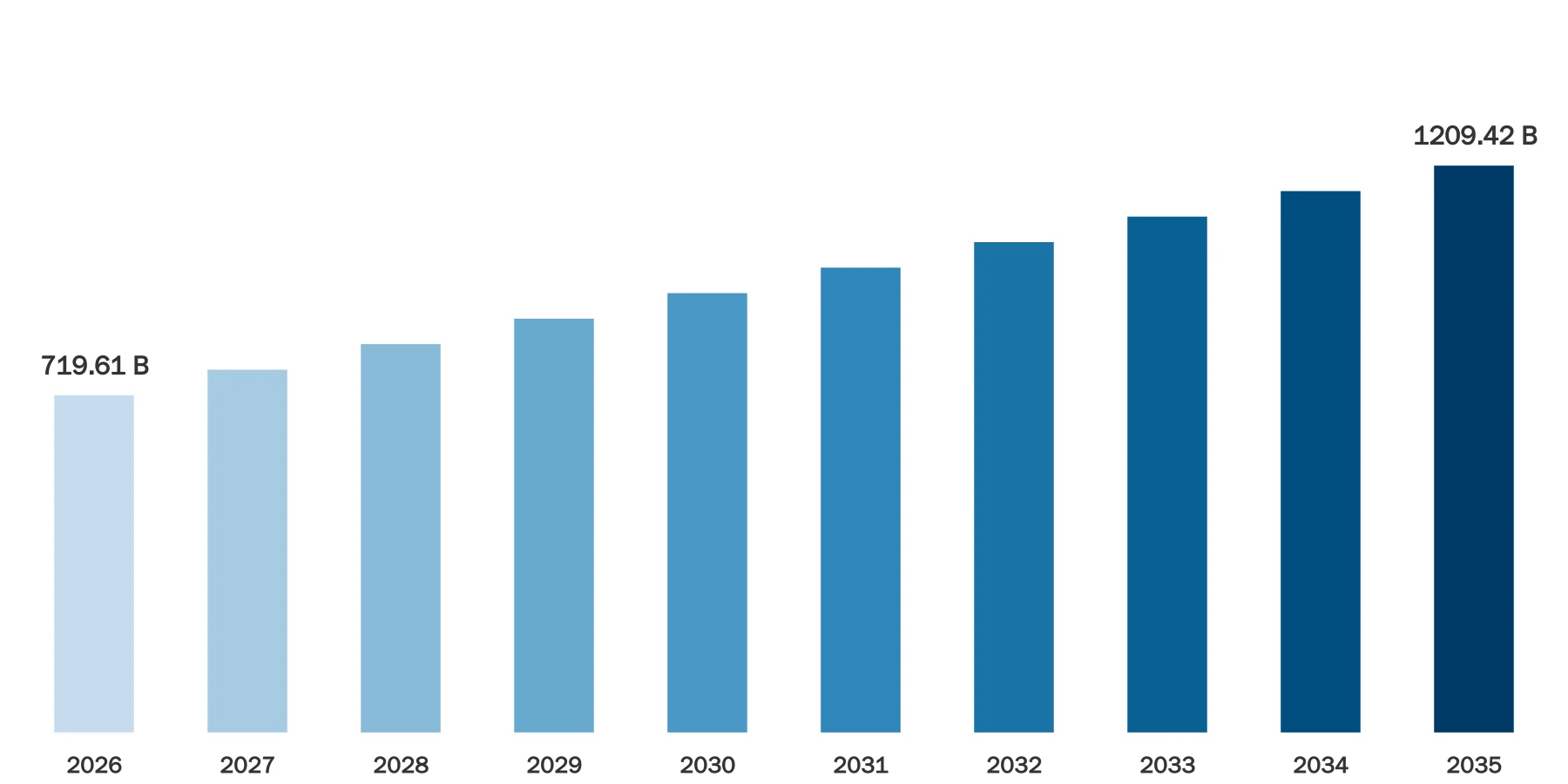
Source: Econ Market Research
The global medical devices market consists of sales of medical devices or equipment and related services by entities (organizations, sole traders, and partnerships) that manufacture medical equipment or devices that are used in the diagnosis, treatment, and monitoring of medical conditions. The medical device market includes establishments that manufacture medical equipment or devices such as in-vitro diagnostic devices, dental devices, diagnostic imaging equipment, dental equipment and supplies, ophthalmic devices, cardiovascular devices, hospital supplies, and other medical devices.
Market Growth
However, a data security threat may hamper the market growth for medical devices as an internet connection is required for transferring patient&rsquo,s data from remote devices to the physician. Hence, this increases the threat to data security. The rising trend for connected devices makes them attractive and thus increases the risk for data breaches or hacks. For instance, in March 2020, critical patient data, including medical questionnaires, copies of driving licences, passports, and national insurance numbers, were leaked for over 2,300 patients of Hammersmith Medicines Research.
The research firm was carrying out trials for the COVID-19 vaccine on these patients. Growth in the medical devices market during the historic period resulted from growth in the number of healthcare facilities, rapid growth in elderly population, economic growth in emerging markets, rapid technological advances, and increased healthcare expenditure. The market was restrained by low healthcare awareness and low healthcare reimbursements. Going forward, the increasing prevalence of chronic diseases, sudden emergence of severe infections will drive growth in the medical devices market. Factors that could hinder the growth of the market in the future include challenges due to regulatory changes, data security issues, and the COVID-19 pandemic.
COVID-19 Analysis
The COVID-19 (coronavirus) outbreak is disrupting supply chains all around the world, with the most aggravating effect on the medical device market. The COVID-19 pandemic has impacted the production scenario globally and changed the business environment for numerous organisations across the world. Most companies have extended their production capacity to meet the increasing demand for essential supplies of COVID-19, which has severely impacted the overall medical devices market around the world and directly influenced hospital capacities and the ability for patients to seek care for a number of diseases. According to the World Health Organization (WHO), during COVID-19, over 28.5 million elective surgeries across the world were cancelled, while 40% of global cancer surgeries were postponed. The coronavirus pandemic caused an unprecedented growth in the demand for medical products. The supply chain for COVID-19-relevant medical devices, such as Personal Protective Equipment (PPE), ventilators, testing supplies, and other equipment, was unprepared to satisfy higher demand.
SEGMENTATION
Type Insights
In Vitro Diagnostics (IVD) devices are used for the diagnosis of diseases or conditions that include an analysis of the state of health for the purpose of mitigating, curing, treating, or preventing disease. These devices are largely used to collect, prepare, and examine the specimen collected from the patient&rsquo,s body. Hence, the increasing prevalence of chronic disease and the need for precise and efficient testing kits for diseases such as malaria, HIV/AIDS, diabetes, and cancer boost the demand for IVD devices. For instance, in 2017, the World Health Organization (WHO) revealed that around 47% of new HIV cases were detected across the globe. In support of the above factors, the IVD segment accounted for a value share of nearly 14.5% in the year 2019. Furthermore, technological advancements in surgical robots, as well as their increasing use by healthcare providers, are expected to drive the Minimally Invasive Surgery (MIS) segment growth during the forecast period. However, the segments of orthopaedic and cardiovascular devices are anticipated to grow at a significant pace, owing to a globally increasing patient pool suffering from different cardiac-related and orthopaedic disorders.
End User Insights
Based on end-user, the market includes hospitals, ASCs, clinics, and others. The hospitals and ASCs segment held a dominant share in 2021 due to the increasing number of multispecialty and community hospitals, especially in emerging countries. Thus, the above factors and the growing emphasis of healthcare agencies and the government toward a routine diagnosis of patients and their timely treatment have resulted in raising awareness among the general population, thereby subsequently propelling the market',s growth during the forecast period.
In 2020, the hospitals and clinics market were the largest segment of the medical devices market segmented by end-user, accounting for 88.7% of the total. Going forward, the diagnostic centers segment is expected to be the fastest growing segment in the medical devices market segmented by end-user.
Competitive Analysis
The global medical devices market is highly fragmented owing to the presence of a large number of market players on a global as well as regional level. Among these companies, Medtronic captures the largest market share with a diverse product portfolio and strong brand name in the global market. Apart from this, most of the industry players invest prominently in research and development (R&,D) activities to develop new products and upgrade the existing product list. Furthermore, these market players largely focus on expanding their distributors across the globe, which allows companies to expand their product offerings.
Major Competitors in The Medical Devices Market Are:
Medtronic Plc
Johnson &, Johnson
Abbott Laboratories
Becton, Dickinson and Company
Siemens Healthineers AG
3M Company
Accord Medical Products Private Limited
Agappe Diagnostics Ltd
ARKRAY Healthcare Pvt. Ltd
B. Braun Medical Inc.
Baxter Healthcare
Beckman Coulter
Boston Scientific
Canon Medical Systems Corporation
Regional Analysis
North America captured the largest revenue share in 2021 and is anticipated to continue its dominance over the upcoming years. The significant growth of the region is primarily because of its developed healthcare infrastructure and the rising concern for a healthy life. The United States is the dominant country in North America, and rapid adoption of new and advanced medical technologies for enhancing the diagnosis and treatment procedures of critical diseases is likely to impel market growth in the region.
The market in Europe is anticipated to register a significant CAGR, owing to increasing healthcare expenditure, well-established infrastructure, and the increasing adoption of advanced diagnostic and treatment devices. A strong focus on a shift of medical care into home care settings and the introduction of portable medical device equipment by leading global and domestic players in the region are expected to drive the growth of the market during the forecast period.
Asia Pacific is expected to grow at a comparatively higher CAGR due to the increasing prevalence of diseases, such as cardiovascular disorders, diabetes, infectious diseases, and dental disorders, along with the increasing focus of market players to expand their direct presence in emerging countries, including China and India, and fulfil the demand of patients in this region.
Recent Developments
In February 2022, Siemens Healthineers and Universal Medical Imaging (China) reached an agreement to promote 5G remote imaging diagnosis for primary care in China, asia regions.
In May 2022, BD launched a fully automatic, high-throughput infectious disease molecular diagnostic platform, the BD Cor System, in the US.
In November 2021, Siemens Healthineers introduced Magnetom Free Star, a cost-effective whole-body MRI scanner, designed to enable significantly better access to Magnetic Resonance Imaging.
Medical Devices Market Report Scope & Segmentation
| Attributes | Details |
|---|---|
Market Size (Current) | US$ 719.61 Billion in 2026 |
Market Size (Forecast) | US$ 1209.42 Billion in 2035 |
Growth Rate | CAGR of 5.94% from 2026 to 2035 |
Forecast Period | 2026 – 2035 |
Base Year | 2025 |
Historical Data Available | Yes |
Regional Scope | Global |
Segments Covered | By Product Type
By Device Class
By Application
By End User
By Technology
By Distribution Channel
|
Frequently Asked Questions
Common questions about this report
The study period covers historical insights and forecast projections for the period 2026-2035.
About the Author
Market research expert with years of industry experience

Dipali Bhingare serves as the Market Research Director at Econ Market Research. With a focus on translating complex global economic shifts into actionable business intelligence, she oversees the strategic direction of comprehensive market studies. Her work empowers organizations to navigate volatile industries through data-driven forecasting and deep-dive competitive analysis.
Related Reports
Explore more market insights from the same category