

Internet of Medical Things (IoMT) Market Overview
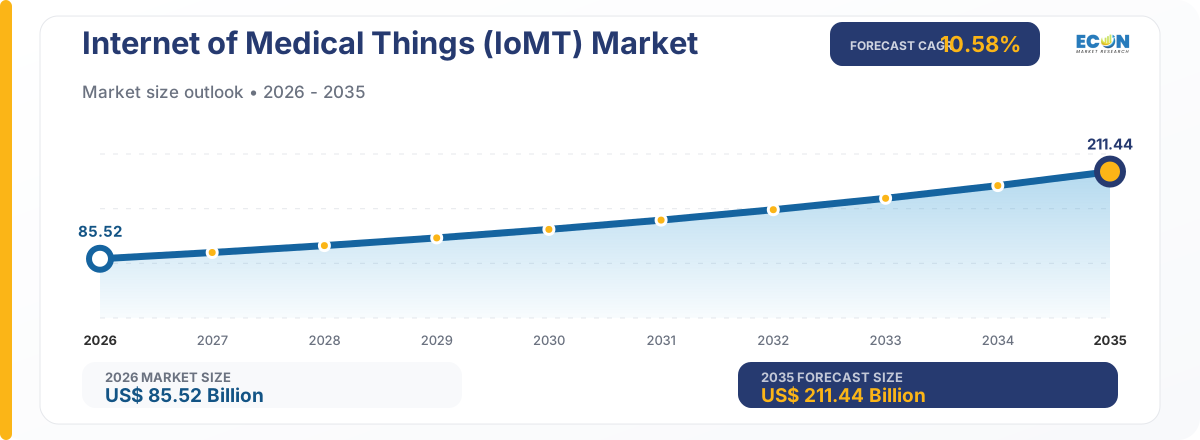
As per Econ Market Research analysis, the Global Internet of Medical Things (IoMT) Market generated revenue of US$ 85.52 Billion in 2026 and is forecast to achieve US$ 211.44 Billion by 2035, at a CAGR of 10.58% during the study period 2026–2035. The base year considered is 2025.
The internet of medical things (IoMT) is a network of several Medical Devices that are connected to a network or to each other and exchange health data without the need for human-to-machine interaction. Because these systems and devices are linked to the internet, remote patient monitoring and diagnosis are possible. Furthermore, the benefits of IoMT include better understanding patient health and providing value-based care to patients, which benefits patients, payers, and providers.
Market Dynamics
Market drivers
Internet of Medical things dramatically lowers patient costs, which eases the financial strain of healthcare on both patients and government. The partnership between IoMT and MedTech firm benefits healthcare organisations by enabling them to achieve better results, increase efficiency, and provide patients with cutting-edge care.
Market expansion is being driven by technological advancement and improved access to personal healthcare. Because of rising demand for linked instruments in the healthcare business, the global Internet of Medical Things (IoMT) market is expected to grow. Furthermore, the growing use of wearable or independent devices for monitoring patients, sensor-based technologies, and asset management is likely to boost market expansion during the projection period.
Market Restraints
One of the factors hindering the market',s growth is a shortage of experts in IoT technology. Additionally, it is anticipated that the hospital and medical sectors', lack of infrastructure facilities and qualified specialists that will restrain market growth.
Market Opportunities
The benefits of IoMT devices in the healthcare sector include real-time monitoring, improved drug management, improved patient outcomes, and decreased medical expenses. As a result, the bulk of these gadgets are used in hospitals and clinics. The market is anticipated to grow faster as a result of these technologies', continuing advancements and the expanding healthcare industries.
Segments Analysis
Application Insights
By application the market is segmented into telemedicine, pharmaceutical management, patient monitoring, and other applications. Among them, the Telemedicine market is the leading market in terms of application, as in today&rsquo,s fast-paced world, it can be difficult to find time for self-care. This is especially true for people with busy schedule and/or childcare responsibilities. Visiting a doctor in person can be time consuming, which can make it even harder to prioritize self-care.
Telemedicine is a convenient solution that can help people get the care they need without having to leave their homes. With telemedicine patient can video chat with a doctor from comfort of their own house. This can save time and hassle, and it can also make it easier to find time for self-care.&emsp,
End User Insights
Healthcare providers, patients, government agencies, and others comprise the end-use segment for IoMT market. The healthcare providers sector is expected to be the market leader by the end of the forecast period. The dominance of this segment is attributed primarily to the adoption of IoT-based medical devices such as linked medical technology devices, monitors, implanted medical devices, and monitoring medical devices in order to deliver better treatment to patients. Furthermore, the use of telehealth-based solutions by doctors and clinicians for patient management and virtual help is fuelling the segment',s demand. Thus, telemedicine tools have lowered the pressure on hospitals, and it has also helped reduce the danger of infections during the epidemic.
Technology Landscape
The IoMT technology landscape is rapidly developing, with new devices and apps appearing on a regular basis. Some of the important technologies driving IoMT growth include:
Wearable gadgets for gathering health data, such as smartwatches and fitness trackers, are becoming more popular.
Remote patient monitoring (RPM) systems allow healthcare providers to monitor patients remotely by using data collected from wearable devices and other sensors.
Artificial Intelligence (AI): AI is being used to develop novel IoMT applications such as AI-powered diagnostics and predictive analytics.
Geography Analysis
The Internet of medical things [IoMT] market is likely to be dominated by North America. The well-established healthcare infrastructure and IT industry, increasing demand for better patient outcomes, increased R&,D expenditure, and technological advancements have all contribute to the growth of the Internet of medical things [IoMT] market in North America. Furthermore, the growing awareness of technological advancements in IoMT devices, as well as the high prevalence of chronic disease, are projected to boost market expansion in this region.
The second-most prominent region in terms of market share is predicted to be Europe. One of the key factors driving the market',s growth in Europe is the improvement of government initiatives to incorporate cutting-edge technology to accelerate the adoption of IoMT products.
The Asia Pacific market is expected to grow at the fastest CAGR, with increasing healthcare spending and a pool of opportunities for company expansion playing a significant role in the region',s faster growth. Furthermore, significant support from governments for the launch and approval of the internet of medical things devices in Asian countries will assist in increasing revenue in the region.
Competitive Landscape
The Internet of Medical Things (IoMT) market',s competitive landscape is described as fragmented. Because of the broad nature of IoMT technologies and applications, there are several players working in various market sectors. Medical device makers, technology businesses, software developers, and healthcare providers are the different stakeholders involved in the market.
While there are larger businesses and industry leaders that control specific segments of the IoMT market, the general landscape remains fragmented, with multiple companies contending for market dominance and establishing themselves as significant competitors in their particular niches. Within the IoMT ecosystem, fragmentation creates chances for collaboration, partnerships, and particular expertise.
Key Market Players
Siemens
General Electric
Biotronik SE & Co.
Medtronic
Boston Scientific Corporation
Hill-Rom Services, Inc.
Neurometrix, Inc.
Honeywell International Inc.
VitaConnect, EKso Bionics
BL Healthcare, Inc.
Koninklijke Philips N.V.
Lenovo
AliveCor, Inc.
Regulatory Environment
The Internet of Medical Things (IoMT) market operates in a complicated and changing regulatory frame work. To assure patient safety, data privacy, and security, regulatory agencies worldwide are aggressively tackling the special issues provided by IoMT technology.
For example, as part of the Federal Food, Drug, and Cosmetic Act, the FDA announced a new Cyber Security strategy for medical devices on March 29, 2023. Medical devices classified as "cyber devices" must now meet certain cybersecurity standards, such as post-market monitoring, vulnerability remediation, and the provision of updates and patches. The FDA can reject submissions that do not fulfil these conditions under the "Refuse to Accept" policy.
Internet of Medical Things (IoMT) Market Report Scope & Segmentation
| Attributes | Details |
|---|---|
Market Size (Current) | US$ 85.52 Billion in 2026 |
Market Size (Forecast) | US$ 211.44 Billion in 2035 |
Growth Rate | CAGR of 10.58% from 2026 to 2035 |
Forecast Period | 2026 – 2035 |
Base Year | 2025 |
Historical Data Available | Yes |
Regional Scope | Global |
Segments Covered | By Component
By Application
By End-User
|
Frequently Asked Questions
Common questions about this report
The study period covers historical insights and forecast projections for the period 2026-2035.
About the Author
Market research expert with years of industry experience

Dipali Bhingare serves as the Market Research Director at Econ Market Research. With a focus on translating complex global economic shifts into actionable business intelligence, she oversees the strategic direction of comprehensive market studies. Her work empowers organizations to navigate volatile industries through data-driven forecasting and deep-dive competitive analysis.
Related Reports
Explore more market insights from the same category