

Edge AI Market
Edge AI Market Size, Share, Trends, Growth, and Industry Analysis, By Component (Hardware, Software, Edge Cloud Infrastructure, Services), By Deployment Type (On-Premises, Cloud-Based), By End Use (Consumer Electronics, Smart Cities, Manufacturing, Automotive, Government, Healthcare, IT & Telecom, Energy, Retail, Others), Regional Analysis and Forecast Period 2026-2035
Edge AI Market Overview
As per Econ Market Research analysis, Global Edge AI Market size stood at US$ 30.32 Billion in 2026 and is projected to reach US$ 177.68 Billion by 2035, growing at a CAGR of 21.71% over the forecast period 2026–2035. 2025 is taken as the base year.
Edge AI Market Size 2025-2035 (USD Billion)

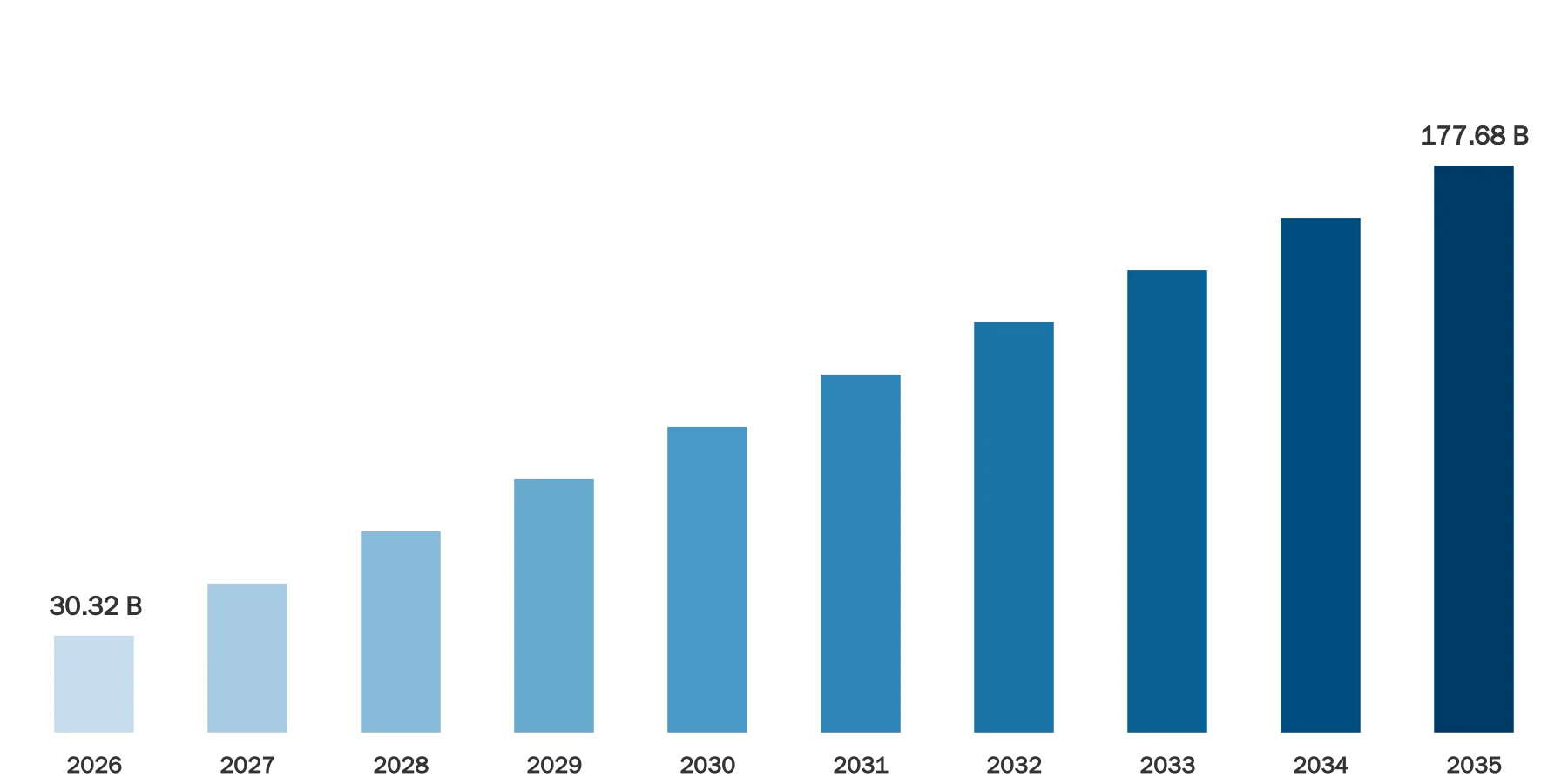
Source: Econ Market Research
The Edge AI Market is expanding rapidly due to the deployment of over 17.2 billion connected IoT devices worldwide in 2025. More than 62% of industrial enterprises now process operational data at the edge instead of centralized cloud environments. Around 75% of enterprise-generated data is expected to be created and processed outside traditional data centers by 2026. Edge AI Market Trends indicate that over 2.3 billion edge AI-enabled devices shipped globally during 2024, including 1.2 billion smartphones and 420 million industrial IoT sensors. AI PCs accounted for 14% of global PC shipments during Q2 2024, while AI-enabled surveillance systems crossed 210 million installed units globally.
The USA Edge AI Market represents a major portion of global deployment activity, supported by more than 5,300 hyperscale data centers and over 46 million smart homes using AI-enabled edge devices. Around 68% of U.S. manufacturing facilities implemented edge analytics systems in 2024. More than 38 million AI-enabled security cameras were installed across U.S. commercial infrastructure by the end of 2025. Edge AI Market Analysis shows that nearly 58% of U.S. telecom operators are integrating edge AI into 5G network optimization. AI PC adoption in the United States exceeded 19 million units in 2024, while autonomous vehicle testing surpassed 42 states using edge inference systems for real-time navigation and safety operations.
The European Edge AI Market is supported by over 340 smart city programs and approximately 31 million industrial IoT deployments. Germany, France, and the UK collectively account for more than 57% of regional edge AI infrastructure implementation. Around 48% of European automotive manufacturers use edge AI for Predictive Maintenance and ADAS systems. Europe deployed over 12 million AI-powered smart surveillance units in 2024. The region also recorded more than 9.8 million AI-enabled industrial robots integrated with edge computing frameworks. Edge AI Industry Analysis indicates that over 44% of healthcare providers across Europe utilize edge AI diagnostics for imaging and remote monitoring applications. European semiconductor companies introduced more than 120 new low-power AI chipsets between 2023 and 2025.
Edge AI Market Latest Trends
The Edge AI Market Report highlights rapid adoption of on-device intelligence across consumer electronics, manufacturing, automotive, and telecom sectors. Global shipments of AI PCs and generative AI smartphones reached nearly 295 million units during 2024, compared with 29 million units in 2023. AI smartphones represented 22% of premium smartphone shipments globally, while AI PCs accounted for 22% of overall PC shipments. More than 130 million AI-enabled PCs are expected to enter enterprise operations by 2026.
Edge AI Market Trends show increasing integration of neural processing units into processors. Consumer devices held approximately 84.2% share of edge AI chipset deployments in 2024. CPUs accounted for 63.7% of chipset utilization due to broad compatibility with inference applications. NVIDIA’s Jetson AGX Thor platform introduced processing capability exceeding 2,070 FP4 TFLOPS with 3.5 times greater energy efficiency than previous models.
Industrial Automation is another major trend in the Edge AI Industry Report. More than 420 million industrial IoT sensors with AI capability were deployed globally in 2024. Smart factories using edge AI reduced predictive maintenance downtime by nearly 37%. Around 59% of logistics facilities now use AI-enabled edge cameras and robotics for inventory tracking and warehouse automation. Autonomous retail systems surpassed 11,000 deployments globally during 2025.
Telecom and 5G integration continue to reshape the Edge AI Market Outlook. Over 70 telecom operators globally launched multi-access edge computing services by 2025. More than 52% of network operators implemented AI-driven traffic optimization at edge locations. Healthcare adoption also accelerated, with approximately 80 million AI-enabled medical edge devices used for remote diagnostics and patient monitoring in 2025.
Edge AI Market Dynamics
The Edge AI Market Growth trajectory is supported by increasing deployment of IoT infrastructure, rising demand for real-time analytics, and the expansion of AI-enabled consumer devices. More than 75% of enterprise data processing is shifting toward decentralized environments. Edge AI Market Insights indicate that latency reduction of up to 60% can be achieved through local processing compared with centralized cloud systems. Over 2.6 billion edge AI devices are projected to operate globally by 2025. Industrial enterprises deploying edge AI reported operational efficiency improvements ranging from 20% to 35%, particularly in predictive maintenance and process optimization.
DRIVER
Increasing Adoption of IoT and Smart Devices
The primary driver in the Edge AI Market is the rapid expansion of IoT ecosystems and smart devices. More than 17 billion connected devices are operational worldwide, and approximately 420 million industrial IoT sensors now include embedded AI acceleration capabilities. Smart home installations surpassed 400 million units globally during 2025, with AI-enabled voice assistants and cameras accounting for nearly 63% of deployments. Automotive manufacturers installed edge AI processors in over 180 million vehicle systems during 2024 for ADAS, predictive diagnostics, and driver monitoring. Manufacturing plants deploying edge AI achieved response latency reductions of 45% and lowered bandwidth utilization by nearly 50%. AI-enabled cameras process up to 95% of visual data locally without requiring cloud transmission, significantly improving operational speed and privacy compliance.
RESTRAINT
High Hardware and Infrastructure Complexity
The Edge AI Industry Analysis identifies infrastructure complexity and hardware limitations as major restraints. Edge AI devices require dedicated NPUs, GPUs, ASICs, or TPUs, increasing deployment complexity in enterprise environments. Around 43% of organizations reported interoperability issues between edge hardware and cloud-based AI platforms in 2024. AI PCs with advanced NPUs remain priced 20% to 35% above conventional systems, slowing mass adoption in emerging markets. Industrial edge systems often require power efficiency below 10 watts while maintaining inference speeds exceeding 200 TOPS, creating engineering challenges. More than 38% of enterprises cite cybersecurity concerns related to distributed AI processing systems. Additionally, edge deployments across remote facilities face connectivity and maintenance issues, particularly in regions with internet penetration below 60%.
OPPORTUNITY
Expansion of Autonomous and Real-Time Applications
The Edge AI Market Opportunities are expanding rapidly in autonomous mobility, healthcare diagnostics, and smart manufacturing. More than 230 million automotive AI units are expected to be integrated into advanced vehicles due to mandatory ADAS regulations. Smart city deployments are projected to add over 150 million edge AI surveillance and traffic management systems. Hospitals implementing AI-powered imaging at edge nodes reduced diagnostic processing time by approximately 35%. Retailers using edge AI analytics improved customer tracking accuracy by nearly 40% while reducing cloud bandwidth usage by 50%. Industrial robotics equipped with edge AI processors surpassed 9.8 million operational units in Europe alone. Telecom companies integrating edge AI into private 5G infrastructure improved network resource allocation efficiency by 27%.
CHALLENGES
Data Security and Standardization Issues
The Edge AI Market faces significant challenges related to cybersecurity, data privacy, and standardization. Approximately 61% of organizations deploying edge AI identified endpoint security as a critical concern in 2025. Distributed AI systems increase vulnerability exposure because enterprises manage thousands of decentralized nodes simultaneously. Around 29% of industrial edge devices still lack hardware-level encryption support. Standardization remains fragmented across AI accelerators, operating systems, and networking protocols. More than 120 different AI edge chipset architectures are currently available, creating compatibility issues for developers. Edge AI workloads often require response latency below 10 milliseconds, but inconsistent network quality affects performance in remote locations. Additionally, energy-efficient processing remains challenging, as advanced AI models can consume 5 to 20 watts per device depending on workload complexity.
SWOT Analysis
Strengths
Edge AI reduces data latency by up to 60% through local processing near data sources.
More than 2.3 billion edge AI-enabled devices shipped globally during 2024.
AI-enabled surveillance systems exceeded 210 million installed units worldwide.
Approximately 75% of enterprise-generated data is expected to be processed outside centralized cloud environments by 2026.
AI PCs represented 14% of PC shipments during Q2 2024.
Weaknesses
Around 43% of enterprises face interoperability issues between edge AI platforms and legacy systems.
AI-enabled PCs remain priced 20% to 35% higher than traditional PCs.
Nearly 29% of industrial edge devices lack hardware-level encryption.
High-performance AI edge chipsets require thermal management below 10 watts in compact environments.
Over 38% of enterprises report cybersecurity concerns in distributed edge networks.
Opportunities
Smart city projects are expected to deploy over 150 million edge AI systems globally.
AI-enabled medical monitoring devices are projected to exceed 80 million units.
Autonomous automotive systems added approximately 180 million AI processing units in 2024.
More than 70 telecom operators launched edge AI-enabled 5G services.
Industrial automation facilities reduced downtime by nearly 37% using predictive edge analytics.
Threats
More than 120 edge chipset architectures create standardization challenges.
Distributed edge systems increase cybersecurity attack surfaces across thousands of endpoints.
Rising semiconductor shortages impact AI accelerator supply chains.
Approximately 34% of enterprises report difficulty scaling edge AI infrastructure globally.
High energy consumption from large AI models limits adoption in battery-powered devices.
Segmentation Analysis
The Edge AI Market Size continues to expand across hardware, software, deployment models, and end-use sectors. Hardware remains dominant because of rising adoption of AI accelerators, NPUs, and AI-enabled processors. Cloud-based deployment is increasing due to hybrid AI architectures integrating edge and cloud computing. Consumer electronics, manufacturing, and automotive sectors collectively account for more than 65% of edge AI deployments globally. AI-enabled industrial systems reduced latency by approximately 45%, while cloud-edge hybrid systems lowered bandwidth consumption by nearly 50%. Healthcare and retail sectors also experienced accelerated adoption due to real-time analytics and privacy-focused AI processing.
By Component
By Component, the Edge AI Market is segmented into Hardware, Software, Edge Cloud Infrastructure, and Services. Hardware accounted for approximately 46% of deployment volume in 2024 because of strong demand for AI accelerators, GPUs, CPUs, ASICs, and TPUs. CPUs represented 63.7% of edge AI chipset usage due to broad enterprise compatibility. AI-enabled processors with integrated NPUs surpassed 130 million shipments globally.
Software accounted for nearly 28% of deployments, driven by edge inference platforms, AI orchestration tools, and real-time analytics frameworks. More than 58% of enterprises implemented AI inference optimization software in industrial applications. Edge cloud infrastructure represented around 17% of market installations, particularly in telecom and 5G edge computing environments. Over 70 telecom operators globally launched edge cloud services integrating AI analytics.
Services contributed approximately 9% of the Edge AI Market Share, supported by consulting, deployment, and maintenance operations. Around 48% of enterprises outsourced AI edge integration services due to hardware complexity and cybersecurity requirements.
By Deployment Type
By Deployment Type, the Edge AI Market is segmented into On-Premises and Cloud-Based systems. On-premises deployment accounted for approximately 61% of installations in 2024 because industries prioritize low latency and data security. Manufacturing plants, Autonomous Vehicles, and healthcare systems prefer local AI processing with response latency below 10 milliseconds. More than 68% of industrial organizations implemented localized edge infrastructure for predictive maintenance and process optimization.
Cloud-based deployment represented nearly 39% of the Edge AI Industry Share due to scalability and hybrid cloud-edge integration. Enterprises deploying cloud-based edge AI reduced operational bandwidth usage by approximately 50%. Telecom operators increasingly utilize cloud-edge orchestration for network optimization, supporting over 52% of 5G traffic management applications globally.
Hybrid deployment architectures are growing significantly, especially in smart cities and retail analytics. More than 11,000 autonomous retail systems use cloud-edge hybrid AI frameworks for customer tracking, inventory management, and fraud prevention. Cloud-based deployment also supports remote software updates across millions of distributed AI endpoints.
By End Use
By End Use, the Edge AI Market includes Consumer Electronics, Smart Cities, Manufacturing, Automotive, Government, Healthcare, IT & Telecom, Energy, Retail, and Others. Consumer electronics dominated with approximately 34% market share because of AI smartphones, smart speakers, wearables, and AI PCs. Global shipments of AI-enabled smartphones exceeded 240 million units in 2024.
Manufacturing represented around 18% of deployments due to predictive maintenance and industrial automation. Over 420 million industrial IoT sensors integrated edge AI analytics during 2024. Automotive accounted for approximately 14% of installations, supported by 180 million AI-enabled vehicle systems used in ADAS and autonomous navigation.
Healthcare contributed nearly 9% of deployments, driven by AI-enabled remote monitoring devices and diagnostic imaging systems. IT & Telecom represented about 11% share due to 5G edge infrastructure and network optimization. Retail applications increased rapidly, with smart checkout and customer analytics systems deployed in over 11,000 locations globally. Smart city projects also accelerated, adding millions of surveillance and traffic management systems using edge AI analytics.
Regional Analysis
North America leads the Edge AI Market with strong AI infrastructure, semiconductor innovation, and enterprise adoption.
Europe focuses on industrial automation, automotive AI integration, and privacy-centric edge computing.
Asia-Pacific dominates consumer electronics manufacturing and large-scale smart city implementation.
Middle East & Africa show increasing adoption in telecom, smart infrastructure, and energy management sectors.
North America
North America accounted for approximately 37% of the global Edge AI Market Share in 2025. The region hosts more than 5,300 hyperscale data centers and over 46 million smart homes using AI-enabled edge devices. The United States dominates regional demand with nearly 68% of manufacturing facilities deploying edge analytics systems. AI PC shipments in North America exceeded 19 million units during 2024.
The automotive sector remains a major contributor, with autonomous testing programs active in over 42 U.S. states. More than 38 million AI-enabled surveillance cameras operate across commercial facilities in the region. Telecom companies expanded edge AI integration into private 5G networks, with over 58% of operators using AI-driven traffic optimization. North America also leads in semiconductor innovation, introducing more than 75 new AI accelerator models between 2023 and 2025.
Healthcare adoption accelerated significantly, with approximately 21 million remote monitoring devices using edge AI diagnostics. Smart retail infrastructure expanded rapidly across the region, with AI-powered checkout systems reducing transaction processing time by nearly 35%.
Europe
Europe represented approximately 27% of the global Edge AI Market Size in 2025. Germany, France, and the UK collectively account for over 57% of regional deployments. More than 340 smart city projects across Europe use edge AI systems for traffic management, surveillance, and environmental monitoring.
The automotive industry remains a dominant sector, with nearly 48% of European vehicle manufacturers integrating edge AI into ADAS and predictive maintenance systems. Europe deployed over 12 million AI-powered surveillance units during 2024. Industrial robotics installations exceeded 9.8 million units integrated with edge inference systems.
European healthcare providers accelerated AI adoption, with around 44% using edge AI imaging systems for diagnostics and remote patient monitoring. Semiconductor manufacturers in Europe introduced more than 120 low-power AI chipsets optimized for industrial and automotive applications. The region also maintains strong privacy regulations, encouraging local AI processing instead of centralized cloud storage.
Telecom companies across Europe launched over 30 edge-enabled 5G infrastructure projects supporting ultra-low-latency applications. Manufacturing facilities using edge AI achieved operational downtime reductions of approximately 33%.
Asia-Pacific
Asia-Pacific accounted for approximately 29% of the global Edge AI Industry Share due to extensive electronics manufacturing and smart city expansion. China, Japan, South Korea, and India remain primary contributors. The region produced over 65% of global AI smartphones and consumer electronics during 2024.
More than 1.2 billion AI-enabled smartphones shipped globally, with Asia-Pacific contributing the majority of manufacturing volume. Smart city initiatives across China and India deployed millions of AI-enabled traffic monitoring systems and surveillance cameras. Industrial automation expanded significantly, with factories in Japan and South Korea integrating over 140 million edge AI-enabled IoT sensors.
Asia-Pacific automotive manufacturers deployed approximately 72 million AI vehicle systems in 2024. Telecom operators accelerated private 5G rollout, with over 40 large-scale edge AI telecom projects launched across the region. India experienced rapid adoption in healthcare AI diagnostics, while Japan led robotics integration with advanced edge inference systems.
Consumer electronics remained the largest segment, representing over 40% of regional edge AI deployments. AI-enabled smart appliances, wearables, and gaming devices continue to drive demand for low-power AI chipsets.
Middle East & Africa
The Middle East & Africa Edge AI Market Outlook is expanding due to increasing smart city investments and telecom modernization. The region accounted for approximately 7% of global deployment activity during 2025. Gulf countries launched more than 25 smart infrastructure projects integrating edge AI surveillance and traffic systems.
Telecom operators across the Middle East accelerated 5G deployment, with over 18 edge computing hubs established for low-latency applications. Smart energy infrastructure using edge AI analytics improved operational monitoring efficiency by approximately 28%. AI-powered security systems exceeded 4 million installed units across airports, ports, and urban infrastructure.
Healthcare adoption increased steadily, particularly in remote diagnostics and AI-powered medical imaging. African telecom providers deployed AI-enabled edge systems to improve rural connectivity and reduce network congestion. Manufacturing adoption remains moderate but is growing in mining, oil, and industrial sectors.
Retail analytics and smart payment infrastructure also expanded rapidly in urban centers. More than 11 large-scale AI infrastructure projects were launched across the UAE and Saudi Arabia between 2023 and 2025. Government-led digital transformation initiatives continue to support regional Edge AI Market Growth.

Competitive Landscape
The Edge AI Market is highly competitive, characterized by semiconductor manufacturers, cloud infrastructure providers, AI software developers, and industrial automation companies. Major companies focus on AI accelerators, low-power chipsets, hybrid cloud-edge integration, and real-time analytics platforms. More than 120 edge AI chipset architectures were introduced globally between 2023 and 2025. AI-enabled processors with integrated NPUs exceeded 130 million shipments in 2024.
Competition intensified in AI PCs, where AI-capable systems represented 14% of total PC shipments during Q2 2024. Apple held approximately 60% share of the AI PC segment due to integrated M-series processors. Semiconductor companies are prioritizing power-efficient AI processing below 10 watts for compact devices.
Cloud and telecom providers are expanding edge AI services through 5G infrastructure. More than 70 telecom operators launched edge computing platforms integrated with AI inference systems. Industrial automation vendors are also increasing investments in predictive maintenance and robotics solutions using edge inference. Companies developing AI-enabled surveillance systems and autonomous vehicle platforms continue to expand deployments globally.
Strategic collaborations remain common, especially between semiconductor manufacturers, telecom operators, and cloud providers. Partnerships focus on reducing inference latency below 10 milliseconds while supporting billions of connected devices worldwide.
List of Top Edge AI Companies
ADLINK Technology Inc.
Gorilla Technology Group
Intel Corporation
IBM Corporation
Alphabet Inc.
Amazon.com, Inc.
Microsoft Corporation
Nutanix, Inc.
Synaptics Incorporated
Leading Companies by Market Share
Intel Corporation holds one of the highest Edge AI Market Shares due to widespread deployment of AI PCs, industrial processors, and edge inference hardware. Intel-powered AI PCs are projected to exceed 130 million units globally by 2026.
Alphabet Inc. maintains strong market presence through AI smartphones, Tensor Processing Units, and edge AI software ecosystems integrated across billions of Android devices globally.
Market Investment Outlook
The Edge AI Market Forecast indicates strong investment momentum across semiconductors, telecom infrastructure, industrial automation, and AI software platforms. More than 70 telecom operators globally invested in edge-enabled 5G infrastructure between 2023 and 2025. Semiconductor manufacturers launched over 120 AI chipset architectures optimized for low-power inference and real-time analytics.
Industrial automation remains a key investment area, with manufacturers deploying over 420 million AI-enabled IoT sensors worldwide. Smart city projects contributed significantly, adding approximately 150 million surveillance and traffic management devices integrated with edge analytics. Governments in North America, Europe, and Asia-Pacific expanded investments in AI infrastructure supporting transportation, defense, and healthcare systems.
Healthcare providers increased investment in AI-enabled diagnostic systems and remote monitoring devices, with approximately 80 million medical edge devices projected for deployment. Retail companies accelerated investment in autonomous checkout systems, inventory monitoring, and customer analytics platforms. Automotive manufacturers also expanded investments in autonomous systems, integrating edge AI into more than 180 million vehicle platforms.
Enterprise investment increasingly focuses on reducing cloud dependency, lowering bandwidth costs by up to 50%, and improving response latency below 10 milliseconds through decentralized AI processing.
New Product Development
New product development in the Edge AI Market focuses on low-power AI accelerators, AI PCs, AI smartphones, and industrial edge inference systems. Semiconductor companies introduced advanced NPUs capable of delivering more than 200 TOPS while operating below 10 watts. NVIDIA’s Jetson AGX Thor platform reached processing capability above 2,070 FP4 TFLOPS with 3.5 times greater energy efficiency than previous systems.
STMicroelectronics launched the STM32N6 edge AI microcontroller series optimized for local image and audio processing in industrial and consumer electronics. The new architecture significantly reduces cloud dependence while lowering electricity consumption.
AI PC development accelerated rapidly, with AI-capable PCs projected to represent 55% of total PC shipments by 2026. AI smartphones equipped with local generative AI capabilities exceeded 240 million shipments in 2024.
Automotive companies introduced edge AI systems supporting advanced driver monitoring and predictive diagnostics. Healthcare technology providers developed AI-enabled portable imaging systems capable of real-time diagnostics without cloud connectivity. Industrial automation companies also released next-generation AI-enabled robotics platforms integrated with edge analytics for predictive maintenance and process optimization.
Recent Developments
In 2024, global shipments of AI PCs and generative AI smartphones reached 295 million units, compared with 29 million units in 2023.
In 2024, AI PCs represented 14% of worldwide PC shipments, with Apple controlling approximately 60% of the AI PC segment.
In 2024, STMicroelectronics launched the STM32N6 edge AI microcontroller series for low-power industrial and consumer AI applications.
In 2025, global edge AI device shipments reached approximately 2.6 billion units, including 230 million automotive AI systems and 150 million smart city devices.
Between 2024 and 2025, more than 70 telecom operators launched AI-enabled edge computing services integrated with private 5G infrastructure.
Report Coverage of Edge AI Market
The Edge AI Market Research Report provides extensive analysis of hardware platforms, AI accelerators, deployment models, and industry adoption trends across global regions. The report covers AI-enabled processors, NPUs, GPUs, ASICs, TPUs, and edge cloud infrastructure supporting real-time analytics and decentralized AI processing.
The study evaluates deployment across consumer electronics, manufacturing, automotive, healthcare, telecom, retail, government, and energy sectors. More than 2.3 billion edge AI-enabled devices shipped globally in 2024 are included within the report scope. The report analyzes AI PC adoption, AI smartphone integration, industrial IoT deployment, and edge-enabled 5G infrastructure.
Regional coverage includes North America, Europe, Asia-Pacific, and Middle East & Africa with detailed insights into smart city expansion, autonomous vehicle integration, industrial robotics, and healthcare AI diagnostics. The report also profiles leading semiconductor manufacturers, cloud providers, and AI software companies operating in the industry.
Additionally, the report examines cybersecurity challenges, interoperability issues, power-efficient AI processing, and edge-cloud hybrid architectures. The analysis includes over 120 AI chipset architectures, millions of AI-enabled surveillance systems, and enterprise adoption metrics across multiple sectors.
Edge AI Market Report Scope & Segmentation
| Attributes | Details |
|---|---|
Market Size (Current) | US$ 30.32 Billion in 2026 |
Market Size (Forecast) | US$ 177.68 Billion in 2035 |
Growth Rate | CAGR of 21.71% from 2026 to 2035 |
Forecast Period | 2026 – 2035 |
Base Year | 2025 |
Historical Data Available | Yes |
Regional Scope | Global |
Segments Covered | By Component
By Deployment Type
By End Use
|
Frequently Asked Questions
Common questions about this report
The study period covers historical insights and forecast projections for the period 2026-2035.
About the Author
Market research expert with years of industry experience

Related Reports
Explore more market insights from the same category