

Computer Vision Market
Computer Vision Market Size, Share, Trends, Growth, and Industry Analysis, By Component (Hardware, Software), By Product Type (Smart Camera-Based Computer Vision Systems, PC-Based Computer Vision Systems), By Application (Quality Assurance & Inspection, Positioning & Guidance, Measurement, Identification, Predictive Maintenance, 3D Visualization & Interactive 3D Modelling), By Vertical (Industrial, Non-Industrial), Regional Analysis and Forecast Period 2026-2035
Computer Vision Market Overview
As per Econ Market Research analysis, the Global Computer Vision Market valuation stood at US$ 28.49 Billion in 2026 and is expected to reach US$ 145.92 Billion by 2035, growing at a steady CAGR of 19.9% from 2026 to 2035. 2025 serves as the base year.
Computer Vision Market Size 2025-2035 (USD Billion)

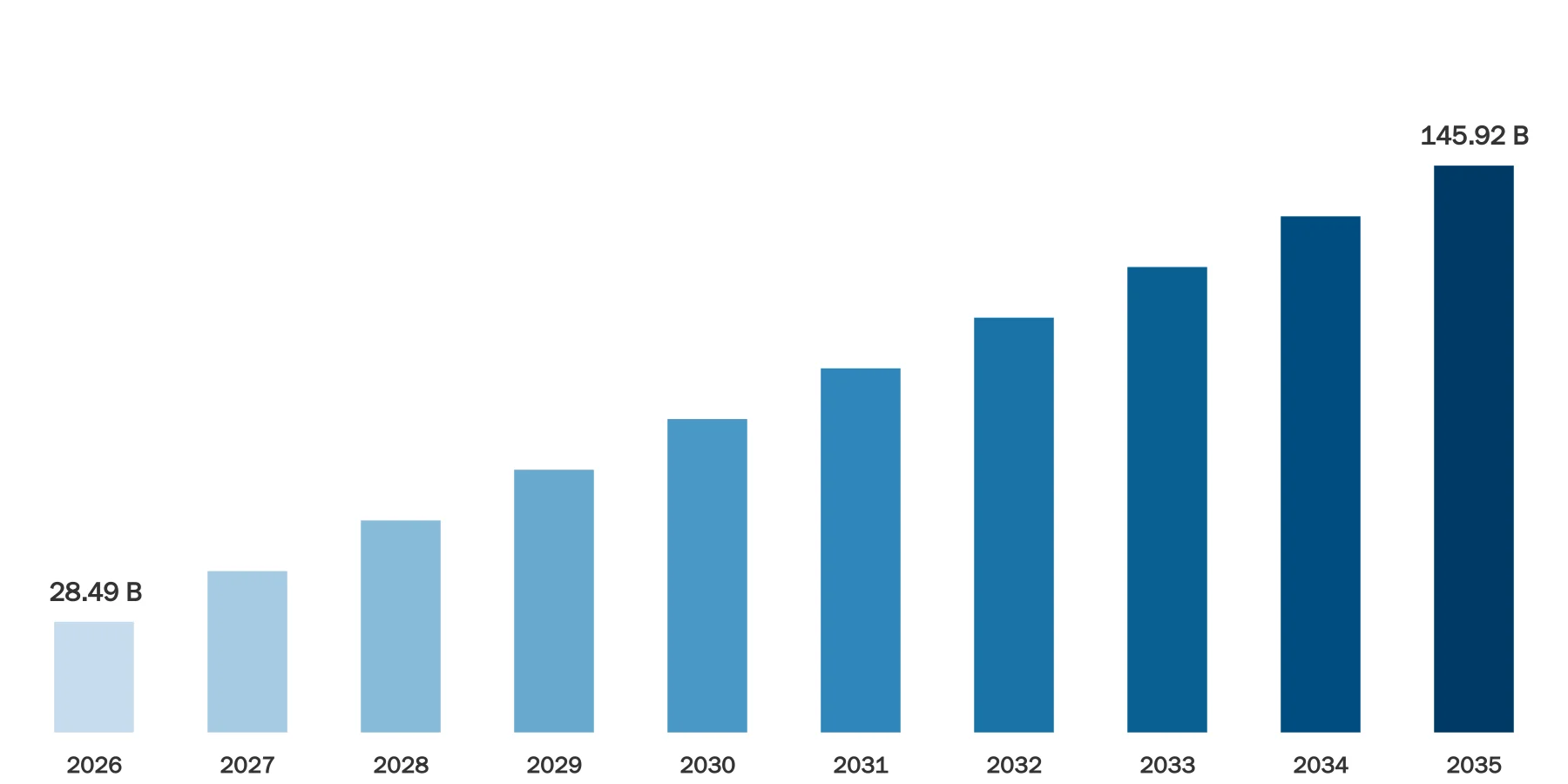
Source: Econ Market Research
The global Computer Vision market is expanding rapidly due to increasing deployment of AI-enabled cameras, edge devices, and automated inspection systems across more than 25 industries. In 2024, over 1.6 billion smart devices integrated some form of computer vision functionality, including facial recognition, object detection, gesture tracking, and image classification. Manufacturing facilities using vision-guided robotics reported defect reduction rates of nearly 35% and productivity improvements exceeding 28%. More than 72% of Industrial Automation deployments now include machine vision sensors and deep-learning-based image analytics. The automotive sector integrated over 140 million ADAS-enabled vision cameras globally during 2024, while healthcare institutions adopted AI imaging systems in more than 48% of diagnostic laboratories worldwide.
The USA computer vision market remains technologically dominant due to extensive AI infrastructure, semiconductor innovation, and enterprise AI adoption. In 2024, the United States accounted for nearly 31% of global AI vision deployments, supported by more than 5,000 AI startups and over 220,000 AI professionals. More than 68% of logistics warehouses in the country implemented vision-guided robotics and automated inspection systems. The healthcare sector processed over 900 million medical images annually using AI-supported imaging tools, while over 80% of autonomous vehicle testing programs in North America used computer vision platforms for object detection and navigation. Retail adoption also accelerated, with more than 45,000 stores implementing cashier-less vision systems and AI-powered customer analytics technologies.
The European computer vision market demonstrates strong adoption across automotive, industrial robotics, and smart surveillance applications. Germany, France, Italy, and the United Kingdom collectively represented more than 62% of regional deployment activity in 2024. Europe installed over 720,000 industrial robots integrated with vision systems in automotive and electronics manufacturing plants. More than 40% of smart city projects across the European Union incorporated AI-enabled video analytics and intelligent traffic monitoring solutions. In healthcare, approximately 38% of radiology centers in Western Europe deployed computer vision-assisted diagnostics platforms. European automotive manufacturers integrated more than 55 million vehicle-mounted vision sensors during 2024 to support lane detection, driver monitoring, and pedestrian recognition systems in electric and autonomous vehicles.
Computer Vision Market Latest Trends
The computer vision market is witnessing accelerated adoption of edge AI, embedded vision sensors, and deep-learning-based automation technologies. In 2024, over 59% of vision-based product developers confirmed adoption or planned deployment of 3D perception systems in robotics, industrial automation, and autonomous mobility applications. AI-powered smart cameras processed image data up to 70% faster than conventional machine vision systems due to integrated GPUs and neural processing units. Edge AI deployment expanded significantly, with more than 65% of industrial computer vision installations using on-device inference instead of centralized cloud processing.
Computer vision market trends also indicate rising integration of multimodal AI systems combining LiDAR, thermal imaging, radar, and computer vision. Automotive manufacturers increased average camera counts per vehicle from 3 units in 2019 to nearly 12 units in 2025 for ADAS and autonomous navigation functions. Smart manufacturing facilities deploying vision-guided robotics reported production downtime reductions of 22% and inspection accuracy levels above 98%. The semiconductor industry alone deployed more than 3.4 million machine vision cameras globally during 2024.
Another major computer vision market trend involves AI-enabled surveillance and security systems. More than 1 billion surveillance cameras worldwide now integrate computer vision analytics such as facial recognition, anomaly detection, and crowd monitoring. Retail companies implementing visual analytics achieved inventory accuracy improvements exceeding 30%. Healthcare institutions increasingly adopted computer vision for pathology and radiology applications, with AI-supported imaging tools reducing diagnostic review times by nearly 45%. Edge AI platforms from GPU and VPU manufacturers also expanded rapidly, supporting deployment across drones, robotics, smart factories, and intelligent transportation infrastructure.
Computer Vision Market Dynamics
The computer vision market analysis shows rapid transformation driven by industrial automation, AI-powered imaging, autonomous systems, and smart infrastructure investments. More than 72% of industrial manufacturers globally now deploy vision inspection systems in at least one production process. Around 48% of enterprises using AI analytics integrated image and video recognition technologies in 2024. Increased adoption of edge AI, 3D imaging, and smart cameras is reshaping the computer vision industry outlook. Sectors including automotive, healthcare, retail, logistics, defense, and agriculture are expanding deployment of image recognition systems, object tracking software, and AI-guided robotics at double-digit implementation rates across developed and emerging economies.
DRIVER
Increasing Adoption of Industrial Automation and AI-Based Inspection Systems
The primary driver of the computer vision market growth is rising industrial automation and demand for AI-powered inspection accuracy. More than 78% of electronics manufacturers implemented Automated Optical Inspection Systems using computer vision in 2024. Automotive assembly plants using AI-guided robotics achieved production efficiency gains above 25% and defect detection rates exceeding 97%. Smart factories integrated over 14 million industrial vision cameras globally during 2024. Predictive Maintenance systems using computer vision reduced equipment failures by approximately 30% in manufacturing plants. Warehousing and logistics facilities also accelerated deployment of AI vision robots, with autonomous mobile robots increasing by nearly 41% year over year. The increasing need for real-time quality assurance and reduced operational errors continues to strengthen computer vision market demand across industrial sectors.
RESTRAINT
High Processing Requirements and Data Privacy Concerns
A major restraint affecting the computer vision market is the high computational requirement for processing visual data. AI-powered image analytics systems require GPUs, TPUs, high-speed DRAM, and advanced networking infrastructure, increasing deployment complexity. More than 52% of medium-sized enterprises reported infrastructure limitations affecting large-scale vision AI implementation in 2024. Data privacy regulations also impact facial recognition and surveillance applications. Over 40 countries introduced stricter AI surveillance regulations between 2022 and 2025. Processing high-resolution video streams from multiple cameras generates significant bandwidth requirements, with some enterprise deployments exceeding 8 terabytes of daily image data transfer. Latency management, cybersecurity concerns, and integration complexity remain barriers for small and medium enterprises adopting advanced computer vision systems.
OPPORTUNITY
Expansion of Edge AI and Autonomous Systems
The largest opportunity in the computer vision market forecast involves edge AI and autonomous systems deployment. More than 65% of enterprises implementing AI vision systems are shifting from cloud-based processing to edge inference platforms for low-latency operations. Autonomous robots using embedded computer vision increased by nearly 38% globally in 2024. The deployment of AI-enabled cameras in smart cities surpassed 180 million units worldwide. Agricultural drones using computer vision for crop monitoring expanded across over 220 million hectares of farmland globally. Edge AI chips optimized for computer vision workloads reduced inference latency by up to 60% compared to cloud-based processing systems. Smart mobility infrastructure, autonomous retail stores, AI-powered diagnostics, and robotics automation continue creating strong opportunities for computer vision market expansion.
CHALLENGES
Increasing Operational Complexity and Model Accuracy Limitations
The computer vision industry faces major challenges related to model accuracy, environmental variability, and operational complexity. Vision systems deployed in dynamic environments experience accuracy fluctuations between 8% and 15% due to lighting changes, camera motion, and occlusion issues. More than 46% of AI developers identified model optimization and real-time processing as critical deployment challenges. Computer vision systems processing moving objects or mobile camera feeds require high computational power and sensor fusion integration. In industrial applications, false-positive detection rates still range from 2% to 5% in complex environments. Shortage of skilled AI engineers also remains a concern, with global demand for computer vision specialists increasing by more than 32% annually. Hardware compatibility, training dataset quality, and cybersecurity vulnerabilities continue affecting enterprise deployment scalability.
SWOT Analysis
Strengths
Computer vision systems achieve inspection accuracy rates above 98% in electronics and automotive manufacturing.
More than 72% of industrial computer vision deployments involve AI-enabled smart cameras and automated analytics systems.
AI vision systems reduce manual inspection time by nearly 50% across manufacturing and logistics sectors.
Over 1 billion surveillance cameras globally now support computer vision analytics functions such as object tracking and facial recognition.
Vision-guided robotics improve warehouse productivity by approximately 28% and reduce operational errors by nearly 35%.
Weaknesses
High-performance AI vision systems require GPUs and accelerators consuming over 250 watts in enterprise-scale deployments.
More than 52% of SMEs face infrastructure limitations for large-scale image analytics implementation.
Training deep-learning vision models requires millions of labeled images and high computational resources.
Environmental factors such as fog, lighting, glare, and occlusion can reduce image recognition accuracy by up to 15%.
AI vision deployments handling multi-camera systems may generate more than 8 terabytes of data daily.
Opportunities
Edge AI adoption in computer vision deployments exceeded 65% during 2024.
Smart city projects using AI vision technologies expanded across more than 300 metropolitan regions globally.
Autonomous mobile robots using vision-guided navigation increased by over 38% globally.
Healthcare imaging systems using AI-supported diagnostics reduced review times by nearly 45%.
Agricultural AI vision deployments expanded across over 220 million hectares for crop monitoring and disease detection.
Threats
More than 40 countries introduced stricter surveillance and facial recognition regulations between 2022 and 2025.
Cybersecurity attacks targeting connected AI cameras increased by nearly 27% in industrial networks.
Semiconductor shortages impacted delivery timelines for vision processors and AI chips by 12 to 20 weeks in some regions.
False-positive detection rates in complex environments still range between 2% and 5%.
Increasing competition among AI hardware vendors creates rapid product obsolescence cycles averaging 18 to 24 months.
Segmentation Analysis
The computer vision market research report identifies segmentation by component, product type, application, and vertical as major growth categories. Hardware systems account for more than 71% of deployment infrastructure due to high demand for cameras, GPUs, sensors, and AI accelerators. Smart camera-based systems dominate factory automation installations, while PC-based systems remain preferred for high-performance analytics. Quality assurance and inspection applications represent one of the largest use cases across automotive and electronics manufacturing. Industrial verticals continue dominating deployment activity, although non-industrial sectors such as healthcare, retail, agriculture, and transportation are witnessing rapid expansion in AI-powered visual analytics and intelligent monitoring solutions.
By Component
The hardware segment dominates the computer vision market share with over 71% contribution in 2024 due to extensive deployment of cameras, processors, sensors, frame grabbers, and lighting systems. GPU-based vision processors accounted for approximately 30% of hardware installations globally. CMOS and CCD image sensors remain the most widely deployed technologies across industrial automation and automotive applications. More than 3.4 million machine vision cameras were installed globally during 2024. Edge AI devices integrating VPUs and ASICs increased by nearly 40% in robotics and autonomous mobility systems.
The software segment is expanding rapidly because enterprises increasingly deploy image classification, object detection, facial recognition, and video analytics platforms. More than 48% of AI analytics deployments in 2024 included computer vision software integration. Deep-learning frameworks improved object recognition accuracy levels beyond 96% across industrial use cases. Software demand also increased in healthcare imaging, autonomous driving, and smart retail analytics. Cloud-native vision software platforms support processing of over 5 billion images daily across enterprise environments.
By Product Type
Smart camera-based computer vision systems account for a significant market share because of compact architecture, integrated processing, and lower infrastructure requirements. More than 58% of newly deployed industrial vision systems in 2024 used smart camera-based architecture. These systems reduce installation complexity by nearly 35% compared to traditional multi-component systems. Smart cameras are increasingly integrated with embedded AI accelerators for real-time analytics in manufacturing, logistics, and retail operations.
PC-based computer vision systems represented approximately 62% share in advanced industrial imaging applications due to superior processing flexibility and scalability. These systems are preferred for high-resolution imaging, 3D modeling, semiconductor inspection, and autonomous vehicle analytics. Industrial facilities using PC-based vision systems processed image streams exceeding 120 frames per second with advanced AI inference capabilities. High-performance computing integration continues driving adoption across sectors requiring complex image analytics and machine learning workloads.
By Application
Quality assurance and inspection applications hold a dominant share in the computer vision market outlook due to increasing automation in manufacturing environments. More than 78% of electronics production lines use AI-powered optical inspection systems. Positioning and guidance applications are expanding rapidly in robotics and autonomous vehicles, with over 140 million ADAS-enabled cameras integrated into vehicles globally during 2024.
Measurement and identification systems are widely deployed in pharmaceuticals, food processing, logistics, and semiconductor industries. Barcode reading systems process billions of packages annually across global logistics networks. Predictive maintenance solutions using computer vision reduced machinery downtime by approximately 30% in smart factories. 3D visualization and interactive modeling applications are expanding in healthcare, architecture, gaming, and industrial digital twin platforms, with 3D imaging deployments increasing by over 45% globally.
By Vertical
The industrial segment dominates the computer vision industry analysis due to widespread deployment across automotive, semiconductor, food processing, electronics, and machinery manufacturing sectors. Industrial applications account for more than 60% of global deployments. Electronics and semiconductor manufacturing facilities alone deployed millions of AI-enabled inspection cameras in 2024. Automotive factories use vision-guided robotics for welding, assembly verification, and defect detection with precision levels exceeding 97%.
The non-industrial segment is witnessing rapid expansion in healthcare, agriculture, transportation, retail, and smart surveillance. More than 1 billion surveillance cameras worldwide support AI-based video analytics. Retail stores implementing visual analytics achieved inventory accuracy improvements exceeding 30%. Healthcare institutions using AI vision systems processed over 900 million diagnostic images annually. Agricultural drones equipped with computer vision expanded across more than 220 million hectares globally for crop monitoring and yield analysis.
Regional Analysis
The computer vision market size demonstrates strong regional variation driven by industrial automation, semiconductor manufacturing, smart city infrastructure, and AI investment activity. Asia-Pacific leads deployment volumes due to electronics manufacturing concentration, while North America dominates AI innovation and enterprise adoption. Europe maintains strong market share in automotive automation and industrial robotics. The Middle East & Africa region is expanding gradually through smart surveillance, logistics automation, and urban infrastructure projects. Increasing deployment of edge AI devices, AI cameras, and intelligent transportation systems continues supporting regional computer vision market growth globally.
North America
North America accounts for approximately 30% of global computer vision market share due to extensive AI infrastructure, semiconductor innovation, and industrial automation deployment. The United States dominates regional adoption with more than 5,000 AI startups and over 220,000 AI professionals working across machine learning and computer vision sectors. Over 68% of logistics warehouses implemented AI-guided robotics and visual inspection systems during 2024.
The automotive sector integrated over 40 million vision sensors across autonomous vehicle testing and ADAS platforms. Healthcare providers in North America process hundreds of millions of diagnostic images annually using AI-supported imaging technologies. Smart retail systems using computer vision expanded across more than 45,000 stores. Government investments in smart surveillance, border security, and intelligent transportation also accelerated deployment of AI-enabled cameras and object recognition platforms.
North America also leads edge AI innovation, with major GPU and AI accelerator manufacturers deploying embedded vision systems across robotics, drones, and industrial automation. Semiconductor companies expanded investment in AI chips optimized for image analytics workloads. Industrial facilities using AI-powered quality inspection systems reported operational efficiency gains exceeding 25%.
Europe
Europe represents a major computer vision market driven by automotive manufacturing, industrial robotics, and smart city initiatives. Germany, France, Italy, and the United Kingdom collectively contribute over 62% of regional deployment activity. More than 720,000 industrial robots integrated with vision systems operate across European manufacturing facilities. Automotive manufacturers installed over 55 million vehicle-mounted cameras and vision sensors during 2024 for ADAS and autonomous mobility functions.
European factories deploying AI-based quality assurance systems achieved defect reduction rates above 30%. Smart transportation infrastructure projects using AI-enabled traffic monitoring expanded across over 120 metropolitan regions. Healthcare institutions increasingly adopted AI diagnostics, with approximately 38% of radiology centers deploying computer vision-assisted imaging platforms.
The region also emphasizes ethical AI and privacy-focused deployment standards. More than 40 regulatory frameworks addressing facial recognition and surveillance technologies were implemented across Europe between 2022 and 2025. Industrial automation remains a major growth engine, especially in electronics, pharmaceuticals, and food processing sectors. Edge AI deployment also accelerated, particularly in robotics and autonomous industrial systems.
Asia-Pacific
Asia-Pacific leads the global computer vision market share with approximately 37% contribution due to strong electronics manufacturing, semiconductor production, and smart factory investments. China, Japan, South Korea, and India dominate regional deployment volumes. The region installed millions of machine vision cameras and industrial robots during 2024, especially across electronics and semiconductor facilities.
China accounts for one of the highest adoption rates of AI-enabled surveillance systems, with hundreds of millions of smart cameras deployed in public infrastructure. Japan and South Korea lead advanced robotics integration, while India witnessed rapid expansion in AI startups and industrial automation investments. Semiconductor manufacturing facilities across Asia-Pacific deployed AI-powered inspection systems capable of detecting microscopic defects with accuracy levels exceeding 98%.
Automotive manufacturers in the region integrated advanced driver-assistance vision systems across millions of vehicles. Agricultural computer vision deployments also expanded significantly, particularly in precision farming and crop health monitoring. Asia-Pacific continues benefiting from lower manufacturing costs, strong semiconductor ecosystems, and expanding AI infrastructure.
Middle East & Africa
The Middle East & Africa computer vision market is expanding through smart city initiatives, security modernization, and logistics automation. Gulf countries implemented AI-powered surveillance and traffic management systems across more than 25 smart city projects during 2024. Airports, ports, and border control systems increasingly adopted facial recognition and automated image analytics technologies.
Industrial automation deployment is increasing in oil and gas facilities, where computer vision systems support predictive maintenance and safety monitoring. Smart retail analytics also gained momentum, with AI-enabled cameras installed in shopping malls and transportation hubs. Healthcare imaging adoption is expanding gradually across urban medical centers in the UAE, Saudi Arabia, and South Africa.
African countries are also deploying computer vision in agriculture for crop monitoring and livestock management. AI-powered drone imaging expanded across thousands of hectares for precision farming applications. Government investments in digital infrastructure and public security continue supporting regional computer vision market opportunities, particularly in transportation, logistics, and urban monitoring applications.

Competitive Landscape
The computer vision market competitive landscape is characterized by intense competition among semiconductor manufacturers, AI software developers, cloud computing providers, and industrial automation companies. Leading participants focus heavily on AI accelerators, smart cameras, edge computing, and deep-learning optimization platforms. More than 300 major technology companies globally are actively developing computer vision hardware and software solutions for industrial and non-industrial applications.
GPU manufacturers dominate high-performance image analytics workloads, while cloud computing companies are integrating AI vision APIs into enterprise platforms. Industrial automation firms continue expanding machine vision portfolios for quality inspection, predictive maintenance, and robotics guidance. Over 60% of competitive investments during 2024 focused on edge AI hardware and embedded vision systems.
Strategic partnerships between semiconductor companies and robotics manufacturers increased significantly between 2023 and 2025. Companies also accelerated acquisitions related to AI imaging, LiDAR integration, and autonomous navigation technologies. AI model optimization, real-time inference speed, and low-latency edge deployment remain major competitive differentiators. Manufacturers capable of delivering integrated AI hardware-software ecosystems continue strengthening market positioning across automotive, healthcare, retail, logistics, and industrial automation sectors.
List of Top Computer Vision Companies
Amazon Web Services, Inc.
Basler AG
Cognex Corporation
Google
Intel Corporation
Microsoft
NVIDIA Corporation
Omron Corporation
Qualcomm Technologies, Inc.
Teledyne Vision Solutions
Leading Companies by Market Share
NVIDIA Corporation leads the computer vision market through dominance in AI GPUs and edge AI processing platforms. More than 70% of enterprise AI training workloads globally use GPU-based acceleration technologies, while NVIDIA Jetson devices are widely deployed across robotics and industrial vision applications.
Cognex Corporation maintains a leading position in industrial machine vision systems with deployment across automotive, electronics, logistics, and semiconductor manufacturing facilities. The company supports thousands of factory automation installations globally and maintains strong penetration in barcode reading and AI-powered quality inspection systems.
Market Investment Outlook
The computer vision market outlook remains highly investment-oriented due to accelerating adoption of AI-driven automation, edge computing, and intelligent imaging technologies. Venture capital and corporate investments in AI vision startups exceeded thousands of funding rounds globally between 2023 and 2025. More than 60% of enterprise AI investments during 2024 focused on edge analytics, robotics vision, and intelligent surveillance systems.
Semiconductor manufacturers are expanding production of GPUs, VPUs, AI accelerators, and CMOS image sensors to meet rising demand for real-time image analytics. Industrial facilities investing in AI-guided automation achieved productivity improvements above 25% and defect reduction nearing 35%. Smart city investments involving intelligent traffic monitoring and surveillance systems expanded across more than 300 urban regions globally.
Healthcare represents another high-potential investment area, with AI-supported imaging systems reducing diagnostic review times by nearly 45%. Autonomous mobility platforms integrating computer vision received substantial investment support due to rising deployment of ADAS technologies. Robotics startups focusing on warehouse automation and machine perception also attracted increased institutional funding. Edge AI platforms enabling low-latency image processing continue generating significant opportunities across industrial automation, logistics, agriculture, healthcare, and transportation sectors.
New Product Development
New product development in the computer vision market is centered around AI-enabled cameras, embedded vision processors, edge AI modules, and 3D imaging technologies. During 2024 and 2025, manufacturers introduced advanced smart cameras supporting real-time inference speeds exceeding 120 frames per second. AI accelerators optimized for vision workloads reduced processing latency by up to 60% compared to earlier-generation systems.
3D depth cameras gained strong adoption across robotics and autonomous navigation applications. New vision sensors integrated thermal imaging, LiDAR, and AI analytics into compact embedded systems for drones, industrial robots, and intelligent transportation infrastructure. Semiconductor manufacturers also introduced AI chips supporting low-power edge inference with processing efficiency improvements exceeding 35%.
Healthcare-focused computer vision products expanded rapidly, including AI-supported pathology imaging systems capable of analyzing thousands of medical images daily. Retail analytics solutions introduced advanced people-counting and shelf-monitoring functions with recognition accuracy above 95%. Automotive manufacturers integrated next-generation driver monitoring systems combining infrared cameras, eye tracking, and facial recognition technologies. Industrial automation companies also launched predictive maintenance vision platforms capable of detecting micro-level equipment anomalies before operational failure occurs.
Recent Developments
In 2025, Intel spinout RealSense secured $50 million in funding to expand AI vision technologies for robotics and autonomous systems, supporting more than 3,000 enterprise customers globally.
In 2024, multiple semiconductor companies introduced edge AI chips capable of reducing computer vision inference latency by approximately 60% in robotics and industrial automation deployments.
During 2024, automotive manufacturers increased average vehicle camera integration to nearly 12 cameras per vehicle for ADAS and autonomous navigation applications.
In 2024, over 59% of vision-based AI developers confirmed adoption or planned implementation of 3D perception systems across robotics and industrial automation applications.
Between 2023 and 2025, smart factories globally deployed millions of AI-enabled machine vision cameras, supporting quality inspection accuracy exceeding 98% in electronics and semiconductor manufacturing.
Report Coverage of Computer Vision Market
This computer vision market report provides comprehensive analysis of hardware, software, smart camera systems, PC-based systems, AI processors, and edge computing technologies across industrial and non-industrial applications. The report covers segmentation by component, product type, application, and vertical while evaluating deployment trends across manufacturing, healthcare, automotive, logistics, retail, agriculture, and smart city infrastructure.
The computer vision market research report includes analysis of more than 25 countries and evaluates regional deployment patterns across North America, Europe, Asia-Pacific, and Middle East & Africa. It examines adoption trends related to AI-enabled surveillance, autonomous vehicles, predictive maintenance, smart manufacturing, and medical imaging systems. More than 100 data points related to industrial robotics, AI cameras, GPU deployment, and edge AI infrastructure are assessed within the report scope.
The report also evaluates competitive benchmarking of major companies involved in machine vision systems, AI accelerators, embedded vision sensors, and intelligent imaging software. Key topics include technological advancements, industrial automation trends, AI model optimization, smart city deployment, edge computing integration, and autonomous system development. Computer vision market insights additionally assess challenges related to privacy regulations, infrastructure requirements, cybersecurity risks, and operational scalability across enterprise deployments.
Computer Vision Market Report Scope & Segmentation
| Attributes | Details |
|---|---|
Market Size (Current) | US$ 28.49 Billion in 2026 |
Market Size (Forecast) | US$ 145.92 Billion in 2035 |
Growth Rate | CAGR of 19.9% from 2026 to 2035 |
Forecast Period | 2026 – 2035 |
Base Year | 2025 |
Historical Data Available | Yes |
Regional Scope | Global |
Segments Covered | By Component
By Product Type
By Application
By Vertical
|
Frequently Asked Questions
Common questions about this report
The study period covers historical insights and forecast projections for the period 2026-2035.
About the Author
Market research expert with years of industry experience
As a Senior Research Associate at Econ Market Research, Akash Bhingare leads comprehensive market studies across dynamic and highly specialized sectors, ranging from advanced biotech fields to niche industrial markets. He excels at dissecting complex supply chains, analyzing market segmentation, and forecasting future industry trajectories. Akash’s commitment to high-fidelity data ensures that every report he authors delivers reliable, foundational knowledge for enterprise-level decision-making.
Related Reports
Explore more market insights from the same category