Industrial Automation Market Overview
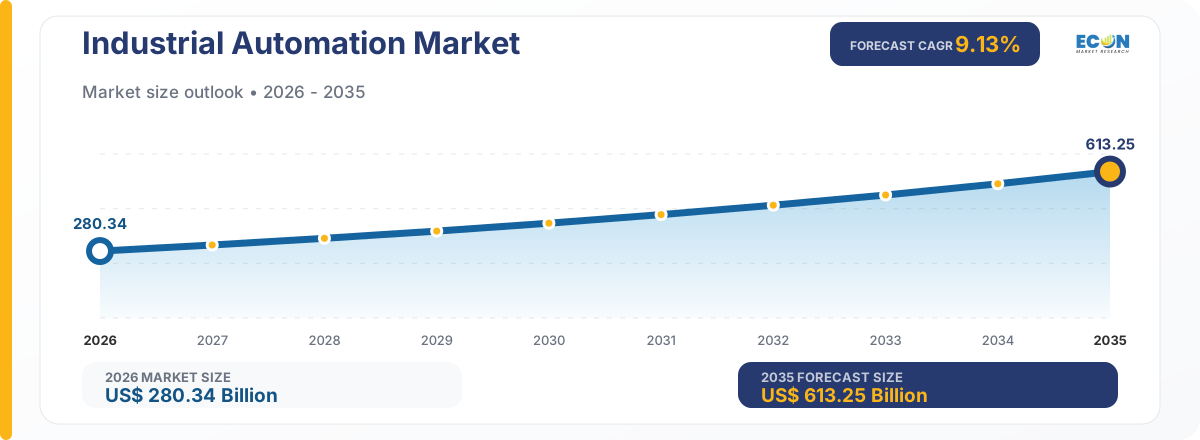
As per Econ Market Research analysis, the Global Industrial Automation Market reached a valuation of US$ 280.34 Billion in 2026 and is anticipated to grow to US$ 613.25 Billion by 2035, at a CAGR of 9.13% during the forecast timeline 2026–2035. The base year considered is 2025.
Industrial Automations includes the integration of control systems, robots, and computers to streamline manufacturing, assembly, and other tasks in various industries such as automotive, electronics, and food processing. In recent years, the market has experienced significant growth due to the increasing demand for higher productivity, quality, and safety in industrial operations. Key drivers of this growth include advancements in technology, such as the Internet of Things (IoT) and Artificial Intelligence (AI), which enable greater connectivity and intelligence in automation systems.
Additionally, factors such as rising labor costs, stringent regulations, and the need for faster production cycles have further fuelled the adoption of industrial automation solutions. As a result, the market is expected to continue expanding, with opportunities emerging in emerging economies where industries are modernizing their operations to stay competitive in the global market landscape. However, challenges such as cybersecurity risks, integration complexities, and concerns about job displacement may pose hurdles to the widespread adoption of industrial automation.
Industrial Automation Dynamics
Key drivers include the increasing demand for higher productivity, operational efficiency, and cost reduction across industries. Industrial automation solutions offer the potential to streamline processes, minimize errors, and enhance output, thereby addressing these needs. Moreover, advancements in technology, such as the Internet of Things (IoT), Artificial Intelligence (AI), and machine learning, are driving innovation in automation systems, enabling greater connectivity, intelligence, and autonomy. This is leading to the development of more sophisticated and adaptable automation solutions capable of meeting the complex requirements of modern industrial operations.
Furthermore, rising labor costs, a scarcity of experienced workers, and the requirement for strict quality control and regulatory compliance are driving the development of automation solutions. Industries are increasingly looking to automation to address these difficulties while remaining competitive in the global marketplace. Furthermore, the COVID-19 pandemic has pushed the deployment of automation as firms seek to avoid disruptions and maintain operational continuity in the face of lockdowns and social distancing measures. However, constraints such as cybersecurity threats, interoperability issues, and a reluctance to invest in new technologies may impede market expansion.
Industrial Automation Drivers
Increasing Demand for Operational Efficiency
One of the primary drivers of the industrial automation market is the escalating demand for operational efficiency across industries. Companies are constantly striving to improve productivity, reduce costs, and enhance the quality of their products and services. Industrial automation solutions offer the means to achieve these objectives by streamlining processes, minimizing human error, and optimizing resource utilization.
For instance, automation can enable predictive maintenance, where equipment failures are anticipated before they occur, minimizing downtime and maximizing asset utilization. Additionally, automation facilitates real-time monitoring and control of manufacturing processes, allowing for immediate adjustments to optimize efficiency and output.
Technological Advancements
Rapid technological advances, especially in the Internet of Things (IoT), Artificial Intelligence (AI), and robotics, are driving innovation in industrial automation. These technologies improve connectedness, intelligence, and autonomy in automation systems, allowing for the development of more sophisticated and adaptive solutions. AI-powered algorithms, for example, may analyze massive quantities of data to detect trends and optimize manufacturing processes, whilst Collaborative Robots (cobots) can work alongside humans to improve productivity and flexibility on the factory floor. Furthermore, the introduction of cloud computing and edge computing allows for easy integration and data interchange between distant systems, improving the possibilities of industrial automation solutions.
Industrial Automation Restraints:
Cybersecurity Risks
Despite the numerous benefits of industrial automation, cybersecurity remains a significant concern for organizations. With increasing connectivity and digitization, industrial systems are becoming more vulnerable to cyber threats such as hacking, malware, and data breaches. A successful cyber-attack on automated systems can result in costly disruptions to operations, loss of sensitive data, and even physical damage to equipment or facilities. Consequently, companies are hesitant to fully embrace automation without robust cybersecurity measures in place, which may slow down the adoption of automation technologies.
Integration Complexities
Another restraint facing the industrial automation market is the complexity of integrating automation solutions with existing infrastructure and processes. Many industrial facilities operate legacy systems that may not be easily compatible with modern automation technologies. Additionally, each component of an automation system may be sourced from different vendors, leading to interoperability challenges.
Ensuring seamless integration between disparate systems requires careful planning, customization, and sometimes significant investments in middleware or integration platforms. Moreover, ongoing maintenance and upgrades of automation systems can further complicate integration efforts, potentially delaying the adoption of automation solutions.
Industrial Automation Opportunities:
Industry 4.0 Initiatives
The Industry 4.0 paradigm, which involves the integration of digital technology into industrial processes, represents a substantial opportunity for the industrial automation business. Industry 4.0 efforts use a variety of technologies, including IoT, AI, big data analytics, and cloud computing, to create smart, linked factories and supply networks. Companies that use these technologies can improve their operational visibility, agility, and efficiency.
For example, predictive maintenance powered by IoT sensors and AI algorithms allows for proactive equipment monitoring and maintenance, decreasing downtime and optimizing asset utilization. Similarly, digital twins, which are virtual representations of physical assets or processes, facilitate simulation, optimization, and predictive modelling, allowing organizations to test and develop production methods prior to deployment.
Segment Overview
By Components
This segment encompasses various components crucial for industrial automation systems. These components include sensors for data acquisition, industrial robots for automation tasks, industrial PCs for computing and control, machine vision systems for inspection and quality control, industrial 3D printing for Additive Manufacturing, human-machine interfaces (HMIs) for operator interaction, field instruments for measurement and control, control valves for fluid control, and other miscellaneous components contributing to the overall automation infrastructure.
By Type
The types of automation delineate different approaches to implementing automation in industrial processes. These include programmable automation, where tasks are controlled by a pre-programmed sequence, fixed or hard automation, characterized by dedicated machinery for specific tasks, integrated automation, which integrates disparate systems for seamless operation, and flexible or soft automation, allowing for adaptability and reconfiguration of processes to accommodate changing requirements.
By End User
The end-user segmentation categorizes industries based on the nature of their manufacturing processes. Process industries involve continuous or batch production of goods such as chemicals, oil, and gas, while discrete industries produce distinct items like automobiles, electronics, and consumer goods.
By Solution
This segment encompasses various solutions tailored to specific automation needs. These solutions include programmable logic controllers (PLCs) for control logic, distributed control systems (DCS) for centralized control of complex processes, supervisory control and data acquisition (SCADA) systems for real-time monitoring and control, enterprise-level controls for overarching management, programmable automation controllers (PACs) for flexible automation, plant asset management (PAM) systems for maintenance optimization, digitalization tools for data-driven decision-making, functional safety systems for risk mitigation, and emission control solutions for environmental compliance.
By Mode of Automation
This categorization distinguishes between semi-automation, where some tasks are automated but require human intervention, and fully automation, where processes are entirely autonomous without human intervention.
By Systems
This segment encompasses different control systems employed in industrial automation. These include proportional-integral-derivative (PID) control systems for continuous processes, model-based control systems utilizing mathematical models for predictive control, and other specialized control systems tailored to specific industrial applications
Industrial Automation Overview by Region
North America, with its mature industrial infrastructure and technological prowess, remains a prominent market for industrial automation solutions. The region benefits from the presence of key industry players, robust R&,D activities, and favourable government initiatives promoting digitalization and Industry 4.0 adoption. Similarly, Europe exhibits strong demand for automation technologies driven by stringent regulatory standards, a focus on sustainability, and a need for operational excellence.
Asia-Pacific emerges as a lucrative market fuelled by rapid industrialization, urbanization, and the proliferation of manufacturing activities in countries like China, India, and Japan. These nations are investing heavily in automation to enhance productivity, efficiency, and competitiveness in the global market. Additionally, the adoption of automation is accelerating in emerging economies across Latin America, the Middle East, and Africa, propelled by growing investments in infrastructure, rising labor costs, and a burgeoning manufacturing sector. However, regional disparities exist, with some regions facing challenges such as inadequate infrastructure, limited access to technology, and geopolitical uncertainties, which may impede market growth.
Industrial Automation Market Competitive Landscape
Major companies such as Siemens AG, ABB Ltd., Schneider Electric SE, Rockwell Automation Inc., and Mitsubishi Electric Corporation dominate the market with their comprehensive portfolios of automation solutions and extensive global presence. These industry leaders focus on strategic initiatives such as mergers and acquisitions, partnerships, and product launches to strengthen their market position and expand their customer base. Additionally, there is a proliferation of smaller players and startups specializing in niche automation technologies, driving innovation and addressing specific industry needs.
Furthermore, the market is witnessing increasing collaboration between automation providers and technology companies to integrate emerging technologies such as artificial intelligence, machine learning, and the Internet of Things into automation systems, enabling smarter, more efficient industrial processes. As competition intensifies, companies are also investing in research and development to develop next-generation automation solutions capable of addressing evolving customer requirements, such as flexibility, scalability, and interoperability.
Industrial Automation Key Players:
MachineMetrics
Analog Devices, Inc.
ABB
AMETEK.Inc.
Bosch Rexroth Corporation
Concept Systems
Delta Electronics, Inc.
Emerson Electric Co
Endress+Hauser Group Services AG
FANUC America Corporation
Fuji Electric Co., Ltd.
General Electric Company
Hitachi Vantara LLC
Industrial Automation Recent Developments
May 2023, Renishaw, a leading global engineering technologies firm, is introducing a fresh product line tailored for the industrial automation sector. Leveraging its established proficiency and technological advancements in industrial metrology, the RCS product line is poised to revolutionize the setup and maintenance of industrial automation systems.
Oct 2023, Rockwell Automation, Inc. and Microsoft Corp. have announced an expansion of their longstanding partnership aimed at expediting industrial automation design and development using generative artificial intelligence (AI). By integrating technologies, the collaboration aims to empower workers and hasten time-to-market for customers constructing industrial automation systems. The initial result of this joint effort will integrate Microsoft&rsquo,s Azure OpenAI Service into FactoryTalk Design Studio, providing pioneering capabilities to accelerate time-to-market for clients developing industrial automation systems.
Industrial Automation Report Segmentation
Industrial Automation Market Report Scope & Segmentation
| Attributes | Details |
|---|---|
| Market Size (Current)Current market valuation | US$ 280.34 Billion in 2026 |
| Market Size (Forecast)Projected market valuation | US$ 613.25 Billion in 2035 |
| Growth RateCompound Annual Growth Rate | CAGR of 9.13% from 2026 to 2035 |
| Forecast PeriodAnalysis timeline | 2026 – 2035 |
| Base YearReference year for analysis | 2025 |
| Historical Data AvailablePast market data availability | Yes |
| Regional ScopeGeographical coverage | Global |
| Segments CoveredMarket segments analyzed | By Solution
By Industry Vertical
|
Frequently Asked Questions
Common questions about this report
The study period covers historical insights and forecast projections for the period 2026-2035.
About the Author
Market research expert with years of industry experience