

Thermal Management Market
Thermal Management Market Size, Share, Trends, Growth, and Industry Analysis, By Product (Hardware, Software, Services), By Material (Metallic, Non-metallic), By Device (Conduction Cooling Devices, Convection Cooling Devices, Advanced Cooling Devices, Hybrid Cooling Devices), By End-Use Industry (Consumer Electronics, Automotive, Aerospace andamp; Defense, Healthcare, Servers andamp; Data Centers, Others), Regional Analysis and Forecast Period 2026-2035
Market Overview
As per Econ Market Research analysis, the Global Thermal Management Market valuation stood at US$ 18.51 Billion in 2026 and is expected to reach US$ 43.42 Billion by 2035, growing at a steady CAGR of 9.95% from 2026 to 2035. 2025 serves as the base year.
Thermal Management Market Size 2025-2035 (USD Billion)

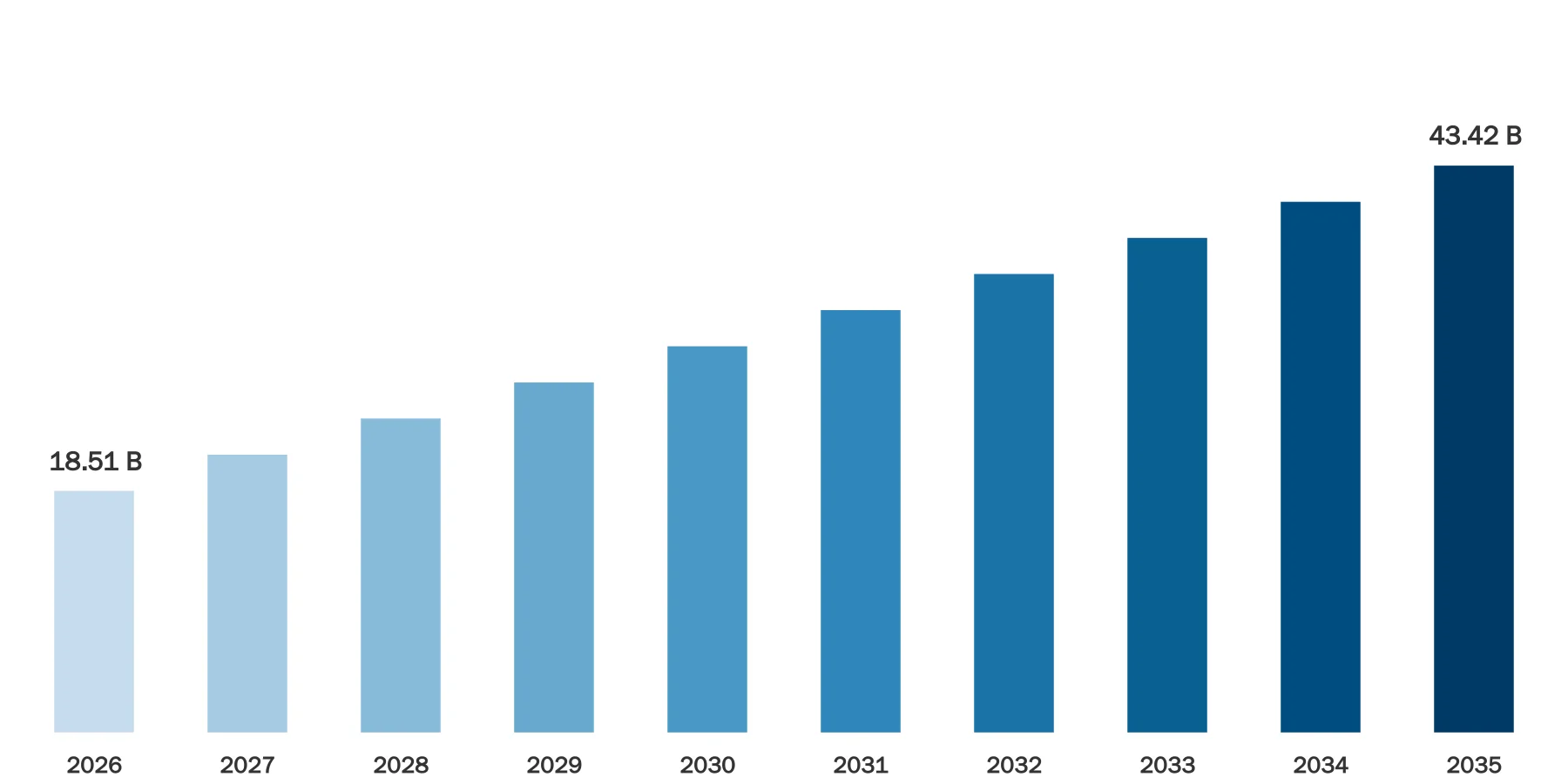
Source: Econ Market Research
Thermal management encompasses the vital task of regulating and controlling the heat generated by Electrical Equipment and systems, ensuring they operate within optimal temperature ranges. This plays a crucial role in maintaining the reliability, performance, and lifespan of electronic components. To effectively address excess heat and achieve temperature balance, a range of techniques and technologies are employed, including heat sinks, fans, Thermal Interface Materials, and liquid cooling systems. As electronic devices continue to experience higher power densities and undergo miniaturization, thermal management has emerged as an integral aspect of design and engineering. Its significance lies in mitigating the risks of overheating, reducing energy consumption, and enhancing overall system efficiency.
Thermal Management Market Dynamics
Efficiency in thermal management systems is now necessary due to the rising demand for electronic devices with higher power densities and smaller sizes. There is a demand for thermal management systems that can efficiently disperse heat and cut energy consumption due to the increasing emphasis on energy economy and sustainability in a number of industries, including automotive, aerospace, and consumer electronics. The need for thermal management solutions has increased as a result of the growing popularity of data centers and cloud computing, which helps to keep servers and networking hardware at ideal temperatures and prevents overheating.
Thermal Management Market Drivers
Rising Demand for Electronics
The rising demand for electronics, such as smartphones, laptops, and tablets, is a significant driver in the thermal management market. As electronic devices become more powerful and compact, managing heat dissipation becomes crucial to ensure optimal performance and prevent overheating. This increasing demand for electronic products fuels the need for efficient thermal management solutions to maintain device reliability and longevity.
Restraints:
Lack of Standardization
The lack of standardization is a restraint in the thermal management market. Without industry-wide standards, there can be compatibility issues and uncertainty for potential buyers. The absence of clear guidelines and benchmarks makes it challenging for businesses to select the most suitable thermal management solutions for their specific needs. Standardization efforts are required to establish common practices, ensure interoperability, and foster confidence in adopting thermal management technologies across different industries and applications.
Opportunities:
IoT-driven Solutions
IoT-driven solutions present opportunities in the thermal management market. By integrating Internet of Things (IoT) technology, real-time monitoring and predictive maintenance capabilities can be achieved. IoT-enabled thermal management systems can collect and analyze data related to temperature, humidity, and equipment performance, allowing for proactive measures to prevent overheating and optimize cooling efficiency. This data-driven approach enhances overall effectiveness, improves energy efficiency, and enables remote monitoring and control of thermal management systems, leading to increased operational efficiency and reduced downtime.
Segment Overview
By Material Type
Based on material type, the global thermal management market is divided into adhesive materials and non-adhesive materials. The adhesive materials category dominates the market with the largest revenue share of around 64.3% in 2022, due to their outstanding bonding properties, adhesive materials enable effective heat transmission between components and heat sinks, which is one of the many aspects that contribute to their dominance in this industry. They provide dependable and long-lasting attachment solutions for a range of products, including electrical gadgets, automobile parts, and industrial machinery. Adhesive materials are adaptable and useful for a variety of industries because of their compatibility with a wide range of surfaces, including metals, ceramics, and plastics.
By End-User
Based on end-user, the global thermal management market is divided into consumer electronics, servers &, data centers, automotive, aerospace &, defense, enterprises, healthcare, and others. The servers &, data centers anticipated to grow at a higher CAGR of 10.6% during the forecast period because the rapid growth of digital data, along with a rising reliance on cloud computing services, has resulted in an increase in the number and size of data centers globally. As these data centers grow in size, the need for effective thermal management systems to maintain ideal operating temperatures and prevent overheating becomes increasingly important.
By Service Type
Based on service type, the global thermal management market is divided into installation &, calibration and optimization &, post-sales support. The installation &, calibration and optimization category is anticipated to grow at a higher CAGR of 8.3% during the forecast period. This expansion may be ascribed to the fact that as modern technologies improve, there is a greater demand for exact system and equipment installation and calibration. Additionally, improving these systems', effectiveness and performance has become a crucial demand. Businesses are looking for expert services to guarantee appropriate installation, calibration, and optimization of their systems in light of the quick adoption of technologies like automation, AI, and IoT.
Thermal Management Market Overview by Region
The global thermal management market is segmented into North America, Europe, Asia-Pacific, and the Rest of the World based on regions. In 2022, Asia-Pacific emerged as the dominant region, capturing approximately 33.5% of the global market share. The demand for efficient thermal management systems in this region is primarily driven by the increasing usage of consumer electronics, mobile devices, and Automotive Electronics. The rapid industrialization and urbanization of countries like India and Southeast Asian nations have further fueled the growth of industries such as manufacturing, information technology, and telecommunications, resulting in a higher demand for thermal management solutions. Additionally, the region',s substantial investments in data centers and reliance on cloud computing services have amplified the need for reliable thermal management systems to ensure optimal performance and prevent overheating.
Thermal Management Market Competitive Landscape
A limited number of key players dominate the industry and possess a strong regional presence. These prominent companies are deeply committed to ongoing research and development initiatives and actively engage in strategic growth endeavors such as product innovation, launching new products, forming partnerships, and establishing joint ventures. By implementing these strategies, these organizations aim to strengthen their market position, expand their customer base, and capture a significant share of the market.
Key Players
Honeywell International Inc.
Vertiv Co.
Delta Electronics, Inc.
Parker Chomerics
TAT Technologies Ltd.
Henkel AG & Co. KGaA
Boyd Corporation
European Thermodynamics Ltd.
Laird Thermal Systems
Pentair Thermal Management
Advanced Cooling Technologies, Inc.
Gentherm Inc.
Autoneum Holding AG
Sapa Extrusions Inc.
AllCell Technologies
Thermacore Inc.
3M Company
Thermal Management Market Recent Developments
In September 2022, Henkel enhanced its foothold in the growing thermal interface material (TIM) sector through the acquisition of Thermexit, Nanoramic Laboratories, division dedicated to thermal management materials. This strategic move bolstered Henkel',s standing and heightened its prominence within the TIM market.
Thermal Management Market Report Scope & Segmentation
| Attributes | Details |
|---|---|
Market Size (Current) | US$ 18.51 Billion in 2026 |
Market Size (Forecast) | US$ 43.42 Billion in 2035 |
Growth Rate | CAGR of 9.95% from 2026 to 2035 |
Forecast Period | 2026 – 2035 |
Base Year | 2025 |
Historical Data Available | Yes |
Regional Scope | Global |
Segments Covered | By Product
By Material
By Device
By End-Use Industry
|
Frequently Asked Questions
Common questions about this report
The study period covers historical insights and forecast projections for the period 2026-2035.
About the Author
Market research expert with years of industry experience

Dipali Bhingare serves as the Market Research Director at Econ Market Research. With a focus on translating complex global economic shifts into actionable business intelligence, she oversees the strategic direction of comprehensive market studies. Her work empowers organizations to navigate volatile industries through data-driven forecasting and deep-dive competitive analysis.
Related Reports
Explore more market insights from the same category