

Artificial Intelligence Sensors Market
Artificial Intelligence Sensors Market Size, Share, Trends, Growth, and Industry Analysis, By Sensor Type (Optical Sensors, Pressure Sensors, Position Sensors, Temperature Sensors, Motion Sensors, Navigation Sensors, Ultrasonic Sensors), By Application (Consumer Electronics, Automotive, Manufacturing, Robotics, Smart Home Automation, Aerospace andamp; Defense), Regional Analysis and Forecast Period 2026-2035
Market Overview
As per Econ Market Research analysis, the Global Artificial Intelligence Sensors Market was valued at US$ 358 Billion in 2026 and is expected to reach US$ 5260 Billion by 2035, registering a CAGR of 30.84% during the forecast period 2026–2035. The base year considered is 2025.
Artificial Intelligence Sensors Market Size 2025-2035 (USD Billion)

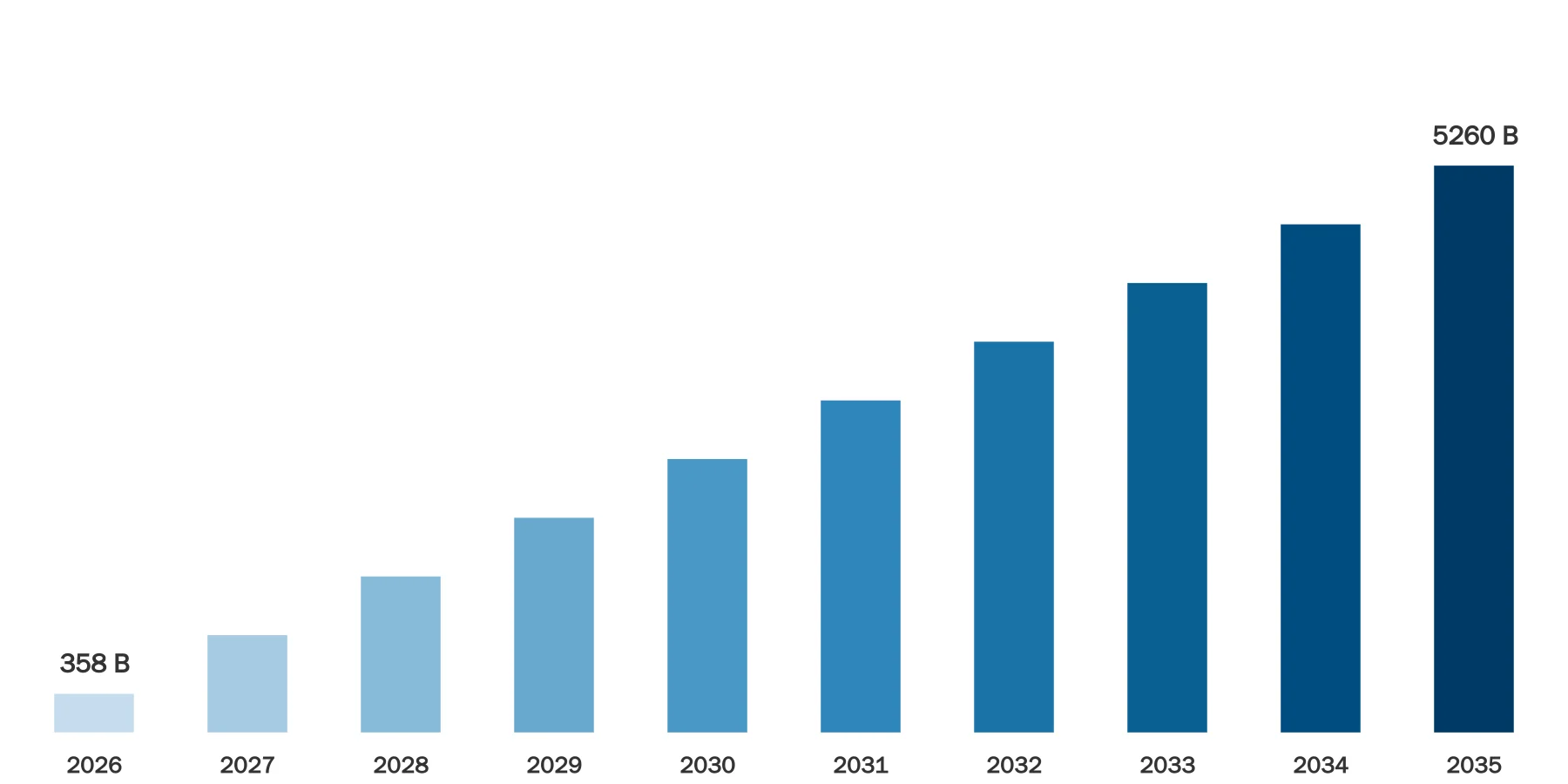
Source: Econ Market Research
AI sensors are indispensable elements within AI systems that enable them to perceive and interact with the physical world. These sensors are specifically designed to capture data from a diverse range of sources including cameras, microphones, temperature sensors, proximity sensors, and more. They gather information from visual, auditory, tactile, and environmental inputs, which is subsequently processed by AI algorithms for analysis and decision-making purposes. AI sensors hold a crucial role in various applications such as Autonomous Vehicles, robotics, smart cities, Industrial Automation, healthcare, and security systems. In the realm of autonomous vehicles, for instance, sensors like LiDAR and radar facilitate real-time perception of the surroundings, aiding in navigation and object detection. In healthcare, sensors can monitor patient vitals and identify irregularities.
Artificial Intelligence Sensors Market Dynamics
The growth and adoption of the artificial intelligence sensors market are propelled by several key factors, due to the increasing demand for AI-driven applications in various sectors such as automotive, healthcare, manufacturing, and consumer electronics drives the market forward. AI sensors play a critical role in enabling these applications to perceive and interact with the environment, thereby enhancing their functionality and capabilities. Furthermore, advancements in sensor technologies are significant drivers of market growth. These advancements encompass miniaturization, improved accuracy, and lower power consumption. They facilitate the integration of sensors into smaller devices while enabling real-time data capture with higher precision. Moreover, there is a notable increase in investments in the research and development of AI sensors.
Artificial Intelligence Sensors Market Drivers
Increasing Demand for AI-Driven Applications
The growing adoption of AI-driven applications across multiple sectors, including automotive, healthcare, manufacturing, and consumer electronics, is a significant driver of the AI sensors market. AI sensors enable these applications to perceive and interact with their environment, enhancing their functionality and expanding their capabilities.
Restraints
Cost Constraints
The cost of AI sensors can be a significant restraint for widespread adoption, particularly in cost-sensitive markets. The high costs associated with developing and implementing advanced sensor technologies can limit their accessibility, especially for smaller businesses or price-sensitive consumers.
Opportunities
Expansion in Automotive Industry
The automotive industry presents significant opportunities for AI sensors. The increasing adoption of autonomous vehicles and the need for advanced driver assistance systems (ADAS) fuel the demand for AI sensors. These sensors enable real-time perception and decision-making, contributing to enhanced safety and autonomous functionalities.
Segment Overview
By Sensor Type
Based on the sensor type, the global artificial intelligence sensors market is segmented into pressure sensors, position sensors, temperature sensors, optical sensors, ultrasonic sensors, motion sensors, and navigation sensors. The motion sensors segment is dominating the market with the largest revenue share of around 27.3% in 2022. Motion sensors are instrumental in a wide range of applications, including gaming consoles, fitness wearables, security systems, and industrial automation, which drives their demand. These sensors play a crucial role in the precise detection and tracking of movement, enhancing user experiences and safety. The growing adoption of motion-based gestures and controls in consumer electronics, such as smartphones and virtual reality devices, has further accelerated the demand for motion sensors.
By Application
Based on the application, the global artificial intelligence sensors market is segmented into automotive, consumer electronics, manufacturing, aerospace &, defense, robotics, smart home automation, and agriculture. The consumer electronics segment is dominating the market with the largest revenue share of around 35.6% in 2022. The demand for AI sensors in the consumer electronics segment has been driven by the growing integration of these sensors into devices such as smartphones, smart speakers, and wearables. This integration has enabled enhanced functionalities like voice recognition, gesture control, and facial recognition, thereby significantly improving user experiences. Furthermore, the increasing popularity of smart homes and Internet of Things (IoT) devices has contributed to the rising demand for AI sensors in consumer electronics.
By Technology
Based on technology, the global artificial intelligence sensors market is segmented into natural language processing, machine learning, computer vision, and context-aware computing. The machine learning segment is dominating the market with the largest revenue share of around 38.2% in 2022. Machine learning algorithms play a pivotal role in analyzing sensor data, extracting patterns, and making predictions. This technology empowers AI systems to learn and enhance their capabilities over time, enabling their effective deployment across diverse applications. The capacity of machine learning to handle complex and extensive datasets, along with advancements in hardware and software, has propelled its widespread adoption.
By Type
Based on type, the global artificial intelligence sensors market is segmented into neural networks, case-based reasoning, inductive learning, and ambient- intelligence. The neural networks segment is anticipated to grow at a higher CAGR of 28.5% during the forecast period. Neural networks have demonstrated significant potential across a range of AI applications, such as image recognition, natural language processing, and predictive analytics. Their capacity to simulate the learning and decision-making processes of the human brain has attracted considerable attention and investment.
Artificial Intelligence Sensors Market Overview by Region
By Region the global artificial intelligence sensors market has been divided into North America, Europe, Asia-Pacific, and the Rest of the World. North America dominated the market with the largest revenue share in 2022.
North America
North America held the largest share, of around 37.6%, of the global market in 2022. North America possesses a formidable technological infrastructure that enables advanced research and development in the field of AI, fostering innovation. The region is host to prominent technology giants and start-ups that prioritize AI, creating a surge in the demand for AI sensors. Furthermore, North America benefits from a thriving ecosystem of industries, including automotive, healthcare, and defense, which heavily rely on AI. These sectors make substantial investments in AI-driven applications, thus driving the demand for AI sensors. Moreover, the region enjoys favorable government initiatives and policies that support AI research and development.
Artificial Intelligence Sensors Market Competitive Landscape
In the global artificial intelligence sensors market, a small number of prominent players hold significant market dominance and have established a strong regional presence. These key participants are committed to ongoing research and development initiatives. Additionally, they actively engage in strategic growth endeavors such as product development, product launches, joint ventures, and partnerships. By pursuing these strategies, these companies aim to strengthen their market position and expand their customer base to capture a substantial share of the market.
Key Players
Robert Bosch GmbH
Goertek Inc.
Baidu, Inc.
Yokogawa Electric Corporation
Excelitas Technologies Corp.
Hokuriku Electric Industry Co., Ltd.
Sensata Technologies, Inc.
Sensirion AG
Sensortek Technology Corporation,
Silicon Sensing Systems Limited
Artificial Intelligence Sensors Market Recent Developments
In April 2022, Robert Bosch GmbH enhanced its position in the markets for smart mobility solutions and autonomous cars by purchasing Five AI (France), a firm specializing in self-driving software components and development platforms. This strategic purchase allows Robert Bosch GmbH to solve significant difficulties in the self-driving car industry, boosting its capabilities in the autonomous cars market.
Artificial Intelligence Sensors Market Report Scope & Segmentation
| Attributes | Details |
|---|---|
Market Size (Current) | US$ 358 Billion in 2026 |
Market Size (Forecast) | US$ 5260 Billion in 2035 |
Growth Rate | CAGR of 30.84% from 2026 to 2035 |
Forecast Period | 2026 – 2035 |
Base Year | 2025 |
Historical Data Available | Yes |
Regional Scope | Global |
Segments Covered | By Sensor Type
By Application
|
Frequently Asked Questions
Common questions about this report
The study period covers historical insights and forecast projections for the period 2026-2035.
About the Author
Market research expert with years of industry experience

Related Reports
Explore more market insights from the same category