

Focused Ion Beam Market
Focused Ion Beam Market Size, Share, Trends, Growth, and Industry Analysis, By Ion Source (Ga+ Liquid Metal Ion Source, Plasma Ion Source, Gas Field Ion Source), By Application (Failure Analysis, Nanofabrication, Device Modification, Circuit Edit, Others), By Vertical (Electronics andamp; Semiconductor, Industrial Science, Material Science, Bioscience), Regional Analysis and Forecast Period 2026-2035
Focused Ion Beam Market Overview
As per Econ Market Research analysis, the Global Focused Ion Beam Market valuation stood at US$ 1.78 Billion in 2026 and is expected to reach US$ 3.36 Billion by 2035, growing at a steady CAGR of 7.3% from 2026 to 2035. 2025 serves as the base year.
Focused Ion Beam Market Size 2025-2035 (USD Billion)

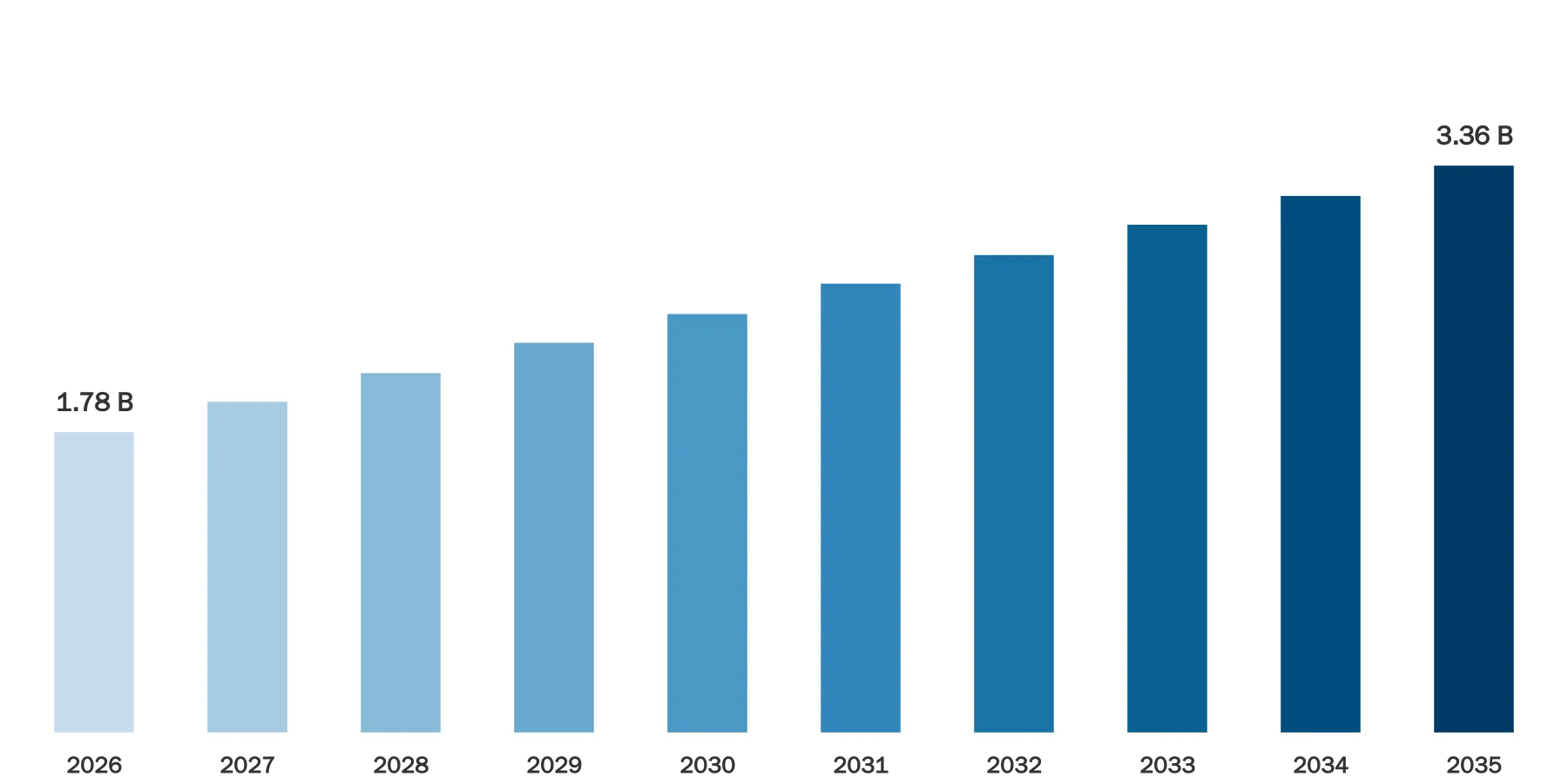
Source: Econ Market Research
Numerous scientific and engineering applications employ the potent nanofabrication and imaging method known as the focused ion beam (FIB). In order to selectively remove material from a sample or precisely deposit material onto a surface, it uses a narrowly focused stream of ions, often gallium ions. The main benefit of FIB is its capacity to carry out extremely localized operations on a nanoscale scale, which makes it crucial in industries like microelectronics, materials science, and biological research. An ion source, an ion column, a scanning system, and detectors make up FIB systems. In addition to material removal and deposition, FIB is widely used for imaging and cutting samples into cross sections for examination.
Focused Ion Beam Market Dynamics
The need for FIB systems is fueled by the growing need for miniaturization and accurate production across a range of sectors, including Semiconductor, electronics, and materials science. A significant motivator is FIB's capacity for high precision and resolution nanoscale operations. Improvements in FIB technology, such as enhanced ion sources, scanning apparatus, and detectors, increase the systems' functionality and effectiveness, drawing in additional users. Furthermore, the rising uses of FIB in industries including materials characterization, failure analysis, and biological research present fresh prospects for market expansion.
Focused Ion Beam Market Drivers
Advancements in Semiconductor Manufacturing
FIB technology plays a crucial role in the semiconductor industry for tasks such as failure analysis, editing integrated circuits, and circuit modification. With the increasing demand for smaller and more powerful electronic devices, the need for precise and accurate fabrication and analysis techniques offered by FIB systems is growing.
Restraints
Competition from Alternative Technologies
Focused Ion Beam systems are sophisticated and expensive instruments, limiting their affordability for small and medium-sized enterprises. The substantial initial investment and maintenance costs can deter potential customers from adopting this technology.
Opportunities
Integration with Other Technologies
Integration of FIB systems with other analytical tools, such as scanning electron microscopes (SEM) and transmission electron microscopes (TEM), can enhance the overall capabilities and functionality. This integration opens up possibilities for new applications and attracts potential customers from multiple industries.
Segment Overview
By Ion Source
Based on ion source, the global focused ion beam market is divided into Ga+ liquid metal, gas field, and plasma. The Ga+ liquid metal dominates the market with the largest revenue share of around 47.2% in 2022. Ga+ liquid metal ion sources provide various advantages over a gas field and plasma sources, including a longer operating lifespan, which reduces the need for frequent replacements and downtime. They have increased brightness, which results in better image resolution and material manipulation precision. Ga+ liquid metal sources also provide improved ion beam control, enabling for more precise and targeted material removal or deposition.
By Vertical
Based on vertical, the global focused ion beam market is divided into electronics &, semiconductors, industrial science, bioscience, and material science. The electronics & semiconductors dominate the market with the largest revenue share of around 33.5% in 2022. The growing need for smaller, quicker, and more powerful electronic gadgets demands new production and analytical procedures. FIB technology has extraordinary capabilities for precise material manipulation, imaging, and failure analysis, making it important in the electronics and semiconductor industries.
By Application
Based on application, the global focused ion beam market is divided into failure analysis, nanofabrication, device modification, circuit edit, and counterfeit detection. The failure analysis category is anticipated to grow at a higher CAGR of 6.8% during the forecast period. Because of the rising complexity and miniaturization of electronic equipment, the demand for failure analysis methodologies is expected to expand significantly. Failure analysis is critical in finding and correcting problems in electronic components and systems. Furthermore, the growing semiconductor and electronics sectors, as well as the increasing use of FIB systems in R&,D, help to the expansion of the failure analysis market.
Focused Ion Beam Market Overview by Region
The global focused ion beam market is divided into North America, Europe, Asia-Pacific, and the Rest of the World. North America emerged as the frontrunner with the largest revenue share, accounting for approximately 40.6% of the global market in 2022. In North America, numerous prominent firms operating in the semiconductor, electronics, and materials science industries extensively utilize focused ion beam (FIB) technology. The region',s strong emphasis on technological advancements and innovation fosters a high demand for FIB systems. Additionally, the presence of well-established research institutes, universities, and government programs dedicated to nanotechnology research and development contributes to the expansion of the market.
Focused Ion Beam Market Competitive Landscape
In the global focused ion beam market, a few major players hold significant market dominance and have established a strong regional presence. These leading companies are committed to ongoing research and development efforts and actively engage in strategic growth initiatives such as product creation, product launches, joint ventures, and partnerships. Through these strategies, these companies aim to enhance their market position, expand their customer base, and capture a significant share of the market.
Key Players
Thermo Fisher Scientific Inc. (FEI Company)
ZEISS International (Carl Zeiss AG)
Hitachi High-Tech Corporation
JEOL Ltd.
TESCAN ORSAY HOLDING
Raith GmbH
Oxford Instruments plc
Veeco Instruments Inc.
Leica Microsystems GmbH
Focus GmbH
Ionoptika Ltd.
A&D Company, Limited
Delong Instruments
Fibics Incorporated
Applied Beams LLC
Elionix Inc.
zeroK NanoTech Corporation
Nanosurf AG
Cordouan Technologies
SII NanoTechnology Inc.
Focused Ion Beam Market Recent Developments
In August 2022, Thermo Fisher Scientific Inc. has unveiled the Arctis Cryo-Plasma Focused Ion Beam (Cryo-PFIB), a cutting-edge microscope that incorporates cryo-electron tomography (cryo-ET) research. This innovative system provides integrated and automated capabilities, allowing researchers to improve their cryo-ET study.
Focused Ion Beam Market Report Scope & Segmentation
| Attributes | Details |
|---|---|
Market Size (Current) | US$ 1.78 Billion in 2026 |
Market Size (Forecast) | US$ 3.36 Billion in 2035 |
Growth Rate | CAGR of 7.3% from 2026 to 2035 |
Forecast Period | 2026 – 2035 |
Base Year | 2025 |
Historical Data Available | Yes |
Regional Scope | Global |
Segments Covered | By Ion Source
By Application
By Vertical
|
Frequently Asked Questions
Common questions about this report
The study period covers historical insights and forecast projections for the period 2026-2035.
About the Author
Market research expert with years of industry experience

Dipali Bhingare serves as the Market Research Director at Econ Market Research. With a focus on translating complex global economic shifts into actionable business intelligence, she oversees the strategic direction of comprehensive market studies. Her work empowers organizations to navigate volatile industries through data-driven forecasting and deep-dive competitive analysis.
Related Reports
Explore more market insights from the same category