

Solid State Battery Market
Solid State Battery Market Size, Share, Trends, Growth, and Industry Analysis, By Type (Thin Film, Portable), By Capacity (Below 20 mAh, 20 mAh to 500 mAh, Above 500 mAh), By Application (Consumer Electronics, Electric Vehicles, Medical Devices, Energy Storage), Regional Analysis and Forecast Period 2026-2035
Solid State Battery Market Overview
As per Econ Market Research analysis, Global Solid State Battery Market size stood at US$ 2.3 Billion in 2026 and is projected to reach US$ 27.7 Billion by 2035, growing at a CAGR of 38% over the forecast period 2026–2035. 2025 is taken as the base year.
Solid State Battery Market Size 2025-2035 (USD Billion)

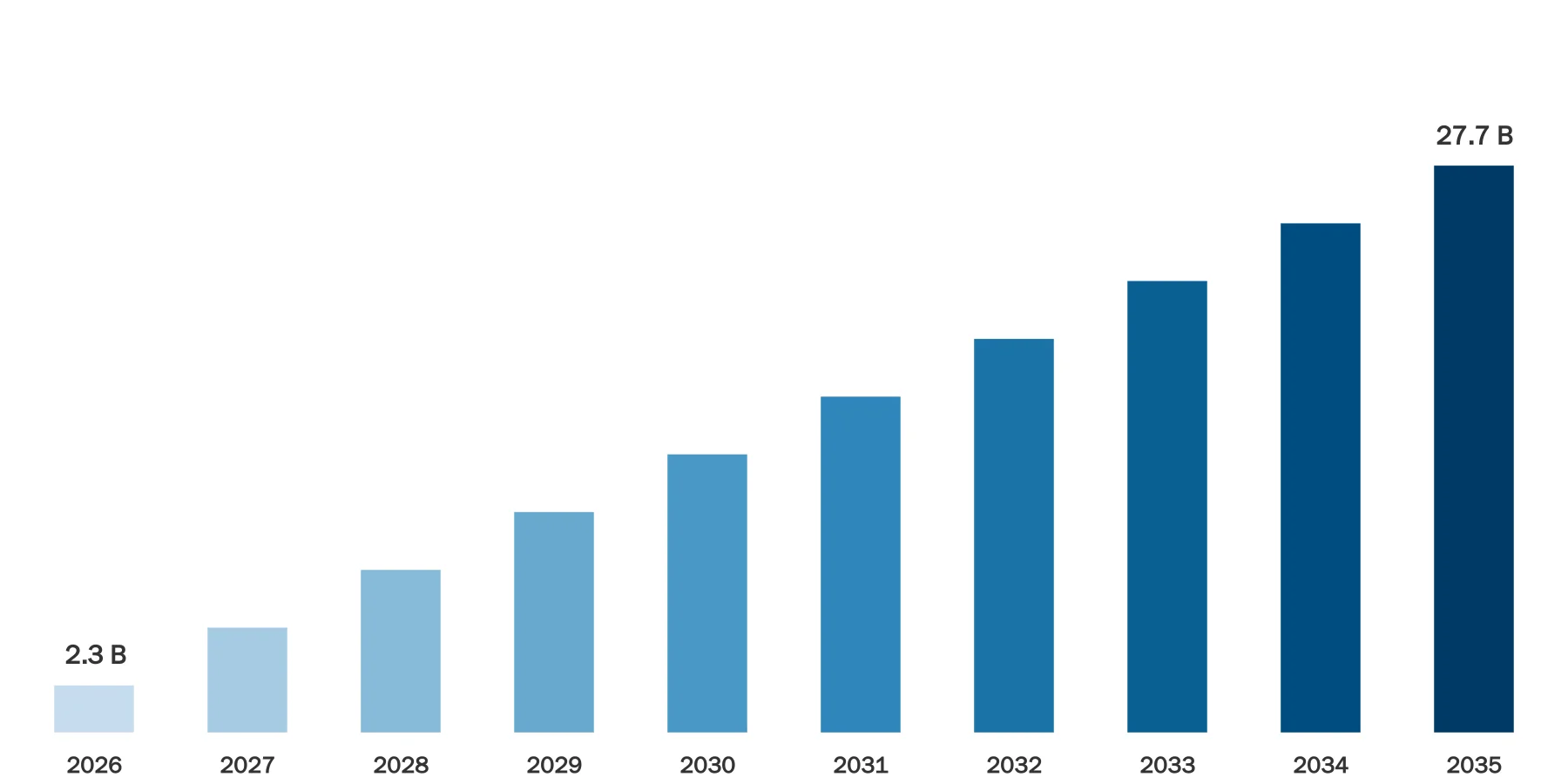
Source: Econ Market Research
Solid-state batteries represent a paradigm shift in battery technology, offering superior performance, enhanced safety, and longer lifespan compared to traditional lithium-ion batteries. These batteries utilize solid electrolytes instead of liquid or gel electrolytes found in conventional batteries, enabling higher energy density and faster charging rates. With applications spanning across various industries such as automotive, consumer electronics, and renewable energy, solid-state batteries are driving innovation and reshaping the future of energy storage solutions. The market is propelled by increasing demand for electric vehicles (EVs) with longer driving ranges, coupled with growing concerns about environmental sustainability and the need for energy-efficient technologies.
Solid State Battery Dynamics
Rapid advancements in technology and materials science are propelling the market forward, enabling the development of solid electrolyte materials with improved conductivity and stability. These technological breakthroughs are fostering intense competition among industry players, driving research and development efforts to enhance battery performance and reduce manufacturing costs. Additionally, stringent regulatory frameworks aimed at curbing greenhouse gas emissions and promoting sustainable energy solutions are incentivizing the adoption of solid-state batteries in electric vehicles, consumer electronics, and renewable energy systems.
The growing emphasis on energy efficiency, coupled with increasing investments in Electric Vehicle infrastructure and renewable energy projects, is further bolstering market growth. Moreover, shifting consumer preferences towards electric vehicles with longer driving ranges and faster charging capabilities are fuelling demand for high-performance solid-state batteries.
The automotive industry, in particular, is witnessing a significant surge in investments and partnerships aimed at developing next-generation battery technologies to meet evolving consumer expectations and regulatory requirements. Furthermore, strategic collaborations between battery manufacturers, automakers, and technology firms are driving innovation and accelerating the commercialization of solid-state batteries. However, challenges such as scalability, manufacturing complexity, and the need for standardization pose hurdles to widespread adoption.
Solid State Battery Drivers
Advancements in Technology:
Solid-state battery development is progressing significantly due to ongoing advances in materials science, nanotechnology, and battery engineering. Advancements in solid electrolyte composition, electrode structure, and production techniques are augmenting the efficacy, security, and energy density of solid-state batteries. Higher efficiency, longer lifespans, and faster charging rates are made possible by these technological advancements, which is hastening the solid-state battery',s adoption in a number of industries, including automotive, electronics, and renewable energy.
Regulatory Support and Environmental Concerns:
Solid-state battery adoption is being driven by strict regulations that aim to reduce greenhouse gas emissions and promote sustainable energy solutions. Solid-state battery technology is helping to promote the shift to electric vehicles and renewable energy sources, which are being supported by policies and incentives put in place by governments across the globe. Furthermore, the market for solid-state batteries is being further propelled by growing consumer awareness and concerns about environmental sustainability, which is driving demand for cleaner energy storage solutions.
Restraints:
Solid-state battery production is still an expensive and intricate process, despite advances in technology. Higher production costs than with conventional lithium-ion batteries are a result of the need for specialised machinery and exact control over manufacturing parameters in order to produce solid electrolytes and integrate them into battery cells. High manufacturing costs prevent solid-state battery production from scaling up and prevent their widespread use, especially in markets where cost is a factor.
Limited Scalability and Commercialization Challenges:
The commercialization of solid-state batteries faces scalability challenges related to production volume, supply chain management, and manufacturing infrastructure. Scaling up production to meet increasing demand while maintaining product quality and consistency is a significant challenge for battery manufacturers. Moreover, the transition from research and development to mass production requires substantial investments in production facilities, equipment, and workforce training, which may deter potential investors and delay market entry.
Opportunities:
Energy Storage Solutions for Renewable Energy:
The demand for sophisticated energy storage solutions that can efficiently store and distribute intermittent renewable energy is being driven by the shift to renewable energy sources like solar and wind power. Solid-state batteries are a good choice for grid-scale energy storage applications because of their high energy density, quick cycle life, and quick charging rates. The market for solid-state batteries in energy storage solutions is anticipated to grow as the demand for renewable energy sources keeps rising, offering chances for battery producers, utilities, and renewable energy developers to profit from this developing market niche.
Segment Overview
By Type
The types of solid-state batteries include thin-film batteries, portable batteries, and other specialized variants. Thin-film batteries are characterized by their ultra-thin profile and flexibility, making them suitable for applications where space and weight are critical factors. Portable batteries are designed for use in consumer electronics, wearable devices, and other portable gadgets, offering compactness and lightweight for on-the-go usage. The ",other", category comprises niche variants tailored to specific industrial or research applications, leveraging solid-state battery technology for specialized purposes.
By Category:
Solid-state batteries are categorized as single-cell or multi-cell batteries based on their configuration and cell arrangement. Single-cell batteries consist of a single electrochemical cell, offering simplicity and compactness for applications with space constraints. Multi-cell batteries feature multiple interconnected cells, providing higher energy capacity and voltage levels, suitable for demanding applications such as electric vehicles and grid-scale energy storage systems.
By Capacity:
Capacity segmentation categorizes solid-state batteries based on their energy storage capacity. Batteries with a capacity of less than 20 mAh are typically used in small electronic devices, sensors, and smart cards where power requirements are minimal. Those ranging between 20 mAh to 500 mAh find applications in various consumer electronics, wearable devices, and portable gadgets, offering a balance between size and energy output. Batteries with capacities above 500 mAh are deployed in high-power applications such as electric vehicles, Medical Devices, and grid-scale energy storage solutions, where longer runtime and higher energy demands are essential.
By Rechargeability:
Solid-state batteries are classified as primary or secondary batteries based on their rechargeability. Primary batteries are designed for single-use applications, offering convenient and maintenance-free power solutions for devices like remote controls, disposable medical devices, and electronic toys. Secondary batteries, also known as rechargeable batteries, can be recharged and reused multiple times, making them ideal for applications requiring extended operational lifespans and reduced environmental impact.
By Application:
The diverse applications of solid-state batteries encompass consumer electronics, electric vehicles, energy harvesting, entertainment, medical devices, packaging, portable devices, smart cards, wearable devices, wireless communication, and other specialized fields. Each application leverages the unique characteristics of solid-state batteries to enhance performance, safety, and sustainability, driving innovation and market growth across various industries and sectors.
Solid State Battery Overview by Region
North America, driven by the United States, holds a prominent position in the market, owing to robust research and development activities, strategic collaborations between industry stakeholders, and government initiatives to promote clean energy technologies. The region',s thriving electric vehicle market, coupled with increasing investments in renewable energy infrastructure, fuels demand for solid-state batteries across automotive, consumer electronics, and energy storage applications. In Europe, countries like Germany, France, and the United Kingdom lead the charge towards decarbonization and sustainable mobility, driving significant investments in solid-state battery technology.
The European Union',s stringent emission targets and incentives for electric vehicle adoption further accelerate market growth. Asia Pacific emerges as a key hub for solid-state battery production and innovation, with countries like Japan, South Korea, and China at the forefront of technological advancements. Rapid urbanization, increasing disposable incomes, and government support for electric vehicle adoption propel market expansion in the region. China, in particular, boasts a robust manufacturing ecosystem and a rapidly growing electric vehicle market, positioning itself as a global leader in solid-state battery production and deployment.
Solid State Battery Market Competitive Landscape
Leading companies such as Toyota, Samsung SDI, and Panasonic Corporation are at the forefront of innovation, leveraging their extensive R&,D capabilities and manufacturing expertise to develop cutting-edge solid-state battery technologies. These industry giants focus on strategic partnerships, acquisitions, and investments to bolster their product portfolios and gain a competitive edge in the market.
Start-ups and emerging players, including QuantumScape, Solid Power, and ProLogium, are driving innovation and disrupting the market with novel approaches to solid-state battery design and manufacturing. These nimble contenders capitalize on venture capital funding, government grants, and collaborative research initiatives to accelerate technology development and scale up production capabilities.
Moreover, a vibrant ecosystem of research institutions, academic organizations, and industry consortia fosters collaboration and knowledge exchange, driving advancements in solid-state battery materials, manufacturing processes, and performance optimization. As market demand intensifies and regulatory pressures mount, players across the solid-state battery value chain are compelled to enhance product quality, reduce costs, and address critical performance parameters to meet evolving customer requirements and gain a competitive advantage.
Solid State Battery Market Leading Companies:
QuantumScape Corporation
Solid Power, Inc.
Toyota Motor Corporation
Ilika plc
Samsung SDI Co., Ltd.
Panasonic Corporation
LG Energy Solution
ProLogium Technology Co., Ltd.
Murata Manufacturing Co., Ltd.
Sakuu Corporation
Solid State Battery Recent Developments
Dec 2023, Changan Automobile, a prominent player in the automotive industry, and Ganfeng Lithium, the world',s leading lithium producer by market capitalization, have forged a collaborative venture with equal ownership stakes.
Oct 2022, Automotive Cells Company (ACC) and ProLogium Technology have entered into a Memorandum of Understanding (MOU) to collaborate on the advancement of solid-state batteries for electric vehicles (EVs). The agreement outlines joint efforts between ACC and ProLogium to develop solid-state EV batteries. Together, they will work on creating ",ProLogium Inside", EV battery solutions for customers, leveraging ProLogium',s cutting-edge solid-state battery technology. Additionally, both parties will explore supply chain and industrial agreements to support the development and production process.
Global Solid State Battery Report Segmentation
Solid State Battery Market Report Scope & Segmentation
| Attributes | Details |
|---|---|
Market Size (Current) | US$ 2.3 Billion in 2026 |
Market Size (Forecast) | US$ 27.7 Billion in 2035 |
Growth Rate | CAGR of 38% from 2026 to 2035 |
Forecast Period | 2026 – 2035 |
Base Year | 2025 |
Historical Data Available | Yes |
Regional Scope | Global |
Segments Covered | By Type
By Capacity
By Application
|
Frequently Asked Questions
Common questions about this report
The study period covers historical insights and forecast projections for the period 2026-2035.
About the Author
Market research expert with years of industry experience

Related Reports
Explore more market insights from the same category