

Solar Energy Market
Solar Energy Market Size, Share, Trends, Growth, and Industry Analysis, By Technology (Photovoltaic Systems, Concentrated Solar Power Systems), By Solar Module (Monocrystalline, Polycrystalline, Cadmium Telluride, Amorphous Silicon Cells), By Application (Residential, Commercial, Industrial), Regional Analysis and Forecast Period 2026-2035
Market Overview
As per Econ Market Research analysis, the Global Solar Energy Market size amounted to US$ 304.32 Billion in 2026 and is anticipated to grow to US$ 522.71 Billion by 2035, recording a CAGR of 6.21% during 2026–2035. The base year taken for analysis is 2025.
Solar Energy Market Size 2025-2035 (USD Billion)

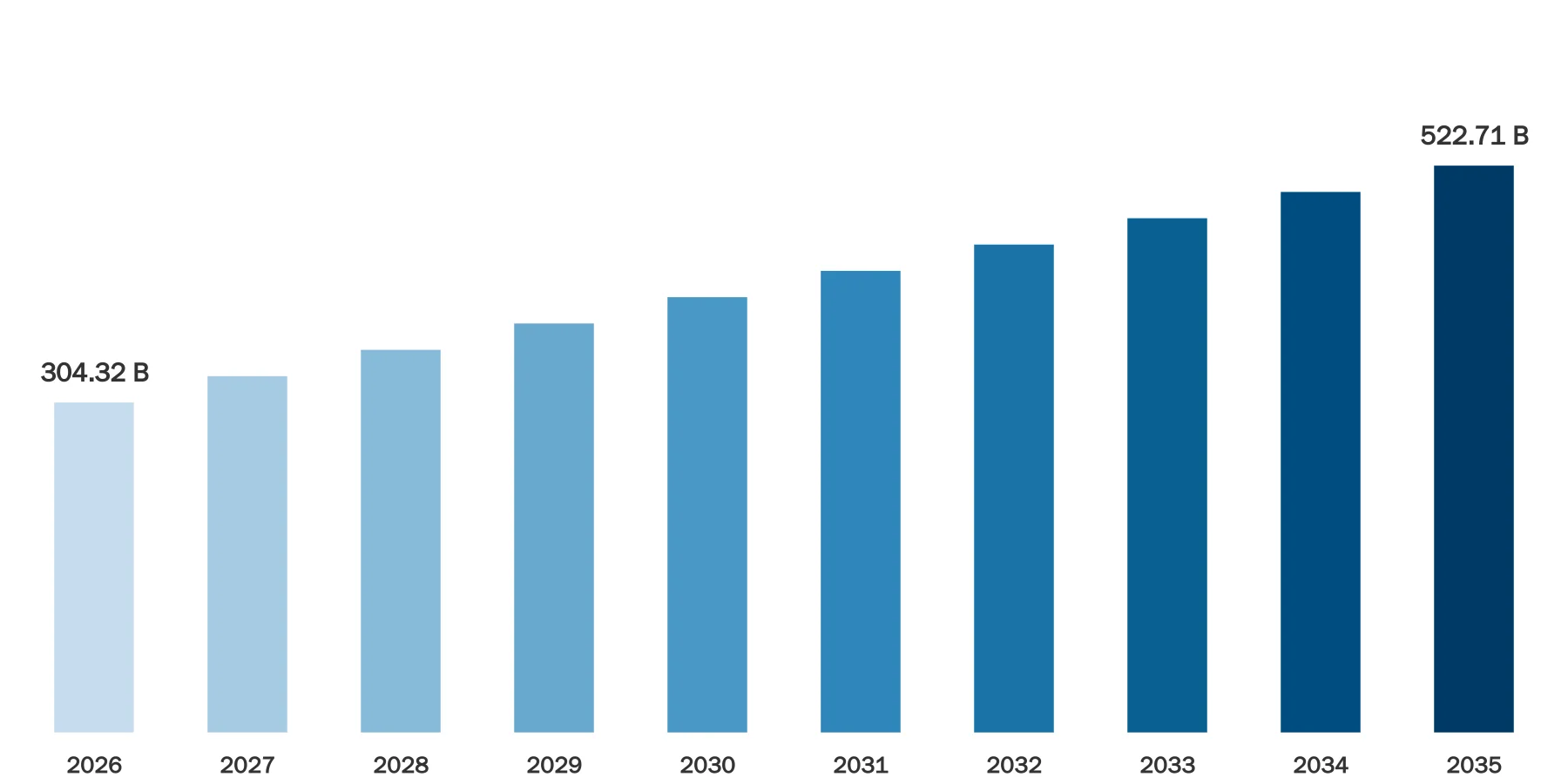
Source: Econ Market Research
Solar energy harnesses the power of sunlight through Photovoltaic (PV) panels or Concentrated Solar Power (CSP) systems, converting it into electricity or heat for various applications. The market encompasses a diverse range of technologies, including rooftop solar installations, utility-scale solar farms, and off-grid solar solutions, catering to residential, commercial, and industrial sectors worldwide.
The solar energy market has grown significantly in recent years due to factors such as rising environmental concerns, government incentives, and technological advancements. Solar energy is becoming more and more competitive with traditional fossil fuels due to factors like falling solar panel costs, increasing efficiency, and improved storage solutions that have boosted adoption rates. Furthermore, the global shift to renewable energy sources has sparked investments and policy support for the deployment of solar energy across the globe, especially in light of the ambitious climate targets set by governments and international agreements like the Paris Agreement.
Solar Energy Dynamics
Technological advancements, including improvements in solar panel efficiency, energy storage solutions, and smart grid integration, continue to drive down costs and enhance the overall performance of solar energy systems. Moreover, the increasing demand for clean energy and the imperative to reduce carbon emissions have propelled governments worldwide to implement favourable policies and incentives, such as feed-in tariffs, tax credits, and renewable energy mandates, which have bolstered investment in solar energy infrastructure.
The proliferation of solar technology providers and project developers has fueled market competition, which in turn has led to innovation in financing mechanisms, business models, and product offerings, thereby propelling market diversification and growth. Demand for solar energy solutions has also increased as a result of consumers', and businesses', growing awareness of environmental sustainability and corporate social responsibility. This is especially true in the commercial and industrial sectors, where solar power offers advantages in terms of both reputation and cost.
Solar Energy Drivers
Declining Costs of Solar Panel:
The steadily falling cost of solar panels is one of the main factors driving the global solar energy market. Over the past ten years, there has been a significant decrease in the cost of solar photovoltaic (PV) modules due to technological advancements, economies of scale, and increased manufacturing efficiencies. Due to its decreased cost, solar energy is now more competitive than traditional fossil fuels, which is encouraging adoption in utility-scale, commercial, and residential applications. As solar technology gets more accessible, more people and businesses can adopt it, which encourages the global deployment and penetration of solar energy systems.
Policy Support and Incentives:
The growth and investment in the solar energy market are largely driven by government policies and incentives. To encourage the deployment of solar energy and lower greenhouse gas emissions, numerous nations have put in place renewable energy targets, feed-in tariffs, tax credits, and subsidies. Through the creation of a regulatory environment that is favourable to solar projects, these policies encourage investment from the private sector and promote innovation in solar technology and project financing. International agreements like the Paris Agreement have strengthened pledges to switch to clean energy sources, which has strengthened policy support for the global development of solar energy.
Restraints:
Intermittency and Grid Integration Challenges:
Solar energy generation is sporadic and weather-dependent, which presents problems for grid stability and reliability despite its many benefits. Sophisticated grid management systems, energy storage options, and adaptable demand-response mechanisms are needed to integrate variable solar power into current electrical grids and balance supply and demand in real time. In order to overcome these grid integration obstacles and allow for increased penetration of renewable energy sources without sacrificing system reliability or grid stability, large investments in regulatory changes and grid infrastructure upgrades are needed.
Supply Chain Vulnerabilities:
The solar energy market is highly dependent on complex global supply chains for raw materials, components, and equipment used in solar panel manufacturing and installation. Disruptions in the supply chain, such as trade disputes, geopolitical tensions, or natural disasters, can lead to supply shortages, price volatility, and project delays, impacting the growth and stability of the solar energy market. Mitigating supply chain vulnerabilities requires diversification of sourcing strategies, localizing manufacturing capabilities, and enhancing supply chain resilience through strategic partnerships and investments in domestic and regional manufacturing capacity.
Opportunities:
Energy Storage Integration:
There are several opportunities to increase grid flexibility, boost system reliability, and optimise the value of solar generation when energy storage technologies are integrated with solar energy systems. The ability to store and dispatch solar power when demand is highest or sunlight is scarce due to advancements in battery storage technologies like lithium-ion batteries, flow batteries, and hydrogen storage reduces dependency on fossil fuel-based peaker plants and increases the penetration of renewable energy in electricity markets.
Segment Overview
By Type
The global solar energy market is segmented by technology into Solar Photovoltaic (PV) and Concentrated Solar Power (CSP), each offering distinct advantages and applications. Solar PV technology converts sunlight directly into electricity using Semiconductor materials, such as silicon-based solar cells, housed within PV panels. PV systems are modular, scalable, and well-suited for various applications, ranging from residential rooftop installations to utility-scale solar farms.
On the other hand, Concentrated Solar Power (CSP) systems concentrate sunlight using mirrors or lenses to generate high-temperature heat, which is then used to produce steam and drive turbines for electricity generation. CSP technology is particularly suitable for utility-scale applications, where large-scale solar thermal power plants can be deployed in regions with high solar irradiance and ample land availability.
By Application
In terms of applications, the solar energy market encompasses residential, non-residential, and utility segments, each serving distinct end-users and market dynamics. Residential solar installations involve the deployment of rooftop PV systems on individual homes, enabling homeowners to generate clean electricity for self-consumption or export excess power to the grid through net metering arrangements. Non-residential applications encompass commercial, industrial, and institutional buildings, where solar PV systems are installed on rooftops, carports, or ground-mounted arrays to offset electricity consumption, reduce operating costs, and demonstrate environmental leadership.
The utility segment represents large-scale solar projects developed by utilities, independent power producers (IPPs), and energy developers to supply electricity to the grid for distribution to consumers. Utility-scale solar farms typically consist of megawatt-scale PV arrays or CSP power plants deployed in sunny regions with favourable solar resources and grid infrastructure. These projects benefit from economies of scale, efficient land use, and centralized operations, making them cost-effective contributors to the energy mix.
Solar Energy Overview by Region
Asia-Pacific stands as a dominant force in the solar energy market, driven by rapid economic growth, supportive government policies, and ambitious renewable energy targets in countries like China, India, and Japan. China, in particular, has emerged as the world',s largest solar market, accounting for a significant share of global solar PV installations, spurred by generous subsidies, feed-in tariffs, and favorable regulatory incentives. India',s solar market is also experiencing rapid expansion, fuelled by ambitious capacity targets, competitive bidding processes, and declining solar tariffs, which have made solar power increasingly cost-competitive with conventional energy sources.
In Europe, countries such as Germany, Spain, and the United Kingdom have been at the forefront of solar energy adoption, leveraging feed-in tariffs, net metering schemes, and renewable energy directives to drive investment in solar PV installations and promote energy transition objectives. Moreover, the European Union',s Green Deal and carbon neutrality goals are expected to further accelerate solar deployment and stimulate innovation in energy storage and grid integration technologies. North America presents a dynamic solar energy market, with the United States leading in solar capacity additions, driven by federal investment tax credits, state-level renewable portfolio standards, and declining technology costs.
Emerging markets in Latin America, such as Mexico, Chile, and Brazil, are also witnessing significant growth in solar energy deployment, driven by favourable solar resources, competitive auction mechanisms, and energy market reforms. In Africa and the Middle East, countries with abundant solar resources, including Morocco, South Africa, and the United Arab Emirates, are investing in utility-scale solar projects, off-grid electrification initiatives, and renewable energy targets to diversify their energy mix, enhance energy security, and stimulate economic development.
Solar Energy Market Competitive Landscape
Leading solar panel manufacturers such as JinkoSolar, Canadian Solar, and LONGi Solar dominate the market with their extensive product portfolios, technological expertise, and economies of scale. These companies continually innovate to improve solar panel efficiency, reduce manufacturing costs, and enhance product reliability to maintain their competitive edge in the market. In addition to panel manufacturers, a plethora of solar project developers and EPC contractors compete to develop, construct, and commission solar installations across residential, commercial, and utility-scale segments.
Companies like SunPower, First Solar, and Sunrun are prominent players in the solar project development space, leveraging their industry experience, project pipelines, and financing capabilities to secure contracts and expand market share. Furthermore, technological advancements in energy storage, smart grid solutions, and digital analytics are driving the emergence of new players offering integrated solar-plus-storage solutions and energy management platforms to optimize system performance and maximize returns on investment.
Solar Energy Market Leading Companies:
NextEra Energy
First Solar
Enphase Energy
Trina Solar
JA Solar
Canadian Solar
SunPower Corporation
SolarEdge Technologies
Longi Green Energy Technology
Iberdrola
Solar Energy Recent Developments
Oct 2023, Amazon has unveiled plans for a new 198 megawatt (MW) wind farm situated in Osmanabad, Maharashtra, India. This project marks Amazon',s 50th wind and solar venture across India, propelling its total renewable energy capacity past 1.1 gigawatts (GW). Notably, Amazon maintains its status as the foremost corporate purchaser of renewable energy worldwide, a position it has held since 2020.
Dec 2023, The Board of Directors at HUL has given the green light for an equity investment of up to 27.73% (and potentially up to 32.24% when factoring in HUL',s wholly-owned subsidiaries) in Transition Sustainable Energy Services One Private Limited. This Special Purpose Vehicle (SPV) was established by Brookfield, a prominent global alternative asset manager renowned for its expansive renewable power portfolio. The SPV has been established under the Government',s Group Captive Open Access Renewable Energy Scheme.
Oct 2023, Sungrow, a prominent global provider of inverters and energy storage systems, showcased its extensive renewable energy solutions and unveiled new products tailored for the Indian market. Given India',s pivotal position in transitioning its energy landscape, Sungrow',s innovative offerings are poised to enhance the nation',s energy infrastructure, facilitating the expansion of efficient, secure, and environmentally friendly energy utilization.
Global Solar Energy Report Segmentation
Solar Energy Market Report Scope & Segmentation
| Attributes | Details |
|---|---|
Market Size (Current) | US$ 304.32 Billion in 2026 |
Market Size (Forecast) | US$ 522.71 Billion in 2035 |
Growth Rate | CAGR of 6.21% from 2026 to 2035 |
Forecast Period | 2026 – 2035 |
Base Year | 2025 |
Historical Data Available | Yes |
Regional Scope | Global |
Segments Covered | By Technology
By Solar Module
By Application
|
Frequently Asked Questions
Common questions about this report
The study period covers historical insights and forecast projections for the period 2026-2035.
About the Author
Market research expert with years of industry experience

Related Reports
Explore more market insights from the same category