

Perovskite Solar Cell Market
Perovskite Solar Cell Market Size, Share, Growth, Trends, Analysis, By Structure Type (Planar Perovskite Solar Cells and Mesoporous Perovskite Solar Cells), By Product Type (Rigid Perovskite Solar Cells and Flexible Perovskite Solar Cells), By Method (Solution Method, Vapor-Deposition Method, and Vapor-Assisted Solution Method), By End-User (Aerospace, Industrial Automation, Consumer Electronics, Energy, and Others), and Regional Insights and Forecast
Market Overview
As per Econ Market Research analysis, the Global Perovskite Solar Cell Market was valued at US$ 0.56 Billion in 2026 and is expected to reach US$ 66.58 Billion by 2035, registering a CAGR of 69.39% during the forecast period 2026–2035. The base year considered is 2025.
Perovskite Solar Cell Market Size 2025-2035 (USD Billion)

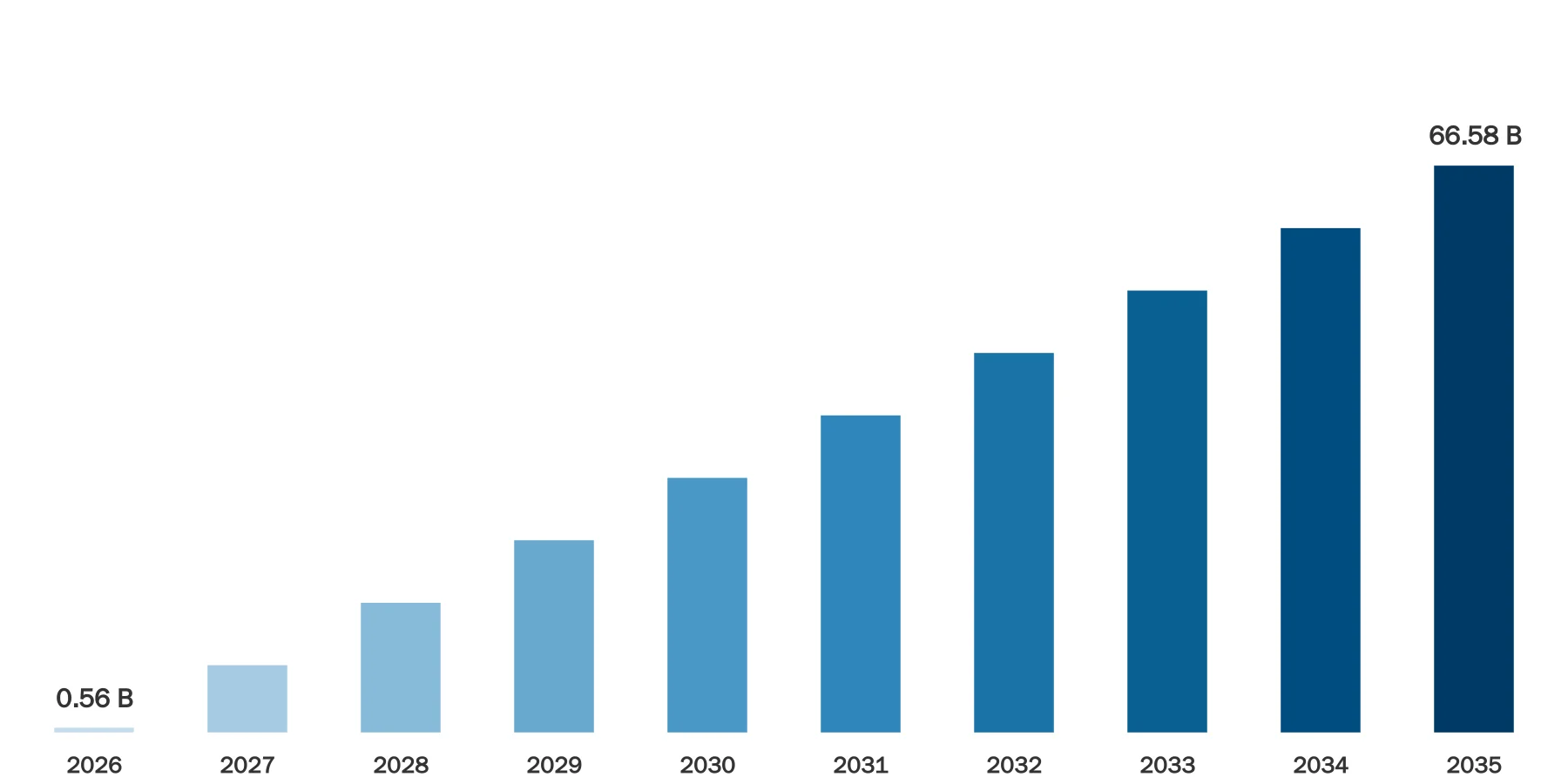
Source: Econ Market Research
Perovskite solar cells are a new type of Photovoltaic technology that has received a lot of interest in recent years. They get their name from the perovskite crystal structure, which is made up of a hybrid organic-inorganic lead halide substance. These solar cells have piqued the interest of researchers because of their amazing qualities, which include high power conversion efficiency and cheap fabrication costs. Perovskite solar cells are a possible alternative to traditional silicon-based solar cells since they can be easily synthesized by utilizing low-temperature solution-based processes. They have a wide absorption spectrum, allowing them to absorb more of the sun spectrum. Perovskite materials also have good charge transport characteristics, allowing for the effective conversion of sunlight into energy.
Perovskite Solar Cell Market Dynamics
Perovskite solar cells have shown the capacity to attain efficiencies equivalent to, if not exceeding, that of classic silicon-based solar cells. Because of their efficiency, they are an appealing alternative for renewable energy generation. Perovskite solar cells', cheap manufacturing costs contribute to their market expansion. These cells' manufacturing methods are very straightforward and can be carried out at lower temperatures, lowering production costs as compared to silicon-based alternatives. This cost advantage has the potential to make perovskite solar cells more affordable and competitive in the market. The adaptability of perovskite materials is driving commercial innovation. Perovskite solar cells may be synthesized in a variety of compositions and architectures, allowing for customization for specific purposes and the creation of flexible and transparent solar cells.
Perovskite Solar Cell Market Drivers
High Efficiency and Low-Cost Potential
Perovskite solar cells offer the potential for high energy conversion efficiencies and low production costs compared to traditional silicon-based solar cells. This combination of high efficiency and low cost makes perovskite solar cells an attractive option for renewable energy deployment, as they can provide a cost-effective solution for meeting the growing global energy demand while reducing reliance on fossil fuels.
Restraints:
Competition from Established Technologies
Perovskite solar cells face strong competition from well-established solar technologies, particularly silicon-based solar cells, which have a mature market presence. The dominance of established technologies poses a challenge for the adoption and market growth of perovskite solar cells, requiring them to demonstrate superior performance, reliability, and cost-effectiveness to compete effectively in the solar industry.
Opportunities:
Building-Integrated Photovoltaics
Building-integrated photovoltaics refers to the integration of solar cells into building materials, such as windows, facades, or roofs, to generate electricity while maintaining the building',s functionality. Perovskite solar cells, due to their flexibility, lightweight nature, and semi-transparency, offer architectural integration opportunities for BIPV applications, enabling buildings to generate clean energy while seamlessly blending with their design aesthetics.
Segment Overview
By Structure Type
Based on the structure type, the global perovskite solar cell market is divided into planar perovskite solar cells and mesoporous perovskite solar cells. The planar perovskite solar cells category dominates the market with the largest revenue share of around 53.4% in 2022. Planar perovskite solar cells are more economically feasible than their predecessors due to their simpler device design and fabrication techniques. Material engineering and device optimization breakthroughs have considerably enhanced their power conversion efficiency.
By Method
Based on the method, the global perovskite solar cell market is divided into solution method, vapor-deposition method, and vapor-assisted solution method. The vapor-deposition method dominates the market with the largest revenue share of around 47.5% in 2022. The vapor-deposition approach provides fine control over the deposition process, allowing for the creation of uniform and high-quality perovskite films. This improves gadget performance and efficiency. Thermal evaporation and sputtering, for example, make it possible to produce perovskite layers on a variety of substrates, including flexible and stiff materials. The adaptability of perovskite solar cells broadens their potential uses.
By Product Type
Based on product type, the global perovskite solar cell market is divided into rigid perovskite solar cells and flexible perovskite solar cells. The flexible perovskite solar cells dominate the market with the largest revenue share of around 58.5% in 2022. This may be due to a number of things, including the fact that flexible perovskite solar cells have benefits like low weight, thinness, and bendability that make it possible for them to be integrated into a wide range of applications, such as wearable technology, photovoltaics that are built into buildings, and portable electronics. Concerns about these cells', long-term performance have been allayed because of improvements in flexible substrate materials and encapsulation methods, which have also increased the stability and toughness of these cells.
By End-User
Based on end-user, the global perovskite solar cell market is divided into aerospace, industrial automation, consumer electronics, energy, and others. The energy category is anticipated to grow at a higher CAGR of 30.6% during the forecast period. The increasing need for clean energy on a global scale in order to combat climate change concerns and wean the world off fossil fuels. Perovskite solar cells are a desirable alternative for generating energy due to their high efficiency and low cost. Perovskite solar cells are becoming more suited for large-scale energy generation due to ongoing improvements in stability, scalability, and durability brought about by improvements in perovskite materials and manufacturing processes.
Perovskite Solar Cell Market Overview by Region
The global perovskite solar cell market is categorized into North America, Europe, Asia-Pacific, and the Rest of the World based on regions. In 2022, Asia-Pacific emerged as the leading region, capturing the largest share of approximately 32.8% in the global market. This can be attributed to the rapid growth of solar energy in countries like China, Japan, and South Korea. These nations have made significant investments in renewable energy infrastructure and implemented favorable regulations and incentives to promote the adoption of solar technology. With a substantial population and increasing energy demand, Asia-Pacific presents a significant market for clean and sustainable energy solutions. Perovskite solar cells, known for their high efficiency and potential for cost-effective manufacturing, are seen as a promising alternative in this region.
Perovskite Solar Cell Market Competitive Landscape
The global perovskite solar cell market is dominated by a small number of prominent players who possess strong regional presence and exert significant market influence. These key participants are dedicated to continuous research and development endeavors and actively engage in strategic growth initiatives such as product innovation, launching new offerings, establishing joint ventures, and forming partnerships. By pursuing these strategies, these companies aim to strengthen their market position and expand their customer base, capturing a substantial share of the market.
Key Players
Greatcell Energy
Hanwha Q CELLS
CubicPV
EneCoat Technologies
Microquanta Semiconductor
P3C
Perovskia Solar AG
Xiamen Weihua Solar Co. Ltd.
Oxford PV
Saule Technologies
Swift Solar
GCL Perovskite (GCL Group)
Hunt Perovskite Technologies
Energy Materials Corporation
Perovskite Solar Cell Market Recent Developments
In February 2022, Microquanta Semiconductor, a prominent player in the perovskite solar cell market, has recently unveiled plans to construct a large-scale perovskite solar power facility in Quzhou, located in Zhejiang Province, China. The facility aims to harness the power of perovskite solar cells to generate clean and renewable energy, contributing to the region's sustainable development goals. This ambitious project demonstrates Microquanta Semiconductor's commitment to expanding their presence in the rapidly growing renewable energy market.
Perovskite Solar Cell Market Report Scope & Segmentation
| Attributes | Details |
|---|---|
Market Size (Current) | US$ 0.56 Billion in 2026 |
Market Size (Forecast) | US$ 66.58 Billion in 2035 |
Growth Rate | CAGR of 69.39% from 2026 to 2035 |
Forecast Period | 2026 – 2035 |
Base Year | 2025 |
Historical Data Available | Yes |
Regional Scope | Global |
Segments Covered | By Structure
By Product
By Application
By End-Use
|
Frequently Asked Questions
Common questions about this report
The study period covers historical insights and forecast projections for the period 2026-2035.
About the Author
Market research expert with years of industry experience

Related Reports
Explore more market insights from the same category