

Material Handling Equipment Market
Material Handling Equipment Market Size, Share, Trends, Growth, and Industry Analysis, By Product (Storage and Handling Equipment, Automated Storage and Retrieval Systems (ASRS), Industrial Trucks, Conveyors and Sortation Systems, Cranes and Lifting Equipment), By End-User Sector (Automotive, Food and Beverages, Chemical, Semiconductor and Electronics, E-commerce, Aviation, Pharmaceutical, Manufacturing, Logistics and Warehousing, Others), By Automation Level (Manual, Semi-Automated, Fully Automated), Regional Analysis and Forecast Period 2026-2035
Material Handling Equipment Market Overview
As per Econ Market Research analysis, the Global Material Handling Equipment Market was recorded at US$ 202.3 Billion in 2026 and is projected to expand to US$ 372.6 Billion by 2035, registering a CAGR of 7% over the forecast period. The base year used is 2025.
Material Handling Equipment Market Size 2025-2035 (USD Billion)

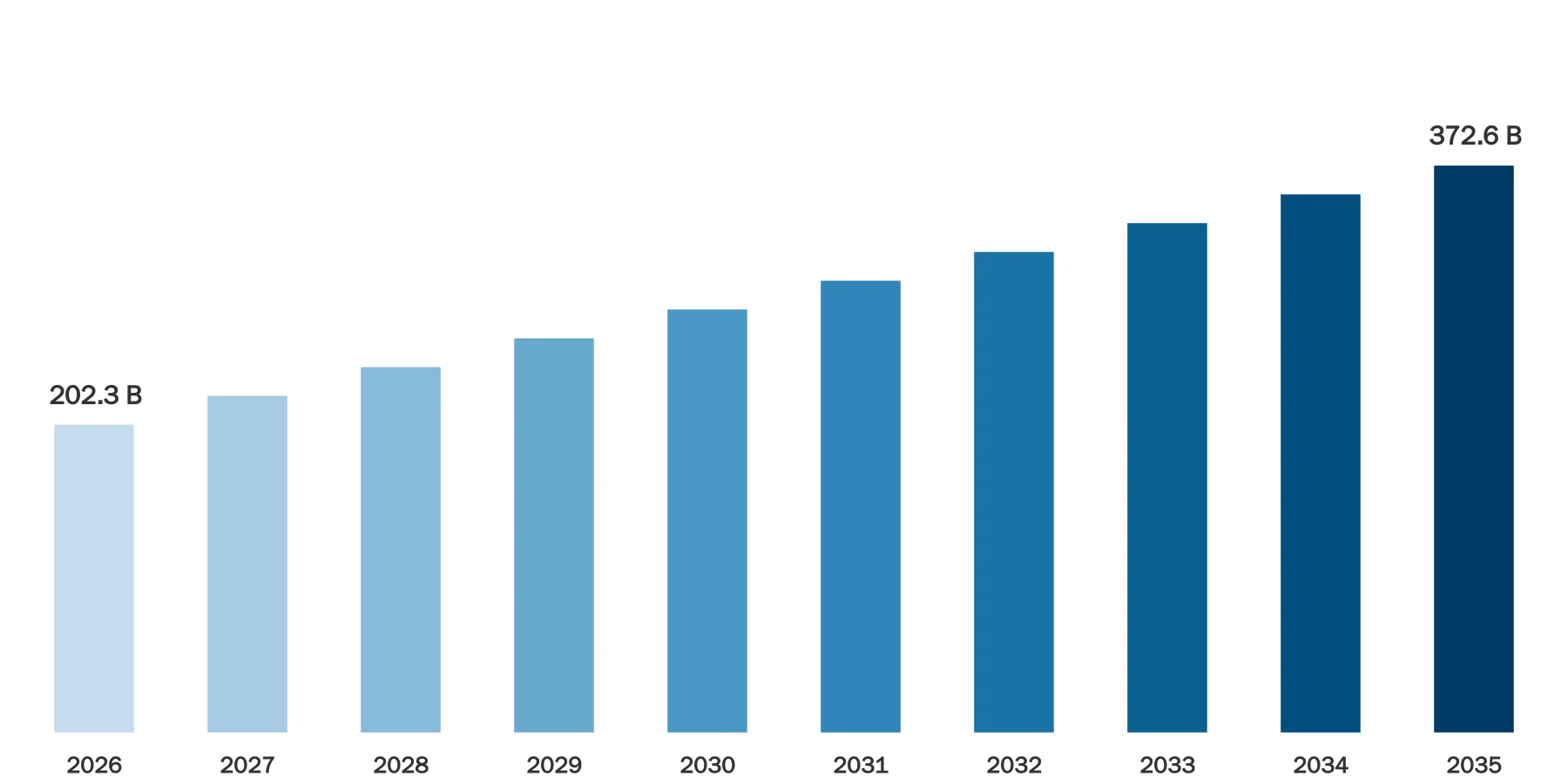
Source: Econ Market Research
The Supply Chain Management driven Material Handling Equipment Market is expanding rapidly due to rising warehouse capacity, Industrial Automation, and e-commerce order volumes. More than 3.6 million forklift units are expected to be shipped globally by 2034, while over 750,000 warehouse robots are already deployed across large fulfillment centers worldwide. Asia-Pacific accounted for nearly 38.6% of Automated Material Handling Equipment deployment in 2025. Industrial trucks represented around 45% of equipment installations in warehouse operations, while robotic systems exceeded 23% share in automated facilities. More than 65% of distribution centers with over 50,000 square feet are integrating conveyor systems, pallet handling systems, and automated storage technologies for operational efficiency.
The USA Material Handling Equipment Market remains one of the most technologically advanced industrial sectors, supported by more than 20,000 large warehousing facilities and rising logistics automation. Around 7,500 forklift-related workplace injuries and nearly 100 fatalities are reported annually, accelerating demand for autonomous forklifts and robotic material handling systems. Over 750,000 robotic systems are operating across automated fulfillment centers in the country. More than 40% of warehouse operators in the United States are upgrading to electric forklifts and lithium-ion battery platforms. Autonomous forklift pilots in large retail warehouses already include more than 19 robotic forklift units in operational testing. Warehouse labor optimization programs reduced manual handling dependency by approximately 15% in selected facilities during 2025.
The European Material Handling Equipment Market is characterized by advanced manufacturing infrastructure, strict workplace safety regulations, and strong industrial automation penetration. Germany, France, Italy, and the Netherlands collectively account for more than 55% of regional automated warehouse installations. Nearly 48% of European warehouses larger than 30,000 square meters use automated conveyors and sortation systems. Electric forklifts account for more than 70% of new forklift registrations across Western Europe. Smart factory investments increased installation of automated storage and retrieval systems by over 30% between 2023 and 2025. More than 12 major multinational material handling suppliers operate manufacturing or integration centers across Europe, supporting logistics, automotive, and semiconductor facilities with advanced robotics and warehouse management technologies.
Material Handling Equipment Market Latest Trends
The Material Handling Equipment Market is witnessing rapid transformation due to robotics integration, warehouse digitization, and electrification of industrial fleets. Autonomous mobile robots, automated guided vehicles, and AI-powered warehouse systems are increasingly replacing conventional manual operations. More than 23% of automated material handling installations in 2025 involved robotic systems, while nearly 49% of warehouse automation hardware investment focused on robotic storage and conveyor technologies. Electric forklifts now represent over 60% of newly procured warehouse lifting vehicles in developed economies.
E-commerce fulfillment centers are deploying high-speed sortation systems capable of processing over 10,000 parcels per hour. Around 65% of newly constructed warehouses larger than 100,000 square feet include integrated automated storage and retrieval systems. AI-enabled vision systems using YOLOv8 and YOLOv11 technologies are improving pallet detection accuracy in autonomous forklifts by more than 90% in pilot environments. Smart sensors, cloud warehouse management systems, and IoT-enabled inventory monitoring are reducing inventory errors by nearly 25%.
Sustainability trends are also reshaping the Material Handling Equipment Industry Analysis landscape. Lithium-ion batteries are replacing lead-acid systems in more than 35% of industrial truck fleets. Warehouse operators are targeting energy reductions of 20% to 30% through regenerative braking systems and smart conveyor motors. Automated pallet conveyors and robotic tuggers are reducing labor-intensive movement operations by nearly 40% in high-volume logistics centers.
Material Handling Equipment Market Dynamics
The Material Handling Equipment Market Outlook remains strongly linked to warehouse automation, industrial robotics, logistics infrastructure, and e-commerce fulfillment expansion. More than 58% of large warehouses globally are investing in semi-automated or fully automated handling systems. Automated equipment installations improved warehouse throughput by nearly 35% while reducing operational delays by approximately 28%. Growth in semiconductor production, pharmaceutical distribution, and food processing industries continues to support demand for conveyors, ASRS systems, industrial trucks, and robotic picking technologies. Increasing urban fulfillment centers and same-day delivery networks are also driving deployment of compact and modular handling systems across industrial facilities.
DRIVER
Rapid Expansion of E-commerce Warehousing
The strongest growth driver in the Material Handling Equipment Market Growth landscape is the rapid expansion of e-commerce warehouses and omnichannel fulfillment centers. Global fulfillment facilities processing more than 100,000 daily orders increased substantially between 2023 and 2025. More than 70% of major online retail distribution centers use conveyor systems, pallet shuttles, robotic sorting systems, and automated guided vehicles. Warehouse operators deploying automated material handling systems achieved order processing improvements exceeding 45%.
Large fulfillment operators already utilize over 750,000 robots across storage, picking, and transportation functions. Automated sortation systems capable of handling 12,000 parcels per hour are becoming standard in mega warehouses larger than 500,000 square feet. Rising parcel shipments, same-day delivery requirements, and SKU complexity exceeding 1 million product variations are forcing logistics operators to modernize warehouse infrastructure. Industrial truck electrification and autonomous forklifts are reducing fuel consumption by nearly 25% and improving operational uptime by over 15%.
RESTRAINT
High Initial Installation and Integration Costs
One of the major restraints in the Material Handling Equipment Market Research Report environment is the high cost of automation integration and infrastructure upgrades. Fully automated warehouse installations require advanced robotics, conveyor systems, warehouse management software, sensors, and integration platforms that increase implementation complexity. Large-scale ASRS deployment in warehouses larger than 200,000 square feet may require installation periods exceeding 12 months.
Small and medium-sized warehouses representing nearly 55% of logistics facilities still depend heavily on manual pallet jacks and conventional forklifts because of cost sensitivity. Around 52.7% of pallet handling operations continue to use manual systems due to lower maintenance requirements and easier deployment. Retrofitting older warehouses with robotic systems often reduces available storage capacity by 8% to 12% during reconstruction phases. Battery replacement cycles, software integration costs, and skilled technician shortages also create operational barriers for smaller warehouse operators.
OPPORTUNITY
Growth of Smart Factories and Industry 4.0
The emergence of smart factories and Industry 4.0 manufacturing environments creates significant Material Handling Equipment Market Opportunities. More than 62% of advanced manufacturing plants are integrating connected conveyor systems, IoT-enabled forklifts, and robotic palletizers into production lines. Semiconductor manufacturing facilities are increasing adoption of clean-room compatible automated handling systems to support wafer transport and precision inventory movement.
Automotive plants now deploy automated guided vehicles capable of transporting over 2,000 kilograms with navigation accuracy below 10 millimeters. AI-powered warehouse management systems improve inventory visibility by nearly 30% and reduce stock discrepancies by approximately 22%. Construction logistics and outdoor material transport also represent emerging opportunities, with autonomous all-terrain forklifts demonstrating near human-level operational performance in industrial pilot projects. Rising investments in electric warehouses and sustainable logistics infrastructure are further accelerating smart equipment demand globally.
CHALLENGES
Workforce Skill Gaps and Safety Risks
A major challenge in the Material Handling Equipment Industry Report environment is the shortage of skilled automation operators and warehouse safety concerns. Around 7,500 workplace injuries related to forklifts occur annually in industrial operations, while nearly 100 fatalities are reported each year in warehouse environments. Automated systems require technicians trained in robotics, warehouse software, AI diagnostics, and industrial networking, yet labor shortages persist across logistics sectors.
More than 40% of warehouse operators report difficulties in recruiting qualified automation technicians. Integration failures between legacy warehouse systems and new robotic platforms can reduce operational productivity by nearly 18% during transition periods. Cybersecurity concerns also increased as over 65% of warehouses adopted cloud-based warehouse management systems connected to IoT devices. Complex maintenance schedules for autonomous vehicles, robotic sorters, and lithium-ion battery systems increase operational downtime risks in facilities operating 24/7 logistics networks.
SWOT Analysis
Strengths
Automated warehouses improve order processing efficiency by nearly 45%.
Asia-Pacific holds approximately 38.6% share of automated material handling installations.
More than 750,000 robots are deployed across large warehouse facilities globally.
Electric forklifts account for over 60% of new industrial truck procurement in developed economies.
Robotic systems contribute more than 23% of automated warehouse installations globally.
Weaknesses
Around 52.7% of pallet handling operations still depend on manual systems.
Installation timelines for large ASRS projects may exceed 12 months.
Warehouse reconstruction can reduce temporary storage capacity by 8% to 12%.
Skilled automation technician shortages affect more than 40% of logistics operators.
Legacy warehouse integration issues reduce operational productivity by nearly 18%.
Opportunities
Smart factories are expanding connected automation deployments by more than 30%.
Semiconductor manufacturing facilities are increasing precision handling system adoption.
Autonomous forklifts are improving operational efficiency by nearly 25%.
Warehouse automation hardware accounts for approximately 49% of modernization spending in India.
Same-day delivery infrastructure is driving high-speed sortation system installations globally.
Threats
Forklift accidents continue causing around 7,500 injuries annually.
Rising cybersecurity threats affect over 65% of cloud-connected warehouse systems.
Manual labor restructuring reached 15% to 20% in smaller warehouses during 2025.
Economic slowdowns can delay warehouse automation investments by 6 to 12 months.
Competition from low-cost refurbished equipment impacts new equipment procurement cycles.
Segmentation Analysis
The Material Handling Equipment Market segmentation includes product categories, end-user sectors, and automation levels. Industrial trucks, conveyors, ASRS systems, cranes, and storage equipment dominate warehouse operations worldwide. E-commerce and logistics sectors represent the largest deployment environments due to high parcel movement and inventory complexity. Semi-automated and fully automated systems are expanding rapidly because warehouses larger than 100,000 square feet increasingly require robotic picking, AI-enabled sorting, and real-time inventory management. Automation penetration remains highest in automotive, semiconductor, pharmaceutical, and large-scale retail logistics industries where throughput, precision, and labor optimization remain strategic priorities.
By Product
Industrial trucks remain the largest product category in the Material Handling Equipment Market Share structure, accounting for nearly 45% of warehouse equipment deployment. Electric forklifts and pallet trucks dominate high-volume warehouse operations because of lower emissions and improved maneuverability. Conveyors and sortation systems represent more than 25% of automated logistics infrastructure installations, particularly in parcel handling facilities processing over 10,000 packages per hour.
Automated Storage & Retrieval Systems are increasingly adopted in warehouses with ceiling heights exceeding 15 meters, improving storage density by nearly 40%. Robotic shuttle systems reduce item retrieval time by approximately 30%. Storage & handling equipment including racks, shelving, and pallets remain essential across over 80% of logistics facilities globally.
Cranes and lifting equipment continue witnessing strong demand in heavy manufacturing, aviation, and port operations. Automated overhead cranes can lift loads exceeding 50 tons while reducing manual intervention by nearly 60%. Conveyor systems integrated with AI sensors improve inventory tracking accuracy above 95% in advanced distribution centers.
By End-User Sector
E-commerce and logistics & warehousing sectors collectively account for more than 35% of Material Handling Equipment Market Size demand due to rapid growth in fulfillment centers and parcel processing networks. Warehouses supporting same-day delivery operations require conveyor belts, robotic picking arms, and automated pallet transport systems operating continuously for 24-hour cycles.
Automotive manufacturing facilities account for nearly 15% of industrial automation deployment because assembly plants rely heavily on AGVs, overhead conveyors, and robotic storage systems. Semiconductor & electronics industries are increasing adoption of precision handling systems capable of operating in contamination-controlled environments below ISO Class 5 standards.
Food & beverage facilities use stainless steel conveyors and hygienic handling systems in more than 70% of automated packaging lines. Pharmaceutical warehouses require temperature-controlled robotic storage systems with inventory tracking accuracy exceeding 99%. Aviation maintenance operations increasingly use automated cranes and heavy lifting platforms capable of handling aircraft components weighing over 5,000 kilograms. Manufacturing industries overall continue accounting for over 25% of equipment demand globally.
By Automation Level
Manual systems still account for around 52.7% of pallet handling operations due to lower installation costs and operational simplicity. Small warehouses under 20,000 square feet often rely on manual pallet jacks, hand-operated stackers, and conventional forklifts. Semi-automated systems represent approximately 30% of warehouse modernization projects because they combine conveyor assistance, barcode scanning, and operator-controlled industrial vehicles.
Fully automated systems are rapidly expanding in mega warehouses exceeding 100,000 square feet. These systems integrate robotic picking arms, autonomous mobile robots, AI-powered sortation, and automated guided vehicles capable of operating continuously with minimal human supervision. Automated systems improve order fulfillment efficiency by nearly 45% and reduce inventory errors by over 20%.
Cloud-connected warehouse management systems are integrated into more than 65% of fully automated facilities. Autonomous forklifts equipped with machine vision technology now achieve navigation precision below 10 millimeters in structured warehouse environments. Fully automated pallet conveyors also reduce labor-intensive material movement by nearly 40% in high-throughput distribution centers.
Regional Analysis
North America maintains strong leadership in warehouse robotics and autonomous forklifts.
Europe emphasizes sustainable electric material handling systems and workplace safety.
Asia-Pacific dominates large-scale warehouse construction and manufacturing automation.
Middle East & Africa are increasing logistics infrastructure investments and industrial modernization.
Cross-border e-commerce growth is accelerating conveyor and ASRS installations globally.
Industrial truck electrification exceeds 60% adoption in developed logistics markets.
North America
North America accounts for a substantial share of the Material Handling Equipment Market Forecast due to extensive warehouse automation and e-commerce infrastructure. The United States operates more than 20,000 large warehousing facilities, many exceeding 100,000 square feet. Around 40% of regional warehouses are integrating AI-driven robotics and autonomous forklifts into logistics operations.
Autonomous mobile robots and robotic pallet systems are heavily deployed in retail and e-commerce fulfillment centers. More than 750,000 robots are operational across automated distribution facilities in North America. Electric forklift penetration exceeded 60% of new fleet procurement across large logistics operators in 2025. Warehouse automation reduced labor dependency by approximately 15% in selected regional facilities.
Canada and Mexico are also expanding industrial automation investments in automotive and manufacturing sectors. High-speed sortation systems processing over 10,000 parcels per hour are increasingly installed in parcel distribution hubs. Safety-driven replacement of conventional forklifts with robotic tuggers and overhead crane systems is improving operational safety across industrial plants. North America represents one of the largest adopters of cloud-connected warehouse management systems and lithium-ion industrial vehicles.
Europe
Europe represents a major Material Handling Equipment Market Analysis region due to strong manufacturing output and advanced industrial automation policies. Germany, France, Italy, and the Netherlands collectively account for more than 55% of regional warehouse automation projects. Electric forklifts represent over 70% of new industrial truck registrations across Western Europe.
European logistics centers increasingly use ASRS systems capable of improving warehouse storage density by nearly 40%. Automotive plants in Germany deploy AGVs transporting over 2,000 kilograms with millimeter-level positioning accuracy. More than 48% of warehouses above 30,000 square meters utilize automated conveyors and robotic sorting technologies.
Sustainability goals are accelerating demand for energy-efficient warehouse systems. Regenerative braking forklifts and smart conveyor motors reduce electricity consumption by approximately 20%. Pharmaceutical and semiconductor facilities are increasing deployment of contamination-controlled robotic handling systems. European labor regulations and workplace safety standards also support replacement of manual handling systems with autonomous technologies. Smart factory initiatives across Europe continue driving integration of IoT-enabled industrial trucks and predictive maintenance software platforms.
Asia-Pacific
Asia-Pacific dominates the Material Handling Equipment Market Size landscape with approximately 38.6% share of automated installations globally. China, Japan, South Korea, and India are rapidly expanding warehouse construction, robotics integration, and manufacturing automation. China alone operates thousands of large-scale fulfillment centers supporting massive e-commerce order volumes.
India’s warehouse automation sector shows strong momentum, with hardware systems accounting for approximately 49% of automation investments. Manufacturing industries represent nearly 25% of automated warehouse demand in India. North India contributes around 30% of regional warehouse automation installations because of industrial corridors and logistics hubs.
Japan and South Korea lead deployment of robotic storage systems and semiconductor material handling solutions. Automated guided vehicles and AI-driven warehouse robots are increasingly common in electronics manufacturing plants. Asia-Pacific also dominates forklift production, accounting for approximately 49% of global forklift market activity in 2025. Rapid urbanization, smart logistics parks, and industrial exports continue driving demand for conveyors, ASRS systems, and industrial trucks throughout the region.
Middle East & Africa
The Middle East & Africa Material Handling Equipment Market Outlook is expanding due to logistics corridor development, industrial diversification, and warehouse modernization projects. Gulf countries are constructing large logistics parks connected to ports, airports, and free trade zones. Warehouses exceeding 50,000 square meters increasingly integrate automated conveyors and pallet handling systems to support import-export operations.
Saudi Arabia and the UAE are investing heavily in smart logistics infrastructure supporting e-commerce, retail, and manufacturing sectors. Automated cranes capable of handling over 40 tons are increasingly deployed at regional ports and industrial terminals. Warehousing investments in Africa are also increasing due to urban retail expansion and rising Cold Chain Logistics requirements.
Mining, oil & gas, and construction industries continue driving demand for heavy-duty lifting equipment and industrial trucks. Electric forklift adoption is increasing gradually in regional logistics centers, particularly in facilities prioritizing sustainability and energy efficiency. Smart warehouse software deployment improved inventory tracking accuracy by nearly 20% in selected regional distribution hubs between 2023 and 2025.

Competitive Landscape
The Material Handling Equipment Market Competitive Landscape remains highly consolidated with multinational companies dominating automation, industrial trucks, conveyors, and warehouse robotics. More than 12 major suppliers globally operate integrated warehouse automation portfolios including ASRS systems, forklifts, robotic picking systems, and warehouse management software. The top 10 industry participants collectively control over 50% of automated warehouse solution deployment worldwide.
Competition focuses heavily on autonomous forklifts, lithium-ion battery platforms, AI-enabled robotics, and cloud-connected warehouse software. Companies are expanding production facilities, robotics integration capabilities, and predictive maintenance services. Warehouse digitalization partnerships increased significantly between 2023 and 2025, particularly among logistics providers and robotics manufacturers.
Manufacturers are also emphasizing sustainability and energy efficiency. Electric forklifts now dominate procurement in developed regions, while regenerative braking systems and smart battery management platforms are becoming standard features. Service contracts, remote monitoring systems, and software integration now represent critical differentiators in the Material Handling Equipment Industry Analysis environment. Robotic shuttle systems, automated pallet conveyors, and AI-powered warehouse analytics platforms remain the primary innovation areas among leading industry participants.
List of Top Material Handling Equipment Companies
Toyota Industries Corporation
KION Group
Jungheinrich
Mitsubishi Logisnext
Daifuku
Honeywell International
SSI SCHAEFER
Hyster-Yale Materials Handling
Crown Equipment Corporation
BEUMER Group
Leading Companies by Market Share
Toyota Industries Corporation holds one of the highest market shares globally, supported by extensive industrial truck production and strong presence across Asia-Pacific, North America, and Europe. The company maintains leadership in electric forklifts and warehouse logistics systems.
KION Group represents another leading market participant with strong deployment across automated warehouses, robotics integration, and industrial truck operations. The company maintains significant presence in Europe and North America with advanced automation subsidiaries and smart warehouse platforms.
Market Investment Outlook
The Material Handling Equipment Market Investment Outlook remains favorable because of rapid warehouse modernization, industrial robotics adoption, and smart logistics infrastructure development. Global warehouse operators are prioritizing investments in autonomous forklifts, AI-powered sortation systems, and automated storage technologies capable of improving throughput by nearly 35%.
Retailers and e-commerce companies are increasing capital allocation toward fulfillment center automation. More than 65% of large warehouse projects launched after 2023 included conveyor automation and robotic pallet handling systems. Lithium-ion battery technology investments are also accelerating because electric forklifts reduce maintenance intervals by approximately 30% compared to internal combustion systems.
Governments across Asia-Pacific and Europe are supporting smart manufacturing and logistics infrastructure upgrades. Semiconductor, pharmaceutical, and automotive sectors continue expanding precision material handling deployments. Investors are increasingly focusing on warehouse software, predictive maintenance platforms, and cloud-connected logistics systems capable of improving inventory accuracy above 95%.
Autonomous forklifts and robotic shuttle systems are attracting strategic partnerships between industrial manufacturers and logistics providers. Smart warehouse retrofitting projects in existing facilities are also increasing due to rising labor costs and order fulfillment complexity. Industrial automation service contracts and warehouse analytics software remain high-opportunity investment segments across the Material Handling Equipment Market Research Report ecosystem.
New Product Development
Innovation in the Material Handling Equipment Market Trends environment is increasingly centered on robotics, AI integration, autonomous navigation, and sustainable warehouse technologies. Autonomous forklifts using machine vision systems now achieve navigation precision below 10 millimeters while detecting pallets with more than 90% accuracy in warehouse environments.
Manufacturers are introducing lithium-ion forklifts with fast charging capabilities reducing charging time by approximately 50%. Automated mobile robots equipped with AI path optimization software can reduce warehouse travel distance by nearly 25%. High-speed sortation systems processing more than 12,000 parcels per hour are becoming common in advanced logistics facilities.
Smart conveyor systems equipped with IoT sensors continuously monitor motor vibration, belt alignment, and load distribution to reduce downtime by over 20%. Robotic picking systems integrated with AI image recognition improve order accuracy above 98%. New ASRS platforms can increase vertical warehouse storage utilization by nearly 40%.
Outdoor autonomous forklifts designed for construction and heavy industrial environments are also emerging. These systems combine AI perception, obstacle avoidance, and terrain adaptation technologies for safer material transport operations. Warehouse software developers are introducing predictive analytics platforms capable of forecasting equipment maintenance requirements up to 30 days in advance, reducing unplanned operational interruptions significantly.
Recent Developments
In 2025, major warehouse operators deployed more than 750,000 robots across fulfillment facilities to improve picking efficiency and reduce labor dependency.
In 2024, autonomous forklift deployment pilots expanded to 19 robotic units across multiple retail distribution centers for pallet transport automation.
In 2025, AI-enabled robotic systems exceeded 23% share of automated material handling equipment installations globally.
In 2025, Asia-Pacific maintained approximately 38.6% share of automated warehouse equipment deployment driven by manufacturing and e-commerce expansion.
During 2023–2025, electric forklifts surpassed 60% of new industrial truck procurement across developed warehouse markets due to sustainability targets and lower maintenance requirements.
Report Coverage of Material Handling Equipment Market
The Material Handling Equipment Market Report covers industrial trucks, ASRS systems, conveyors, cranes, robotic warehouse systems, pallet handling equipment, and warehouse software solutions across global industrial sectors. The report evaluates operational trends in logistics, automotive, semiconductor, pharmaceutical, aviation, food processing, and e-commerce industries.
The scope includes analysis of automation penetration, warehouse robotics deployment, electric forklift adoption, and smart logistics infrastructure. More than 20 industrial sectors and multiple warehouse automation technologies are assessed for installation trends, equipment utilization, and operational efficiency metrics. The report also covers AI integration, IoT-enabled warehouse systems, cloud-connected inventory management platforms, and autonomous navigation technologies.
Regional analysis includes North America, Europe, Asia-Pacific, and Middle East & Africa with market share evaluation, warehouse infrastructure development, and industrial modernization trends. The report further examines industrial truck electrification, robotic pallet systems, high-speed sortation networks, and predictive maintenance technologies.
Competitive analysis focuses on leading multinational manufacturers, automation providers, and warehouse software developers. The study also reviews strategic partnerships, smart factory projects, logistics modernization investments, and innovation pipelines influencing the Material Handling Equipment Market Insights landscape between 2023 and 2025.
Material Handling Equipment Market Report Scope & Segmentation
| Attributes | Details |
|---|---|
Market Size (Current) | US$ 202.3 Billion in 2026 |
Market Size (Forecast) | US$ 372.6 Billion in 2035 |
Growth Rate | CAGR of 7% from 2026 to 2035 |
Forecast Period | 2026 – 2035 |
Base Year | 2025 |
Historical Data Available | Yes |
Regional Scope | Global |
Segments Covered | By Product
By End-User Sector
By Automation Level
|
Frequently Asked Questions
Common questions about this report
The study period covers historical insights and forecast projections for the period 2026-2035.
About the Author
Market research expert with years of industry experience

Related Reports
Explore more market insights from the same category