

Construction Robots Market
Construction Robots Market Size, Share, Trends, Growth, and Industry Analysis, By Product Type (On-Site Production Robots, Pre-Fabricated Construction Robots, Autonomous Vehicles, Inspection Robots in Construction, Exoskeletons), By Function (Bricklaying, 3D Printing and Contour Crafting, Demolition, Inspection and Surveillance, Welding, Roadwork, Others), By Application (Commercial and Industrial Infrastructure, Residential Buildings, Nuclear Dismantling and Demolition, Others), Regional Analysis and Forecast Period 2026-2035
Construction Robots Market Overview
As per Econ Market Research analysis, the Global Construction Robots Market accounted for US$ 1.66 Billion in 2026 and is expected to surpass US$ 6.06 Billion by 2035, witnessing a CAGR of 15.29% throughout 2026–2035. The analysis is based on 2025 as the base year.
Construction Robots Market Size 2025-2035 (USD Billion)

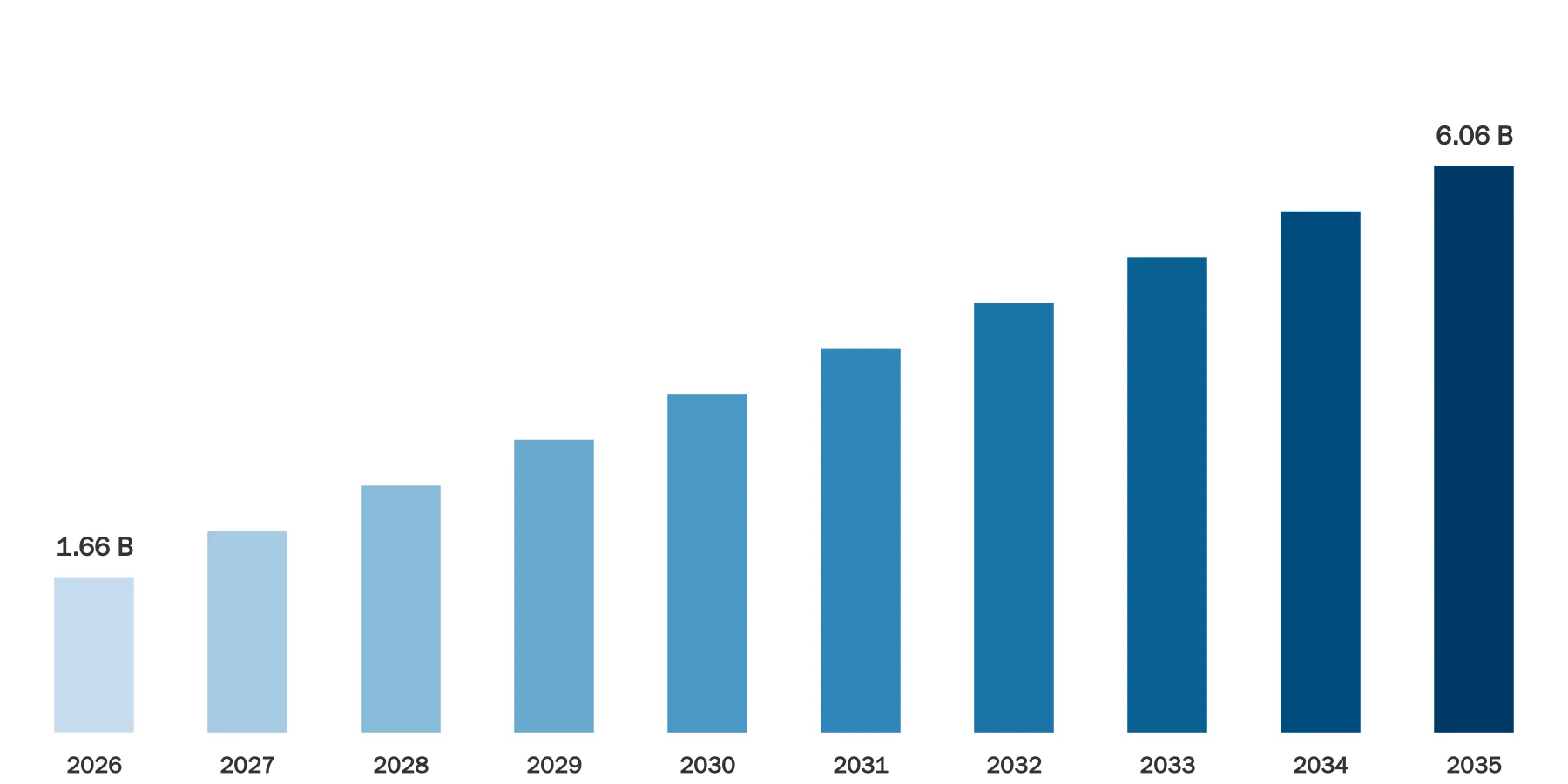
Source: Econ Market Research
Various factors such as reduced labor costs, increased safety due to robotic automation, and rapid urbanization and industrialization are contributing to growth. Global demand for construction robots is expected to increase as more and more construction firms undertake automation initiatives and increase funding for modernizing their construction activities. The increasing need for advanced infrastructure, coupled with the ever-increasing population, is expected to drive the demand for automatic construction solutions. According to a report by Autodesk Inc., around 14,000 buildings need to be constructed daily by 2051 to accommodate the increasing population. The reasons for the shift towards construction robots are smart agility, convenience, and cost-effectiveness. The growing emphasis of construction firms on reducing resource waste and overall costs is expected to grow the construction robot market. Additionally, the emphasis on reducing the turnaround time of construction projects is motivating market players to launch new and innovative products with increased efficiency and speed of construction robots market.
The main driver of the market's expansion is the booming building sector, which is also accelerated urbanization. The need for construction robots to address the shortage of trained workers has also increased due to the expanding building of megastructures and high-quality infrastructure. Moreover, technical developments like the use of 3D printing robots in construction projects are fostering market expansion. They are employed to create bridge models and building prototypes that streamline the construction of complex structures in order to conserve time and materials. Furthermore, the market is anticipated to be driven by the emerging trend of aerial robotics. Unmanned aerial vehicles (UAV) or drones, which are frequently employed for safety inspections, site surveys, and entering hazardous zones, are among these robots. Exoskeleton equipment, such as wearable mechanical suits to move large objects like machinery and supplies, is also accelerating market expansion.
The COVID-19 outbreak negatively impacted the construction industry, with construction work coming to a halt in the early months of the lockdown. However, due to the safety benefits provided by the technology, product demand has seen an increase in adoption from the industry. The manufacturing of essential raw materials for construction was severely restricted. This LED to a decline in the demand as well as the supply of construction robots, hindering market growth.
Market Dynamics
Construction Robots Market Drivers
Increased Urbanization to Drive Construction Robots Market Growth
The revenue growth of the global construction robots market is significantly driven by the need to bridge the gap caused by the shortage of skilled laborers in construction activities. Because they are controlled by wireless remote controls, construction robots can be used in demolition. Deployment of construction robots in demolition activities can allow humans to stay at a safe distance and thus avoid the risk of sustaining injuries. This is a significant advantage offered by construction robots in terms of safety.
Robotic automation has the potential to save money and time since robots can operate continuously, allowing certain stages of projects to be completed considerably faster and at a lesser cost than before. Robots' great precision helps to prevent waste as well for example, 3D printers construct components using only the material needed with no leftovers, while also reducing the cost and size of the technology. All these factors are expected to boost revenue growth in the global market.
Construction Robots Market Restraints
The global construction robots market's growth is substantially hampered by several unfavorable factors, such as construction sites being difficult for robots to navigate due to their complexity and the judgments involved. Building sites may be dangerous areas, and thus the management of health and safety is a significant challenge for the use of robotics in construction. Further, investing in robotics entails significant initial costs, including substantial R&D expenditure, which is expected to restrain market growth to some extent. In addition, robots are not yet widely used, and only a few companies are actively deploying robots on-site due to a lack of technological advancement. This is another important factor that can affect market revenue growth.
Construction Robots Market Opportunities
It is anticipated that the focus on integrating robots with emerging technologies, such as Building Information Modeling (BIM) and Computer-Aided Manufacturing (CAM), to scale up production, which can lead to more affordable and adaptable systems, will continue to open up lucrative business opportunities for major players and new entrants in the global market. Also, the switch from 2D CAD to 3D BIM can make it possible to manufacture complete assemblies utilizing quickly developing robotic technology, which is most likely to be utilised in off-site prefabrication facilities for the creation of repeated building types. In the future, this is also anticipated to fuel market expansion.
Regional Analysis
North America dominated the global construction robots market in 2021, accounting for approximately 36.1% of its share. Primary factors influencing growth of the market in the region include growing investments in public infrastructure and rising spending on construction across commercial and residential sectors in the region. In November 2021, the U.S. Congress approved the Infrastructure Investment and Jobs Act, and this bill carries a price tag of US$ 1.2 trillion, which includes US$ 550 billion for transportation, broadband, and utilities; US$ 110 billion for roads, bridges, and other major infrastructure projects; and $40 billion for bridge repair and replacement.
Europe and Asia Pacific are also key markets for construction robots, and they held shares of 26.5% and 20.1%, respectively, in 2021. Growing labor shortages and rising fatal accidents and workplace injuries are significant factors boosting the adoption of construction robots in these regions. Asia-Pacific is a potential market because of its huge population and the resulting rise in demand for residential and industrial infrastructure. For instance, Schindler stated in February 2022 that their Schindler R.I.S.E. robot would be deployed in the Asia Pacific region. An autonomous, self-climbing robot called Schindler R.I.S.E. is employed for installation tasks in elevator shafts.
The Middle East & Africa is a larger market for construction robots as compared to the market in South America, and the market in the Middle East & Africa is projected to advance at a CAGR of 14.4% during the forecast period.
Competitor Analysis
The leading industry key players are undertaking strategies such as product innovations, collaborations, and partnerships to expand their business footprints and survive the competitive environment. For instance, in November 2022, Exyn Technologies, a provider of AI-powered industrial robots and drones, in a tie-up with Trimble Inc., a services, hardware, and software technology company, announced the launch of an autonomous construction surveillance technology. The new technology will enable the agreement of fully autonomous missions within dynamic and complex construction environments, resulting in precise and consistent reality capture for quality and production control workflows.
Key Players:
ABB Robotics
Advanced Construction Robotics
Giant Hydraulic Tech
TopTec Spezialmaschinen
Cyberdyne Inc.
Beijing Borui Intelligent Control Technology
Boston Dynamics
Brokk Group
Hyperion Robotics
Built Robotics Inc.
Komatsu
Fujita
Autonomous Solutions
Ekso Bionics
Husqvarna
Fastbrick Robotics
Construction Robotics
Conjet AB
DJI
Kewazo GmbH
Yingchuang Building Technique (Shanghai) Co. Ltd. (WinSun)
Recent Developments in Global Construction Robots Market
In January 2022, FANUC America launched the new M-1000iA robot that can be used for handling very heavy products, including Automotive Components, construction materials, and others for industrial use. It has a 1,000-kg maximum payload capacity with full articulation.
In Feb 2022: Husqvarna AB will begin a pilot project with Watt Battery in February 2022.
Fastbrick Robotics Ltd.'s Hadrian X robotic machine has begun work on the walls of 16 townhouses as part of the Satterley development.
In April 2022: Fastbrick Robotics Ltd. signed a Memorandum of Understanding with the UAE's Ministry of Energy and Infrastructure on April 20, 2022.
Construction Robots Market Report Scope & Segmentation
| Attributes | Details |
|---|---|
Market Size (Current) | US$ 1.66 Billion in 2026 |
Market Size (Forecast) | US$ 6.06 Billion in 2035 |
Growth Rate | CAGR of 15.29% from 2026 to 2035 |
Forecast Period | 2026 – 2035 |
Base Year | 2025 |
Historical Data Available | Yes |
Regional Scope | Global |
Segments Covered | By Product Type
By Function
By Application
|
Frequently Asked Questions
Common questions about this report
The study period covers historical insights and forecast projections for the period 2026-2035.
About the Author
Market research expert with years of industry experience

Dipali Bhingare serves as the Market Research Director at Econ Market Research. With a focus on translating complex global economic shifts into actionable business intelligence, she oversees the strategic direction of comprehensive market studies. Her work empowers organizations to navigate volatile industries through data-driven forecasting and deep-dive competitive analysis.
Related Reports
Explore more market insights from the same category