

Floating Solar Panels Market
Floating Solar Panels Market Size, Share, Trends, Growth, and Industry Analysis, By Capacity (Up to 500 kW, 500 kW to 1 MW, 1 MW to 3 MW, Greater than 3 MW), By Type (Stationary Floating Solar Panel, Tracking Floating Solar Panel), By Panel Type (Mono-crystalline, Poly-crystalline, Thin Film), Regional Analysis and Forecast Period 2026-2035
Floating Solar Panels Market Overview
As per Econ Market Research analysis, the Global Floating Solar Panels Market was valued at approximately US$ 25.52 Billion in 2026 and is predicted to reach US$ 174.4 Billion by 2035, expanding at a CAGR of 23.76% over the forecast duration. The base year is 2025.
Floating Solar Panels Market Size 2025-2035 (USD Billion)

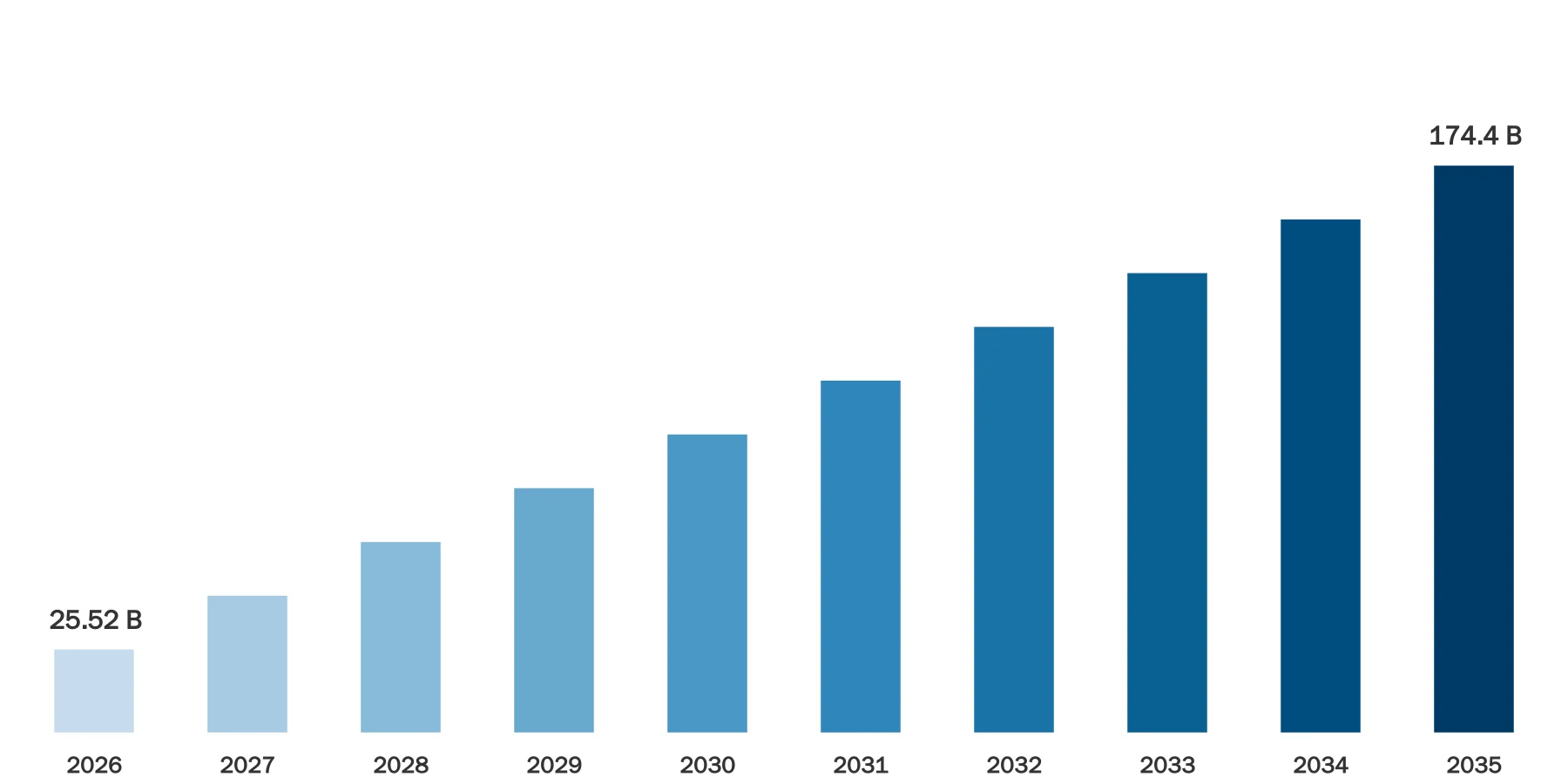
Source: Econ Market Research
Floating Solar panel technology has been coming under the spotlight as a favourable and cost-effective alternative to land-based Photovoltaic systems. It is a new method of using the water surface available on dams, reservoirs, and other water bodies for the generation of Solar Energy. Floating Solar Panels consist of panels that are installed on water bodies such as irrigation ponds, reservoirs, lakes, canals, and the ocean. It is a new method of utilizing the water surface available on dams, reservoirs, and other water bodies for the generation of solar energy. These panels are on water bodies, which helps to maintain the temperature of the silicon panels by upholding their efficiency.
These systems have various benefits over traditional power generation systems, such as safe and noiseless power generation. A floating solar panel plant or farm is an arrangement of photovoltaic solar panels on a structure that floats on a water body, which is generally a lake or reservoir. Solar panels used in the construction of floating solar farms are known as floating solar panels. Floating solar panels and plants help conserve water through the reduction of evaporation, and increase power generation due to the cooling effect of the solar panels.
Growth Factors
The floating solar panels attached to a structure that floats on a body of water, usually a reservoir or lake, are known as floating solar or floating photovoltaics. The fundamental benefit of floating photovoltaic plants is that they do not require any land, with the exception of the small areas required for the electric cabinet and grid connections. Their cost is equivalent to that of land-based plants, but they offer a smart option to avoid using the land.
The floating solar panels have been highlighted as a viable and cost-effective alternative to land-based photovoltaic systems. It',s a novel way to generate solar energy by utilizing the available water surface on dams, reservoirs, and other water resources. Solar panels that float on water, such as irrigation ponds, reservoirs, lakes, canals, and the ocean, are known as floating solar panels. It',s a novel way of generating solar energy by utilizing the available water surface on dams, reservoirs, and other sources of water. These panels, which are located near bodies of water, serve to keep the temperature of the silicon panels consistent, increasing efficiency.
The companies in the floating solar sector are upbeat about the global expansion of large-scale projects. Utility-scale floating solar plants are receiving increased attention, which would cut the imports of fossil fuels while saving nations money in foreign currency. Site selection is essential when building floating solar plants, though. Businesses should therefore get completely knowledgeable about the waterbed',s geography and its appropriateness for anchoring floats. By distributing the loads produced by the wind and waves, anchoring lowers the possibility that the solar island may run afoul of the banks or be blown away during storms.
Floating solar producing projects are becoming a crucial component due to their inherent advantages over on-land installations, which need enormous contiguous stretches of non-farming and non-forested land. Additionally, floating solar reduces temperature-related losses because to the cooling effect of the water they float on. In addition to being low-maintenance, floating solar power installations aid in reducing the rate of evaporation of water bodies. As people become more aware of the advantages of renewable energy, businesses in the floating solar sector are seeing value-grab potential. In order to plan and implement floating solar producing projects that are commercially viable, businesses are stepping up their research and development activities.
Region Insights
Asia-Pacific dominated the floating solar market in 2022. Due to a lack of available land and a fixed supply of fossil fuels, the Asia-Pacific region has a high level of penetration in the market for floating solar panels. As a result, the government has approved many designs and structures for floating solar panels to accommodate rising electricity demand while causing less ecological damage.
North America, on the other hand, is expected to develop at the fastest rate during the forecast period (2023&ndash,2031). The variables, such as the ability to float solar technology to reduce evaporation and land availability, are projected to raise the demand for floating solar in the region over the projection period.
Floating Solar Panels Market: Competition Landscape
The global market is highly competitive due to the presence of major industries across the region, as these companies are fairly concentrated and highly competitive. Ciel &, Terre is one of the biggest installers in the market. The company operates in almost all parts of the world and has a well-established track record of over 180 floating solar PV farms. The company has installed more than fifty percent of the total number of floating solar panel farms present across the world. Also, the company is the most active participant in the industry and has up-to-date technology solutions. Some of the prominent players operating in the global floating solar panels market are:
Trina Solar
Sharp Energy Solutions Corporation (Sharp Corporation)
KYOCERA Corporation
JA SOLAR Technology Co., Ltd.
Yingli Solar
Ciel &, Terre International
GreenYellow (Thailand) Limited
Cleantech Solar
Solarvest Holdings Berhad
NOVATON AG
Pristine Sun Corp
Recent INDUSTRY DEVELOPMENTS
In April 2021, KYOCERA Corporation and AVX Corporation established a new integrated brand, "KYOCERA AVX," to be used for the KYOCERA Group's electronic components business. The brand-new structure is expected to boost its electronic components business worldwide.
In February 2021, GreenYellow (Thailand) Limited, a subsidiary of GreenYellow, installed a 2 MW floating solar power plant at the facilities of SPM Group in Thailand. The 6,000 solar panels used for the project occupy a 1.6-hectare area on a 4.3-hectare pond. The plant would produce 2.8 GWh of low-carbon electricity per year, covering up to 20% of the site's annual energy consumption.
Floating Solar Panels Market Report Scope & Segmentation
| Attributes | Details |
|---|---|
Market Size (Current) | US$ 25.52 Billion in 2026 |
Market Size (Forecast) | US$ 174.4 Billion in 2035 |
Growth Rate | CAGR of 23.76% from 2026 to 2035 |
Forecast Period | 2026 – 2035 |
Base Year | 2025 |
Historical Data Available | Yes |
Regional Scope | Global |
Segments Covered | By Capacity
By Type
By Panel Type
|
Frequently Asked Questions
Common questions about this report
The study period covers historical insights and forecast projections for the period 2026-2035.
About the Author
Market research expert with years of industry experience

Related Reports
Explore more market insights from the same category