


Top Companies Shaping the Optical Interconnect Industry
The top optical interconnect companies are examined by core technologies, product portfolios, industry presence, regional reach, and key future opportunities.
Introduction
Overview of the Global Optical Interconnect Industry
The global optical interconnect industry has become a critical part of data-center, cloud, telecommunications, artificial-intelligence, high-performance-computing, and storage infrastructure. Ethernet interfaces standardized at 400 Gb/s and 800 Gb/s now support the movement of data between servers, switches, accelerators, storage arrays, data halls, and geographically separated facilities. IEEE 802.3df-2024 added MAC parameters and physical-layer specifications for 800 Gb/s Ethernet, while the emerging IEEE P802.3dj framework extends the architecture toward 1.6 Tb/s links using electrical and optical lane rates reaching 200 Gb/s. These standards provide the interoperability foundation required for transceiver manufacturers, switch-silicon suppliers, laser producers, DSP developers, and network operators to deploy compatible systems.
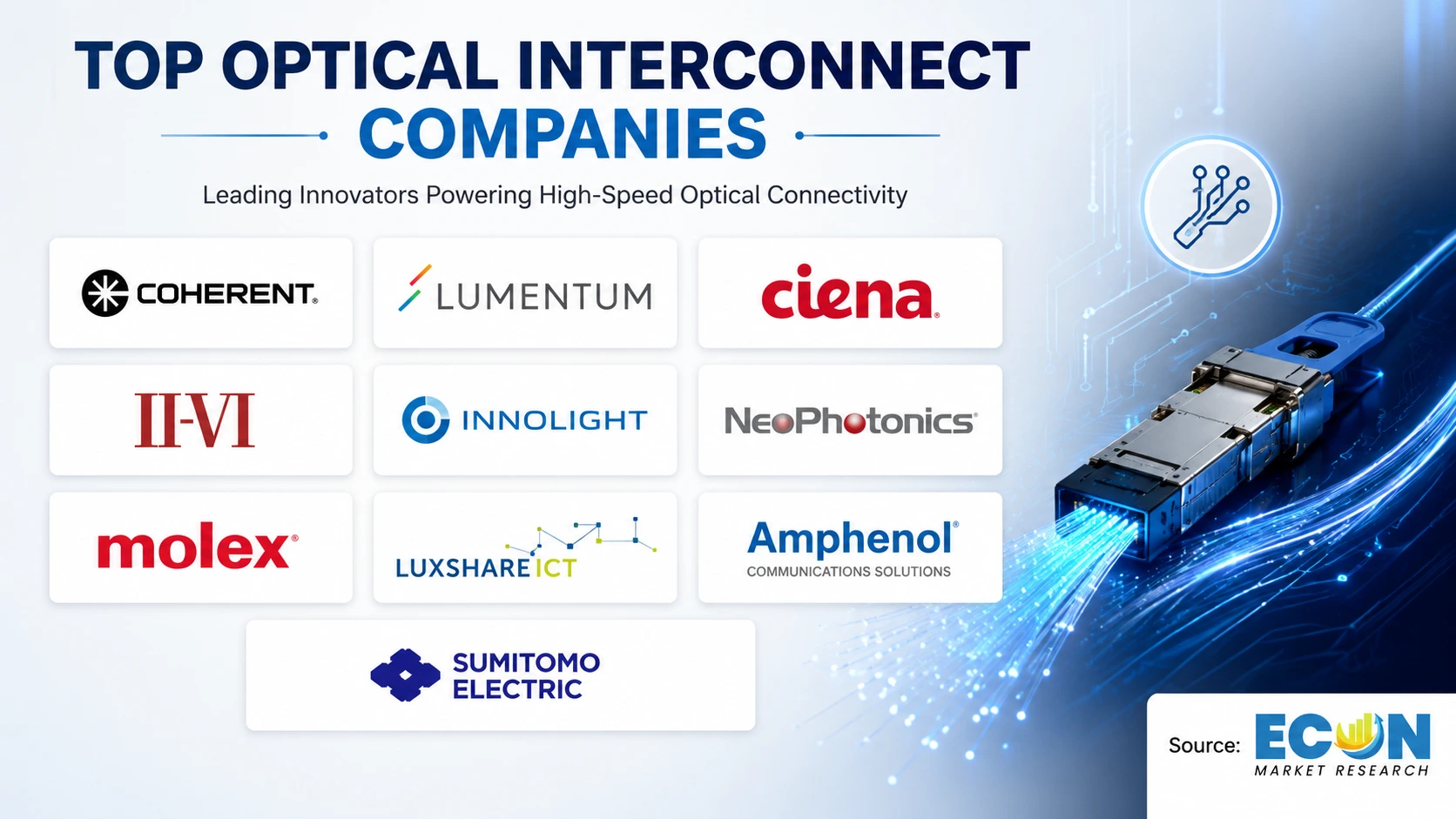
Current optical interconnect deployments span short-reach multimode links inside racks, single-mode connections across data halls, coherent pluggable links between campuses, and wavelength-division-multiplexed networks connecting regional facilities. Commercial portfolios now include 400G, 800G, and 1.6T transceivers in OSFP and QSFP-DD form factors, with reach options extending from several meters to 2,000 km. Cisco ships 12 million pluggable optical transceivers per year, while Cisco and Acacia have delivered 650,000 coherent ports. These operating volumes show that optical connectivity is no longer limited to telecommunications backbones; it has become a standardized component of enterprise switching, hyperscale computing, AI clusters, and distributed cloud infrastructure.
The industry’s supply chain contains at least 6 specialized technology layers: optical materials, lasers and photodiodes, silicon-photonics engines, analog drivers and amplifiers, digital signal processors, and complete transceiver modules. Additional participants provide connectors, fiber assemblies, optical circuit switches, test equipment, packaging, and network-management software. A 1.6T module can integrate 8 electrical lanes operating at 200 Gb/s with 8 optical lanes at the same signaling rate. This level of integration requires coordinated development across semiconductor design, indium-phosphide fabrication, silicon photonics, precision packaging, thermal engineering, firmware, and automated testing, creating a technically demanding competitive environment with high qualification requirements.
Market Evolution and Growth Drivers
Optical interconnect technology has advanced from 10G serial links to 1.6T modules through successive increases in lane speed, parallelism, modulation complexity, and packaging density. Broadcom’s product history records 10 Gbps CMOS transceivers in 2002, 100 Gbps optical modules in 2013 and 2014, complete 800G solutions in 2020, 200G-per-lane platforms in 2023, and third-generation co-packaged optics in 2025. This progression demonstrates how the industry has combined PAM4 signaling, advanced CMOS process nodes, integrated laser drivers, silicon-photonics platforms, and higher-density switch silicon to increase total port bandwidth without expanding front-panel space at the same rate.
Artificial-intelligence infrastructure is now the strongest technical driver because modern clusters connect thousands of accelerators that must exchange model parameters, gradients, and inference data with limited latency. U.S. data centers consumed 176 TWh of electricity in 2023, compared with 58 TWh in 2014, and their share of national electricity consumption could reach 11.8% by 2030. These power constraints are accelerating demand for optical components that reduce energy use per transmitted bit. A transition from 5 nm to 3 nm optical DSPs can lower 1.6T module power by 20%, while co-packaged optical architectures can produce 3.5-fold power-consumption savings relative to conventional approaches.
Standardization is another major adoption driver. The 800ZR implementation agreement released in 2024 defines an interoperable coherent interface for amplified links spanning 80 km to 120 km, while the 800LR agreement released in 2025 addresses additional long-reach applications. Standardized interfaces reduce the risk of proprietary lock-in and allow operators to qualify optical modules from multiple suppliers. At the same time, new 1.6T Ethernet work is establishing physical-layer specifications for 200G, 400G, 800G, and 1.6T operation, supporting a common upgrade path based on 1, 2, 4, or 8 optical lanes.
Top 5 Latest Trends in the Optical Interconnect Industry
Transition from 800G to 1.6T optical connectivity
Commercialization of co-packaged optics
Adoption of linear and transmit-retimed optics
Expansion of coherent pluggable interconnects
Development of optical scale-up and circuit-switched fabrics
1. Transition from 800G to 1.6T Optical Connectivity
The move from 800G to 1.6T is restructuring product roadmaps throughout the optical interconnect industry. IEEE 802.3df-2024 established standardized 800 Gb/s Ethernet, while IEEE P802.3dj is developing 1.6 Tb/s MAC and physical-layer specifications based on signaling rates of 200 Gb/s or higher. Commercial 1.6T modules typically use 8 electrical lanes and 8 optical lanes operating at 200 Gb/s, allowing manufacturers to double port capacity while retaining established OSFP dimensions. This transition matters because a switch containing 64 ports can theoretically support 102.4 Tb/s of aggregate front-panel bandwidth when every port operates at 1.6T.
Product development has already progressed from prototypes into volume deployment. Marvell introduced a 5 nm 1.6T DSP in 2023 and a 3 nm platform in 2024, with mass-volume shipments supporting hyperscale deployments by 2026. Coherent demonstrated 1.6T DR8 modules using silicon photonics and 200G-per-lane electrical and optical interfaces in 2025. Lumentum has added 1.6T 2×DR4 OSFP and 1.6T transmit-retimed modules, including configurations supporting 500-meter single-mode-fiber connections. These developments are moving 1.6T from laboratory demonstrations into AI scale-out networks, cloud data centers, and high-density switching platforms.
2. Commercialization of Co-Packaged Optics
Co-packaged optics integrates optical engines and high-capacity switching or computing silicon on the same packaged substrate. The architecture shortens the electrical path between the ASIC and the optical interface, reducing insertion loss and limiting the amount of signal compensation required from power-intensive retiming electronics. Broadcom began its first co-packaged-optics development cycle in 2021, released second-generation 100G-per-lane systems for production, and introduced a third-generation 200G-per-lane product line in 2025. The company reports bandwidth density above 1 Tb/s per millimeter and optics cost-per-bit improvement of 40% for its CPO platform.
Commercial adoption is being driven by switch capacity and thermal limits. Broadcom’s Tomahawk 6 platform supports 102.4 Tb/s of switching capacity, while the company’s optical roadmap extends toward 200T systems. Its CPO portfolio also includes a 6.4-Tb/s optical attachment designed for custom AI accelerators. These configurations allow optical links to move closer to GPUs, XPUs, and switch ASICs, which can improve scale-up connectivity across multiple racks. The remaining challenges involve fiber routing, repairability, laser placement, packaging yield, thermal isolation, and field-service procedures, making manufacturing maturity as important as raw optical performance.
3. Adoption of Linear and Transmit-Retimed Optics
Linear pluggable optics remove the conventional full-retiming DSP from a transceiver and rely on the host ASIC’s signal-processing capability. Transmit-retimed optics retain digital processing in the transmit direction while simplifying the receive path. Both architectures target power reduction in short-reach AI fabrics where distances are controlled and channel conditions can be tightly engineered. Marvell’s 1.6T LPO chipset supports 800G and 1.6T modules through 200G-per-lane laser drivers and transimpedance amplifiers, addressing links that extend beyond the practical reach of passive direct-attach copper cables.
The technology is diversifying rather than converging on a single design. Marvell’s 1.6T silicon-photonics light engine integrates a linear driver, transimpedance amplifier, photonics chip, microcontroller, and firmware in 1 package. Coherent has demonstrated 3 separate 1.6T DR8 implementations: a linear-receive-optics module, a low-bit-error-rate module, and a module using a 3 nm DSP. Lumentum’s product range includes both fully retimed and transmit-retimed 1.6T OSFP devices. This variety enables network designers to select different balances of power, reach, signal margin, fault isolation, and interoperability for scale-up and scale-out networks.
4. Expansion of Coherent Pluggable Interconnects
Coherent optics are moving from dedicated transport platforms into routers, switches, and compact pluggable modules. The 800ZR implementation agreement defines 800G coherent operation over amplified 80-km to 120-km DWDM connections, allowing data-center operators to link facilities without deploying separate transponder shelves for every connection. Marvell’s 800G ZR and ZR+ modules support distances reaching 2,000 km, while its 1.6T coherent-lite DSP addresses campus links from 2 km to 20 km. These products create distinct interconnect categories for campus, metro, regional, and multi-site AI-training networks.
Cisco’s coherent-optics portfolio demonstrates the scale of this transition. Cisco and Acacia have shipped 650,000 coherent ports, accounting for 25% of deployed coherent ports according to company data. Since 2013, Acacia coherent interconnects have reduced watt-per-bit power consumption by 85%. Cisco has also expanded routed optical networking with 100G, 400G, 800G, and 1.2T-class technologies, allowing service providers to converge packet and optical layers. This convergence can reduce equipment stages, simplify management, and shorten the operational path between routing capacity and wavelength-level transport.
5. Development of Optical Scale-Up and Circuit-Switched Fabrics
AI scale-up networks connect accelerators within tightly coordinated computing domains, where low latency and high bandwidth are required across hundreds or thousands of devices. Copper remains effective for the shortest electrical paths, but distance, cable weight, insertion loss, and power consumption become restrictive as clusters grow. Coherent has introduced a 1.6T multimode architecture using a 32×50G NRZ two-dimensional VCSEL and photodiode array. The design targets dense “slow-and-wide” interconnections and provides a pathway toward near-packaged and co-packaged optical configurations.
Optical circuit switching is developing alongside these parallel optical links. Coherent offers OCS-optimized 400G and 800G transceivers in QSFP-DD and OSFP form factors, with supported reaches extending to 6 km. Optical circuit switches can dynamically establish direct light paths between resources, reducing the number of electronic switching stages traversed by selected traffic flows. This capability is relevant to AI clusters that periodically reorganize communication patterns during training. Future systems could combine 1.6T transceivers, optical circuit switches, and software-controlled topology management to reconfigure bandwidth according to workload requirements.
Top 5 Companies in the Optical Interconnect Industry
The following 5 companies are presented according to product capability, technical expertise, manufacturing scope, deployment scale, research activity, geographic presence, and direct relevance to optical interconnect development. The list is not intended as a strict financial or market-share ranking.
Coherent Corp.
Broadcom Inc.
Cisco Systems, Inc.
Marvell Technology, Inc.
Lumentum Holdings Inc.
1. Coherent Corp.
Company Overview: Coherent retains a founding year of 1971 and adopted its current corporate identity in 2022 following the combination of II-VI and Coherent. The company operates across a 20-country-plus footprint and supplies photonic materials, lasers, optical components, transceivers, subsystems, switches, and test equipment.
Headquarters: Coherent has maintained its corporate headquarters in Saxonburg, Pennsylvania, United States, since the 2022 corporate name transition. Its international structure includes research, manufacturing, sales, service, and distribution operations supporting communications and datacenter customers.
Core Optical Interconnect Expertise: The company develops indium-phosphide lasers, VCSELs, photodiodes, silicon-photonics modules, optical circuit switches, coherent components, and high-speed transceivers. Its 2025 demonstrations included 200G VCSELs, 400G differential EML technology, and 3 distinct 1.6T silicon-photonics module architectures.
Major Products and Services: Coherent supplies 400G, 800G, and 1.6T transceivers, including OCS-optimized products supporting links of 2 km and 6 km. It also provides WaveAnalyzer testing equipment with 100 MHz absolute frequency accuracy and full C+L-band coverage.
Industry Significance: Coherent controls multiple layers of the optical supply chain, from laser and photodiode fabrication to complete modules and switching technologies. Its 1.6T SR8 demonstration uses 8 optical and 8 electrical interfaces operating at 200G, illustrating the company’s ability to integrate component manufacturing with full transceiver engineering.
2. Broadcom Inc.
Company Overview: Broadcom’s technology heritage spans 60 years, while the current Broadcom corporate structure emerged after Avago acquired Broadcom Corporation in 2016. The company’s optical history includes fiber transmitters from the 1970s, 100G modules from 2013, 800G platforms from 2020, and 102.4T switching systems in 2025.
Headquarters: Broadcom is headquartered in Palo Alto, California, United States, and lists engineering or operating locations across at least 10 North American cities. Its semiconductor model combines optical-component design, networking silicon, DSP technology, packaging, and software-supported infrastructure products.
Core Optical Interconnect Expertise: Broadcom develops switch ASICs, SerDes, PAM4 DSPs, silicon-photonics engines, VCSELs, EMLs, continuous-wave lasers, transimpedance amplifiers, and co-packaged optical systems. Its Sian3 platform uses a 3 nm process and 200G-per-lane signaling for 800G and 1.6T modules.
Major Products and Services: The portfolio includes Tomahawk Ethernet switches, 51.2T and 102.4T CPO platforms, XPU-attached optical engines, PCIe Gen6 optical connectivity, and 6.4-Tb/s optical attachments. Broadcom’s third-generation CPO family supports 200G-per-lane operation.
Industry Significance: Broadcom integrates switching silicon and optical I/O in a single architecture, enabling design optimization that component-only suppliers cannot independently perform. Its reported CPO benefits include 3.5-fold power savings, 40% lower optics cost per bit, and bandwidth density above 1 Tb/s per millimeter.
3. Cisco Systems, Inc.
Company Overview: Cisco was founded in 1984 and shipped its first networking products in 1986. Its optical capabilities expanded through internal development and the 2021 acquisition of Acacia Communications, which added coherent DSPs, modules, silicon photonics, and long-distance interconnect technologies.
Headquarters: Cisco is headquartered in San Jose, California, United States, where it established a major campus presence in 1994. The company operates a global networking ecosystem covering enterprise, cloud, service-provider, data-center, metro, long-haul, and subsea applications.
Core Optical Interconnect Expertise: Cisco combines routing platforms, Ethernet switching, coherent pluggable optics, line systems, optical controllers, network software, and Acacia DSP technology. The portfolio supports transmission rates from 10G to 1.2T, with 1.6T OSFP products added for next-generation AI systems in 2026.
Major Products and Services: Cisco supplies 12 million pluggable optical transceivers annually and has delivered 650,000 coherent ports through Cisco and Acacia. Products include coherent ZR and ZR+ modules, the NCS 1000 family, routed optical networking systems, 2.4T line cards, and 400G digital coherent optics.
Industry Significance: Cisco can qualify optics, switches, routers, software, and transport systems within a unified operating environment. Since 2013, its Acacia coherent platforms have achieved an 85% reduction in watt-per-bit power consumption, supporting operators seeking higher bandwidth without proportional energy growth.
4. Marvell Technology, Inc.
Company Overview: Marvell was founded in 1995 and operates as a fabless semiconductor company focused on data-infrastructure silicon. Its optical portfolio has evolved through 6 generations of PAM4 DSP development and now covers electrical cables, pluggable optics, coherent modules, silicon-photonics engines, telemetry, and co-packaged systems.
Headquarters: Marvell’s principal U.S. headquarters is in Santa Clara, California, at 5488 Marvell Lane. The company established its Silicon Valley operations during the 1990s and now supports product development through international semiconductor-design and engineering locations.
Core Optical Interconnect Expertise: Marvell develops PAM4 DSPs, coherent DSPs, SerDes, laser drivers, transimpedance amplifiers, silicon-photonics light engines, gearboxes, retimers, and interconnect telemetry. Its Ara platform uses a 3 nm process and integrates 8 electrical plus 8 optical lanes at 200G.
Major Products and Services: Marvell’s portfolio includes Nova, Ara, Ara T, Ara X, Petra, Aquila, COLORZ, and RELIANT products. Aquila supports 1.6T coherent-lite links from 2 km to 20 km, while COLORZ 800G ZR and ZR+ modules support transmission distances reaching 2,000 km.
Industry Significance: Marvell supplies the semiconductor processing layer used inside modules manufactured by multiple optical vendors. The Ara DSP can reduce 1.6T module power by 20%, while its 1.6T light engine combines photonics, analog electronics, firmware, and control functions in 1 package.
5. Lumentum Holdings Inc.
Company Overview: Lumentum launched as an independent company in 2015 following its separation from JDS Uniphase. By 2019, it had expanded its optical-component portfolio for 100G and 400G systems, and its current products address 800G, 1.6T, coherent transport, AI scale-up, and cloud interconnect applications.
Headquarters: Lumentum is headquartered in San Jose, California, United States, and operates an international network of research, manufacturing, and sales sites. Its optical components are used in telecom, enterprise, cloud, sensing, and data-center systems across multiple continents.
Core Optical Interconnect Expertise: The company specializes in indium-phosphide EMLs, DMLs, continuous-wave lasers, photodiodes, coherent components, VCSELs, optical modules, and external light sources. Its EML portfolio supports 100G and 200G lane rates for 400G, 800G, and 1.6T modules.
Major Products and Services: Lumentum offers 1.6T 2×DR4 OSFP, 1.6T transmit-retimed OSFP, 800G datacom modules, tunable transceivers, and 200G PAM4 EMLs. Its 1.6T DR8 TRO module supports 8×200G connectivity over 500 meters of single-mode fiber.
Industry Significance: Lumentum demonstrated 2 different NVIDIA 1.6T OSFP architectures in 2026: one using an ultra-high-power continuous-wave laser with silicon photonics and another using 8 integrated 200G EML channels. This component flexibility allows customers to develop multiple optical architectures from a common supplier base.
Regional Outlook
North America
North America remains a central development region for optical interconnects because 5 of the companies profiled in this article maintain headquarters in the United States. California and Pennsylvania support concentrations of switch-silicon design, coherent DSP engineering, laser manufacturing, silicon-photonics development, networking software, and module qualification. The region’s demand is strongly influenced by data-center electricity requirements: U.S. facilities accounted for 4.4% of national electricity consumption in 2023, and the projected share for 2030 is 11.8%. This pressure is encouraging operators to evaluate CPO, LPO, lower-power DSPs, optical circuit switching, and direct coherent routing.
The United States leads regional design activity, Canada contributes optical research, telecom operations, and cloud infrastructure, while Mexico provides opportunities for electronics manufacturing, cable assembly, and supply-chain localization. The 3-country structure creates a potential North American production corridor in which advanced chips and photonic devices are designed in the United States or Canada and integrated into modules, switches, and cable assemblies through regionally distributed manufacturing. In 2026, the key constraint is not basic demand but the availability of photonic-packaging capacity, qualified labor, electrical power, cooling infrastructure, and high-volume testing equipment.
The United States is likely to remain the region’s primary 1.6T adoption center because its hyperscale facilities require high-radix switching and energy-efficient accelerator connectivity through 2030.
Canada can strengthen its role by connecting optical research programs with 3 commercialization areas: silicon photonics, quantum communications, and energy-efficient data-center networking.
Mexico can expand participation through 2 practical segments: optical-module assembly and precision fiber-cable manufacturing for North American equipment suppliers.
Europe
Europe’s optical interconnect industry is shaped by telecommunications expertise, photonics research, industrial automation, energy regulation, and sustainability requirements. European data-center policy is increasingly important because global facilities consumed 415 TWh of electricity annually, and consumption could reach 945 TWh by 2030. The European Union has set an objective for data centers to become climate-neutral and highly energy-efficient by 2030, encouraging adoption of lower-power optical modules, disaggregated networking, workload-aware switching, and architectures that reduce electrical signal paths.
Germany supports industrial photonics and advanced manufacturing, the United Kingdom maintains strength in compound semiconductors and optical-network research, and France has capabilities in telecommunications, lasers, and integrated photonics. Italy and Spain are developing cloud and edge infrastructure, while the Netherlands remains important for internet exchange and interconnection activity. Nordic markets provide favorable conditions for energy-efficient data centers because operators can combine lower ambient temperatures with renewable-energy availability. Across the 27-member European Union, common reporting and efficiency rules can give suppliers a clearer basis for designing optics that meet measurable power, repairability, and lifecycle requirements.
Germany and France can connect 2 existing strengths—industrial photonics and telecommunications engineering—to expand local production of lasers, photonic integrated circuits, and test equipment.
The United Kingdom and Netherlands can support 800ZR adoption by combining coherent-optics research with dense metro and data-center-interconnect networks.
Italy, Spain, and the Nordic countries can create new 1.6T deployment locations as cloud capacity becomes distributed beyond Europe’s traditional interconnection hubs.
Europe’s principal barrier is the fragmentation of manufacturing across multiple national ecosystems. An optical module can require wafers from 1 country, lasers from a second, packaging in a third, and final qualification in a fourth. Regional programs that standardize photonic design kits, reliability testing, and packaging interfaces could reduce this complexity before 2030. The opportunity is strongest in energy-efficient coherent optics, silicon photonics, advanced fiber, test equipment, and repairable pluggable systems.
Asia-Pacific
Asia-Pacific has the broadest optical interconnect manufacturing ecosystem, spanning semiconductor fabrication, lasers, printed circuit boards, connectors, optical modules, switches, server systems, and fiber production. China’s East Data, West Computing initiative established 8 national computing hubs and 10 data-center clusters. By 2026, the associated monitoring system covered those 10 clusters and incorporated 1.37 million PFLOPS of intelligent-computing capacity, equal to 72% of China’s total intelligent-computing capability. These distributed facilities require long-distance optical transport, high-density intra-data-center links, and campus-scale interconnects.
Japan is advancing all-photonic networking through the IOWN program. Its long-term performance targets include 125-fold transmission-capacity improvement, 100-fold power-efficiency improvement, and end-to-end latency reduced to 1/200 of the reference level. IOWN 1.0 began commercial service in 2023, while one demonstration connected musicians across a 700-km path with 20-ms latency. These targets create demand for photonics-electronics convergence, wavelength control, optical switching, and high-capacity transceivers.
India’s BharatNet program is designed to extend optical-fiber connectivity across 640,000 villages and support 15 million subsidized FTTH connections. The platform offers minimum broadband speeds of 25 Mbps and dark-fiber access for authorized operators. Although BharatNet primarily serves access connectivity rather than hyperscale interconnects, its fiber footprint expands the national base of technicians, equipment suppliers, network operators, and data-generation endpoints that can support future regional and edge data centers.
South Korea and Taiwan provide 2 essential inputs: advanced semiconductor manufacturing and high-density electronics assembly.
Singapore and Australia function as regional cloud and submarine-cable gateways, supporting coherent data-center interconnect and long-reach optical transport.
Southeast Asian manufacturing centers can capture 3 expanding activities: module assembly, fiber-cable production, and transceiver testing.
Middle East and Africa
The Middle East is developing optical interconnect demand through cloud expansion, sovereign digital infrastructure, AI computing, and national transformation programs. Saudi Arabia reported 60 data centers operated by 20 companies in 2026, while fiber coverage reached 3.9 million homes and national internet penetration reached 99% in 2025. These indicators support demand for 400G and 800G data-center links, metro coherent transport, and future 1.6T connections between high-density AI facilities.
The United Arab Emirates launched its Digital Economy Strategy in 2022 with a 10-year implementation horizon and adopted infrastructure objectives under the We the UAE 2031 vision. The strategy emphasizes intelligent connectivity, cloud services, cybersecurity, and digital-government platforms. Qatar and Israel add regional demand through telecommunications, research, cloud, and semiconductor activity, while Egypt is expanding fiber connectivity and replaced copper access infrastructure serving 4.2 million homes. Egypt also introduced a 2025–2030 AI strategy, strengthening the case for domestic data-processing and optical backbone capacity.
Africa’s optical interconnect opportunity remains uneven because internet usage reached 35.7% of the population in 2025, compared with a global rate of 73.6%. South Africa, Kenya, Nigeria, and Egypt have the clearest near-term potential for data-center and interconnection growth, while other markets remain constrained by electricity availability, international bandwidth, equipment-import dependence, and specialist skills. The connectivity gap creates a long-term need for metro fiber, regional data centers, internet exchanges, submarine-cable capacity, and lower-cost optical modules.
Saudi Arabia and the UAE can become early 1.6T adopters as AI clusters and sovereign cloud platforms expand through 2030 and 2031.
South Africa and Egypt can serve as 2 manufacturing, integration, and service hubs for optical equipment entering African markets.
Kenya and Nigeria can support regional cloud growth if operators improve 3 infrastructure layers: power availability, metro fiber, and international connectivity.
Future Opportunities in the Optical Interconnect Industry
Development of 3.2T optical modules
Expansion of co-packaged optics into AI accelerators
Replacement of short-reach copper with optical scale-up links
Standardized 1.6T coherent and Ethernet interoperability
Localization of photonic packaging and testing
1. Development of 3.2T Optical Modules
The next performance opportunity is the transition from 1.6T to 3.2T modules. Lumentum demonstrated a prototype in 2026 using 4 differential EML lasers operating at 400G each, combined with an 8×200G electrical host interface. Broadcom has also reported development of a 400G-per-lane optical DSP. These technologies indicate that future 3.2T modules may use either 8 lanes at 400G or alternative configurations combining fewer optical wavelengths with advanced modulation. The engineering priorities will include signal integrity, laser efficiency, thermal management, forward-error correction, connector performance, and manufacturable packaging.
2. Expansion of Co-Packaged Optics into AI Accelerators
CPO is expected to move beyond Ethernet switches and attach directly to AI processors, custom accelerators, and memory-centric computing systems. Broadcom has demonstrated a 6.4-Tb/s optical attachment for XPUs, while Marvell has developed a 6.4T light engine for co-packaged applications. Integrating optical I/O beside compute silicon could enable scale-up domains spanning multiple racks without relying exclusively on short copper connections. The commercial opportunity depends on solving 5 operational issues: external laser servicing, fiber routing, connector density, package yield, and thermal separation between high-power compute dies and temperature-sensitive photonic components.
3. Replacement of Short-Reach Copper with Optical Scale-Up Links
The growth of accelerator clusters creates an opportunity to replace copper in links that exceed practical electrical reach. Coherent’s 32×50G VCSEL array, Marvell’s 1.6T LPO chipset, and Lumentum’s scale-up demonstrations represent 3 different strategies for low-power optical connectivity within server rows and multi-rack systems. Optical scale-up links can reduce cable weight, extend reach, improve bandwidth density, and limit equalization requirements. Adoption will initially concentrate in controlled hyperscale environments where hosts, cables, optics, and switches can be jointly qualified.
4. Standardized 1.6T Coherent and Ethernet Interoperability
Completion of the IEEE 1.6T Ethernet framework will give transceiver, switch, and component suppliers a common foundation for 200G-per-lane products. The project includes specifications for 200G, 400G, 800G, and 1.6T operation and was scheduled for completion in 2026. Similar interoperability work for coherent optics can extend 800ZR principles into new campus and regional applications. Standardized 1.6T interfaces will be especially valuable for operators seeking multi-vendor supply chains, predictable link budgets, and compatible management systems across at least 4 reach categories.
5. Localization of Photonic Packaging and Testing
Photonic packaging is becoming a strategic production bottleneck because 1.6T and 3.2T products require submicron alignment, high-speed electrical interconnects, optical coupling, thermal control, firmware calibration, and automated reliability testing. A single module may contain components produced in 5 countries before final assembly. Regional packaging centers in North America, Europe, India, Southeast Asia, and the Middle East could shorten qualification cycles and reduce supply disruption. The strongest opportunities include wafer-level photonic testing, passive optical alignment, co-packaged-optics assembly, burn-in systems, connector inspection, and software-driven production analytics.
Conclusion
The optical interconnect industry in 2026 is defined by a transition from standardized 800G systems to commercial 1.6T platforms. The 5 latest trends—200G-per-lane connectivity, co-packaged optics, simplified pluggable architectures, coherent interconnect expansion, and optical scale-up fabrics—are addressing the combined requirements of AI computing, cloud infrastructure, telecommunications, and distributed data centers. Each trend reflects a measurable shift in bandwidth, power efficiency, reach, packaging density, or network architecture.
The 5 top companies in the optical interconnect industry contribute different technical strengths. Coherent combines photonic materials with complete optical systems, Broadcom integrates switch silicon with co-packaged optics, Cisco connects coherent modules with routing platforms, Marvell supplies advanced DSP and interconnect silicon, and Lumentum provides high-speed lasers, components, and transceivers. Their portfolios span 400G, 800G, 1.2T, 1.6T, and emerging 3.2T technologies.
Regional development follows 4 distinct patterns. North America leads system architecture and semiconductor design, Europe emphasizes efficiency and regulation, Asia-Pacific combines manufacturing scale with large infrastructure programs, and the Middle East and Africa present a mix of high-capacity national projects and basic connectivity requirements. Future competition will depend on 5 capabilities: 400G-per-lane development, reliable CPO manufacturing, optical scale-up deployment, standards-based interoperability, and localized photonic packaging. Companies that combine these capabilities with measurable energy efficiency and high-volume quality control will remain central to the next generation of global digital infrastructure.