

Hyperscale Computing Market
Hyperscale Computing Market Research Report: By Component (Solution, Service), By Enterprise Size (Large Enterprises and Small & Medium Enterprises), By Application (Cloud Computing, Big Data, IoT, and Others), By End-use (BFSI, Healthcare, IT & Telecom, Media & Entertainment, Retail & E-commerce, and Others), and Region (North America, Europe, Asia-Pacific, and Rest of the World) Global Industry Analysis, Size, Share, Growth, Trends, Regional Analysis, Competitor Analysis and Forecast
Market Overview
As per Econ Market Research analysis, the Global Hyperscale Computing Market valuation stood at US$ 553.92 Billion in 2026 and is expected to reach US$ 5837.58 Billion by 2035, growing at a steady CAGR of 29.9% from 2026 to 2035. 2025 serves as the base year.
Hyperscale Computing Market Size 2025-2035 (USD Billion)

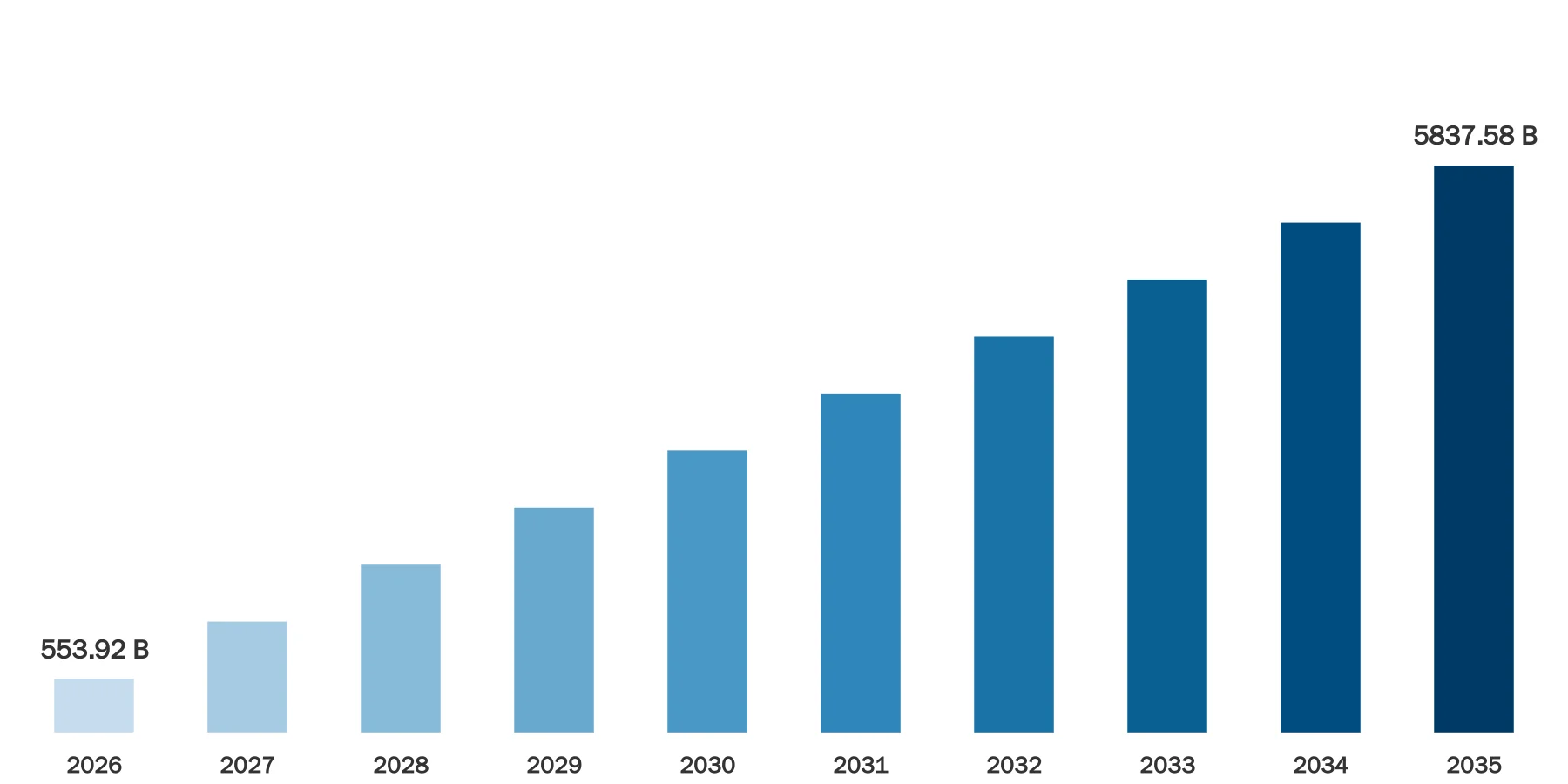
Source: Econ Market Research
A form of computer architecture known as hyperscale computing. It is developed to manage and scale with highly massive workloads and data volumes. It is characterized by its capacity to increase its computer resources quickly and effectively in order to satisfy the demands for different applications and services. Data centers, cloud computing, and internet services that demand a lot of processing and storage capacity are all examples of hyperscale computing. Hyperscale computing heavily depends on virtualization technologies like virtual machines and containerization. They allow effective resource management and workload segregation.
Large workloads and amounts of data are supported by hyperscale computing platforms. When necessary, they can smoothly scale up or down to meet changing user demand with minimal disruption. The popularity of cloud computing is accelerating, which is fueling market expansion. Additionally, there is tremendous development potential due to the increasing use of big data, machine learning, IoT, and artificial intelligence.
Hyperscale Computing Dynamics
The adoption of cloud computing by enterprises from a variety of industries as a part of their digital transformation projects rapidly growing. There has been an enormous rise in the demand for hyperscale computing infrastructure, due to the scalability, cost-efficiency, and flexibility provided by hyperscale cloud providers. Several companies have taken on hybrid and multi-cloud strategies, combining hyperscale resources with on-premises infrastructure or services from various cloud providers.
Hyperscale Computing Drivers
Adoption of Cloud Computing and Digital Transformation
Cloud computing is becoming more and more popular among businesses as a way to increase flexibility and scalability. Platforms for hyperscale computing offer the infrastructure needed to deliver cloud services at an enormous scale. Businesses from many sectors are implementing digital transformation strategies to streamline processes, enhance consumer interactions, and take advantage of data-driven insights. These activities are aided by hyperscale computing, which offers the processing power required for sophisticated analytics and Artificial Intelligence based operations. Furthermore, Hyperscale computing accelerates the development and deployment of Artificial Intelligence models by offering vast computing power.
High Performance and Flexibility for Modern Workloads
Modern workloads, such as AI, ML, and data-intensive applications, require significant computing power and resources. Hyperscale computing platforms are designed to meet these demands by providing high-performance computing capabilities. These platforms can rapidly provision resources, scale up or down based on workload requirements and deliver optimized performance for complex tasks. As organizations strive to gain competitive advantages through innovation and data-driven decision-making, they are increasingly turning to hyperscale solutions to support the performance and flexibility needed for these workloads. The ability to quickly adapt to changing business needs and efficiently process demanding workloads is a compelling driver behind the adoption of hyperscale computing.
Restraints:
Data Privacy and Security
Hyperscale data centers store and process vast amounts of sensitive data, making security and compliance top priorities. Organizations must ensure the protection of customer data, intellectual property, and other confidential information. However, the scale and complexity of hyperscale environments can pose challenges for maintaining robust security measures and adhering to industry-specific regulations. Security breaches, data leaks, or non-compliance with data protection laws can lead to severe financial and reputational damages. These concerns can lead to hesitation among businesses considering hyperscale adoption, particularly those operating in heavily regulated industries, and can slow down the market',s expansion.
Environmental Impact and Sustainability Considerations
The energy consumption of hyperscale data centers is a growing concern, given their large-scale operations and power-hungry infrastructure. The environmental impact of these facilities, including carbon emissions and energy consumption, has drawn attention from both regulatory bodies and the public. Pressure to reduce the carbon footprint and adopt more sustainable practices can affect the growth of the hyperscale computing market. Organizations are increasingly seeking energy-efficient solutions, renewable energy sources, and strategies to minimize the environmental impact of their Data Center operations. Compliance with environmental regulations and addressing sustainability concerns may add complexities and costs that restrain the widespread adoption of hyperscale computing.
Opportunities:
Combining Edge Computing with Hyperscale Architecture
The rise of edge computing, driven by the proliferation of IoT devices and the need for real-time data processing, creates new opportunities in the hyperscale computing market. Edge computing involves processing data closer to the source, reducing latency and enabling faster decision-making. Hyperscale computing providers can capitalize on this trend by offering edge-focused solutions, such as edge data centers and edge-friendly hardware configurations. Developing edge-to-core architectures that seamlessly integrate with hyperscale infrastructure can address the unique challenges of edge computing, including limited resources and connectivity issues. The expansion into edge computing aligns well with the capabilities of hyperscale providers and opens doors to new revenue streams and market segments.
Global Expansion and Market Penetration
As organizations all over the world progressively adopt cloud-based services and digital transformation projects, so it helps to the hyperscale computing market to grow in upcoming years. There are several chances for hyperscale providers to access underserved markets and new geographical areas. Hyperscale companies can be able to respond to particular market needs and preferences thanks to regional alliances, localized data centers, and compliance with local data protection laws. Providers could grab a bigger piece of the burgeoning market for hyperscale computing services by carefully increasing their presence and tailoring their solutions to diverse areas, which will increase revenue and market penetration.
Segment Overview
By Component
Based on the component segment, the global hyperscale computing market is divided into solution and service. The solution segment dominates the global hyperscale computing market with a major revenue share of around 78.3% in 2022. In the perspective of hyperscale computing, the numerous components, building blocks, and technologies that join together to form an all-encompassing hyperscale computing environment are referred to as solution components.
By Enterprise Size
Based on the enterprise size segment, the global hyperscale computing market is categorized into large enterprises and small &, medium enterprises. The large enterprises segment leads the global hyperscale computing market with the largest revenue share of around 70.2% in 2022. Large organizations have access to a strong tool for managing an active business through the use of well-designed apps and an effective hyperscale architecture, giving them a competitive advantage. Also, to improve business operations, small and medium-sized businesses are rapidly adopting hyperscale innovations including software-defined networking (SDN), micro-segmentation, and converged infrastructure.
By Application
Based on the application segment, the global hyperscale computing market is segmented into cloud computing, big data, IoT, and others. In the global hyperscale computing market, the cloud computing segment dominates with the largest revenue share of around 30.9% in 2022. They provide many different cloud services, such as computing, storage, databases, AI, machine learning, analytics, and others. They are able to provide enterprises with scalable, dependable, and adaptable cloud solutions. IoT is the second-largest market segment in hyperscale computing market. Where, consumers are increasingly adopting IoT gadgets like connected appliances, wearable fitness trackers, and smart home items.
By End-use
Based on the end-use segment, the global hyperscale computing market is divided into BFSI, healthcare, IT &, telecom, media &, entertainment, retail &, e-commerce, and others. The IT &, telecom segment leads the market with the highest revenue share of around 23.1% in 2022. Due to its advantages, such as streamlined management, reduced downtime, increased operational efficiency, easier data backups, and scalability, IT and telecom firms are widely utilizing hyperscale computing. Growing demand for digital transformation services and greater use of cloud-native platforms are the two main factors driving this segment',s market expansion.
Hyperscale Computing Overview by Region
The global hyperscale computing market is categorized into North America, Europe, Asia-Pacific, and the Rest of the World. North America emerged as the leading region, capturing approximately 32.2% of the market share in 2022. The expansion of end-use industries such as media &, entertainment, retail &, e-commerce, IT &, telecom, BFSI, and healthcare, among others, is responsible for the market growth in the area. Technology improvements in data center technology, virtualization, networking, and software have all been made in the United States. This breakthrough has helped hyperscale computer architectures become more flexible and scalable. Also, The legislative climate in North America generally encourages technological advancement and the expansion of cloud-based services, fostering an atmosphere that is favorable for hyperscale computing.
Competitive Landscape
In the global hyperscale computing market, a few major players exert significant market dominance and have established a strong regional presence. These leading companies remain committed to continuous research and development endeavors and actively engage in strategic growth initiatives, including product development, launches, joint ventures, and partnerships. By pursuing these strategies, these companies aim to strengthen their market position, expand their customer base, and capture a substantial share of the market.
Key Players
Texas Instruments Incorporated
Analog Devices, Inc.
NXP Semiconductors N.V.
Renesas Electronics Corporation
Infineon Technologies AG
STMicroelectronics N.V.
Panasonic Holdings Corporation
LG Energy Solution Ltd.
Samsung SDI Co., Ltd.
BYD Company Ltd.
Robert Bosch GmbH
Continental AG
Denso Corporation
Sensata Technologies Holding plc
Elithion Inc.
Recent Developments
In February 2023, Microsoft announced Serverless Hyperscale in Azure SQL Database. According to company, Azure SQL Database is Serverless for Hyperscale and combines the advantages of serverless and hyperscale into a single database solution. Now, databases', compute and storage requirements are scaled automatically.
In March 2023, NVIDIA Chooses Oracle Cloud Infrastructure for AI Services. Oracle has extended its collaboration with NVIDIA to include running strategic NVIDIA AI applications on the new Oracle Cloud Infrastructure (OCI) Supercluster&trade,. NVIDIA has selected OCI as the first hyperscale cloud provider to offer NVIDIA DGX Cloud&trade,, an AI supercomputing service, at massive scale.
Hyperscale Computing Market Report Scope & Segmentation
| Attributes | Details |
|---|---|
Market Size (Current) | US$ 553.92 Billion in 2026 |
Market Size (Forecast) | US$ 5837.58 Billion in 2035 |
Growth Rate | CAGR of 29.9% from 2026 to 2035 |
Forecast Period | 2026 – 2035 |
Base Year | 2025 |
Historical Data Available | Yes |
Regional Scope | Global |
Segments Covered | By Component
By Enterprise Size
By Application
By End-User
|
Frequently Asked Questions
Common questions about this report
The study period covers historical insights and forecast projections for the period 2026-2035.
About the Author
Market research expert with years of industry experience

Dipali Bhingare serves as the Market Research Director at Econ Market Research. With a focus on translating complex global economic shifts into actionable business intelligence, she oversees the strategic direction of comprehensive market studies. Her work empowers organizations to navigate volatile industries through data-driven forecasting and deep-dive competitive analysis.
Related Reports
Explore more market insights from the same category