


Top Hyperscale Data Center Companies Leading Global Innovation
The top hyperscale data center companies are shaping cloud, AI, connectivity, cooling, and sustainable infrastructure across key global markets in 2026.
Introduction
Overview of the Global Hyperscale Data Center Industry
The global hyperscale data center industry has become the physical foundation for cloud computing, artificial intelligence, video streaming, digital commerce, and enterprise software. In 2024, data centers consumed 415 terawatt-hours of electricity, representing 1.5% of worldwide electricity consumption. The United States accounted for 45% of this usage, China represented 25%, and Europe contributed 15%. Global data center electricity consumption is projected to reach 945 terawatt-hours by 2030 as hyperscale operators deploy larger computing clusters, storage platforms, and high-speed networks. Modern hyperscale campuses can contain 5 or more buildings connected through unified power, cooling, and networking systems.
Market Evolution and Growth Drivers
The hyperscale data center market has evolved from standardized server halls into AI factories capable of supporting trillion-parameter models and clusters containing 100,000 GPUs. By 2026, AWS operated 123 Availability Zones across 39 geographic regions, Microsoft maintained 70+ Azure regions and 400+ data centers, and Google Cloud supported 43 regions and 130 zones. AI infrastructure is accelerating this evolution because 1 liquid-cooled rack can now connect 72 GPUs and 36 CPUs as a single computing system. Rising cloud adoption, data-localization regulations, enterprise AI, cybersecurity requirements, and demand for sub-50-millisecond application latency are driving new hyperscale data center construction.
Top 5 Latest Trends in the Hyperscale Data Center
The 5 leading hyperscale data center trends in 2026 are:
AI-driven high-density computing
Liquid cooling and zero-water cooling systems
Distributed cloud regions and availability zones
Energy efficiency and carbon-aware operations
Sovereign infrastructure and software-defined interconnection
1. AI-Driven High-Density Computing
Artificial intelligence is transforming hyperscale data center design by increasing the amount of computing equipment installed inside each rack. Traditional enterprise racks frequently operated below 15 kilowatts, while modern AI deployments can require 30 kilowatts, 80 kilowatts, 120 kilowatts, or 150 kilowatts per cabinet. The GB200 NVL72 architecture connects 72 GPUs and 36 CPUs through a rack-scale liquid-cooled design, providing 130 terabytes per second of GPU communication bandwidth. The system delivers 30 times faster real-time inference and 4 times faster large-model training than the referenced previous-generation infrastructure. These specifications are encouraging hyperscale data center companies to redesign electrical distribution, floor loading, networking, and cooling systems for AI clusters.
High-density computing is also shifting infrastructure planning from individual servers to complete rack-scale systems. A single AI rack may contain thousands of components, multiple network switches, cooling manifolds, power shelves, and 72 interconnected accelerators. Meta demonstrated this scale by creating 2 clusters containing 24,000 GPUs each for generative AI workloads and later assembling a cluster with 129,000 H100 GPUs across repurposed production facilities. These deployments show that hyperscale data center capacity is increasingly measured in GPU count, megawatts, network bandwidth, and training time rather than conventional server quantity alone. Operators capable of coordinating 10,000 or 100,000 accelerators will gain a significant advantage in AI infrastructure.
2. Liquid Cooling and Zero-Water Cooling Systems
Liquid cooling has moved from a specialized high-performance computing technology to a core hyperscale data center requirement. Air cooling becomes less practical when cabinet densities rise above 30 kilowatts because fans must move larger volumes of air while consuming additional electricity. Direct liquid cooling transfers heat through cold plates connected directly to CPUs, GPUs, and memory components. High-density colocation platforms now support configurations ranging from 30 kilowatts to 150 kilowatts per cabinet. This 5-fold density range allows operators to support conventional enterprise systems, AI inference clusters, and advanced training environments within the same hyperscale data center campus.
Water conservation is developing alongside liquid cooling. Microsoft introduced a next-generation data center design in August 2024 that uses a closed-loop system and consumes zero water through evaporation for cooling. The architecture is expected to avoid 125 million liters of water per data center annually. This approach is important because a hyperscale campus may operate for 20 years or longer, making lifetime water consumption a major environmental and permitting consideration. Future facilities will increasingly combine chip-level cooling, dry coolers, recycled water, intelligent temperature controls, and real-time water-usage monitoring to reduce both operational risk and dependence on local water supplies.
3. Distributed Cloud Regions and Availability Zones
Hyperscale infrastructure is expanding beyond a small number of established markets into distributed cloud regions, availability zones, local zones, and edge locations. AWS operated 123 Availability Zones within 39 geographic regions in 2026, with plans for 7 additional zones and 2 additional regions. Microsoft maintained 70+ Azure regions and 400+ data centers, while Google Cloud supported 43 regions and 130 zones across 6 continents. This distributed model enables enterprises to place applications closer to customers, reduce latency, satisfy residency rules, and separate workloads across multiple failure domains.
The availability-zone model also improves resilience because each region can contain multiple physically separated data center locations. AWS defines an Availability Zone as 1 or more discrete data centers with independent power, networking, and connectivity. Google generally structures a region around 3 or more zones, allowing applications to distribute resources across separate operational environments. In 2026, AWS Local Zones were available in 30+ metropolitan areas across 6 continents, including newer locations in Istanbul and Hanoi. These distributed hyperscale data center models support low-latency gaming, industrial automation, financial transactions, media rendering, healthcare applications, and AI inference services.
4. Energy Efficiency and Carbon-Aware Operations
Energy efficiency has become a strategic requirement because global data center electricity consumption reached 415 terawatt-hours in 2024 and is projected to reach 945 terawatt-hours by 2030. This increase is encouraging hyperscale data center companies to optimize power usage effectiveness, server utilization, cooling efficiency, workload scheduling, and renewable energy procurement. Google reported a fleet-wide average power usage effectiveness of 1.09 for 2025, meaning that only 0.09 units of overhead electricity were used for every 1 unit delivered to computing equipment. The company also stated that its facilities used 83% less overhead energy than the referenced industry average.
Carbon-aware computing is expanding beyond annual renewable energy contracts toward hourly matching and location-based workload management. Hyperscale operators can move flexible workloads between 2 or more regions based on electricity availability, network capacity, weather conditions, and local carbon intensity. Global electricity generation required to supply data centers is projected to rise from 460 terawatt-hours in 2024 to 1,000+ terawatt-hours in 2030. Renewable sources are expected to meet close to 50% of the additional requirement during the next 5 years, while natural gas, coal, and nuclear power will continue supporting reliability. These conditions will make energy orchestration a core hyperscale data center capability.
5. Sovereign Infrastructure and Software-Defined Interconnection
Data sovereignty is influencing where hyperscale data centers are built and how their services are managed. Governments and regulated enterprises increasingly require information to remain within specified national or regional boundaries. Microsoft’s global infrastructure includes regions such as Germany Northeast Sovereign, Germany Central Sovereign, Israel Central, Qatar Central, UAE North, and South Africa North. AWS operates dedicated regions in Bahrain and the United Arab Emirates, each containing 3 Availability Zones. Sovereign infrastructure enables public agencies, banks, healthcare organizations, and defense-related users to maintain local data processing while accessing advanced cloud and AI services.
Software-defined interconnection is developing alongside sovereign infrastructure. Digital Realty’s ServiceFabric connects workloads across 800+ data centers and 350+ cloud on-ramps, allowing enterprises to establish private connections without relying on 1 proprietary cloud network. The platform added AI-native programmable controls in 2026 to support private AI infrastructure, model providers, partners, and distributed data locations. This model is important because enterprise AI may require data to remain in 1 jurisdiction while computing resources operate in another approved location. Hyperscale data center companies that combine physical capacity with programmable connectivity will be better positioned to support hybrid, multicloud, private AI, and sovereign cloud deployments.
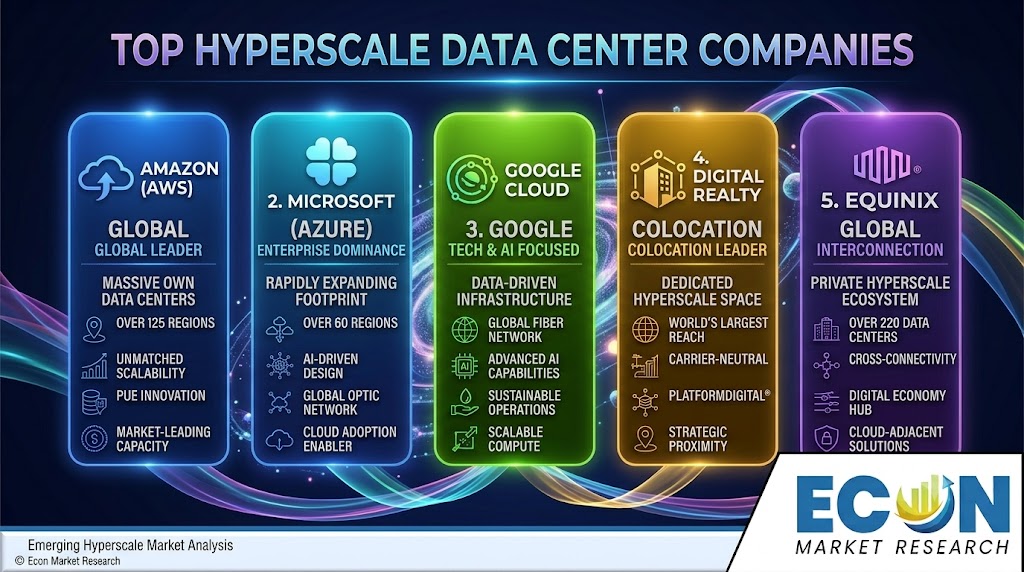
Top 5 Companies in the Hyperscale Data Center
1. Amazon Web Services
Company overview: Amazon was incorporated in 1994, while its cloud business developed into 1 of the world’s largest hyperscale infrastructure platforms. AWS designs and operates cloud regions, Availability Zones, Local Zones, edge locations, and dedicated infrastructure for enterprise, government, startup, and AI workloads. Its architecture emphasizes geographic isolation, automated scaling, service availability, and distributed fault tolerance.
Headquarters: Amazon’s principal corporate offices are located in Seattle, Washington, where the company established its initial operations during the 1994–1995 period. The wider Puget Sound headquarters footprint includes facilities across Seattle, Bellevue, and Redmond, providing access to a technology and cloud engineering ecosystem developed over 30+ years.
Core hyperscale data center expertise: AWS operated 123 Availability Zones across 39 geographic regions in 2026, with 7 additional zones and 2 regions announced. North America alone contained 31 Availability Zones across 9 geographic regions. AWS separates facilities through independent power and networking systems, enabling customers to distribute applications across 2 or 3 zones for resilience.
Major products and services: AWS provides 5 foundational hyperscale service groups through compute, storage, database, networking, and AI platforms. Major offerings include Amazon EC2, Amazon S3, Amazon EBS, Amazon RDS, Amazon EKS, Amazon Bedrock, AWS Direct Connect, Local Zones, Outposts, and multiple high-performance accelerator instances. These services support deployments ranging from 1 virtual server to distributed AI clusters operating across several Availability Zones.
2. Microsoft
Company overview: Microsoft was founded in 1975 and has developed a hyperscale data center network supporting Azure, Microsoft 365, Dynamics 365, security platforms, gaming services, and AI products. Its infrastructure strategy combines public cloud regions, sovereign regions, edge systems, high-performance computing, and dedicated enterprise services. The company celebrated its 50-year milestone in 2025 while continuing to expand AI-ready data center capacity.
Headquarters: Microsoft’s headquarters are located in Redmond, Washington, on a campus covering 500 acres and containing 125+ buildings. The company moved to its Redmond corporate campus in 1986, creating a long-established engineering base for operating systems, enterprise software, cloud infrastructure, and global data center development.
Core hyperscale data center expertise: Microsoft operated 70+ Azure regions and 400+ data centers by 2026. Its regional architecture supports availability zones, geographic disaster recovery, local data residency, hybrid cloud, and specialized government environments. The company has also introduced chip-level liquid cooling and a closed-loop design expected to avoid 125 million liters of cooling water per facility annually.
Major products and services: Microsoft’s hyperscale portfolio includes Azure Virtual Machines, Azure Storage, Azure Kubernetes Service, Azure SQL, Azure OpenAI Service, Microsoft Fabric, Azure Arc, ExpressRoute, and confidential computing. These 8 service areas allow organizations to deploy traditional applications, AI models, analytics platforms, databases, virtual desktops, security tools, and hybrid infrastructure across multiple regions.
3. Google
Company overview: Google was officially established in 1998 and has expanded from search infrastructure into a global hyperscale cloud, advertising, video, mobile, mapping, and AI platform. Its data centers support products used by billions of users while also delivering infrastructure services to enterprise and public-sector customers. Google’s engineering model emphasizes custom servers, proprietary accelerators, software-defined networking, and automated workload management.
Headquarters: Google is headquartered at the Googleplex in Mountain View, California. The company moved from its original garage-based operation to Mountain View after its 1998 formation, creating a technology campus that supports thousands of engineers working on cloud computing, AI, networking, hardware, and digital services.
Core hyperscale data center expertise: Google Cloud operated 43 global regions and 130 zones across 6 continents in 2026. A standard region generally contains 3 or more zones, helping customers isolate resources and design applications for high availability. Google also reported a 2025 fleet-wide power usage effectiveness of 1.09 and 83% less overhead energy than the referenced industry average.
Major products and services: Google’s hyperscale offerings include Compute Engine, Google Kubernetes Engine, Cloud Storage, BigQuery, Cloud SQL, Vertex AI, Tensor Processing Units, and private networking. These 8 major service groups support AI training, inference, analytics, application modernization, data warehousing, databases, storage, and globally distributed digital platforms.
4. Meta Platforms
Company overview: Meta was established in February 2004 and operates hyperscale infrastructure for Facebook, Instagram, WhatsApp, Messenger, Reality Labs, advertising systems, and Meta AI. Unlike public cloud providers, Meta primarily designs data centers for its own platforms, giving the company direct control over hardware design, storage systems, network fabrics, software deployment, and workload optimization.
Headquarters: Meta is headquartered in Menlo Park, California, where it has maintained its principal U.S. headquarters since the 2000s. Its MPK21 building was completed in less than 18 months and includes a 3.6-acre rooftop garden containing 200+ trees, illustrating the scale of the company’s broader engineering and corporate campus.
Core hyperscale data center expertise: Meta’s data center regions commonly contain 5 or more similar buildings. The company created 2 AI clusters containing 24,000 GPUs each and later assembled a 129,000-GPU H100 cluster by repurposing 5 production data centers. Meta is also developing gigawatt-scale AI clusters connected through backend aggregation networks capable of linking thousands of GPUs across multiple facilities and regions.
Major products and services: Meta’s infrastructure portfolio includes AI training clusters, inference platforms, custom compute systems, object storage, file storage, block storage, backbone networking, and open hardware designs. Its storage environment operates hundreds of exabyte-scale clusters supporting at least 7 major product and internal workload categories, including Facebook, Instagram, Reality Labs, Meta AI, advertising, databases, and data warehouses.
5. Digital Realty
Company overview: Digital Realty is a major cloud- and carrier-neutral hyperscale data center provider with a global footprint exceeding 300 facilities across 55+ metropolitan areas and 30+ countries on 6 continents. The company supports cloud providers, enterprises, network operators, AI developers, financial institutions, and digital platforms through colocation, hyperscale capacity, connectivity, and build-to-suit infrastructure.
Headquarters: Digital Realty relocated its global headquarters to Austin, Texas, in January 2021. The location places the company within a major U.S. technology and data center market while supporting its operations across North America, Latin America, Europe, Asia-Pacific, the Middle East, and Africa.
Core hyperscale data center expertise: Digital Realty provides high-density infrastructure starting at 30 kilowatts per cabinet and scaling to 150 kilowatts per cabinet. Its platform supports direct liquid cooling, air-assisted liquid cooling, multi-megawatt deployments, private AI, hybrid cloud, sovereign infrastructure, and high-performance computing. A referenced high-density framework covers 170 sites across 33 markets.
Major products and services: The company’s primary offerings include PlatformDIGITAL, high-density colocation, data center suites, Powered Base Buildings, build-to-suit facilities, ServiceFabric, and cloud interconnection. ServiceFabric provides connectivity across 800+ data centers and 350+ cloud on-ramps, while technical support services operate 24 hours per day, 7 days per week, and 365 days per year.
Regional Outlook
North America
North America is the largest hyperscale data center region because it contains extensive cloud infrastructure, major AI development clusters, mature fiber networks, and large enterprise technology markets. The United States accounted for 45% of global data center electricity consumption in 2024. U.S. data center electricity usage increased from 58 terawatt-hours in 2014 to 176 terawatt-hours in 2023, representing 4.4% of national electricity consumption. By 2028, consumption could reach 325–580 terawatt-hours and account for 6.7%–12% of total U.S. electricity demand. These projections are influencing utility planning, transmission development, power-generation decisions, and hyperscale campus locations.
Northern Virginia, Texas, Oregon, Ohio, Arizona, Iowa, Georgia, and several Canadian provinces remain important hyperscale data center locations because they combine fiber availability, land, electricity access, and cloud connectivity. AWS operated 31 Availability Zones across 9 North American regions in 2026, demonstrating the scale of regional cloud deployment. North American operators are also adopting 30-kilowatt to 150-kilowatt cabinet designs to accommodate AI systems. However, projects increasingly face grid interconnection queues, transformer shortages, construction labor constraints, water restrictions, and community scrutiny. Successful developers will need to coordinate 5 critical resources: land, electricity, water, fiber, and skilled labor.
The North American hyperscale data center market will increasingly extend into secondary locations rather than concentrating all construction in 3 or 4 established hubs. Local Zones, edge facilities, and distributed inference environments can support applications requiring response times below 50 milliseconds. The region also offers access to nuclear, natural gas, wind, solar, hydroelectric, and battery storage resources. As AI demand grows through 2030, hyperscale operators will prioritize campuses capable of supporting 100-megawatt and gigawatt-scale power requirements while maintaining multiple network paths and modular expansion options.
Europe
Europe represents a strategically important hyperscale data center market because of its large digital economy, strict data-protection requirements, extensive subsea connectivity, and emphasis on sustainable infrastructure. European data centers accounted for 15% of global data center electricity consumption in 2024. Facilities within the European Union have consumed 40–45 terawatt-hours annually, representing 1.4%–1.6% of total EU electricity use. Major hubs include Frankfurt, London, Amsterdam, Paris, Dublin, Madrid, Milan, Stockholm, Warsaw, and Zurich, while newer capacity is developing in Denmark, Finland, Greece, Austria, Belgium, and Spain.
Energy regulation is a defining feature of the European hyperscale data center industry. The 2023 Energy Efficiency Directive introduced mandatory public reporting for data centers with power demand above 500 kilowatts. A subsequent 2024 regulation established standardized performance indicators and an EU-wide sustainability rating framework. Operators were required to submit initial information by September 15, 2024, followed by reporting deadlines beginning May 15, 2025. These requirements increase transparency regarding power consumption, water usage, renewable energy, waste heat, and facility efficiency.
Future European hyperscale data center development will focus on renewable-rich regions, heat-reuse systems, sovereign cloud services, and liquid-cooled AI capacity. Germany, France, the Nordic countries, the United Kingdom, Italy, Spain, and Poland offer different combinations of power supply, connectivity, regulation, and market access. Operators will increasingly evaluate facilities using at least 4 operational indicators: power usage effectiveness, water usage effectiveness, energy reuse, and renewable energy coverage. The region’s regulatory approach may raise development complexity, but it can also encourage efficient facilities with lower environmental impact and stronger public accountability through 2030.
Asia-Pacific
Asia-Pacific is experiencing rapid hyperscale data center expansion due to cloud adoption, digital payments, mobile services, manufacturing automation, video consumption, and AI development. China accounted for 25% of worldwide data center electricity consumption in 2024, making it the 2nd-largest national contributor after the United States. Japan, India, Singapore, Australia, South Korea, Indonesia, Malaysia, New Zealand, and Taiwan are also receiving new hyperscale cloud regions and data center campuses. The region combines highly developed digital hubs with emerging markets containing hundreds of millions of new internet and cloud users.
Singapore continues to serve as a major interconnection and enterprise cloud center despite its limited land and power resources. Its Green Data Centre Roadmap targets at least 300 megawatts of additional capacity in the near term, with further capacity expected through green energy deployments. The strategy encourages energy-efficient computing, innovative cooling, and access to low-carbon electricity. This controlled expansion model may influence other dense Asian markets where electricity, water, and land cannot support unlimited data center construction.
India, Japan, Australia, and Southeast Asia present significant opportunities for localized cloud and AI infrastructure. Google opened a 2nd Indian cloud region in Delhi NCR, supplementing its existing Mumbai presence, while Microsoft’s regional portfolio includes Central India, South India, West India, Japan East, Japan West, Korea Central, Korea South, Australia East, and several additional Asia-Pacific locations. Digital Realty opened its 3rd facility at its NRT campus in Japan during 2026 and expanded into Indonesia and Malaysia. Across Asia-Pacific, the strongest projects will combine 3 features: local data residency, high-capacity connectivity, and reliable low-carbon electricity.
Middle East & Africa
The Middle East and Africa hyperscale data center market is moving from limited regional infrastructure toward a distributed cloud ecosystem. AWS launched its Bahrain region in 2019 and its United Arab Emirates region in 2022, with each region containing 3 Availability Zones. A Saudi Arabia region was listed among the company’s announced infrastructure plans for 2026. Microsoft’s footprint includes Qatar Central, UAE North, UAE Central, Israel Central, South Africa North, and South Africa West, while additional capacity is being developed across regional markets.
Gulf countries offer access to large-scale energy systems, international fiber routes, expanding digital economies, and government-led AI programs. However, ambient temperatures above 40 degrees Celsius during parts of the year create cooling challenges. Operators must therefore use advanced air management, closed-loop liquid cooling, heat-resistant equipment, and water-efficient systems. The potential to avoid 125 million liters of cooling water per facility annually makes zero-water cooling particularly relevant to arid markets. Solar generation, battery storage, natural gas, and future nuclear capacity can support hyperscale facilities requiring 100 megawatts or more.
Africa’s hyperscale infrastructure remains concentrated in South Africa, but the regional footprint is widening. Microsoft opened cloud regions in Cape Town and Johannesburg in 2019, AWS launched a 3-Availability-Zone Cape Town region in 2020, and Google opened its 1st African cloud region in Johannesburg in January 2024. These milestones create local infrastructure for financial services, telecommunications, government platforms, healthcare, education, and digital commerce. Future expansion into Kenya, Nigeria, Egypt, Morocco, and other markets will depend on 4 essential improvements: electricity reliability, fiber connectivity, regulatory certainty, and access to skilled technical workers.
Future Opportunities in the Hyperscale Data Center
Future opportunities in the hyperscale data center market will be strongly connected to artificial intelligence. Global data center electricity consumption is projected to increase from 485 terawatt-hours in 2025 to 950 terawatt-hours in 2030, while electricity use from AI-focused data centers could triple during the same 5-year period. This expansion will create demand for GPU clusters, custom accelerators, high-bandwidth memory, optical networking, liquid cooling, energy storage, transformers, substations, and intelligent facility management. Companies that can deliver 30-kilowatt to 150-kilowatt rack environments will capture opportunities from AI training, inference, digital twins, robotics, drug discovery, autonomous systems, and scientific computing.
Power availability will become one of the largest opportunities and constraints. Developers may increasingly colocate hyperscale data centers near nuclear facilities, renewable energy zones, natural gas generation, hydroelectric resources, and large battery installations. Global electricity generation needed to support data centers could exceed 1,000 terawatt-hours in 2030 and reach 1,300 terawatt-hours by 2035. This requirement creates opportunities for grid-interactive data centers that reduce workloads during peak periods, move flexible computing between 2 regions, or operate energy storage systems that support local electricity networks.
Modular construction will provide another opportunity by reducing development schedules and standardizing electrical, mechanical, and cooling systems. Prefabricated power rooms, cooling modules, server halls, and network units can be assembled in controlled environments before installation at the data center site. A 100-megawatt campus can then be developed through multiple phases instead of requiring all capacity on the 1st operational day. This approach reduces capital exposure, improves quality control, and allows facilities to adopt newer hardware during later phases.
Sovereign AI and private AI will also generate demand for hyperscale-quality infrastructure outside traditional public cloud environments. Financial institutions, governments, healthcare organizations, manufacturers, and telecommunications companies may require dedicated GPU systems located within 1 approved jurisdiction. Providers that combine high-density colocation, private networking, model access, and compliance controls can support these requirements. Software-defined platforms connecting 800+ data centers and 350+ cloud on-ramps demonstrate how physical infrastructure can become programmable, allowing enterprises to manage private and multicloud AI environments through unified interfaces.
Conclusion
The hyperscale data center industry entered a new stage in 2026 as cloud computing, generative AI, sovereign infrastructure, and high-density computing converged. Global data center electricity consumption reached 415 terawatt-hours in 2024 and could rise toward 945–950 terawatt-hours by 2030. At the same time, rack-scale systems now connect 72 GPUs, 36 CPUs, and 130 terabytes per second of communication bandwidth inside 1 liquid-cooled architecture. These advances are changing how hyperscale facilities are designed, powered, cooled, connected, and operated.
Amazon Web Services, Microsoft, Google, Meta, and Digital Realty represent 5 influential hyperscale data center companies because each contributes a different combination of cloud regions, AI clusters, network engineering, high-density infrastructure, and global connectivity. Future leadership will depend on more than the number of facilities operated. Successful hyperscale data center companies will need to secure reliable electricity, support 100-kilowatt-class cabinets, reduce water consumption, comply with regional data rules, and deliver resilient services across multiple availability zones. As AI models, digital services, and enterprise data volumes continue expanding through 2030, hyperscale data centers will remain critical infrastructure for the global digital economy.