


Healthcare Digital Twin Companies Advancing Virtual Care
The healthcare digital twin industry is advancing through patient simulations, virtual clinical trials, hospital modeling, AI, and precision medicine platforms.
Introduction
Overview of the Global Healthcare Digital Twin Industry
The global healthcare digital twin industry is developing around virtual representations of patients, organs, medical devices, hospitals and clinical processes. Unlike static 3D models, a digital twin can combine medical imaging, electronic health records, laboratory measurements, wearable-device signals, physiological models and continuously updated operational information. Commercial activity now spans precision medicine, cardiovascular simulation, metabolic disease management, hospital capacity planning, clinical trials, medical-device testing and healthcare robotics. The European Commission launched its Virtual Human Twins Initiative in 2023, while healthcare technology providers are operating digital-twin programs across North America, Europe and Asia-Pacific. GE HealthCare’s hospital command-center technologies have demonstrated operational use across nearly 500 hospitals and medical facilities representing more than 55,000 beds, illustrating that healthcare twins are progressing beyond research laboratories into operational environments.
Current industry maturity differs substantially by application. Hospital operational twins are already used for capacity planning, patient-flow optimization and facility design, while patient-specific whole-body twins remain more specialized. Twin Health reports over 115,000 members in India using its AI-supported metabolic health model, which processes more than 3,000 daily data points for individualized guidance. Virtonomy provides access to thousands of virtual patient twins based on clinical CT data for medical-device development, while Dassault Systèmes’ Living Heart initiative connects hundreds of clinicians, researchers, regulators and industry participants. Clinical-trial specialist Unlearn applies AI-generated participant twins to statistical analysis in Phase 2 and Phase 3 studies. These deployments show that the industry is not one homogeneous product segment; it encompasses physiological simulation, synthetic controls, operational modeling and connected-care applications.
Market Evolution and Growth Drivers
Healthcare digital twin technology evolved from engineering simulation and product-lifecycle modeling into patient-specific and health-system applications as computational capacity, artificial intelligence and connected medical data improved. Siemens Healthineers identifies 4 essential requirements for a functional digital patient twin: digitally networked care environments, structured and annotated data, patient control over data use and clinician access to processed information. The industry has advanced from isolated cardiac or liver models toward multi-organ and whole-body concepts supported by imaging, sensors and population-level datasets. In 2025, Dassault Systèmes began beta testing a new generation of its Living Heart model that can be configured for individual patients or defined populations, marking another step from generalized anatomical simulation toward personalized virtual physiology.
Regulation, healthcare labor pressure and demand for personalized treatment are also accelerating development. The European Virtual Human Twins Initiative includes research and deployment actions extending across multiple disease and clinical-use cases, while the European Commission initiated development of an advanced VHT platform in June 2025. The United States National Heart, Lung, and Blood Institute highlighted digital heart twins in January 2025 as an emerging pathway for forecasting disease risk, treatment response and surgical outcomes. Hospitals are simultaneously adopting operational twins because real-world facility changes can be modeled before implementation; GE HealthCare reports that a typical strategic digital-twin engagement can extend across 5 months of simulation and analysis. These developments position digital twins as decision-support infrastructure rather than simple visualization tools.
Top 5 Latest Trends in the Healthcare Digital Twin Industry
Patient-specific physiological and whole-body digital twins
Digital twins in clinical trials and synthetic controls
Hospital operational twins for capacity and workflow planning
Organ-level simulation for medical devices and precision treatment
AI, cloud and real-time sensor integration
Trend 1: Patient-Specific Physiological and Whole-Body Digital Twins
Patient-specific digital twins are shifting healthcare from population-average recommendations toward individualized simulation. Twin Health’s Whole Body Digital Twin combines AI, sensors and continuous metabolic information to model a member’s response to food, sleep, activity and other factors. The platform reports processing over 3,000 data points per member each day and supporting more than 115,000 members in India. Its reported real-world outcomes include 76.5% diabetes reversal and an average weight reduction of 6.5 kilograms within its participating population. These figures illustrate how continuously updated patient twins differ from traditional clinical risk scores, which usually provide a probability based on a smaller set of variables. Future whole-body models may incorporate genomics, imaging and organ-level simulation, but present commercial systems remain focused on defined conditions where continuous data can be collected and clinically interpreted.
Trend 2: Digital Twins in Clinical Trials and Synthetic Controls
Clinical-trial digital twins are emerging as a distinct branch of the healthcare digital twin industry. Unlearn generates AI-based forecasts of how an enrolled participant would be expected to perform under control or standard-of-care conditions. The company’s PROCOVA methodology has received formal qualification from the European Medicines Agency for selected Phase 2 and Phase 3 trials involving continuous outcomes, while the United States FDA has provided positive feedback regarding its covariate-adjustment methodology. Unlike a conventional historical-control database, a digital twin is generated for each participant using individual baseline information. This approach can increase statistical power or reduce the required size of a control group under appropriate trial designs. In July 2026, Unlearn also responded to the FDA’s AI-enabled early-phase clinical-trial pilot, illustrating growing regulatory engagement with AI-supported trial simulation.
Trend 3: Hospital Operational Twins for Capacity and Workflow Planning
Hospital digital twins are being used to simulate patient flow, bed utilization, staffing, operating-room schedules and expansion strategies before physical changes are made. GE HealthCare’s Command Center platform has documented deployments across nearly 500 hospitals and medical facilities containing more than 55,000 beds. Its digital-twin technology models the statistical behavior of patients, staff and resources so health systems can test scenarios such as adding beds, changing service lines or designing new towers. One 2025 case described use of digital-twin simulation in planning a 12,000-square-foot command center. Siemens Healthineers applies a comparable concept through workflow simulation that creates a protected 3D representation of a healthcare institution using patient pathways, staff movement, equipment utilization and operational performance data. These tools turn hospital planning into a repeatable simulation process rather than relying only on historical averages.
Trend 4: Organ-Level Simulation for Medical Devices and Precision Treatment
Organ-level twins are among the most technically established healthcare digital twin applications because anatomy and biomechanics can be represented using imaging and physics-based models. Dassault Systèmes’ Living Heart Project unites hundreds of clinicians, researchers, industrial companies and regulators to model structural, electrical and fluid behavior of the heart. Virtonomy’s v-Patients platform contains thousands of digital patient twins derived from real CT scans and allows medical-device developers to filter virtual cohorts according to characteristics such as age, sex, disease and anatomical measurements. Medical-device applications include heart valves, stents, catheters, cannulas, occluders and cardiac-assist devices. Virtonomy was founded in 2019 specifically to apply virtual patients to device verification and validation, demonstrating how in-silico testing is becoming a commercial development service rather than remaining solely an academic research technique.
Trend 5: AI, Cloud and Real-Time Sensor Integration
The next generation of digital twins is combining simulation with AI, cloud computing, wearables and physical-AI systems. Microsoft Azure Digital Twins allows organizations to build connected twin graphs representing rooms, devices, workflows and entire environments; its official documentation includes a hospital example that models patient rooms, motion sensors and smart dispensers. NVIDIA introduced Isaac for Healthcare in March 2025, combining 3 computing layers—MONAI, Omniverse and Holoscan—to develop AI-enabled medical robotics. The framework includes 2 end-to-end reference workflows for surgical-subtask automation and autonomous robotic ultrasound and uses high-fidelity digital twins for reinforcement and imitation learning. These technologies broaden healthcare twins beyond simulation by connecting virtual models to physical devices, real-time telemetry and autonomous systems, increasing the importance of latency, cybersecurity and traceable model updates.
Top 10 Companies in the Healthcare Digital Twin Industry
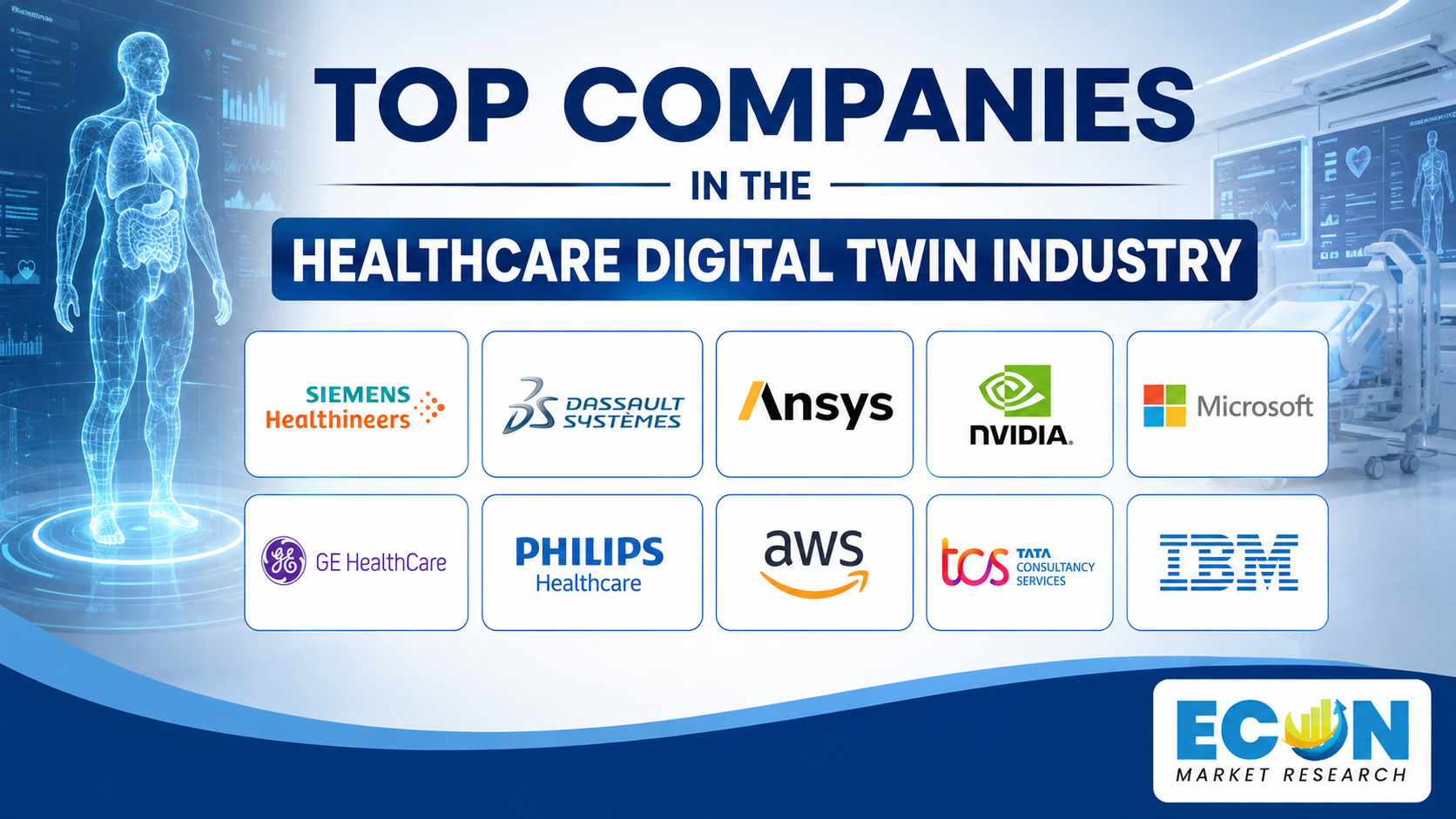
The following 10 companies are not presented as a strict ranking. They are included based on measurable activity in patient twins, virtual human modeling, hospital digital twins, clinical-trial simulation, medical-device testing, connected healthcare infrastructure and healthcare-specific digital-twin research.
1. Dassault Systèmes
Company Overview: Dassault Systèmes has operated for over 40 years and employs approximately 25,000 people across 184 sites, with active customers in 159 countries. Headquarters: Vélizy-Villacoublay, France. Core Healthcare Digital Twin Expertise: The company applies its 3DEXPERIENCE platform to virtual humans, organs, medical devices and therapy development. Major Products and Services: Its Living Heart Project brings together hundreds of clinicians, researchers, regulators and industry participants to simulate cardiac structure, electrical activity and blood flow. In February 2025, the company began beta testing a new AI-enabled Living Heart generation configurable for individual patients or populations. Dassault Systèmes also participates in an FDA-focused in-silico clinical-trial project and supports virtual human modeling across pharmaceutical, medical-device and patient-care workflows.
2. Siemens Healthineers
Company Overview: Siemens Healthineers operates in more than 180 countries, maintains direct representation in over 70 and employed approximately 74,000 people during fiscal 2025. Headquarters: Erlangen, Germany. Core Healthcare Digital Twin Expertise: The company develops both patient-twin concepts and operational twins for healthcare organizations. Major Products and Services: Its patient-twinning strategy uses imaging, diagnostics, AI and longitudinal clinical information to create virtual representations that can support diagnosis, therapy selection and monitoring. Its operational-twin approach combines data from multiple hospital sources and can execute billions of potential scenario simulations for process optimization. Workflow Simulation creates a 3D digital twin of an institution incorporating patient movement, staff schedules, equipment utilization and performance information. These capabilities connect physiological modeling with hospital operations rather than restricting digital twins to a single healthcare application.
3. GE HealthCare
Company Overview: GE HealthCare employs approximately 54,000 people, serves customers in more than 160 countries, conducts research and development in 18 countries and manufactures products in 20. Headquarters: Chicago, Illinois, United States. Core Healthcare Digital Twin Expertise: The company focuses on health-system simulation, capacity planning and operational optimization. Major Products and Services: GE HealthCare’s Digital Twin technology is integrated with Command Center software and enables hospitals to model capacity, workflow, facility design, service-line strategy and surge conditions before implementation. The wider Command Center environment has demonstrated outcomes across nearly 500 hospitals and medical facilities containing more than 55,000 beds. Digital Twin projects can model statistical behavior across patients, staff and resources, providing a virtual environment for evaluating scenarios before hospitals modify real-world infrastructure.
4. Twin Health
Company Overview: Twin Health was founded in 2018 and operates in the United States and India with a team reported at more than 500 people. Headquarters: Menlo Park, California, United States. Core Healthcare Digital Twin Expertise: Twin Health created a Whole Body Digital Twin focused on metabolic conditions such as type 2 diabetes, obesity, fatty liver and hypertension. Major Products and Services: Its AI-supported platform integrates continuous glucose data, activity, sleep, nutrition and other physiological measurements into an individualized metabolic model. The Indian program reports more than 115,000 members and over 3,000 daily data points used for each digital model. The platform combines automated insights with physician and health-coach oversight, illustrating a commercial healthcare digital twin deployed directly into chronic-care management rather than limited to research or simulation laboratories.
5. Unlearn
Company Overview: Unlearn develops AI technologies specifically for clinical research and has built its platform around participant-level digital twins. Headquarters: San Francisco, California, United States. Core Healthcare Digital Twin Expertise: Its technology forecasts clinical outcomes that individual trial participants would be expected to experience under control or standard-of-care conditions. Major Products and Services: Digital twins support randomized trials, single-arm studies, interim analyses and retrospective evaluations. PROCOVA has received European Medicines Agency qualification for selected Phase 2 and Phase 3 trials, while the FDA has issued positive feedback on its statistical methodology. In July 2026, Unlearn submitted recommendations regarding the FDA’s AI-Enabled Optimization of Early-Phase Clinical Trials Pilot Program. Its commercial importance lies in connecting digital-twin methods directly with regulated pharmaceutical development and statistical trial design.
6. Virtonomy
Company Overview: Virtonomy was founded in 2019 by Dr. Simon J. Sonntag and Wen-Yang Chu. Headquarters: Munich, Germany. Core Healthcare Digital Twin Expertise: The company creates virtual patients for in-silico testing and medical-device development using imaging, computational modeling and clinical data. Major Products and Services: Its v-Patients system provides access to thousands of digital patient twins derived from CT scans. Developers can construct populations according to disease, age, sex, ethnicity, ejection fraction and anatomical parameters. Supported applications include heart valves, stents, catheters, cannulas, occluders and heart-assist devices. The system combines virtual implantation, 3D measurements, physics-based simulation, statistical shape models and regulatory reporting, allowing manufacturers to identify edge cases before physical testing or clinical deployment.
7. NVIDIA
Company Overview: NVIDIA was founded in 1993 and is headquartered in Santa Clara, California. Headquarters: Santa Clara, California, United States. Core Healthcare Digital Twin Expertise: NVIDIA supplies accelerated computing, simulation and AI infrastructure used to create virtual clinical environments and train medical robots. Major Products and Services: Isaac for Healthcare, launched in March 2025, combines 3 major computing components—MONAI, Omniverse and Holoscan—to support medical robotics development. It includes 2 reference workflows focused on surgical automation and autonomous ultrasound and uses digital twins to generate synthetic data and train policies before deployment to physical systems. NVIDIA’s role in the industry is primarily enabling infrastructure, but the healthcare-specific Isaac framework gives the company direct relevance in high-fidelity simulation of operating rooms, medical equipment and robotic procedures.
8. Microsoft
Company Overview: Microsoft was founded in 1975 and maintains its corporate headquarters in Redmond, Washington, with subsidiaries operating across more than 100 national and regional markets as of March 2026. Headquarters: Redmond, Washington, United States. Core Healthcare Digital Twin Expertise: Microsoft provides cloud infrastructure for creating digital representations of hospitals, connected medical spaces, IoT devices and operational systems. Major Products and Services: Azure Digital Twins uses a model-based twin graph to connect digital representations of physical environments and live telemetry. Official implementation documentation demonstrates a healthcare scenario where patient rooms, motion sensors and smart handwashing dispensers form a hospital twin. Azure also supports IoT Hub integration, event routing, storage, analytics, monitoring and cross-region disaster recovery. This infrastructure allows healthcare organizations and software developers to build digital-twin architectures without creating an underlying cloud platform from the ground up.
9. Royal Philips
Company Overview: Philips has more than 130 years of healthcare and technology history and operates internationally across connected care, imaging, monitoring and informatics. Headquarters: Amsterdam, Netherlands. Core Healthcare Digital Twin Expertise: Philips applies digital-twin concepts to patient modeling, medical equipment monitoring and hospital operations. Major Products and Services: The company has analyzed technical data from more than 15,000 MRI, CT and interventional X-ray systems to support predictive maintenance concepts. Its healthcare modeling and simulation consulting creates digital replicas of health systems to test capacity, staffing and patient-flow scenarios. Philips also describes patient twins that integrate medical records, personal history, wearables and biomedical knowledge. One enterprise capacity model uses machine learning to predict census at hospital and unit levels and evaluates readmission risk within 30 days, demonstrating how twin-style models can connect operational and clinical data.
10. Tata Consultancy Services
Company Overview: Tata Consultancy Services was established in 1968 and employed 593,798 professionals as of June 30, 2026, with operations in 50 countries and 187 solution centers across 19 countries. Headquarters: Mumbai, India. Core Healthcare Digital Twin Expertise: TCS develops digital twins for human physiology, life-sciences research and simulation through its research and enterprise technology programs. Major Products and Services: The company created a Digital Twin Heart for marathon champion Des Linden using MRI, training information and other physiological datasets, and expanded the concept through its Future Athlete Project. Its healthcare research also includes a computational digital twin of human skin for in-silico testing of drug and cosmetic formulations. TCS TwinX provides a broader AI-powered digital-twin environment, while TCS research applies digital twins to healthcare, pharmaceutical development and personalized physiological analysis.
Regional Outlook
North America
North America combines advanced research institutions, clinical-trial developers, cloud providers and health-system simulation deployments. The United States hosts GE HealthCare, Twin Health, Unlearn, NVIDIA and Microsoft, giving the region strong capabilities across patient twins, clinical trials, hospital operations and computing infrastructure. GE HealthCare’s Command Center technology has demonstrated use across nearly 500 hospitals and facilities globally, while Twin Health’s United States operations support its Whole Body Digital Twin program. The National Heart, Lung, and Blood Institute highlighted digital heart twins in January 2025 as a route toward predicting disease risk, simulating surgery and evaluating treatment response. Canada contributes AI and digital-health research through national healthcare institutions, while Mexico offers a growing hospital digitization environment but has fewer visible commercial healthcare-twin deployments.
Regional opportunities include clinical-trial optimization, hospital simulation, cardiac modeling and IoT-driven facility twins. Microsoft’s Azure platform can represent hospital rooms and sensors in connected twin graphs, while NVIDIA’s 2025 Isaac for Healthcare launch expanded simulation into robotic surgery and autonomous ultrasound. North American adoption must comply with healthcare privacy, medical-device and clinical-research requirements, creating high validation expectations for systems that influence patient care. Operational twins generally face a different risk profile than diagnostic patient twins because changing a bed-allocation scenario is not equivalent to recommending a therapy. The principal regional challenge is therefore governance: institutions need to distinguish models used for strategic simulation from those that directly affect diagnosis, treatment or trial endpoints.
Europe
Europe has established one of the most coordinated public-sector healthcare digital twin initiatives. The European Virtual Human Twins Initiative was launched in December 2023 and supports models spanning cells, tissues, organs and complete organ systems. In June 2025, the European Commission initiated development of an advanced platform designed to integrate and validate VHT models. The program also includes a pan-European federated infrastructure for intensive-care data and a dedicated VHT Uptake Incubator. Companies such as Dassault Systèmes, Siemens Healthineers, Philips and Virtonomy provide additional industrial capabilities across France, Germany and the Netherlands, while academic and regulatory collaboration supports in-silico medicine and personalized treatment.
Regulation will strongly influence European commercialization because patient twins can involve sensitive health information, artificial intelligence and medical-device functionality simultaneously. Unlearn’s PROCOVA methodology has already achieved European Medicines Agency qualification for defined Phase 2 and Phase 3 applications, demonstrating that regulators are willing to evaluate digital-twin-derived methods when statistical assumptions and validation are clearly defined. Virtonomy also participates in international regulatory activities related to computational modeling and medical devices. Europe’s 27 European Union member states provide a large clinical and research base, but fragmented hospital IT systems and national healthcare processes remain implementation barriers. Interoperability and validation are therefore as important as raw simulation performance.
Asia-Pacific
Asia-Pacific combines a large healthcare population with expanding AI, cloud and medical-technology ecosystems. India has become a visible patient-twin deployment market through Twin Health, whose Indian platform reports over 115,000 members and more than 3,000 daily data points used in personalized metabolic modeling. TCS, headquartered in Mumbai, operates across 50 countries and has applied digital twins to the human heart and skin. Australia has also become a deployment location for operational digital twins: in March 2026, the first GE HealthCare Command Center in the Southern Hemisphere began operating across 3 Melbourne hospitals—The Alfred, Caulfield Hospital and Sandringham Hospital. These examples show regional activity across patient care, hospital operations and physiological research.
Japan, South Korea, Singapore, China and Taiwan provide additional opportunities because of their medical-device manufacturing, semiconductor, robotics and digital-health capabilities. NVIDIA announced a new Taiwan development facility designed for roughly 4,000 employees, strengthening regional AI engineering capacity that can support simulation workloads. Singapore and Australia provide advanced healthcare IT environments, while India supplies large engineering and clinical-research workforces. Regional risks include unequal health-data standards, limited interoperability between hospital systems and different rules for cross-border transfer of patient information. Healthcare digital twins that rely on continuous wearable data or imaging will therefore need localized architectures rather than a single global configuration.
Middle East & Africa
Middle East adoption is being supported by national digital-health programs and centralized hospital networks. The 6 Gulf Cooperation Council countries are expanding connected care, virtual medicine and AI-supported health infrastructure. Saudi Arabia’s Seha Virtual Hospital already coordinates with 224 hospitals and provides 44 specialized services, demonstrating the scale of digitally connected care that could support future operational and patient twins. The United Arab Emirates is similarly building national digital-health infrastructure and AI capabilities. These environments create opportunities for hospital capacity models, chronic-disease digital twins and remote specialist simulations, particularly where centralized systems can aggregate standardized health information.
Africa’s near-term use cases are likely to focus on health-system planning and targeted disease applications rather than computationally intensive whole-body twins. Limited connectivity, fragmented electronic records and shortages of specialized personnel constrain continuous data synchronization in lower-resource settings. However, a digital twin does not always require real-time whole-body modeling: operational simulations can initially focus on hospital beds, staffing or patient movement using existing datasets. By 2030, digital-health infrastructure and workforce development programs could create stronger conditions for patient-specific models in South Africa, Egypt, Kenya and Nigeria. The practical opportunity is to design lighter, cloud-accessible twins that can operate with incomplete infrastructure rather than assuming every hospital has advanced sensors and continuous data feeds.
Future Opportunities in the Healthcare Digital Twin Industry
Future opportunities for the Top Companies in the Healthcare Digital Twin Industry will center on connecting previously separate models into broader virtual representations. Current products often focus on 1 organ, 1 disease or 1 operational problem, but integrated models could combine imaging, genomics, laboratory results, wearables, medication history and environmental information. The European initiative specifically defines VHTs across multiple biological levels, ranging from cells to complete organ systems. Siemens Healthineers identifies patient twinning as a strategic technology for diagnosis, therapy selection, monitoring and aftercare, while Philips has described a long-term model continuously updated through scans, examinations and behavioral information. The strongest opportunity therefore lies in interoperability between partial twins rather than expecting a complete digital human to emerge from a single model.
Clinical development provides another realistic pathway. Virtonomy already offers thousands of virtual patients for medical-device simulations, and Unlearn applies participant-level twins in regulated clinical-trial analysis. Future virtual cohorts could allow developers to evaluate edge-case anatomies and expected control outcomes before enrolling large physical populations. Regulatory acceptance will depend on validation, traceability and the ability to explain how the twin differs from the physical patient. The 2026 FDA early-phase AI pilot and existing European regulatory engagement indicate increasing institutional interest, but digital twins are expected to supplement rather than automatically replace conventional evidence.
Healthcare robotics and hospital automation create a third opportunity. NVIDIA’s Isaac for Healthcare already uses digital environments for 2 reference workflows involving surgical-task automation and autonomous ultrasound, while hospital systems can use operational twins to model capacity before physical changes. Digital twins can become training environments in which AI agents test millions or billions of possible scenarios without exposing real patients to experimental actions. Cloud, edge computing and connected sensors will make these twins more responsive, but continuous synchronization also raises cybersecurity and reliability requirements. By 2030, competitive differentiation is likely to depend on validated integration, clinical governance and data quality rather than simulation complexity alone.
Conclusion
The Healthcare Digital Twin industry has progressed from isolated simulation experiments toward commercial applications covering metabolic care, hospital operations, medical-device testing, clinical trials and medical robotics. The 5 major trends—whole-body patient twins, synthetic clinical-trial controls, hospital operational twins, organ-level simulation and AI-connected environments—show that digital twins are developing across multiple layers of healthcare. Dassault Systèmes, Siemens Healthineers, GE HealthCare, Twin Health, Unlearn, Virtonomy, NVIDIA, Microsoft, Philips and TCS each approach the field differently, ranging from thousands of virtual patients and more than 115,000 metabolic-program members to hospital platforms spanning nearly 500 facilities.
Regional development also differs substantially. Europe launched its coordinated Virtual Human Twins Initiative in 2023, North America concentrates major software and clinical-trial developers, Asia-Pacific includes patient-twin deployments and digital-heart research, and the Middle East is building digitally connected hospital infrastructure across the 6 GCC countries. The strongest future opportunities involve combining partial organ and disease twins, expanding in-silico trials, integrating real-time sensors and using AI agents to test healthcare scenarios safely. The Top Companies in the Healthcare Digital Twin Industry will ultimately be differentiated by measurable clinical validity, interoperability, privacy protection and the ability to keep virtual models synchronized with real-world patients and healthcare systems.