

Synthetic Data Market
Synthetic Data Market Size, Share, Trends, Growth, and Industry Analysis, By Data Type (Tabular Data, Text/NLP Data, Image & Video Data, Others), By Offering (Fully Synthetic Data, Partially Synthetic/Hybrid Data), By Technology (Generative Adversarial Networks (GANs), Diffusion Models, Variational Autoencoders (VAEs), Others), By Deployment Mode (Cloud, On-Premises), By Application (AI/ML Training & Development, Data Privacy & Compliance, Test Data Management, Others), By End User (BFSI, Healthcare & Life Sciences, Automotive, Retail & E-commerce, IT & Telecommunications, Government & Defense, Others), Regional Analysis and Forecast Period 2026-2035
Synthetic Data Market Overview
As per Econ Market Research analysis, the Global Synthetic Data Market valuation stood at US$ 0.75 Billion in 2026 and is expected to reach US$ 14.51 Billion by 2035, growing at a steady CAGR of 38.98% from 2026 to 2035. 2025 serves as the base year.
Synthetic Data Market Size 2025-2035 (USD Billion)

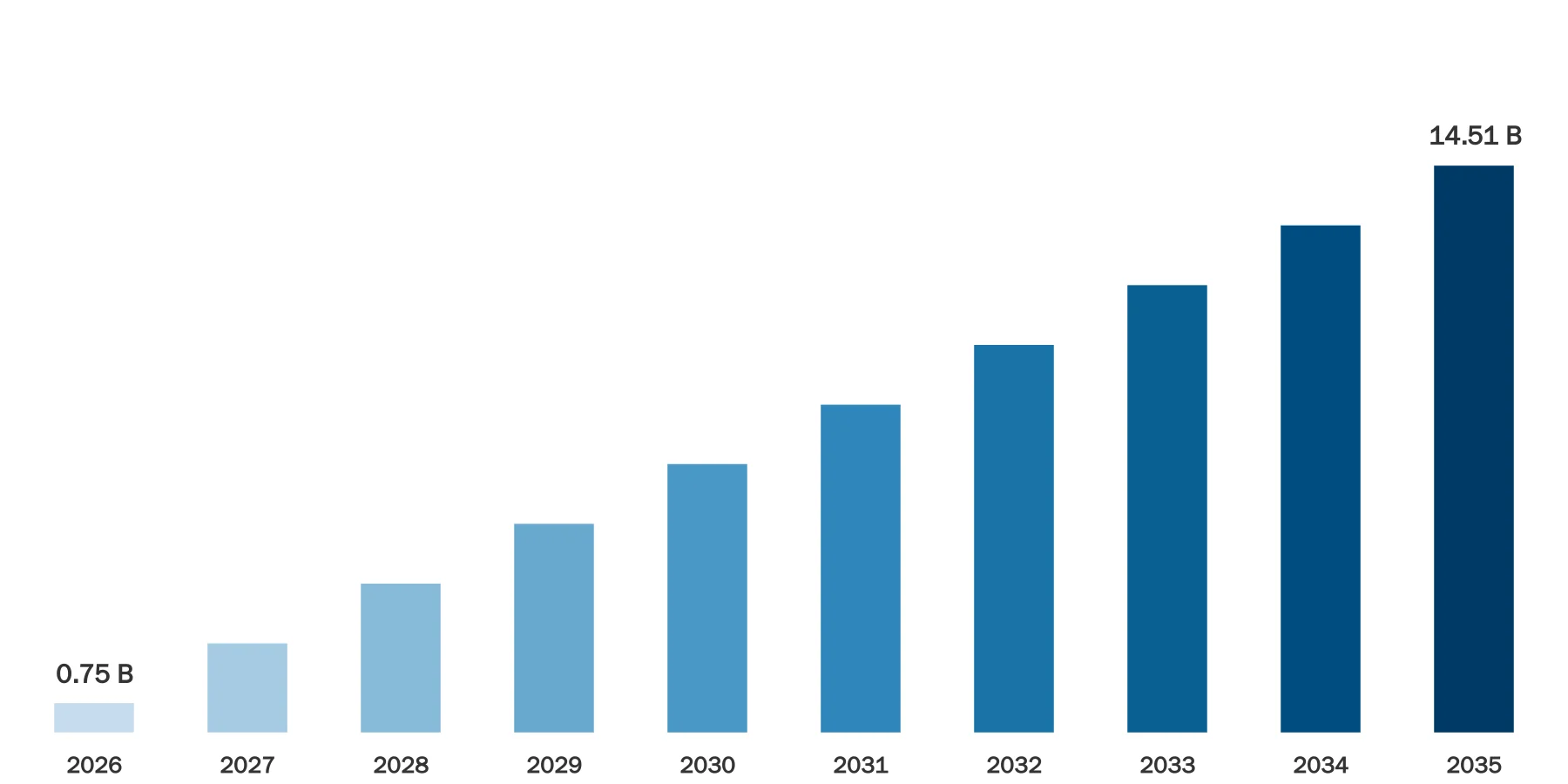
Source: Econ Market Research
The Synthetic Data market is expanding rapidly as enterprises increase AI model training volumes by more than 45% annually across healthcare, BFSI, retail, and automotive sectors. More than 62% of AI developers now rely on synthetic datasets to overcome data scarcity and privacy restrictions. Over 70% of machine learning projects require datasets exceeding 1 million records, creating strong demand for scalable synthetic data generation platforms. Approximately 58% of enterprises implementing generative AI tools in 2025 integrated synthetic data into at least 1 operational workflow. Synthetic datasets reduce data labeling workloads by nearly 50% and improve testing speed by approximately 35% in enterprise AI deployment pipelines.
The USA Synthetic Data Market accounts for nearly 38% of global enterprise adoption due to strong AI infrastructure and cloud computing penetration. More than 78% of Fortune 500 technology firms in the United States use synthetic data for AI testing, fraud analytics, or cybersecurity simulations. Around 46% of U.S. internet adults used at least 1 generative AI tool during 2025, accelerating synthetic dataset requirements for enterprise model training. Healthcare organizations in the United States processed over 50 million synthetic patient records for medical imaging simulations and diagnostics training during 2025. More than 60% of U.S. financial institutions implemented synthetic transaction datasets to strengthen anti-money laundering algorithms and fraud detection systems.
The European Synthetic Data Market represents nearly 27% of global implementation activity due to GDPR compliance requirements and growing AI governance regulations. More than 55% of European enterprises using AI analytics platforms deploy synthetic datasets to maintain privacy compliance during customer data processing. Germany, France, and the United Kingdom collectively account for over 65% of regional synthetic data deployment projects. Nearly 40% of European automotive AI testing environments use synthetic image and sensor datasets for Autonomous Vehicle simulations. Healthcare systems across Europe increased synthetic medical image generation by approximately 48% between 2024 and 2025 to improve AI-driven radiology workflows and patient privacy protection initiatives.
Synthetic Data Market Latest Trends
The Synthetic Data Market is witnessing significant transformation due to generative AI adoption, diffusion model advancements, and increased AI regulation. Nearly 60% of organizations deploying generative AI solutions integrated synthetic data into production-level applications during 2025. Text-based synthetic data accounted for approximately 43% of enterprise AI training datasets, while synthetic image datasets represented nearly 47% of implementations in automotive and retail computer vision projects. Diffusion models improved synthetic image realism by more than 30% compared with earlier GAN-based systems.
Cloud-based synthetic data generation platforms now support over 75% of enterprise deployments because organizations require scalable GPU infrastructure for high-volume simulations. Around 65% of enterprises deploying AI systems now generate synthetic customer interaction datasets for chatbot and NLP training. The gaming industry also increased synthetic asset deployment, with nearly 20% of newly released games in 2025 using AI-generated assets or environments.
Cybersecurity simulation emerged as another major trend, as organizations recorded more than 223 monthly AI-related data policy incidents involving sensitive information exposure. This increased enterprise investment in synthetic cybersecurity datasets for threat detection testing and red-team simulations. Synthetic biometric datasets increased by nearly 40% during 2025 for facial recognition and identity verification applications. The healthcare sector expanded synthetic radiology image generation by approximately 50% to address shortages of labeled medical imaging data.
Synthetic Data Market Dynamics
The Synthetic Data Market Dynamics are influenced by rising enterprise AI adoption, stricter privacy regulations, increased cloud computing deployment, and rapid advances in generative AI models. More than 88% of organizations globally implemented AI in at least 1 business function during 2025, creating significant demand for privacy-compliant training datasets. Enterprises generating over 10 terabytes of operational data weekly increasingly rely on synthetic alternatives to reduce storage complexity and regulatory risks. Approximately 57% of enterprises expanded synthetic data projects to support machine learning scalability and automated testing operations.
DRIVER
Increasing Adoption of AI and Machine Learning Systems
The primary growth driver in the Synthetic Data Market is the accelerating adoption of AI and machine learning technologies across enterprises. Around 60% of organizations globally now deploy generative AI solutions in production environments. More than 70% of machine learning workflows require high-volume structured or unstructured datasets exceeding 1 million records for effective model training. Synthetic data significantly reduces data collection costs by nearly 40% while improving AI testing efficiency by approximately 35%.
Healthcare organizations increasingly use synthetic MRI, CT, and radiology images to train AI systems without exposing patient information. Financial institutions generate synthetic transaction datasets to improve fraud detection models capable of processing more than 100,000 transactions per second. Retail companies use synthetic consumer behavior datasets to optimize recommendation engines serving over 500 million digital interactions monthly. Autonomous vehicle developers now conduct millions of synthetic driving simulations annually to improve object detection and navigation algorithms.
RESTRAINT
Concerns Regarding Data Accuracy and Model Bias
One major restraint in the Synthetic Data Market involves concerns regarding synthetic dataset accuracy and algorithmic bias. Nearly 43% of enterprises report challenges validating synthetic datasets against real-world scenarios. Around 37% of AI developers identified limitations in preserving statistical consistency across highly complex synthetic datasets. Bias amplification remains a major concern because improperly generated datasets can replicate or intensify demographic inequalities.
More than 45 percentage points of adoption disparity were observed in specific demographic groups due to differing perceptions of AI-related risks and ethical concerns. Synthetic image datasets occasionally fail to represent rare edge-case scenarios required for autonomous systems and medical diagnostics. Approximately 47% of organizations also reported security concerns associated with unmanaged AI applications processing synthetic and real datasets simultaneously. Validation overhead and prompt engineering challenges continue affecting deployment efficiency in enterprise-scale projects.
OPPORTUNITY
Rising Demand for Privacy-Compliant Data Solutions
The Synthetic Data Market presents strong opportunities through increasing global privacy regulations and enterprise compliance requirements. More than 90% of organizations now block at least 1 generative AI application due to concerns about sensitive data exposure. Enterprises increasingly use synthetic datasets to comply with GDPR, HIPAA, and regional cybersecurity regulations while maintaining AI innovation capacity.
Healthcare institutions process millions of synthetic patient records annually to improve diagnostics research without violating patient confidentiality requirements. Banking organizations increasingly deploy synthetic transaction histories to strengthen anti-money laundering systems and financial risk analysis. Approximately 71% of enterprises identified multi-source data integration as a critical challenge, increasing interest in synthetic data solutions capable of generating unified datasets across cloud environments. Synthetic cybersecurity simulations are also gaining importance, with enterprises running thousands of attack scenarios monthly to improve resilience against AI-powered threats.
CHALLENGES
Increasing Computational Complexity and Infrastructure Demand
The Synthetic Data Market faces substantial challenges related to computational intensity and infrastructure scaling requirements. Training advanced diffusion models and GAN architectures requires extensive GPU clusters and high-performance cloud infrastructure. Large enterprises now process petabytes of synthetic data annually, increasing storage and energy consumption.
Infrastructure limitations, particularly power supply constraints in data centers, continue affecting AI scaling projects globally. Around 43% of organizations reported difficulties evaluating synthetic dataset quality across multiple AI training environments. Generative AI prompt volumes increased by nearly 500% during the last year, increasing infrastructure stress for cloud providers and enterprise AI teams. Smaller enterprises also struggle with limited access to advanced AI hardware and synthetic data engineering expertise. The absence of standardized validation frameworks further complicates synthetic dataset benchmarking and interoperability across industries.
SWOT Analysis
Strengths
Synthetic datasets reduce data labeling workloads by nearly 50% across AI development projects.
More than 60% of enterprises use synthetic data to accelerate AI testing and machine learning model optimization.
Synthetic healthcare imaging datasets improved diagnostic AI training efficiency by approximately 40%.
Cloud deployment supports over 75% of enterprise synthetic data generation workloads globally.
Synthetic transaction simulations process more than 100,000 financial records per second for fraud detection training.
Weaknesses
Nearly 43% of organizations experience difficulties validating synthetic dataset realism.
Bias replication affects approximately 37% of AI models trained on incomplete synthetic datasets.
Advanced diffusion models require high-performance GPU infrastructure with energy-intensive workloads.
Around 47% of enterprises report security concerns involving unmanaged AI applications.
Lack of universal validation standards limits interoperability across industries.
Opportunities
More than 90% of organizations seek privacy-compliant AI data alternatives due to regulatory pressure.
Synthetic cybersecurity datasets are increasingly used for thousands of attack simulations monthly.
Autonomous vehicle companies run millions of synthetic driving scenarios annually.
Retail AI personalization systems analyze billions of synthetic customer interactions every year.
Government defense agencies increasingly deploy synthetic battlefield simulation datasets.
Threats
AI-generated misinformation and low-quality synthetic content continue increasing globally.
Approximately 223 monthly AI-related data incidents affect enterprise compliance operations.
High infrastructure costs create barriers for smaller organizations.
Increasing regulatory oversight may limit unrestricted AI dataset generation.
Competitive open-source AI platforms intensify pricing and technology pressure across vendors.
Segmentation Analysis
The Synthetic Data Market segmentation includes By Data Type, By Offering, By Technology, By Deployment Mode, By Application, and By End User. Tabular datasets account for major enterprise analytics applications, while image and video datasets dominate computer vision use cases. Fully synthetic datasets represent strong adoption in healthcare and BFSI due to privacy requirements. GANs and diffusion models lead technological innovation with high-quality image generation capabilities. Cloud deployment dominates because more than 75% of enterprises rely on scalable AI infrastructure. AI/ML training remains the leading application segment, while BFSI and healthcare collectively contribute more than 40% of enterprise synthetic data implementations globally.
By Data Type
Tabular Data accounts for nearly 34% of the Synthetic Data Market due to strong use in BFSI, insurance, and enterprise analytics applications. More than 65% of financial institutions deploy synthetic tabular datasets for fraud detection, customer analytics, and anti-money laundering systems. Text/NLP Data represents approximately 26% of adoption because enterprises increasingly train chatbots and large language models using synthetic conversational datasets.
Image & Video Data contributes nearly 31% of market deployment activity, particularly in autonomous driving, facial recognition, retail surveillance, and healthcare imaging applications. Automotive AI testing environments process millions of synthetic image frames every week for autonomous navigation systems. Synthetic medical imaging datasets increased by approximately 48% during 2025 for radiology AI training.
Other data types, including audio and time-series datasets, account for nearly 9% of implementation activity. Manufacturing companies increasingly use synthetic sensor datasets to monitor Predictive Maintenance systems processing over 1 million machine events daily.
By Offering
Fully Synthetic Data holds approximately 63% share in the Synthetic Data Market because enterprises prioritize complete privacy protection and regulatory compliance. Healthcare providers increasingly use fully synthetic patient records to support AI diagnostics training while eliminating exposure to identifiable patient information. BFSI institutions deploy fully synthetic transaction histories to improve fraud analytics and transaction monitoring systems.
Partially Synthetic/Hybrid Data accounts for nearly 37% of market activity, primarily among enterprises requiring statistical similarity with real operational datasets. Hybrid datasets combine real-world transactional structures with synthetic augmentation to improve AI training diversity. Approximately 52% of large enterprises prefer hybrid synthetic datasets for customer analytics applications because they maintain higher operational realism.
Cloud-native AI vendors increasingly integrate hybrid synthetic data generation tools into enterprise machine learning pipelines. Retail companies use partially synthetic purchasing histories to optimize recommendation systems handling more than 10 million customer interactions daily. Hybrid datasets also improve testing environments for software quality assurance and enterprise cybersecurity simulations.
By Technology
Generative Adversarial Networks (GANs) account for nearly 41% of the Synthetic Data Market technology segment due to their strong performance in image generation and computer vision applications. GAN-based synthetic datasets are widely used in autonomous driving simulations, medical imaging analysis, and biometric recognition systems. More than 60% of image-focused synthetic data platforms continue using GAN architectures for high-resolution visual generation.
Diffusion Models represent approximately 29% of the market and are rapidly gaining enterprise adoption because they improve image realism and reduce distortion issues. Diffusion models improved synthetic image quality by nearly 30% compared with earlier AI generation techniques. Fashion retail and gaming sectors increasingly deploy diffusion-generated assets for virtual environments and product visualization.
Variational Autoencoders (VAEs) contribute nearly 18% of adoption, particularly in anomaly detection and compressed dataset generation applications. Other technologies, including reinforcement learning-based generators and rule-based synthetic engines, account for roughly 12% of deployment activity. Enterprises increasingly combine multiple AI generation methods to create scalable, multimodal synthetic datasets for large AI ecosystems.
By Deployment Mode
Cloud deployment dominates the Synthetic Data Market with approximately 76% share because enterprises require scalable GPU infrastructure and distributed computing capabilities. More than 70% of AI startups deploy cloud-native synthetic data platforms to support real-time AI model training and testing. Cloud-based systems process billions of synthetic records monthly across BFSI, healthcare, and retail environments.
On-Premises deployment represents nearly 24% of market adoption, particularly among government, defense, and highly regulated financial organizations. Enterprises handling classified or sensitive operational data continue preferring internal deployment environments for stronger access control and cybersecurity governance. Defense agencies increasingly run synthetic battlefield simulations within isolated on-premises infrastructure supporting advanced autonomous systems testing.
Hybrid cloud strategies are also increasing because organizations combine internal compliance systems with scalable external AI infrastructure. Approximately 58% of enterprises deploying synthetic AI workflows use multi-cloud environments to distribute computational workloads and improve disaster recovery capabilities. Cloud adoption remains strongest in North America and Asia-Pacific due to extensive hyperscale Data Center Infrastructure.
By Application
AI/ML Training & Development holds nearly 44% of the Synthetic Data Market because enterprises require scalable datasets for machine learning model optimization. More than 70% of enterprise AI systems depend on synthetic augmentation to improve training diversity and reduce bias. Retail recommendation engines, fraud analytics systems, and autonomous driving platforms collectively process billions of synthetic records annually.
Data Privacy & Compliance contributes approximately 24% of adoption activity. Enterprises increasingly use synthetic datasets to comply with GDPR, HIPAA, and data localization regulations. More than 90% of organizations now restrict certain AI applications because of privacy concerns, increasing reliance on synthetic alternatives.
Test Data Management accounts for nearly 21% of market demand due to rising software testing complexity. Enterprises simulate thousands of operational scenarios daily using synthetic test environments. Other applications, including cybersecurity simulation, digital twins, and smart manufacturing analytics, represent approximately 11% of implementation activity. Synthetic cybersecurity datasets now support thousands of attack simulations monthly for enterprise security testing operations.
By End User
BFSI accounts for nearly 24% of the Synthetic Data Market because banks and insurance companies require privacy-compliant fraud detection and transaction analytics systems. Financial institutions process millions of synthetic financial records daily for anti-money laundering monitoring and predictive risk analysis.
Healthcare & Life Sciences represent approximately 21% of market adoption. Hospitals and pharmaceutical organizations increasingly generate synthetic medical imaging datasets to improve AI-assisted diagnostics and drug discovery workflows. Automotive contributes nearly 15% of demand, with autonomous vehicle companies conducting millions of virtual driving simulations annually.
Retail & E-commerce holds approximately 13% share due to increasing use of synthetic customer behavior analytics and recommendation systems. IT & Telecommunications contributes around 12% because enterprises require synthetic datasets for network optimization and AI chatbot development. Government & Defense represents nearly 9% of market deployment, particularly in cybersecurity, surveillance simulation, and military training applications. Other industries collectively account for approximately 6% of synthetic data implementations globally.
Regional Analysis
North America leads the Synthetic Data Market with approximately 39% global share due to advanced AI infrastructure and high enterprise cloud adoption.
Europe accounts for nearly 27% of market activity because of strict data privacy regulations and increasing AI governance initiatives.
Asia-Pacific contributes approximately 24% share driven by AI expansion in China, Japan, South Korea, and India.
Middle East & Africa holds nearly 10% share due to increasing smart city investments and digital transformation programs.
North America
North America dominates the Synthetic Data Market with approximately 39% market share supported by extensive AI adoption across healthcare, BFSI, retail, and defense sectors. The United States accounts for more than 82% of regional synthetic data deployment projects. Around 78% of Fortune 500 technology firms use synthetic datasets for AI testing, cybersecurity simulation, or machine learning development.
Healthcare organizations in North America generated over 50 million synthetic patient records during 2025 to support diagnostics AI and medical imaging analytics. Financial institutions process synthetic transaction datasets containing billions of records annually to improve fraud prevention systems. More than 70% of cloud-native AI startups operating in North America integrate synthetic data generation into enterprise AI pipelines.
The region also benefits from strong hyperscale cloud infrastructure and GPU availability. Around 60% of organizations implementing generative AI solutions in North America use synthetic augmentation techniques for model training. Government agencies increasingly deploy synthetic cybersecurity environments for defense and intelligence simulations involving thousands of attack scenarios monthly.
Europe
Europe represents approximately 27% of the Synthetic Data Market due to stringent GDPR regulations and rising enterprise focus on privacy-preserving AI systems. Germany, France, and the United Kingdom collectively contribute more than 65% of regional adoption activity. Around 55% of European organizations implementing AI analytics solutions use synthetic datasets for regulatory compliance and secure data sharing.
Automotive companies in Germany and France conduct millions of synthetic driving simulations annually for autonomous vehicle testing. More than 40% of European automotive AI systems rely on synthetic sensor and image datasets. Healthcare institutions across Europe increased synthetic radiology image generation by approximately 48% during 2025 to improve AI diagnostics training.
European enterprises increasingly deploy synthetic data for cybersecurity simulations and financial compliance analytics. Banking organizations across the region process millions of synthetic transaction records daily for anti-money laundering testing. Public sector organizations also expanded synthetic population datasets for smart city planning and digital governance programs. AI governance frameworks in Europe continue accelerating enterprise demand for privacy-safe data generation technologies.
Asia-Pacific
Asia-Pacific accounts for approximately 24% of the Synthetic Data Market and remains the fastest-expanding regional ecosystem for AI-driven applications. China, Japan, South Korea, and India collectively represent more than 75% of regional deployment activity. South Korea experienced significant generative AI expansion during 2025, moving from 25th to 18th position in AI adoption rankings.
Manufacturing and smart city projects are major drivers of synthetic data demand across Asia-Pacific. Chinese AI firms increasingly use synthetic image and surveillance datasets for computer vision systems processing millions of visual inputs daily. Japan’s automotive industry runs extensive synthetic autonomous vehicle simulations for robotics and mobility innovation programs.
India witnessed rapid AI startup growth, with cloud-based AI platforms increasingly integrating synthetic customer datasets for fintech and e-commerce analytics. Telecommunications operators across Asia-Pacific process billions of synthetic network events monthly to improve predictive maintenance and traffic optimization. Regional gaming and entertainment sectors also expanded AI-generated asset deployment significantly, particularly in virtual environments and digital avatars. Government-backed AI initiatives and semiconductor manufacturing investments continue supporting synthetic data ecosystem development throughout the region.
Middle East & Africa
Middle East & Africa contributes approximately 10% of the Synthetic Data Market, supported by increasing digital transformation programs and AI investments across Gulf countries and emerging African technology hubs. Governments in the United Arab Emirates and Saudi Arabia continue deploying AI-powered smart city systems that rely heavily on synthetic urban mobility and surveillance datasets.
Financial institutions across the Gulf region increasingly use synthetic transaction records for anti-fraud monitoring and cybersecurity testing. Smart transportation systems process millions of synthetic traffic simulation records annually for infrastructure optimization initiatives. Healthcare organizations also increased synthetic patient data adoption for diagnostics and telemedicine systems.
African markets are witnessing rising AI adoption due to expanding cloud infrastructure and open-source AI platforms. Chinese AI ecosystems and open-source generative AI tools gained strong traction across African regions underserved by traditional technology providers. Educational institutions and public-sector agencies increasingly use synthetic datasets for language AI development supporting multilingual populations. Telecommunications companies in Africa deploy synthetic network simulations to improve mobile connectivity across high-density urban regions and remote rural areas.

Competitive Landscape
The Synthetic Data Market is highly competitive with increasing participation from AI startups, cloud computing providers, and enterprise analytics companies. More than 150 technology vendors globally now provide synthetic data generation solutions for healthcare, BFSI, automotive, retail, and cybersecurity applications. Around 60% of enterprise AI vendors integrated synthetic data generation capabilities into their machine learning platforms during 2025.
Competition focuses heavily on scalability, data realism, privacy compliance, and multimodal generation capabilities. GAN-based and diffusion-based technologies dominate vendor innovation strategies. Cloud-native deployment models account for more than 75% of commercial synthetic data implementations due to enterprise demand for scalable AI infrastructure.
Major companies increasingly invest in partnerships with healthcare institutions, automotive manufacturers, and cybersecurity providers. Automotive simulation platforms now generate millions of synthetic driving environments every month. Healthcare AI companies process synthetic imaging datasets containing millions of annotated records for diagnostics research. Competitive differentiation also depends on regulatory compliance features, federated learning compatibility, and synthetic data validation frameworks. Open-source AI models continue intensifying market competition by lowering entry barriers for emerging synthetic data startups.
List of Top Synthetic Data Companies
Mostly AI
Synthetaic
DataGen Technologies
IBM Corporation
Microsoft Corporation
Google
NVIDIA Corporation
Synthesized
K2view
Leading Companies by Market Share
Microsoft Corporation and Google hold the largest Synthetic Data Market shares due to their extensive AI cloud ecosystems and enterprise AI deployments. Microsoft supports synthetic AI workloads across more than 60 global cloud regions, while Google processes billions of AI-generated data interactions daily through advanced generative AI infrastructure. Both companies expanded multimodal synthetic data generation capabilities during 2025 to support healthcare, retail, cybersecurity, and autonomous mobility applications.
Market Investment Outlook
Investment activity in the Synthetic Data Market continues increasing as enterprises expand AI deployment and regulatory compliance initiatives. More than 57% of organizations increased AI and synthetic data infrastructure budgets during 2025 to support production-scale machine learning environments. Cloud infrastructure providers expanded GPU capacity significantly to manage growing synthetic dataset workloads involving billions of generated records monthly.
Healthcare AI startups attracted strong investment due to increasing demand for synthetic medical imaging and patient simulation datasets. Autonomous vehicle companies continue funding synthetic driving environment platforms capable of generating millions of simulation miles daily. Cybersecurity vendors also increased investment in synthetic attack simulation tools following rising enterprise AI-related data incidents.
Open-source generative AI ecosystems are creating new investment opportunities for synthetic dataset platforms targeting SMEs and educational institutions. More than 70% of enterprise AI buyers now prioritize privacy-preserving synthetic data solutions when evaluating AI deployment vendors. Venture capital activity also increased in multimodal synthetic generation technologies supporting text, image, video, and sensor simulation workflows. Strategic partnerships between hyperscale cloud providers and AI startups continue accelerating market expansion across North America, Europe, and Asia-Pacific.
New Product Development
New product development in the Synthetic Data Market focuses heavily on multimodal AI generation, real-time simulation, and privacy-enhancing technologies. Diffusion-based synthetic image platforms improved visual realism by approximately 30% compared with earlier GAN systems. More than 65% of enterprise AI vendors introduced synthetic NLP and conversational AI training modules during 2025.
Automotive technology providers launched advanced synthetic driving simulation systems capable of generating millions of traffic scenarios with weather variability, pedestrian movement, and sensor distortions. Healthcare AI companies developed synthetic MRI and CT image generation tools supporting radiology training with millions of anonymized image variations. Retail technology firms expanded virtual try-on systems using diffusion-generated digital twin technology.
Cybersecurity vendors introduced synthetic phishing, malware, and attack simulation platforms processing thousands of threat scenarios per hour. Telecommunications providers also launched synthetic network optimization systems generating billions of traffic simulation records for predictive analytics. AI startups increasingly integrate federated learning with synthetic dataset generation to improve cross-enterprise collaboration while maintaining privacy compliance. Multilingual synthetic NLP systems supporting more than 100 languages also emerged as major innovation areas during 2025.
Recent Developments
Microsoft Corporation expanded enterprise generative AI deployment during 2025, supporting AI adoption growth where approximately 1 in 6 global users actively utilized generative AI systems.
Google introduced enhanced AI image and virtual try-on technologies in 2025, improving synthetic retail visualization accuracy and customer interaction capabilities.
NVIDIA Corporation expanded GPU-accelerated AI infrastructure supporting synthetic data generation workloads involving billions of AI-generated records monthly.
Gretel.ai introduced upgraded privacy-preserving synthetic NLP systems during 2024, enabling enterprise AI training with enhanced regulatory compliance capabilities.
IBM Corporation expanded synthetic cybersecurity simulation platforms in 2025 to address rising enterprise AI-related security incidents exceeding 223 monthly cases in many organizations.
Report Coverage of Synthetic Data Market
The Synthetic Data Market Report provides extensive analysis of enterprise AI deployment trends, privacy-compliant data generation technologies, cloud infrastructure expansion, and multimodal AI innovation. The report evaluates more than 20 countries across North America, Europe, Asia-Pacific, and Middle East & Africa. Market analysis includes segmentation by Data Type, Offering, Technology, Deployment Mode, Application, and End User industries.
The report examines enterprise adoption statistics involving healthcare imaging, fraud analytics, autonomous driving simulation, retail recommendation systems, cybersecurity testing, and telecommunications optimization. More than 150 market participants are evaluated based on technology capabilities, deployment models, AI integration strategies, and synthetic dataset scalability.
Regional analysis covers AI infrastructure growth, cloud adoption trends, regulatory frameworks, and enterprise digital transformation programs. The report also analyzes GANs, diffusion models, VAEs, and multimodal synthetic generation technologies supporting text, image, audio, and sensor simulation workflows. Competitive benchmarking includes enterprise partnerships, AI platform innovation, cybersecurity integration, and cloud-native deployment strategies. Market coverage additionally examines AI governance trends, privacy compliance requirements, synthetic dataset validation frameworks, and infrastructure constraints affecting enterprise AI scalability.
Synthetic Data Market Report Scope & Segmentation
| Attributes | Details |
|---|---|
Market Size (Current) | US$ 0.75 Billion in 2026 |
Market Size (Forecast) | US$ 14.51 Billion in 2035 |
Growth Rate | CAGR of 38.98% from 2026 to 2035 |
Forecast Period | 2026 – 2035 |
Base Year | 2025 |
Historical Data Available | Yes |
Regional Scope | Global |
Segments Covered | By Data Type
By Offering
By Technology
By Deployment Mode
By Application
By End User
|
Frequently Asked Questions
Common questions about this report
The study period covers historical insights and forecast projections for the period 2026-2035.
About the Author
Market research expert with years of industry experience

Related Reports
Explore more market insights from the same category