


Top Companies in the AI Data Center Industry Driving Global Innovation
The top AI data center companies are advancing accelerated computing, liquid cooling, cloud infrastructure, high-density servers, and global AI capacity.
Introduction
Overview of the Global AI Data Center Industry
The global AI data center industry has become a critical foundation for generative AI, machine learning, autonomous systems, scientific computing, and real-time analytics. AI-focused facilities combine high-performance processors, accelerated networking, large-scale storage, advanced power distribution, and specialized cooling within campuses that may require 100 MW, 500 MW, or even 1 GW of electrical capacity. Active data center capacity dedicated specifically to AI workloads is projected to increase from 11.5 GW in 2026 to 43.6 GW by 2031. Global data center electricity consumption is also expected to reach 945 TWh by 2030, representing just under 3% of worldwide electricity use.
Market Evolution and Growth Drivers
The AI data center market has evolved from conventional 5–15 kW server racks into high-density AI clusters operating at 40 kW, 80 kW, 120 kW, and higher per rack. This transition is being driven by trillion-parameter language models, multimodal AI, enterprise copilots, autonomous agents, digital twins, and high-volume inference. Data center electricity demand increased by 17% in 2025, compared with 3% growth in total global electricity demand. Leading AI systems now connect 72 GPUs and 36 CPUs in a single liquid-cooled rack, while next-generation infrastructure planning is preparing for deployments approaching 1 MW of computing equipment per rack-scale or pod-scale configuration by 2027.
Top 5 Latest Trends in the AI Data Center
1. High-Density Liquid Cooling
Liquid cooling has moved from a specialized high-performance computing solution to a core requirement for modern AI data center infrastructure. Traditional air cooling becomes increasingly difficult when rack density rises above 30–40 kW, while current AI platforms can require 120 kW per rack. Direct-to-chip liquid cooling transfers heat from GPUs and CPUs through cold plates, coolant loops, pumps, heat exchangers, and coolant distribution units. A fully optimized liquid-cooled facility study recorded a 10.2% reduction in total data center power and an improvement of over 15% in total usage effectiveness compared with conventional approaches. These performance improvements make liquid cooling essential for dense AI training and inference clusters.
The latest AI data center designs increasingly combine direct-to-chip cooling with rear-door heat exchangers, hybrid air-liquid systems, and closed-loop water architectures. A 72-GPU rack-scale platform uses a fully liquid-cooled design to connect 72 accelerators through a unified high-bandwidth domain. Experimental direct-to-chip channel optimization for a GB200-class processor demonstrated a reduction of over 5°C in average temperature and over 35°C in maximum temperature compared with a baseline channel design. Hybrid systems are also becoming more flexible, with some packaged platforms capable of changing between air and liquid cooling modes in 4 hours or less.
Liquid cooling is also influencing site selection, mechanical-room design, water strategy, and maintenance processes. Operators must now evaluate supply water temperature, coolant chemistry, leak detection, pipe redundancy, flow rates, pressure stability, and heat-reuse opportunities before deploying 1,000-GPU or 10,000-GPU clusters. Closed-loop systems can limit continuous freshwater withdrawal, while warmer coolant temperatures may enable heat reuse for nearby buildings or industrial applications. As AI data centers scale from 100 MW campuses toward multi-gigawatt developments, thermal management will be planned as an integrated part of the compute architecture rather than as a separate facility service.
2. Rack-Scale AI Computing and Accelerated Networking
AI infrastructure is shifting from individual servers to rack-scale systems that operate as unified computing platforms. A leading rack-scale architecture combines 72 GPUs, 36 CPUs, 18 compute trays, 9 switching trays, 2 management switches, and dedicated power shelves. Its 72-GPU communication domain provides 130 TB per second of low-latency GPU connectivity, enabling large models to exchange data without relying only on conventional server-to-server networking. This architecture can deliver 30 times faster real-time inference for trillion-parameter models and 10 times higher performance for certain mixture-of-experts workloads.
Accelerated networking has therefore become as important as processing power. AI training clusters may connect 1,000, 10,000, or over 100,000 accelerators, requiring low-latency fabrics, intelligent network interfaces, optical interconnects, Ethernet switching, InfiniBand, and data-processing units. A delay of only 1 GPU waiting for network communication can reduce the utilization of an entire synchronized training group. AI data center operators are consequently designing non-blocking or near-non-blocking networks, multi-rail connectivity, resilient spine-leaf topologies, and high-speed links operating at 400 Gbps, 800 Gbps, and beyond.
The rack-scale trend also changes procurement and construction. Instead of installing generic racks and adding equipment later, developers are increasingly deploying pre-engineered compute, networking, cooling, power, controls, and cable assemblies as 1 integrated system. Modular designs can reduce on-site assembly, improve configuration consistency, and shorten deployment schedules. However, the approach requires floors, busways, piping, switchgear, and structural systems to support substantially higher weight and power density than conventional 10 kW racks. AI data center companies with full-stack capabilities are therefore gaining an advantage over suppliers offering only isolated components.
3. Dedicated AI Factories and Gigawatt-Scale Campuses
The concept of the AI factory is replacing the traditional view of a data center as a general-purpose facility. An AI factory is designed to convert electricity and enterprise data into trained models, predictions, generated content, and inference tokens. These facilities use accelerated computing clusters, high-speed fabrics, optimized storage, orchestration software, and industrial-scale cooling. AI-focused capacity is projected to rise from 11.5 GW in 2026 to 43.6 GW in 2031, indicating that purpose-built AI infrastructure will represent a rapidly expanding share of global data center development.
Campus scale is also increasing. Data center developers are planning sites with 100 MW, 300 MW, 500 MW, and 1 GW power requirements, while some multi-phase developments are designed to expand beyond 2 GW. This concentration enables operators to install thousands of accelerators in closely connected clusters, but it also creates major grid-interconnection challenges. In the United States, transformer lead times have exceeded 160 weeks for some categories of electrical equipment, while data center demand could reach 110 GW by 2030. Developers are responding through long-term equipment reservations, on-site generation, dedicated substations, energy-storage systems, and direct agreements with power producers.
Gigawatt-scale AI data center campuses require development strategies similar to major industrial projects. A single campus may need 2–5 electrical substations, multiple transmission connections, backup generation, thousands of kilometers of fiber, and construction work involving 1,000 or more personnel. Land availability alone is insufficient; the location must also provide firm electricity, water or low-water cooling options, fiber diversity, regulatory approval, skilled labor, and access to equipment supply chains. Consequently, power-ready land and grid capacity have become more important than proximity to traditional metropolitan data center markets.
4. Custom AI Accelerators and Heterogeneous Computing
AI data center operators are adopting heterogeneous computing architectures that combine GPUs, CPUs, TPUs, custom ASICs, DPUs, and specialized inference processors. GPUs remain central to large-scale model training, but hyperscale cloud providers are developing custom silicon to reduce dependence on a single accelerator type and optimize specific workloads. Modern TPU infrastructure supports multiple generations, including TPU7x, TPU v6e, and TPU v5p, while a TPU v5p pod can contain 8,960 chips and support large scheduled jobs using 6,144 chips.
Custom accelerators allow AI data center companies to match hardware more closely with matrix multiplication, recommendation systems, language inference, media processing, and internal machine learning frameworks. A platform designed for training may prioritize high-bandwidth memory and interconnect speed, while an inference chip may prioritize token throughput, low latency, energy efficiency, and model quantization. As model architectures diversify, operators may deploy 3–6 processor families within the same AI data center portfolio rather than standardizing on 1 universal chip.
Heterogeneous infrastructure creates new challenges for scheduling, software portability, cooling, power distribution, and capacity planning. Different accelerators can require different rack densities, network topologies, memory capacities, compiler stacks, and maintenance procedures. Operators must therefore use sophisticated orchestration software to allocate workloads according to cost, model size, latency targets, data location, and hardware availability. The companies capable of integrating hardware, networking, cloud software, model services, and developer tools across 1 platform are best positioned to lead the AI data center market.
5. Energy-Aware AI Workload Management
Electricity availability has become one of the strongest constraints on AI data center expansion. Global data center electricity use is projected to reach 945 TWh by 2030, while the United States is expected to account for almost 50% of the country’s incremental electricity-demand growth through that period. Data centers represented 4% of total United States electricity consumption in 2024, and their demand is expected to exceed 2 times that level by 2030.
Energy-aware computing allows operators to shift flexible AI workloads across time, hardware, or geographic locations. A training run lasting 7–30 days may be scheduled during periods of stronger renewable generation or lower grid stress, while latency-sensitive inference continues near end users. Operators can also reduce power peaks through workload checkpointing, battery support, accelerator power capping, and dynamic cooling controls. Because AI training demand can change rapidly as thousands of processors synchronize, electrical infrastructure must handle both steady baseload consumption and short-duration power fluctuations.
Regulators are also applying greater scrutiny to AI data center electricity and water use. In 2026, New York introduced a 1-year pause affecting certain new data centers above 50 MW, while 12 GW of proposed data center connections were reported as pending in the state. Similar debates are occurring in European and Asia-Pacific markets where power availability, water stress, land use, and community impact are influencing approvals. As a result, measurable energy performance, grid contributions, closed-loop cooling, renewable procurement, and transparent resource reporting are becoming essential elements of AI data center development.
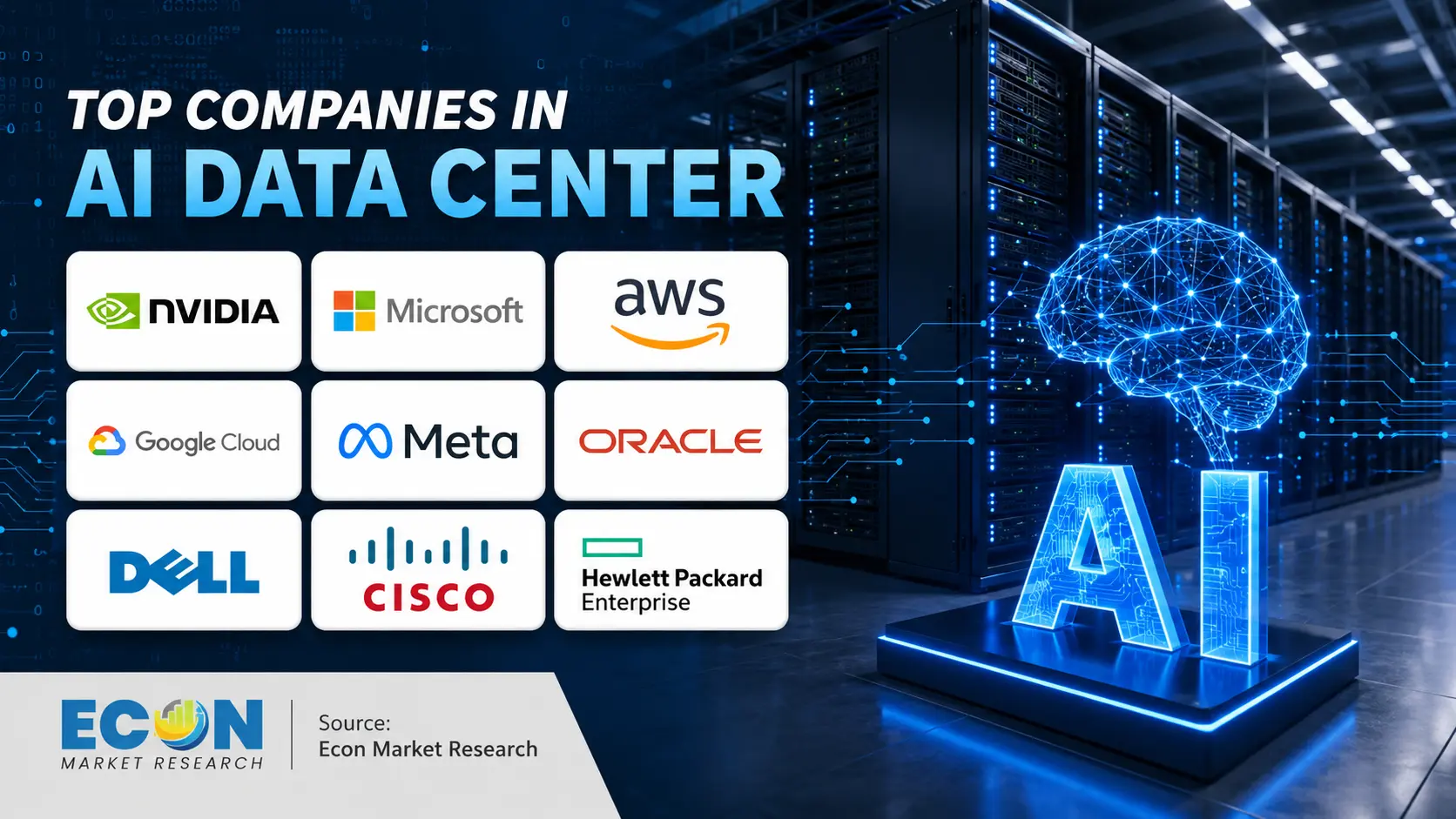
Top 5 Companies in the AI Data Center
1. NVIDIA
Company Overview: NVIDIA was founded in 1993 and is headquartered in Santa Clara, California, United States. The company has evolved from a graphics processor supplier into a full-stack accelerated-computing provider serving AI data centers, cloud platforms, research institutions, enterprises, and high-performance computing facilities. Its technology is widely used for large-language-model training, multimodal inference, robotics simulation, scientific computing, recommendation systems, and generative AI.
Headquarters: Santa Clara, California, United States.
Core AI Data Center Expertise: NVIDIA’s core expertise includes GPUs, CPUs, rack-scale computing, high-bandwidth interconnects, Ethernet, InfiniBand, DPUs, AI software libraries, cluster management, and reference architectures. Its GB200 NVL72 platform connects 72 Blackwell GPUs and 36 Grace CPUs through a 72-GPU communication domain providing 130 TB per second of aggregate low-latency communication. The newer GB300 NVL72 integrates 72 Blackwell Ultra GPUs and 36 Grace CPUs and provides 2 times higher attention performance than the preceding Blackwell generation.
Major Products and Services: Major offerings include DGX systems, DGX SuperPOD, GB200 NVL72, GB300 NVL72, HGX platforms, Spectrum-X Ethernet, Quantum InfiniBand, BlueField DPUs, ConnectX network adapters, CUDA, AI Enterprise software, inference engines, model libraries, and AI factory reference designs. The company’s full-stack approach allows operators to deploy 1 rack or scale toward clusters containing thousands of accelerators.
2. Microsoft
Company Overview: Microsoft was founded in 1975 and is headquartered in Redmond, Washington, United States. Its Azure infrastructure supports public cloud services, enterprise applications, generative AI, data platforms, cybersecurity, high-performance computing, and industry-specific solutions. Microsoft operates one of the world’s largest cloud and AI data center footprints, covering over 80 announced regions and over 500 data centers.
Headquarters: Redmond, Washington, United States.
Core AI Data Center Expertise: Microsoft specializes in hyperscale AI cloud infrastructure, distributed data center operations, GPU clusters, supercomputing, enterprise AI deployment, availability-zone architecture, and data-residency services. Availability zones use independent power, cooling, and networking systems to reduce the impact of a failure within 1 location. The company is also expanding regional AI capacity in countries including India and Saudi Arabia, with its Saudi Arabia East region scheduled to support customer workloads from the fourth quarter of 2026.
Major Products and Services: Microsoft’s major offerings include Azure AI infrastructure, virtual machines with accelerated processors, Azure Machine Learning, Azure Kubernetes Service, high-performance storage, networking, confidential computing, model hosting, database services, AI development platforms, and enterprise copilots. Its combination of over 80 regions, software ecosystems, security controls, and enterprise relationships gives Microsoft a significant position among the top companies in the AI data center industry.
3. Amazon Web Services
Company Overview: Amazon Web Services began providing commercial cloud services in 2006 and operates as the cloud-computing division of Amazon, headquartered in Seattle, Washington, United States. Its infrastructure supports organizations ranging from 1-person startups to multinational enterprises and government agencies. As of 2026, the AWS Cloud spans 123 availability zones across 39 geographic regions, with plans for 7 additional zones and 2 additional regions.
Headquarters: Seattle, Washington, United States.
Core AI Data Center Expertise: AWS specializes in hyperscale cloud operations, distributed computing, AI training, inference, storage, databases, custom processors, edge infrastructure, and resilient multi-zone architectures. Each AWS region contains multiple isolated availability zones, and each zone includes 1 or more discrete data centers with independent power, networking, and connectivity. This structure supports high availability while enabling AI customers to distribute workloads across 3 or more zones in many regions.
Major Products and Services: Major offerings include accelerated compute instances, managed machine learning services, foundation-model platforms, custom AI training and inference chips, general-purpose processors, object storage, parallel file systems, cloud databases, elastic networking, container orchestration, and high-performance computing clusters. AWS also operates local infrastructure across over 30 metropolitan locations on 6 continents, helping enterprises support AI inference, low-latency applications, and data-residency requirements.
4. Google
Company Overview: Google was founded in 1998 and is headquartered in Mountain View, California, United States. The company operates a global cloud infrastructure platform and has developed custom AI accelerators for over 10 years. Google’s data centers support search, video, advertising, enterprise cloud, generative AI, analytics, and machine learning workloads used by billions of users and organizations.
Headquarters: Mountain View, California, United States.
Core AI Data Center Expertise: Google’s core AI data center expertise includes custom tensor processing units, distributed training, AI-optimized zones, cloud networking, machine learning frameworks, container management, and hyperscale efficiency. Tensor Processing Units are application-specific integrated circuits designed for matrix operations and are accessible through virtual machines, managed Kubernetes, and AI development services. Its AI zones provide specialized GPU and TPU capacity for high-throughput training and inference.
Major Products and Services: Google’s major offerings include Cloud TPU, GPU computing, Compute Engine, Kubernetes Engine, Vertex AI, distributed storage, data analytics, high-speed networking, managed databases, model deployment tools, and sovereign or regional cloud configurations. Supported accelerator generations include TPU7x, TPU v6e, and TPU v5p, giving customers multiple performance options for training, fine-tuning, and inference.
5. Vertiv
Company Overview: Vertiv is headquartered in Westerville, Ohio, United States, and operates in over 130 countries. The company provides the power, cooling, rack, monitoring, and modular infrastructure that supports high-density AI data centers. Unlike hyperscale cloud operators, Vertiv focuses on the physical systems required to keep accelerated computing clusters powered, cooled, monitored, and available.
Headquarters: Westerville, Ohio, United States.
Core AI Data Center Expertise: Vertiv specializes in critical power systems, uninterruptible power supplies, thermal management, liquid cooling, coolant distribution units, rack infrastructure, prefabricated modules, monitoring software, and facility controls. Its high-density cooling portfolio addresses AI workloads that exceed the practical limits of traditional air cooling. The company has also expanded manufacturing capacity for thermal-management equipment and integrated infrastructure designed for AI data center deployments.
Major Products and Services: Major products include direct-to-chip cooling systems, coolant distribution units, heat-rejection equipment, hybrid cooling platforms, UPS systems, switchgear, busways, power distribution units, integrated racks, modular data center systems, monitoring platforms, and engineering services. A hybrid cooling platform can transition between air and liquid operating modes in 4 hours or less, supporting facilities that must accommodate multiple generations of AI and conventional IT equipment.
Regional Outlook
North America
North America remains the most influential AI data center region because it combines major cloud providers, semiconductor companies, software developers, research institutions, capital availability, and extensive fiber connectivity. Regional data centers consumed an estimated 125–200 TWh of electricity in 2023, including 120–195 TWh in the United States. Data centers subsequently represented 4% of total United States electricity consumption in 2024, and electricity use from the sector is expected to increase substantially through 2030 as AI training and inference expand.
Northern Virginia remains a major data center concentration because it provides dense fiber connectivity, established cloud infrastructure, enterprise demand, and access to government customers. However, expansion is spreading toward Texas, Ohio, Georgia, Arizona, Nevada, Oregon, Iowa, and other states offering larger land parcels and new power-generation opportunities. By 2026, over 700 data centers were reported as under construction across 38 United States states, representing roughly 18 GW of new capacity, with Texas accounting for 140 projects and Virginia accounting for 136 projects.
Power availability is now the region’s most significant constraint. Some transformer lead times have surpassed 160 weeks, requiring developers to place orders 3 years before equipment installation. Data center power demand in the United States could reach 110 GW by 2030, encouraging utilities and operators to explore new transmission lines, natural-gas generation, nuclear power, renewable energy, battery storage, and on-site microgrids. In certain markets, developers are using bring-your-own-power strategies to reduce dependence on congested public-grid connections.
Community and regulatory scrutiny is also increasing. In July 2026, New York introduced a 1-year pause for certain new projects exceeding 50 MW, while 12 GW of proposed data center applications were pending in the state. Similar discussions are taking place in multiple states over electricity costs, freshwater consumption, tax incentives, construction noise, and land use. Despite these issues, North America is expected to retain a leading position because 4 of the largest AI cloud and platform companies operate extensive infrastructure from the region.
Europe
Europe is an important AI data center market supported by strong enterprise demand, advanced telecommunications, public cloud adoption, financial services, automotive engineering, pharmaceutical research, and data-sovereignty requirements. European data centers consumed an estimated 55–80 TWh of electricity in 2023. Major hubs include Frankfurt, London, Amsterdam, Paris, and Dublin, while secondary markets such as Madrid, Milan, Warsaw, Berlin, Stockholm, Helsinki, and Oslo are attracting new development.
The European AI data center landscape is increasingly shaped by power availability and environmental regulation. Data centers often operate with load factors of 80–90%, creating a continuous baseload requirement rather than a limited seasonal peak. This characteristic places pressure on transmission systems, especially in established hubs where available grid capacity may already be committed. Research covering 21 European AI-growth scenarios indicates that AI infrastructure could add 73–723 TWh of electricity demand by 2050, depending on adoption, efficiency, workload management, and energy-system development.
European authorities have introduced reporting and efficiency requirements for data centers, with aggregated energy-performance data submitted under regional energy-efficiency rules beginning in the 2024 reporting period. Developers are consequently focusing on renewable energy, heat reuse, low-water cooling, carbon-aware workload scheduling, and measurable efficiency. Northern European countries offer cooler climates and access to renewable electricity, while southern and eastern markets provide land, network expansion, and growing local cloud demand.
Restrictions in mature hubs are supporting geographic diversification. Amsterdam introduced development limitations beginning in 2019 and extended controls through 2030, while Dublin maintained connection constraints from 2021 until late 2025. New Irish projects are now expected to address power-generation and grid-support requirements more directly. These policies are directing AI data center investment toward locations that can provide at least 50–100 MW of reliable capacity, multiple fiber routes, and clear permitting frameworks.
Europe’s future position will depend on balancing data sovereignty with access to large accelerator clusters. Enterprises in banking, healthcare, government, manufacturing, and defense increasingly require AI workloads to remain within specific national or regional boundaries. This requirement creates opportunities for sovereign AI infrastructure, regional GPU clouds, and secure facilities using 2–3 availability zones. Europe may develop fewer gigawatt campuses than North America, but it is likely to lead in regulated, energy-accountable, and sovereignty-focused AI data center deployment.
Asia-Pacific
Asia-Pacific is one of the fastest-expanding regions for AI data center construction due to large digital populations, cloud migration, manufacturing, e-commerce, financial technology, gaming, and government AI programs. Operational data center capacity across the region reached 13,763 MW in the second half of 2025. The development pipeline reached 19,371 MW, including 3,677 MW under construction and 15,694 MW in planned projects.
The region contains mature hubs such as Singapore, Tokyo, Sydney, Hong Kong, Seoul, Beijing, Shanghai, and Mumbai, alongside emerging destinations including Johor, Bangkok, Jakarta, Hyderabad, Chennai, Osaka, Manila, and Ho Chi Minh City. Asia-Pacific capacity is expected to increase from 32 GW to 57 GW by 2030. This expansion is being supported by international hyperscalers, Chinese technology companies, regional telecommunications providers, colocation operators, and government-backed infrastructure programs.
India is becoming a significant AI data center location due to its population of over 1.4 billion, expanding cloud adoption, digital public infrastructure, and demand for local data processing. Major cloud operators have established regions in Mumbai, Hyderabad, Chennai, and Pune. One large provider operates 2 Indian regions, with its Hyderabad region containing 3 availability zones, while another has confirmed continued expansion across 3 operational Indian data center regions.
Southeast Asia is benefiting from Singapore’s capacity constraints and regional data-localization requirements. Johor is attracting large campuses due to available land and proximity to Singapore, while Thailand, Indonesia, and Malaysia are adding cloud and AI facilities. A second major cloud data center opened in Thailand in 2025, supported by demand from generative AI, financial technology, retail, and digital businesses.
Asia-Pacific also faces substantial energy challenges. Regional data centers consumed an estimated 105–180 TWh in 2023, including 70–130 TWh in China. In markets dependent on coal or imported natural gas, AI data center growth can conflict with electricity affordability and emissions targets. Water scarcity, tropical cooling loads, limited grid capacity, and lengthy permitting processes create additional barriers. Operators are responding with renewable power agreements, direct-to-chip cooling, higher-temperature liquid loops, and facility locations closer to generation resources.
Middle East & Africa
The Middle East and Africa AI data center market is expanding as governments seek to build sovereign cloud capacity, national AI platforms, digital public services, smart cities, and diversified technology economies. Middle Eastern data center capacity is expected to increase from 1 GW in 2025 to 3.3 GW within 5 years. Saudi Arabia and the United Arab Emirates are leading regional development through national transformation programs, cloud-region launches, AI research initiatives, and large-scale energy infrastructure.
Saudi Arabia is attracting cloud and AI data center development through local data requirements, available land, national digital programs, and power-sector investment. A major cloud provider has confirmed that its Saudi Arabia East data center region will support customer workloads from the fourth quarter of 2026. New projects are expected to serve government agencies, financial institutions, energy companies, healthcare providers, and Arabic-language AI applications.
The United Arab Emirates is developing AI infrastructure in Abu Dhabi and Dubai, supported by international connectivity, government-backed technology entities, and access to regional enterprises. The Gulf region’s advantages include large industrial sites, substantial generation resources, and strong investment capability. However, cooling is a major operational issue because ambient temperatures can exceed 40°C during summer periods. Operators therefore require water-efficient cooling, high-temperature liquid loops, closed-loop systems, and carefully designed heat rejection.
Africa’s data center sector is smaller but strategically important. The continent has less than 1% of global data centers despite serving a population of over 1.4 billion, while internet penetration was measured at only 38% in a 2026 infrastructure analysis. South Africa remains the largest established market, while Kenya, Nigeria, Egypt, Morocco, Ethiopia, and Ghana are developing regional hubs. Kenya and Ethiopia together account for roughly 80% of East Africa’s commercial data center capacity, and Ethiopia’s commercial capacity increased by over 130% within 3 years.
Future AI data center growth in Africa will depend on affordable electricity, submarine cable capacity, terrestrial fiber, political stability, access to skilled technicians, and cloud adoption. Smaller modular facilities of 1–20 MW may be more practical than 500 MW hyperscale campuses in many markets. These facilities can support government services, banking, telecommunications, language-model inference, healthcare applications, and regional content delivery while reducing the need to process African data on another continent.
Future Opportunities in the AI Data Center
The future of the AI data center industry will be shaped by demand for training, reasoning, inference, robotics, scientific discovery, and autonomous software. AI-dedicated capacity is forecast to expand from 11.5 GW in 2026 to 43.6 GW in 2031, creating opportunities across accelerators, networking, power systems, cooling, storage, construction, software, and facility operations. Companies that solve the constraints surrounding electricity, heat, equipment supply, and deployment speed will capture a growing share of the AI infrastructure value chain.
One major opportunity is the development of modular AI data centers. Prefabricated electrical rooms, cooling skids, compute modules, and integrated rack systems can reduce on-site complexity and support repeatable deployments. Instead of constructing every 100 MW facility from a unique design, operators can standardize 5 MW, 10 MW, or 25 MW building blocks. Modular systems also make it easier to upgrade facilities when rack density rises from 40 kW to 120 kW or when new processor generations require different coolant temperatures.
Sovereign AI infrastructure represents another important opportunity. Governments and regulated industries increasingly want models, training data, and inference workloads hosted within national borders. This trend creates demand for locally operated GPU clouds, secure public-sector AI facilities, and national computing clusters containing 1,000–10,000 accelerators. Countries that cannot support 1 GW campuses may still develop strategically valuable 10–100 MW sovereign AI centers for healthcare, education, defense, language technology, and public administration.
Inference infrastructure is likely to become more geographically distributed than training infrastructure. Large training runs can be concentrated in 2–5 low-cost power regions, but conversational AI, autonomous vehicles, industrial automation, and real-time media applications require low latency near users. This creates opportunities for metropolitan inference centers, edge data centers, telecom facilities, and local zones across 30 or more cities. These smaller sites may use compact liquid-cooled clusters and specialized inference processors rather than the largest training systems.
Power innovation will generate further opportunities. Global data center electricity consumption is projected to reach 945 TWh by 2030, requiring new generation, grid upgrades, substations, batteries, microgrids, and intelligent workload controls. Nuclear power, natural gas with emissions controls, geothermal energy, hydropower, solar, wind, and long-duration storage may all support different AI campuses. Operators that can shift 5–20% of flexible computing demand across time may also help stabilize electricity systems while maintaining service availability.
Heat reuse and water conservation will become commercially and socially important. Liquid-cooled servers can produce higher-temperature waste heat that is more suitable for district heating, industrial processes, greenhouses, or nearby buildings. Closed-loop cooling can also reduce ongoing freshwater withdrawal compared with evaporative designs. As regulators examine facilities exceeding 50 MW, projects that demonstrate measurable energy efficiency, community benefits, water stewardship, and grid investment will have a stronger chance of receiving approval.
Conclusion
The top companies in the AI data center industry are building the physical and digital foundation for the next generation of artificial intelligence. NVIDIA leads in accelerated processors, rack-scale systems, networking, and AI software, while Microsoft, Amazon Web Services, and Google operate global cloud platforms spanning dozens of regions and over 100 availability zones. Vertiv supports this ecosystem through power, thermal management, liquid cooling, modular systems, and critical infrastructure deployed in over 130 countries.
The competitive landscape will no longer be determined by processor performance alone. Successful AI data center companies must coordinate at least 6 interconnected layers: compute, networking, storage, software, cooling, and power. A 72-GPU rack delivering 130 TB per second of GPU communication illustrates how tightly integrated the modern AI data center has become. At the regional level, North America, Europe, Asia-Pacific, and the Middle East are expanding rapidly, while Africa offers long-term potential as connectivity, electricity, and cloud adoption improve.
By 2030, global data center electricity consumption could reach 945 TWh, making efficiency and energy supply central business considerations. Operators must therefore combine high-density liquid cooling, resilient grids, modular deployment, workload flexibility, and transparent environmental performance. The companies that provide reliable AI infrastructure at 10 MW, 100 MW, and 1 GW scales will define how quickly enterprises, governments, and consumers can adopt advanced artificial intelligence.