


Top GPU Server Neocloud Companies Shaping AI Infrastructure
The top GPU server neocloud companies are transforming AI infrastructure with scalable GPU clusters, advanced networking, and high-performance cloud services.
1. Introduction
Overview of the Global GPU ServerNeocloud Industry
The global GPU ServerNeocloud industry has developed into a specialized infrastructure segment focused on providing high-performance graphics processing units for artificial intelligence, machine learning, scientific computing and large-scale inference. By 2026, GPU server neocloud providers were operating purpose-built clusters containing hundreds or thousands of interconnected accelerators instead of relying on conventional general-purpose cloud servers. Global data-center electricity consumption reached approximately 415 terawatt-hours in 2024, representing around 1.5% of worldwide electricity demand, and could reach nearly 945 terawatt-hours by 2030 as AI infrastructure expands. This rising requirement for compute, electricity, networking and cooling is increasing demand for dedicated GPU ServerNeocloud capacity.
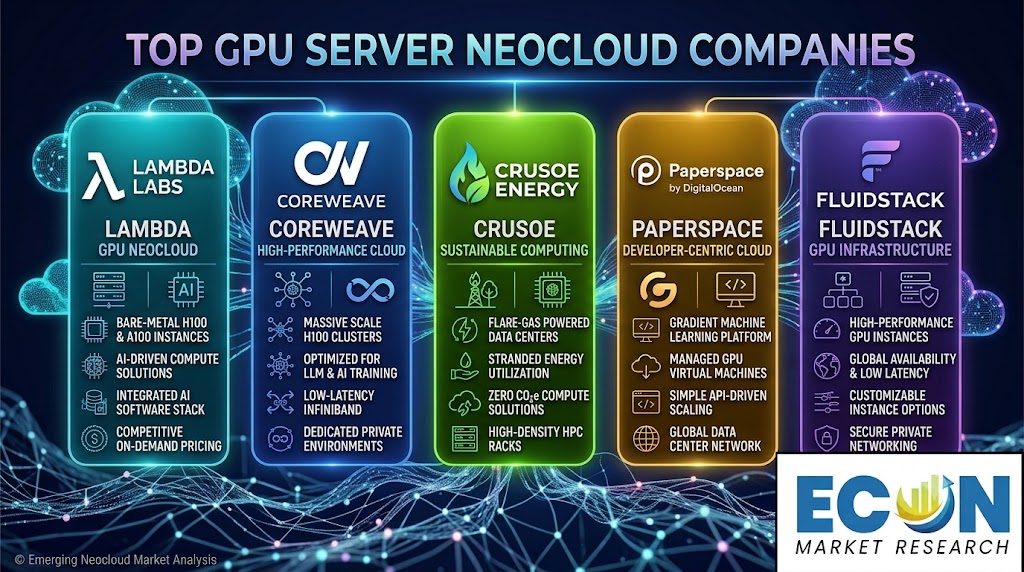
Market Evolution and Growth Drivers
The GPU ServerNeocloud market evolved through 3 major stages: individual GPU instances, interconnected multi-node clusters and vertically integrated AI factories. Lambda began building AI-focused infrastructure in 2012, CoreWeave expanded into purpose-built GPU cloud infrastructure after its establishment in 2017, and Crusoe introduced its energy-first computing model in 2018. By 2026, CoreWeave’s global network included 33 data centers, while Lambda offered production-ready clusters ranging from 16 to more than 2,000 GPUs. Growth is being driven by larger foundation models, enterprise inference, agentic AI, sovereign computing requirements and the need to provision thousands of GPUs without waiting 12–24 months for privately built infrastructure.
2. Top 5 Latest Trends in the GPU ServerNeocloud
1. Adoption of Rack-Scale Blackwell and Blackwell Ultra Systems
Rack-scale architecture is becoming one of the most important GPU ServerNeocloud trends because modern models require GPUs to operate as a unified computing system. The GB200 NVL72 architecture connects 72 Blackwell GPUs with 36 Grace CPUs in a single liquid-cooled rack. Its 72-GPU NVLink domain functions as one large accelerator and can provide up to 30 times faster real-time inference for trillion-parameter models and 10 times higher performance for mixture-of-experts workloads compared with previous architectures. The newer GB300 NVL72 retains the 72-GPU and 36-CPU configuration while offering approximately 1.5 times denser FP4 performance and 2 times higher attention performance. GPU ServerNeocloud providers are adopting these systems because rack-scale integration reduces communication delays and improves distributed model execution.
The transition also increases infrastructure density. A DGX B200 system contains 8 Blackwell GPUs, 1,440 GB of combined HBM3e memory and approximately 64 TB per second of aggregate memory bandwidth while consuming up to 14.3 kilowatts. A complete NVL72 deployment may therefore require liquid cooling, high-capacity busways, advanced power distribution and purpose-built network fabrics. GPU ServerNeocloud companies that control facility design, rack integration and orchestration can deploy this hardware faster than providers using traditional air-cooled data centers.
2. Multi-Thousand-GPU Clusters and 800 Gb/s Networking
The second major GPU ServerNeocloud trend is the movement from isolated 8-GPU nodes toward clusters containing 1,000, 10,000 or even more than 100,000 interconnected accelerators. Lambda offers self-service clusters ranging from 16 to more than 2,000 NVIDIA H100 or B200 GPUs, while its dedicated supercluster architecture is designed for configurations starting at 4,000 GPUs and potentially extending beyond 165,000 GPUs. These configurations are intended for foundation-model training, reinforcement learning, high-volume inference and scientific workloads requiring synchronized communication across thousands of processors.
Networking performance is becoming as important as raw GPU capacity. Quantum-X800 InfiniBand switches provide 144 ports, with each port supporting up to 800 gigabits per second. The architecture incorporates adaptive routing, congestion control and in-network computing to prevent thousands of GPUs from remaining idle while waiting for model parameters or training data. As GPU ServerNeocloud clusters become larger, customers increasingly evaluate useful model-training throughput rather than simply counting installed GPUs. A 10,000-GPU cluster with inefficient networking may deliver lower productive capacity than an 8,000-GPU cluster supported by optimized storage, topology and workload scheduling.
3. Expansion from Model Training to Managed Inference
GPU ServerNeocloud providers are expanding beyond training infrastructure and introducing managed inference, fine-tuning, model deployment and token-generation services. Earlier platforms concentrated on renting 1–8 GPUs by the hour, but enterprise customers now require complete pipelines supporting model preparation, distributed training, evaluation, deployment, monitoring and autoscaling. Crusoe offers infrastructure and managed AI services backed by 99.5% reported cloud uptime and 24/7 enterprise support, while Nscale provides inference endpoints, fine-tuning workflows and a unified prompt workbench.
This trend is being accelerated by agentic AI, reasoning models and retrieval systems that execute multiple inference steps for every user request. A basic chatbot may generate 1 response, while an autonomous agent may perform 10, 50 or more model calls to search data, test alternatives and complete a workflow. Consequently, GPU ServerNeocloud infrastructure must support low latency, continuous availability and efficient batching rather than only large training jobs. Nebius has reported AI workflow implementations that reduced setup time by 70%, demonstrating how integrated infrastructure, storage and orchestration can shorten development cycles from months to days.
4. Sovereign AI and Regional GPU Capacity
Sovereign AI is creating regional demand for GPU ServerNeocloud infrastructure because governments and regulated enterprises want models, datasets and inference workloads located within approved jurisdictions. By April 2026, Europe had 19 operational AI Factories and 13 associated AI Factory Antennas. India’s national AI compute initiative was established around 18,693 GPUs, including H100, H200, MI200 and MI300 accelerators, with 10,000 units operational during the initial deployment stage. These programs support local-language models, public-sector applications, healthcare research and domestic AI startups.
Private GPU ServerNeocloud companies are participating in the same regionalization trend. Nebius announced 7 AI clusters across 6 countries in Europe, North America and the Middle East, while the United Arab Emirates launched plans for a 1-gigawatt AI cluster with an initial 200-megawatt phase expected to operate during 2026. Customers are therefore choosing providers based on 4 location-related requirements: data residency, network latency, energy availability and regulatory compliance. This development will encourage GPU ServerNeocloud operators to create smaller regional zones alongside centralized multi-gigawatt campuses.
5. Energy-First Data Centers and Liquid Cooling
Power availability has become a defining competitive factor in the GPU ServerNeocloud industry. A single 8-GPU DGX B200 server can draw approximately 14.3 kilowatts at maximum utilization, before networking, storage and cooling requirements are included. When thousands of these systems operate together, an AI campus may require 100, 500 or more than 1,000 megawatts. Global data-center power demand could increase from approximately 415 terawatt-hours in 2024 to 945 terawatt-hours by 2030, making grid connections, generation capacity and cooling efficiency essential components of GPU ServerNeocloud strategy.
Leading companies are responding through direct-to-chip liquid cooling, renewable energy, modular power systems and campuses located close to available generation. Crusoe’s contracted data-center and cloud capacity approached 5 gigawatts by June 2026. Nscale’s Loughton campus is designed to support 50 megawatts initially and scale to 90 megawatts, while its Glomfjord facility operates using 100% renewable power. These developments show that future GPU ServerNeocloud competitiveness will depend on how efficiently a company combines GPUs, electricity, cooling, networking and software—not simply how many accelerators it purchases.
3. Top 5 Companies in the GPU ServerNeocloud
1. CoreWeave
Company overview: CoreWeave is one of the largest specialized GPU ServerNeocloud providers, operating an AI-native cloud platform for model training, fine-tuning, inference and high-performance computing. By 2026, its network included 33 and rising global data centers, with 28 facilities located across the United States. Its Lancaster campus is designed with the ability to scale toward 300 megawatts.
Headquarters: CoreWeave is headquartered in Livingston, New Jersey, at 290 West Mount Pleasant Avenue, Suite 4100. The company operates across North America and Europe, giving customers access to multiple GPU regions rather than depending on 1 centralized data-center location.
Core GPU ServerNeocloud expertise: CoreWeave specializes in bare-metal GPU performance, Kubernetes-based orchestration, high-throughput storage, cluster observability and AI workload optimization. Its architecture supports multi-GPU systems such as 8-GPU HGX servers and 72-GPU rack-scale platforms for training and real-time inference.
Major products and services: CoreWeave offers GPU Compute, managed Kubernetes, object storage, mission control, model and agent development, runtime acceleration and infrastructure control. According to company-reported performance data, customers have collectively saved approximately 3.1 million GPU hours and experienced 50% fewer interruptions per day through its optimized infrastructure.
2. Lambda
Company overview: Lambda was founded in 2012 by machine-learning engineers and has remained 100% focused on AI workloads and infrastructure. The company builds GPU instances, clusters and modular AI factories for startups, enterprises, hyperscalers and frontier-model developers.
Headquarters: Lambda is headquartered at 45 Fremont Street in San Francisco, California 94105, with an additional location at 2510 Zanker Road in San Jose. Its U.S. presence supports infrastructure engineering, cluster operations and enterprise AI deployments.
Core GPU ServerNeocloud expertise: Lambda’s expertise includes distributed model training, high-density power systems, liquid-cooled GPU clusters, InfiniBand networking and single-tenant AI factories. Its 1-Click Clusters are available in configurations ranging from 16 to more than 2,000 GPUs, while dedicated supercluster designs range from 4,000 to more than 165,000 GPUs.
Major products and services: Lambda offers on-demand instances containing 1–8 GPUs, production-ready 1-Click Clusters, dedicated superclusters, managed cluster operations and engineering support. Available accelerator options include NVIDIA H100, H200 and B200 systems for model development, fine-tuning and inference.
3. Crusoe
Company overview: Crusoe was founded in 2018 with an energy-first approach to high-performance computing. The company vertically integrates energy sourcing, data-center construction, modular infrastructure and cloud services. By June 2026, its contracted AI infrastructure capacity was approaching 5 gigawatts across data centers and cloud deployments.
Headquarters: Crusoe is headquartered in Denver, Colorado, where it announced a significant headquarters expansion in 2021. By 2026, the company listed offices across at least 8 locations, including Denver, Arvada, Bellevue, San Francisco, Sunnyvale, Tulsa, Dublin and Tel Aviv.
Core GPU ServerNeocloud expertise: Crusoe specializes in energy-integrated AI factories, direct liquid cooling, modular data centers and RDMA-backed GPU cloud networking. Its Abilene development has been designed around capacity reaching 1.2 gigawatts, with individual buildings capable of supporting up to 50,000 GB200 NVL72 systems.
Major products and services: Crusoe provides GPU instances, multi-thousand-GPU clusters, managed inference, data-center infrastructure, modular Spark systems and an AI operations Command Center. Its cloud supports NVIDIA GB200 NVL72, HGX B200 and AMD MI350 accelerators, with reported availability of 99.5% and 24/7 enterprise support.
4. Nebius
Company overview: Nebius is an Amsterdam-based GPU ServerNeocloud company providing infrastructure across the complete AI lifecycle, including data preparation, training, tuning and production deployment. By late 2025, the company had announced 7 AI clusters located across 6 countries in Europe, North America and the Middle East.
Headquarters: Nebius is headquartered in Amsterdam, with its legal office located at Schiphol Boulevard 165, 1118 BG Schiphol in the Netherlands. The company also operates engineering and business locations across Europe, Israel and the United States.
Core GPU ServerNeocloud expertise: Nebius focuses on full-stack AI cloud infrastructure, high-speed networking, managed Kubernetes, scalable storage and self-service GPU clusters. Its Kansas City deployment was designed to begin with thousands of H200 GPUs and scale from an initial 5 megawatts to 40 megawatts, equivalent to potential capacity of approximately 35,000 GPUs.
Major products and services: Nebius offers AI Cloud, GPU instances, managed Kubernetes, object storage, model-training environments and Token Factory inference services. Self-service HGX B200 clusters became available in 2025, while its UK deployment introduced Blackwell Ultra GPUs and Quantum-X800 InfiniBand networking.
5. Nscale
Company overview: Nscale is a UK-based vertically integrated GPU ServerNeocloud provider operating across energy, data centers, GPU infrastructure and orchestration software. Its announced deployments include approximately 200,000 Blackwell Ultra GPUs across the United States and Europe and an additional 66,000 Vera Rubin GPUs planned for Portugal.
Headquarters: Nscale is headquartered in London and listed 11 owned, available or partner-operated data-center locations during 2026. These locations include sites in the United Kingdom, Norway, Portugal, Iceland and the United States.
Core GPU ServerNeocloud expertise: Nscale specializes in modular AI factories, sovereign GPU capacity, liquid cooling and large-scale Blackwell infrastructure. Its announced plans include approximately 104,000 GB300 GPUs at a 240-megawatt Texas campus, 52,000 GB300 GPUs in Narvik and 23,000 GB300 GPUs at its Loughton campus.
Major products and services: Nscale organizes its platform into 4 principal layers: AI Services, Platform Services, Infrastructure Services and Fleet Operations. Products include inference endpoints, fine-tuning, Prompt Workbench, Managed Slurm, Kubernetes, GPU instances, storage, networking, Control Center, Observability and Radar API.
4. Regional Outlook
North America
North America represents the most concentrated GPU ServerNeocloud region because it combines major AI laboratories, semiconductor suppliers, cloud customers, private energy development and large data-center markets. CoreWeave had 28 of its 33 global facilities in the United States by 2026, while its Lancaster site was designed to scale toward 300 megawatts. U.S. data centers accounted for more than 4% of national electricity use in recent estimates, and their share could reach as much as 12% by 2028. This power requirement is pushing GPU ServerNeocloud projects toward Pennsylvania, Texas, New Jersey, West Virginia, Wyoming and other locations offering available land, transmission infrastructure and potential on-site generation.
The region is also becoming a center for gigawatt-scale AI factories. Crusoe expanded its Abilene campus plan toward 1.2 gigawatts and later announced a separate 900-megawatt AI factory campus. Nscale’s West Virginia project includes a proposed 1.35 gigawatts of Vera Rubin compute capacity and access to a site with more than 8 gigawatts of potential microgrid power. North American customers can therefore select among 3 infrastructure models: hourly GPU instances, reserved multi-thousand-GPU clusters and dedicated AI factories. However, grid delays, transformer availability, water constraints and local approval processes are becoming significant barriers, making vertically integrated GPU ServerNeocloud operators increasingly valuable.
Europe
Europe’s GPU ServerNeocloud market is being shaped by sovereign AI, renewable energy and strict data-governance requirements. By April 2026, the European AI infrastructure network included 19 AI Factories and 13 regional Antennas, with facilities supporting startups, research organizations and small and medium-sized enterprises. Of the 19 AI Factories, 17 included healthcare among their supported areas, highlighting the importance of regulated and scientific workloads. European buyers increasingly prefer GPU infrastructure located within approved jurisdictions, particularly for medical data, financial models, government applications and proprietary industrial information.
Northern Europe is becoming a major GPU ServerNeocloud hub because of renewable electricity and cooler operating conditions. Stargate Norway is targeting 100,000 GPUs by the end of 2026, while Portugal’s Sines campus is scheduled to support more than 12,600 GB300 GPUs before adding over 66,000 Vera Rubin GPUs from late 2027. In the United Kingdom, Nscale’s Loughton facility is designed for 50 megawatts, expandable to 90 megawatts, with capacity for up to 45,000 advanced GPUs. Nebius has also deployed Blackwell Ultra infrastructure near London. These projects position Europe as a market for sovereign clusters, renewable-powered training and low-latency enterprise inference.
Asia-Pacific
Asia-Pacific is developing into a diversified GPU ServerNeocloud market supported by national AI programs, electronics manufacturing, telecom operators and local-language model development. India’s AI compute platform was established around 18,693 GPUs, including H100, H200, MI200 and MI300 systems. Approximately 10,000 GPUs formed the initial operational capacity, with another 8,693 units identified for subsequent availability. Eligible users can receive compute access at reductions of up to 40%, improving infrastructure accessibility for startups, researchers and public institutions. These programs are creating opportunities for GPU ServerNeocloud providers that can deliver managed clusters, regional storage and compliance-ready model deployment.
Southeast Asia is also expanding GPU availability through data centers in Singapore, Thailand, Indonesia and Malaysia, with regional deployments planned across at least 4 national markets. Asia-Pacific demand is being driven by 4 major workload groups: multilingual foundation models, manufacturing computer vision, telecom inference and scientific research. The region contains large populations requiring low-latency inference, but electricity constraints and cross-border data rules make a single centralized cluster unsuitable for every application. GPU ServerNeocloud companies can address this challenge by combining large training campuses with smaller inference zones situated closer to users. Support for both NVIDIA and AMD accelerators will also be important as customers seek alternatives across H200, B200, B300 and MI300-class systems.
Middle East & Africa
The Middle East is moving rapidly toward gigawatt-scale GPU ServerNeocloud infrastructure. Stargate UAE includes plans for a 1-gigawatt AI cluster in Abu Dhabi, with an initial 200-megawatt phase expected to operate during 2026. Saudi Arabia has announced plans for up to 500 megawatts of AI factories powered by several hundred thousand advanced GPUs over a 5-year period. The first Saudi phase includes an 18,000-unit GB300 Grace Blackwell supercomputer connected through InfiniBand networking. These developments create opportunities for neocloud platforms offering sovereign capacity, Arabic-language model training and regionally hosted inference.
Africa remains at an earlier infrastructure stage, but the region offers opportunities across 3 critical areas: national research computing, telecom-based AI services and enterprise inference. Instead of beginning with 100-megawatt campuses, many African deployments may use modular clusters that can expand from dozens of GPUs to several thousand units as electricity and network capacity improve. A distributed GPU ServerNeocloud model could combine 1 central training cluster with multiple smaller inference zones, reducing international data transfers and service latency. The primary constraints are reliable power, fiber connectivity and access to advanced accelerators, while the strongest demand areas include agriculture, healthcare, financial inclusion, language processing and climate modeling.
5. Future Opportunities in the GPU ServerNeocloud
The future of the GPU ServerNeocloud industry will be shaped by the transition from individual servers to complete AI factories. Rack-scale platforms already connect 72 GPUs as 1 NVLink domain, while next-generation Rubin systems are designed to provide 3.6 TB per second of NVLink bandwidth per GPU and approximately 260 TB per second across a 72-GPU rack. These improvements will support increasingly complex reasoning models, multimodal systems, robotics and scientific simulations. Providers that combine hardware with optimized model runtimes can deliver more tokens per second and higher training utilization without increasing GPU counts at the same rate as demand.
Enterprise adoption creates another major opportunity because many organizations need 100–1,000 GPUs but cannot construct private data centers. These customers require predictable capacity, private networking, security certifications, managed Kubernetes and direct engineering support. GPU ServerNeocloud providers can serve this segment through reserved clusters lasting 12, 24 or 36 months, dedicated inference endpoints and hybrid-cloud connectivity. Industry-specific services for healthcare, automotive, finance, manufacturing and media could become important differentiators because each sector has different requirements for latency, uptime, model governance and data location.
Energy optimization will create opportunities for operators that can achieve higher model throughput per megawatt. Blackwell Ultra systems have demonstrated up to 50 times higher throughput per megawatt than Hopper systems for selected low-latency agentic workloads. Future GPU ServerNeocloud platforms may combine liquid cooling, workload-aware power scheduling, renewable energy, battery storage and on-site generation. Instead of evaluating providers only by GPU-hour pricing, customers will increasingly compare 5 operational indicators: completed training steps, tokens generated, cluster availability, time to deployment and energy efficiency.
Sovereign and edge AI represent an additional opportunity. Governments may require 1 national training facility supported by 5–20 regional inference locations, while multinational companies may distribute models across several legal jurisdictions. Modular GPU ServerNeocloud zones can support these deployments more quickly than traditional hyperscale construction. Providers with standardized server designs, automated orchestration and portable model environments will be positioned to expand into emerging regions without rebuilding the complete software stack for every facility.
6. Conclusion
The GPU ServerNeocloud industry has become an essential part of global AI infrastructure by giving organizations access to specialized compute without requiring them to build private GPU campuses. CoreWeave, Lambda, Crusoe, Nebius and Nscale represent 5 leading companies combining advanced accelerators, high-speed networking, storage, cooling and orchestration. Their platforms range from 1-GPU development instances to clusters containing more than 100,000 accelerators, allowing customers to move from experimentation to large-scale training and production inference.
Technology differentiation is expanding beyond GPU inventory. Systems containing 72 interconnected Blackwell or Blackwell Ultra GPUs, 800 Gb/s network ports and multi-terabyte memory fabrics require specialized facility and software engineering. Successful GPU ServerNeocloud companies must maintain high cluster utilization, rapid provisioning, reliable storage and efficient cooling while supporting changing hardware generations such as H200, B200, B300 and Vera Rubin.
Regional expansion will remain equally important. Europe’s 19 AI Factories, India’s 18,693-GPU compute initiative, the UAE’s planned 1-gigawatt cluster and Saudi Arabia’s first 18,000-unit GB300 deployment demonstrate that sovereign AI infrastructure is becoming a worldwide priority. As training, reasoning and agentic inference become more computationally intensive, GPU ServerNeocloud providers that integrate energy, data centers, accelerators and software into 1 coordinated platform will be positioned to support the next generation of enterprise and national AI systems.