

Top AI Data Center Cooling Companies Driving High-Density Infrastructure
The top AI data center cooling companies deliver liquid cooling, CDUs, immersion systems, and thermal solutions for high-density AI infrastructure worldwide.
Introduction
Overview of the Global AI Data Center Cooling Industry
The global AI data center cooling industry is becoming a critical part of digital infrastructure as artificial intelligence servers generate substantially more heat than traditional enterprise equipment. Conventional data center racks commonly operate between 10 kW and 30 kW, while advanced AI training systems can exceed 100 kW per rack and emerging configurations are moving toward 600 kW or more. Global data center electricity consumption reached approximately 485 TWh in 2025 and is projected to approach 950 TWh by 2030, with AI-focused facilities accounting for the fastest increase. These conditions are accelerating demand for direct-to-chip liquid cooling, coolant distribution units, rear-door heat exchangers, immersion cooling, precision chillers and intelligent thermal controls.
Market Evolution and Growth Drivers
AI data center cooling has evolved from conventional computer-room air conditioning into an integrated thermal-management architecture connecting the chip, server, rack, coolant loop, chiller and heat-rejection system. Air cooling can become insufficient when rack density moves above approximately 80–100 kW, encouraging operators to adopt liquid cooling for graphics processing units, central processing units and memory components. Direct-to-chip systems can remove approximately 75% of server heat through liquid, while a fully optimized hybrid design has demonstrated a 10.2% reduction in total data center power and an improvement of more than 15% in total usage effectiveness. Electricity demand from data centers increased by 17% during 2025, reinforcing the need for cooling systems that improve capacity without proportionally increasing facility energy consumption.
Top 5 Latest Trends in the AI Data Center Cooling
1. Direct-to-Chip Liquid Cooling Becomes the Preferred Architecture
Direct-to-chip liquid cooling is becoming a core AI data center cooling technology because it captures heat directly from processors before that heat spreads into the server enclosure. Current AI systems can exceed 100 kW per rack, compared with approximately 15–30 kW for many air-cooled deployments. A cold-plate system circulates coolant over the hottest components, transfers the heat through rack manifolds and sends it to a coolant distribution unit for removal. Single-phase direct liquid cooling is expected to remain the preferred design for the next 5–10 years because the coolant stays liquid, maintenance procedures are comparatively familiar and integration with server roadmaps is straightforward. Direct-to-chip cooling also allows operators to install 50–100 kW racks in footprints that previously supported only 15–30 kW, increasing compute density by as much as 5 times without constructing an entirely new data hall.
2. Hybrid Air-and-Liquid Cooling Expands Retrofit Opportunities
Hybrid thermal architectures are expanding because millions of existing servers, network switches and storage systems still require airflow even when AI processors use liquid cooling. In a typical liquid-cooled AI server, approximately 20% of the remaining heat may still need to be removed through air. This creates opportunities for rear-door heat exchangers, in-row coolers, heat-dissipation units and liquid-to-air coolant distribution units. A rear-door heat exchanger captures hot exhaust air through a water coil mounted behind the rack, while an air-cooled CDU transfers server heat into the room without requiring a facility-water connection. Modern liquid-to-air systems can deliver 180–240 kW of cooling in a 2-rack footprint, allowing legacy facilities to support high-density AI clusters without installing new chilled-water piping throughout the building. Hybrid AI data center cooling therefore offers a practical transition path between conventional 20 kW racks and future 100 kW-plus computing environments.
3. Megawatt-Scale Coolant Distribution Units Gain Adoption
Coolant distribution units are moving from rack-level equipment to megawatt-scale infrastructure as AI clusters increase from several hundred accelerators to tens of thousands of processors. Current commercial CDU platforms range from approximately 70 kW for a compact deployment to 14 MW for centralized AI cooling. Individual high-capacity systems now provide 2.3 MW or 2.5 MW of heat-removal capacity, while centrally controlled configurations can scale beyond 10 MW. These units regulate secondary coolant temperature, pressure, flow rate, filtration and heat exchange while isolating sensitive server loops from facility water. Megawatt-scale CDUs also reduce the number of individual systems required in large facilities, improving floor-space utilization and simplifying controls. A 14 MW modular CDU platform, for example, can support a large AI infrastructure zone through a centralized arrangement rather than requiring dozens of smaller 200 kW units. This trend is positioning the CDU as 1 of the most important components in AI data center cooling design.
4. Efficiency Measurement Moves Beyond Traditional PUE
Power Usage Effectiveness has remained an important data center metric for more than 15 years, but liquid cooling is encouraging operators to adopt additional measurements such as Total Usage Effectiveness, Water Usage Effectiveness and Power Compute Effectiveness. PUE divides total facility power by IT power, yet it does not fully capture improvements occurring inside liquid-cooled servers. An optimized liquid-cooling study identified a 10.2% reduction in total data center power and a greater than 15% improvement in Total Usage Effectiveness. Direct liquid cooling can also remove approximately 75% of the server heat load, reducing fan power inside IT equipment. The opportunity becomes significant at a 100 MW AI campus, where even a 5% reduction in supporting energy can represent several megawatts of avoided electrical demand. AI data center cooling suppliers are consequently integrating thermal sensors, flow meters, pump controls, compute telemetry and energy-management software to measure useful computing output rather than focusing exclusively on building-level electricity ratios.
5. Predictive Maintenance and Full-Scale Thermal Validation Increase
AI data center cooling systems contain pumps, valves, cold plates, hoses, manifolds, sensors, heat exchangers and coolant chemistry that must operate reliably during 24-hour computing cycles. As cooling capacity moves beyond 1 MW per unit, predictive maintenance is becoming necessary to identify pressure changes, contamination, pump degradation and minor leaks before an AI cluster is affected. Manufacturers are expanding full-scale validation facilities, including 6 MW CDU test rigs, 1 MW data center simulators and laboratories with 18 thermal chambers. These environments allow operators to verify flow, redundancy, control logic and thermal performance before deployment. Coolant cleanliness is especially important because particles or chemical instability can reduce heat-transfer performance and damage small cold-plate channels. New platforms increasingly include N+1 pumps, 2N pumping arrangements, automated leak detection, real-time fluid monitoring and remote diagnostics. The result is a shift from reactive equipment repair toward lifecycle-based AI data center cooling services supported by digital monitoring and planned maintenance.
Top 5 Companies in the AI Data Center Cooling
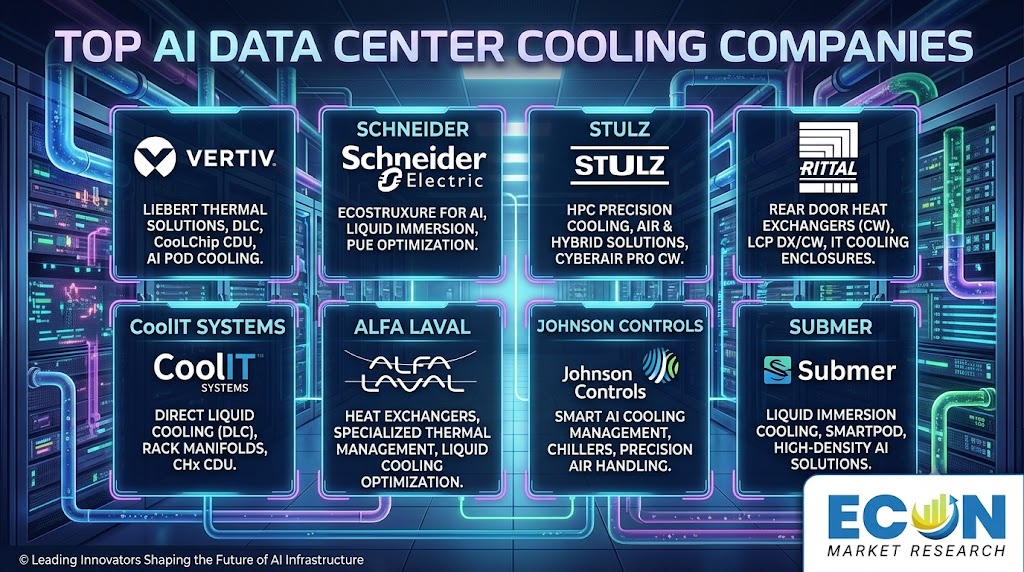
The following 5 companies have been selected based on their AI-focused product capacity, thermal-management portfolio, global deployment capabilities, technical specialization and ability to support high-density computing projects in 2026.
1. Vertiv
Vertiv is a global critical digital infrastructure company headquartered in Westerville, Ohio, United States, with operations in more than 130 countries, approximately 30 manufacturing locations, around 320 service centers and nearly 5,000 field service engineers. Its core AI data center cooling expertise covers direct-to-chip liquid cooling, rear-door cooling, coolant distribution, chilled-water systems, air cooling, fluid networks, heat rejection and prefabricated infrastructure. The Vertiv CoolChip CDU family ranges from approximately 70 kW to 2.3 MW, including compact 100 kW-plus in-rack units, a 600 kW in-row system and a 2.3 MW centralized model. Vertiv also provides MegaMod HDX modular infrastructure supporting capacities up to 10 MW and rack densities from approximately 50 kW to more than 100 kW. Major products and services include CoolChip CDUs, CoolChip Fluid Networks, Liebert thermal-management systems, chillers, rear-door heat exchangers, direct-to-chip integration, commissioning, maintenance and AI infrastructure consulting. This broad portfolio enables Vertiv to support both 1-rack enterprise installations and multi-megawatt hyperscale AI data center cooling projects.
2. Schneider Electric
Schneider Electric is an energy-technology and automation company headquartered in Rueil-Malmaison, France, with approximately 160,000 employees and operations spanning more than 100 countries. Through its Motivair liquid-cooling portfolio, Schneider Electric provides end-to-end AI data center cooling from the processor cold plate to the facility heat-rejection system. The company’s CDU family ranges from 105 kW to 2.5 MW per unit, while centralized controls allow multiple units to scale beyond 10 MW. Its core expertise includes direct-to-chip cooling, dynamic cold plates, coolant distribution, rear-door heat exchangers, heat-dissipation units, chillers, precision air cooling, building controls and digital energy management. Major products and services include the MCDU-70 2.5 MW system, Dynamic Cold Plates, ChilledDoor rear-door exchangers, HDUs, Uniflair cooling equipment, EcoStruxure monitoring and lifecycle maintenance. Schneider Electric’s combined electrical and cooling capabilities support integrated “grid-to-chip” designs, which are increasingly important for AI facilities where a 100 MW compute deployment requires coordinated power, cooling, controls and redundancy instead of isolated mechanical systems.
3. CoolIT Systems
CoolIT Systems, an Ecolab company since the completion of its acquisition on July 2, 2026, is headquartered in Calgary, Alberta, Canada. Founded in 2001, the company has accumulated 25 years of direct liquid cooling experience, deployed equipment in more than 300 data centers and shipped more than 5 million cold plates. Its core AI data center cooling expertise centers on single-phase direct liquid cooling, processor cold plates, cold-plate loops, rack manifolds, coolant distribution units, system design, fluid management and deployment services. Major products include the CHx2000 liquid-to-liquid AI CDU, the 240 kW AHx240 liquid-to-air CDU, the 180 kW AHx180, the CHx200 in-rack unit and customized rack-level cooling assemblies. The AHx240 can manage 2 high-density GB300 NVL72 racks without requiring facility water and can be manufactured at a rate of approximately 100 units per week. CoolIT also operates a 112,000-square-foot Calgary manufacturing facility, a 6 MW CDU test rig and advanced laboratories supporting validation, prototyping and thermal-performance testing.
4. STULZ
STULZ is a specialized mission-critical cooling company headquartered in Hamburg, Germany, and founded in 1947. The company operates through more than 30 production and sales organizations, works with over 150 international partners and employs approximately 3,500 people worldwide. Its core AI data center cooling expertise includes precision air conditioning, direct liquid cooling, immersion-cooling support, coolant distribution, chillers, free cooling, humidity management and customized thermal engineering. The CyberCool CMU, manufactured at the company’s Hamburg headquarters, is offered in 2 sizes and provides continuously variable cooling output of up to 1,380 kW. It can operate as part of a direct-to-chip system, an immersion-cooling system or a hybrid air-and-liquid environment. Major products and services include CyberCool CDUs and CMUs, CyberCool chillers, CyberAir precision-cooling equipment, free-cooling boosters, dry coolers, control platforms, testing and global maintenance. STULZ is particularly well positioned for customized projects in which a 1 MW-plus AI deployment must integrate new liquid loops with existing air-cooled infrastructure, climate-specific heat rejection and precise temperature control.
5. LiquidStack
LiquidStack, acquired by Trane Technologies in March 2026, is headquartered in Carrollton, Texas, United States, where it operates manufacturing and research facilities. The company specializes exclusively in advanced liquid thermal management for generative AI, high-performance computing, hyperscale platforms and edge infrastructure. Its core expertise covers centralized direct-to-chip coolant distribution, single-phase immersion cooling, 2-phase immersion cooling, modular system design and high-capacity deployment engineering. Major products include the GigaModular CDU platform, which delivers up to 14 MW of direct-to-chip cooling, and immersion systems offering up to 252 kW of thermal capacity. LiquidStack also secured a 300 MW CDU order from a major United States data center operator, demonstrating its ability to support large multi-building installations. Its products are designed to reduce the number of cooling units, optimize facility space and provide modular expansion as AI compute is added. Through Trane Technologies, LiquidStack can combine chip-level liquid systems with chillers, heat-rejection equipment, controls and service capabilities for complete AI data center cooling projects.
Regional Outlook
North America
North America represents one of the most active regions for AI data center cooling because the United States contains large hyperscale campuses, cloud regions, AI research clusters and semiconductor-development ecosystems. United States data centers consumed approximately 176 TWh of electricity in 2023, equal to about 4.4% of national electricity use. Consumption could increase to between 325 TWh and 580 TWh by 2028, representing approximately 6.7–12% of total United States electricity. A newer 2030 assessment estimates a central share of 11.8%, with scenarios ranging from 9.5% to 15.3%. Grid-connection requests for new hyperscale facilities increasingly involve individual loads of 300–1,000 MW, creating strong pressure to reduce non-compute energy consumption.
AI data center cooling investment in North America is concentrated in Virginia, Texas, Ohio, Arizona, Georgia, Nevada, Oregon and several Canadian provinces. Operators are deploying 100 kW-plus racks, 1–2.5 MW CDUs, liquid-ready server rows and prefabricated cooling plants. Water availability is becoming a major site-selection issue in drought-sensitive states, increasing interest in closed-loop direct liquid cooling, dry coolers and waterless liquid-to-air CDUs. Canada provides opportunities for free cooling because colder outdoor conditions can reduce mechanical chiller operation during many of the year’s 8,760 hours. North American demand is also supported by local manufacturing expansion: suppliers have established 112,000-square-foot plants, 6 MW validation rigs and CDU production capabilities of approximately 100 units per week. These investments are transforming AI data center cooling from a specialized HPC solution into a standardized part of hyperscale engineering, procurement, construction and long-term facility operations.
Europe
Europe is developing a highly regulated AI data center cooling environment that emphasizes measurable energy efficiency, water consumption, heat reuse and carbon reduction. Data centers in the European Union consumed an estimated 45–65 TWh of electricity in 2022, representing approximately 1.8–2.6% of total regional electricity use. A separate long-term assessment indicates that consumption could rise from 76.8 TWh in 2018 to approximately 98.5 TWh by 2030. Since 2023, data centers with an installed IT power demand above 500 kW have faced mandatory sustainability reporting requirements covering energy and water performance. Operators were required to provide initial information by September 15, 2024, followed by annual reporting deadlines beginning May 15, 2025. These regulations are increasing demand for cooling systems with detailed energy, water, temperature, flow and heat-recovery measurements.
Northern European countries benefit from lower ambient temperatures, allowing free-cooling systems to operate for a high proportion of the year’s 8,760 hours. Germany, France, the Netherlands, Ireland and the Nordic countries are also evaluating ways to reuse data center heat in district-heating networks, industrial processes and nearby buildings. However, grid constraints in established hubs are encouraging new facilities in secondary markets with available renewable electricity and land. European AI data center cooling demand is therefore moving toward warm-water direct-to-chip systems, low-global-warming-potential refrigerants, dry coolers, heat pumps and intelligent controls. High-capacity European-made CDUs now provide approximately 1,380 kW to 2.5 MW per unit, while modular cooling systems can scale beyond 10 MW. The combination of regulatory reporting, colder climates, heat-reuse opportunities and growing AI density makes Europe a significant development region for efficient and auditable liquid-cooling technology.
Asia-Pacific
Asia-Pacific is expected to become one of the largest AI data center cooling regions because China, Japan, Singapore, India, Australia and Southeast Asia are expanding cloud computing and sovereign AI infrastructure. China’s data center electricity consumption is projected to increase by approximately 175 TWh between 2024 and 2030, representing an increase of around 170%. Japan is expected to add approximately 15 TWh during the same period, an increase of about 80%. China and the United States together are expected to account for nearly 80% of global data center electricity-consumption growth through 2030. These figures indicate that Asian operators will need high-efficiency thermal systems capable of supporting GPU clusters while limiting the power required for fans, compressors and water circulation.
Climate conditions vary significantly across the region’s more than 40 major national markets. Northern China, Japan, South Korea and parts of Australia can use seasonal free cooling, while Singapore, India, Indonesia and Malaysia face high temperatures and humidity for thousands of hours annually. Singapore’s Green Data Centre Roadmap initially targeted at least 300 MW of additional capacity, followed by another application process making at least 200 MW available. Because land, water and electricity are constrained, new facilities are expected to prioritize high-density racks, closed-loop liquid cooling and improved PUE. Regional manufacturing is another advantage, as several cooling suppliers operate factories and engineering centers in China, Taiwan, India and Southeast Asia. AI data center cooling opportunities will include direct-to-chip systems, compact CDUs, tropical-climate chillers, water-efficient heat rejection and modular cooling plants that can be deployed rapidly alongside new 100–500 MW compute campuses.
Middle East & Africa
The Middle East and Africa region is emerging as a strategic AI data center cooling market because governments are building sovereign computing capacity while facing some of the world’s most challenging thermal conditions. Abu Dhabi’s planned UAE–US AI Campus is designed for 5 GW of total capacity across approximately 10 square miles. The Stargate UAE portion is planned as a 1 GW compute cluster, with an initial 200 MW phase expected to become operational in 2026. Saudi Arabia has also announced a Tier IV government cloud data center project with a total planned capacity of 480 MW. Projects of this scale can produce hundreds of megawatts of continuous heat, making cooling architecture a central design decision rather than an auxiliary building system.
Outdoor temperatures in Gulf markets can exceed 45°C during summer, reducing the number of hours available for conventional air-side free cooling. Water scarcity also limits unrestricted use of evaporative cooling, creating demand for closed-loop direct-to-chip cooling, dry coolers, treated-water systems and hybrid heat-rejection plants. High-capacity 2.3–14 MW CDUs could be especially valuable because they reduce equipment count in multi-gigawatt campuses. In Africa, South Africa, Kenya, Nigeria, Egypt and Morocco represent important data center locations, although grid reliability and electricity availability remain constraints. South Africa’s national cloud policy recognizes that data centers operate 24 hours a day and require substantial continuous electricity, making thermal efficiency and backup-system coordination essential. Regional opportunities will therefore focus on water-efficient AI data center cooling, renewable-energy integration, thermal storage, predictive maintenance and modular systems designed for high dust levels, high ambient temperature and limited service infrastructure.
Future Opportunities in the AI Data Center Cooling
Future opportunities in AI data center cooling will be shaped by the transition from individual high-density racks to complete AI factories operating at 100 MW, 500 MW and eventually multi-gigawatt scale. Global data center electricity consumption is projected to increase from approximately 485 TWh in 2025 to around 950 TWh in 2030, while electricity use from AI-focused facilities could triple during that 5-year period. Cooling providers that can reduce facility power, improve server performance and support rapid construction will therefore become increasingly important. Opportunities include 2.5–14 MW centralized CDUs, prefabricated 10 MW cooling modules, factory-integrated cold plates, smart manifolds, leak-detection systems and automated fluid-quality management.
Warm-water cooling represents another major opportunity because higher coolant temperatures can increase the number of hours in which mechanical chillers are unnecessary. Captured heat can also support district heating, industrial processes, agriculture or building hot-water systems when local infrastructure is available. Single-phase direct-to-chip technology is likely to dominate many deployments during the next 5–10 years, but single-phase immersion, 2-phase immersion and 2-phase direct cooling will remain relevant for extreme-density applications. Standardized server connections, coolant specifications and facility interfaces could shorten installation schedules from several months to a few weeks.
AI-enabled cooling controls create an additional opportunity by using thousands of temperature, pressure, humidity, flow and workload data points to optimize pumps, fans and chillers in real time. A 1% improvement at a 500 MW campus can represent 5 MW of power capacity, making small efficiency gains commercially and operationally meaningful. Predictive-maintenance platforms can identify pump wear, blocked cold plates, declining coolant quality or heat-exchanger fouling before performance is affected. Suppliers that combine cooling hardware, coolant chemistry, monitoring software, installation and 24-hour support will be better positioned than companies offering isolated components. Future AI data center cooling strategies will ultimately be judged by 4 outcomes: usable computing density, system uptime, total energy consumption and water impact.
Conclusion
AI data center cooling has moved from a supporting mechanical function to a strategic technology that determines how much artificial intelligence compute can be installed, operated and expanded within a facility. Traditional 10–30 kW air-cooled racks remain suitable for many enterprise applications, but AI training systems exceeding 100 kW per rack require direct liquid cooling, high-capacity coolant distribution and coordinated heat rejection. Commercial solutions now range from compact 70–240 kW systems to centralized 2.3–14 MW platforms, demonstrating how rapidly cooling technology is scaling.
Vertiv, Schneider Electric, CoolIT Systems, STULZ and LiquidStack represent 5 important companies shaping the AI data center cooling industry through cold plates, CDUs, chillers, immersion systems, hybrid cooling and digital services. Their technologies are supporting projects ranging from 1 liquid-cooled rack to AI campuses planned at 5 GW. Regional demand will differ, with North America prioritizing rapid hyperscale deployment, Europe emphasizing reporting and heat reuse, Asia-Pacific addressing tropical climates and the Middle East and Africa focusing on extreme heat and water scarcity.
By 2030, global data center electricity demand could approach 950 TWh, making thermal efficiency essential to the continued development of AI infrastructure. Companies that integrate chip-level cooling, megawatt-scale equipment, predictive maintenance and water-efficient heat rejection will play a central role in building reliable, scalable and sustainable AI data centers.