

Intelligent Transportation System Market
Intelligent Transportation System Market Size, Share, Trends, Growth, and Industry Analysis, By Mode of Transport (Roadways, Railways, Airways, Maritime), By System (Advanced Traffic Management System (ATMS), Advanced Traveler Information System (ATIS), Advanced Transportation Pricing System (ATPS), Advanced Public Transportation System (APTS), Commercial Vehicle Operation (CVO)), By Application (Traffic Management, Freight Management, Public Transport, Road Safety andamp; Security, Parking Management), Regional Analysis and Forecast Period 2026-2035
Intelligent Transportation System Market Overview
As per Econ Market Research analysis, the Global Intelligent Transportation System Market accounted for US$ 34.49 Billion in 2026 and is expected to surpass US$ 48.31 Billion by 2035, witnessing a CAGR of 3.8% throughout 2026–2035. The analysis is based on 2025 as the base year.
Intelligent Transportation System Market Size 2025-2035 (USD Billion)

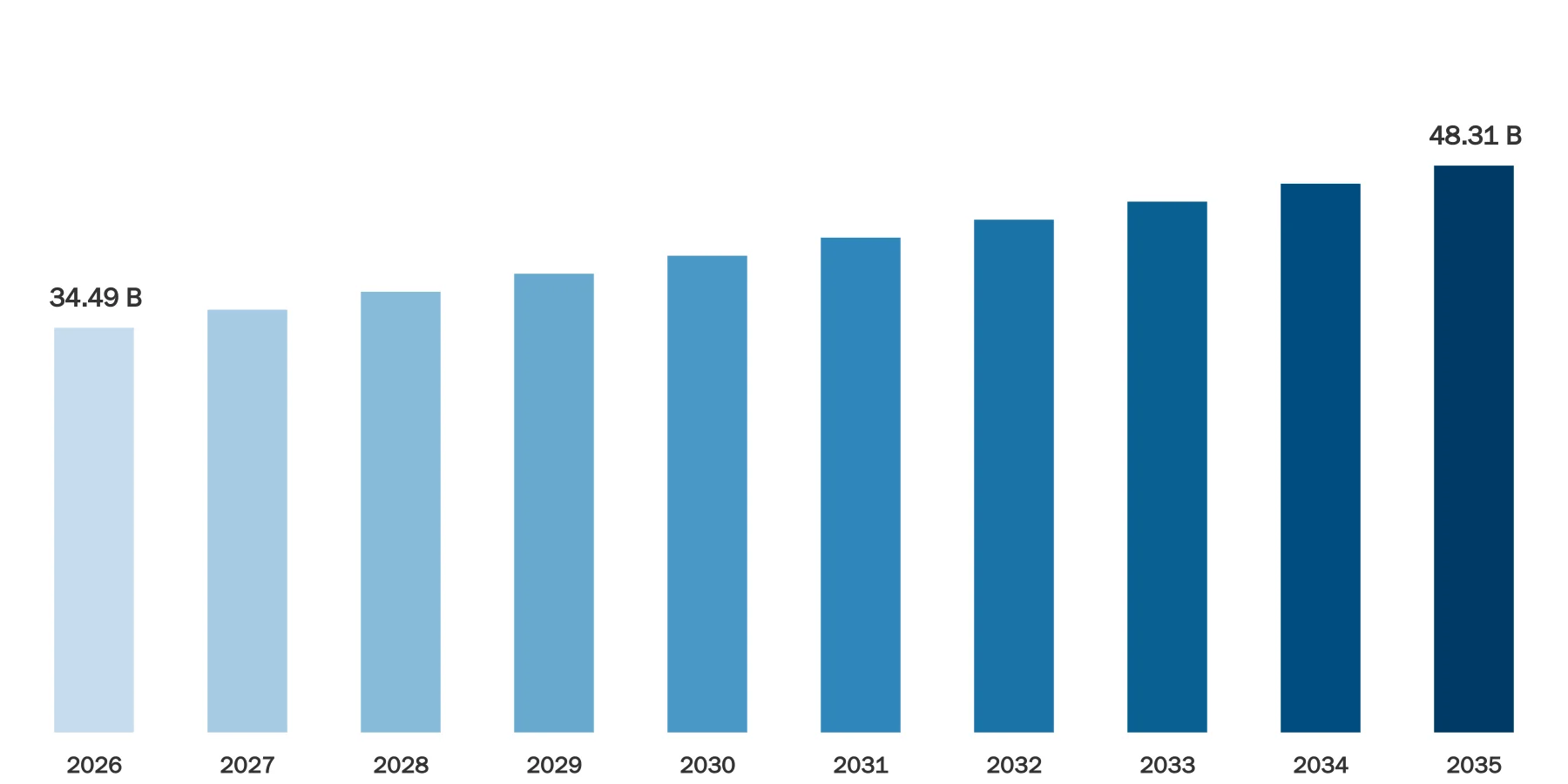
Source: Econ Market Research
A group of cutting-edge technologies known as an intelligent transportation system (ITS) are used to increase the effectiveness, security, and sustainability of transportation networks. In order to improve overall transportation operations, ITS incorporates a number of components, including sensors, communication networks, Data Analytics, and control systems. Intelligent infrastructure, including intelligent traffic signals and changeable message signs, as well as vehicle-to-vehicle and vehicle-to-infrastructure communication systems, are important elements of ITS. Real-time data interchange and educated decision-making are made possible by these technologies, which optimize traffic patterns, lessen congestion, and improve road safety. ITS also includes tools like advanced traveler information systems, which provide drivers up-to-the-minute traffic data, and vehicle automation, which makes autonomous driving possible.
Intelligent Transportation System Market Dynamics
A primary driver is the growing demand for effective traffic management and congestion reduction. As cities become more densely populated, the need for smart transport solutions to reduce traffic congestion grows. The increased emphasis on road safety and the desire to reduce accidents drives the deployment of ITS technologies that enable real-time monitoring, automated event detection, and emergency response systems. The increasing emphasis on environmental sustainability and the need to minimize carbon emissions push the incorporation of ITS in promoting environmentally friendly transportation options. Overall, government initiatives and investments in smart city development, infrastructure modernization, and digital connection help to move the ITS industry ahead, offering possibilities for technology suppliers and solution vendors.
Intelligent Transportation System Market Drivers
Increasing Urbanization
The rapid urbanization in many countries has resulted in the growth of the urban population and increased traffic congestion. Intelligent transportation systems offer solutions to manage traffic flow efficiently, reduce congestion, and improve overall transportation management.
Restraints
Privacy and Security Concerns
The implementation of intelligent transportation systems involves significant upfront costs, including infrastructure development, installation of sensors and cameras, and integration of various components. These high costs can be a major restraint, especially for developing economies with limited financial resources.
Opportunities
Sustainable Transportation Solutions
The growing emphasis on sustainability and environmental concerns offers opportunities for intelligent transportation systems to support eco-friendly transportation solutions. Integration of electric vehicles, optimized routing algorithms, and intelligent energy management can contribute to reducing carbon emissions and promoting sustainable transportation.
Segment Overview
By Application
Based on application, the global intelligent transportation system market is divided into traffic management, road safety &, security, freight management, public transport, environment protection, automotive telematics, parking management, and road tolling systems. The traffic management category dominates the market with the largest revenue share of around 30.5% in 2022. The growing demand for effective traffic management solutions to reduce congestion, improve traffic flow, and increase transportation efficiency has spurred demand for sophisticated traffic management systems. These systems include a variety of technologies and solutions, including as traffic monitoring and control, signal synchronization, incident detection, and traffic data analytics.
Rapid urbanization, population expansion, and the concomitant increase in car ownership have increased the need to properly manage traffic in metropolitan areas. Furthermore, technological breakthroughs such as Artificial Intelligence, IoT, and Cloud Computing have enabled traffic management systems to become more intelligent, adaptable, and efficient, bolstering their market domination. The continued emphasis on smart city efforts and infrastructure development is projected to support traffic management segment growth in the near future.
By Type
Based on the type, the global intelligent transportation system market is divided into advanced traveler information system, advanced traffic management system, advanced transportation pricing system, advanced public transportation system, and emergency medical system. The advanced traffic management system category dominates the market with the largest revenue share of around 29.3% in 2022. The growing demand for effective traffic management solutions to reduce congestion, improve traffic flow, and increase transportation efficiency has spurred demand for sophisticated traffic management systems. These systems include a variety of technologies and solutions, including as traffic monitoring and control, signal synchronization, incident detection, and traffic data analytics.
Intelligent Transportation System Market Overview by Region
By Region, the global intelligent transportation system market has been segmented into North America, Europe, Asia-Pacific, and the Rest of the World. North America had the greatest share, of around 31.4%, of the global market in 2022. This region has a well-developed transport infrastructure, which serves as a solid platform for implementing modern ITS technology. Furthermore, the existence of significant market participants, technical improvements, and a favorable regulatory environment all contribute to North America's ITS industry supremacy. Continuous innovation and collaboration among industry players are expected to keep this market leadership in place for the foreseeable future.
Intelligent Transportation System Market Competitive Landscape
In the global intelligent transportation system market, only few of players dominated the market and have a strong regional presence. They are actively participating in strategic growth initiatives like as product creation, product launches, joint ventures, and partnerships. These organizations intend to pursue these tactics in order to increase their market position and develop their client base in order to acquire a significant portion of the market.
Key Players
Agero, Inc.
Denso Corporation
EFKON GmbH
Garmin Ltd.
Thales Group
Xerox Corporation
Hitachi, Ltd.
Ricardo
Sensys Networks, Inc.
Telenav, Inc.
Iteris, Inc.
Kapsch TrafficCom
Lanner
Nuance Communications, Inc.
Q-Free ASA
TomTom International BV
Siemens AG
Intelligent Transportation System Market Recent Developments
In November 2022, Hitachi Rail Limited has been awarded a Framework Agreement contract by Ferroviaria Italiana (RFI) to design and install the European Rail Transport Management System (ERTMS) digital signaling on a 1,885-kilometer section of the Italian rail network.
Intelligent Transportation System Market Report Scope & Segmentation
| Attributes | Details |
|---|---|
Market Size (Current) | US$ 34.49 Billion in 2026 |
Market Size (Forecast) | US$ 48.31 Billion in 2035 |
Growth Rate | CAGR of 3.8% from 2026 to 2035 |
Forecast Period | 2026 – 2035 |
Base Year | 2025 |
Historical Data Available | Yes |
Regional Scope | Global |
Segments Covered | By Mode of Transport
By System
By Application
|
Frequently Asked Questions
Common questions about this report
The study period covers historical insights and forecast projections for the period 2026-2035.
About the Author
Market research expert with years of industry experience

Dipali Bhingare serves as the Market Research Director at Econ Market Research. With a focus on translating complex global economic shifts into actionable business intelligence, she oversees the strategic direction of comprehensive market studies. Her work empowers organizations to navigate volatile industries through data-driven forecasting and deep-dive competitive analysis.
Related Reports
Explore more market insights from the same category