

Connected Cars Market
Connected Cars Market Size, Share, Trends, Growth, and Industry Analysis, By Connectivity Solution (Integrated, Embedded, Tethered), By Service (Driver Assistance, Safety, Entertainment, Well-being, Vehicle Management, Mobility Management), By Technology (3G, 4G-LTE, 5G), By End Use (Original Equipment Manufacturers (OEMs), Aftermarket), Regional Analysis and Forecast Period 2026-2035
Market Overview
As per Econ Market Research analysis, the Global Connected Cars Market was valued at US$ 100.49 Billion in 2026 and is expected to reach US$ 364.04 Billion by 2035, registering a CAGR of 15.37% during the forecast period 2026–2035. The base year considered is 2025.
Connected Cars Market Size 2025-2035 (USD Billion)

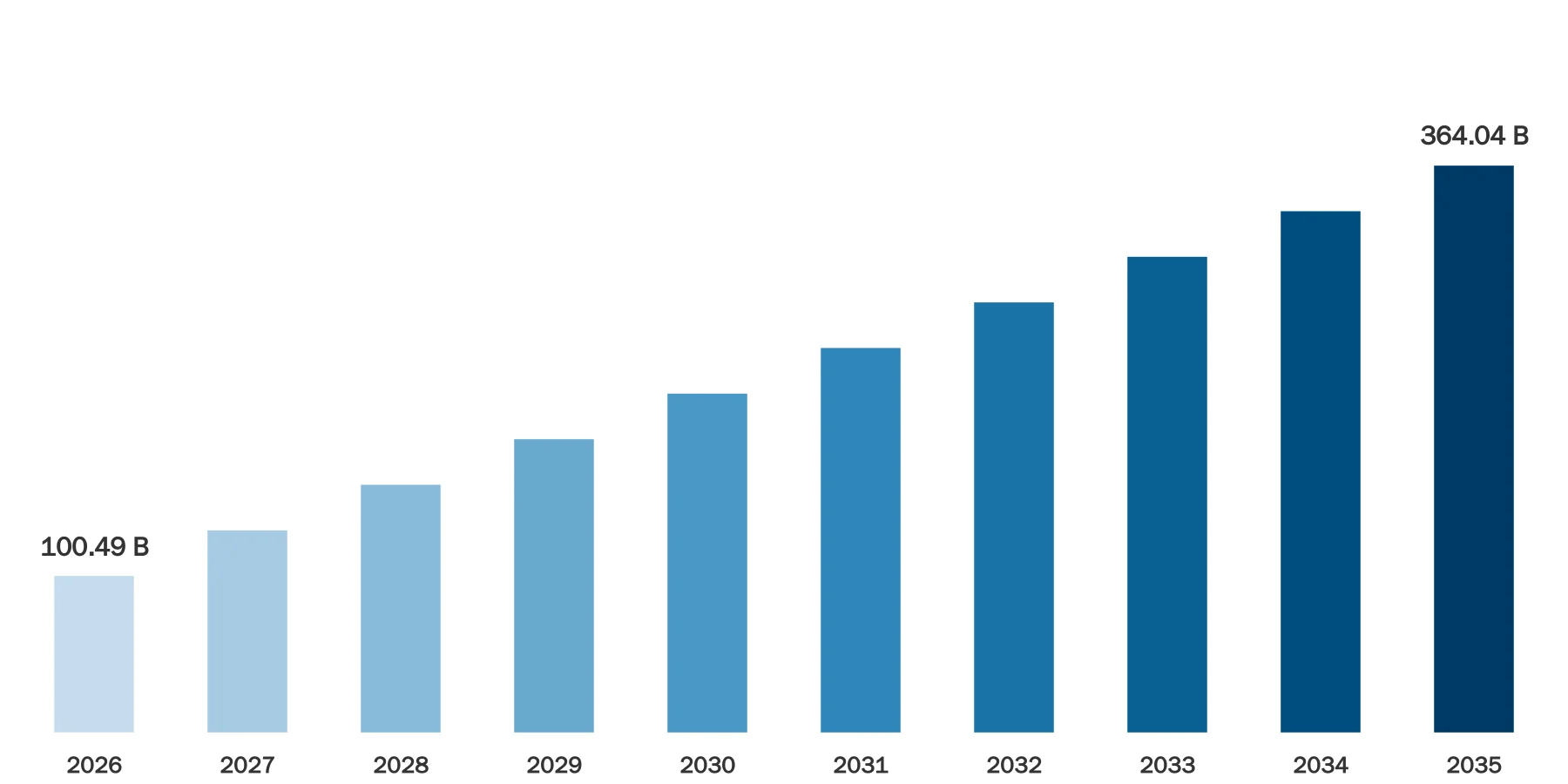
Source: Econ Market Research
By incorporating cutting-edge technologies to improve driving, the market for connected cars is growing quickly. These cars facilitate real-time data transmission between the car, other devices, and infrastructure by utilizing internet connectivity. This allows for the use of functions like entertainment, navigation, and diagnostics. Thanks to 5G, AI, and IoT, connected automobiles are changing transportation networks with increased safety, efficiency, and convenience. With the hope of mass adoption and smart city integration, automakers are aggressively investing in the development of connected car platforms. Connected cars are set to revolutionize mobility and open the door to a more autonomous and connected future as the automotive sector embraces digital transformation.
Connected Car Dynamics
The growing demand from consumers for cutting-edge features like safety, entertainment, and navigation is fueling the connected car market. Technological breakthroughs such as 5G connection, AI-driven systems, and IoT integration fuel innovation and extend capabilities. The market is growing even faster thanks to regulatory initiatives that support safety standards and vehicle-to-everything (V2X) connection. Cooperation between telecom providers, tech firms, and automakers promotes ecosystem growth and interoperability. Notable obstacles include issues with infrastructure, data security, and privacy. Nonetheless, the market continues to flourish with investments in research, development, and partnerships aimed at creating smarter, safer, and more connected vehicles for the future.
Connected Car Drivers
Integration of 5G Connectivity, AI-driven Systems, and IoT
The connected car market is mostly driven by the combination of 5G connection, AI-driven technologies, and IoT. 5G allows for incredibly quick data transfer, enabling real-time connectivity between infrastructure, the cloud, and automobiles. By analyzing enormous volumes of data and making snap judgments, Artificial Intelligence (AI) improves driver assistance functions like adaptive cruise control and lane-keeping. IoT makes it possible to link to other devices seamlessly, which improves safety, entertainment, and navigation features and, in the end, changes driving and boosts vehicle performance.
Increasing Desire for Navigation, Entertainment, and Safety Functionalities
Customers want smooth navigation experiences with optimal route recommendations and real-time traffic updates. Passengers', need for entertainment on-the-go is met by improved entertainment options including streaming services and in-car connectivity. Furthermore, the emphasis on Road Safety is reflected in the prioritizing of safety technologies such autonomous emergency braking and collision detection systems. The increasing need for diverse features propels innovation and the uptake of connected automotive technologies.
Restraints
Data Security and Privacy Concerns
The danger of cyberattacks and illegal access rises as cars are more networked and gather enormous volumes of sensitive data. Customers are reluctant to embrace connected car technology because they are concerned about possible breaches of their personal data. The development and implementation of connected automotive systems are made more complex and expensive by the need to adhere to strict privacy standards and implement strong Cyber Security protections.
High Implementation Costs
Significant infrastructure, R&,D, and development investments are needed to integrate cutting-edge technologies like 5G connectivity, AI-driven systems, and the Internet of Things. Furthermore, it may be unaffordable for both automakers and customers to retrofit current cars with linked features. Because of their exorbitant pricing, connected car technologies are not widely adopted, particularly in price-sensitive regions. Moreover, the implementation of novel features may be delayed, which would restrict market growth and accessibility.
Opportunities
Smart City Integration
Working together with infrastructure suppliers and urban planners enables the creation of intelligent transportation systems that improve overall mobility solutions, optimize traffic flow, and lessen congestion. Vehicles can interact with parking lots, traffic signals, and other infrastructure by utilizing connected car technologies, which facilitates better traffic management and guidance for drivers. This connection makes transportation in smart cities more fluid, improves urban efficiency, and lessens environmental impact.
Subscription-Based Models
Manufacturers may create ongoing revenue streams after the initial car purchase by offering subscription packages that grant access to premium features, upgrades, and services. This strategy makes it easier to customize offerings to meet the interests of specific customers while also increasing consumer engagement and loyalty. Furthermore, subscription-based business models make it easier to gradually roll out new features and technological advancements. This ongoing monetization and adaptability to changing customer needs promotes long-term profitability and competitiveness.
Segment Overview
By Connectivity Solution
Based on connectivity solutions, the global connected car market is divided into integrated, embedded, and tethered. The integrated category dominates the market with the largest revenue share in 2023. Vehicles with built-in systems that can connect to the internet and communicate with other devices are said to have integrated connectivity. Usually, the onboard infotainment or telematics system of the car includes these systems. Cars that have an inbuilt, manufacturer-installed dedicated modem are said to have embedded connection. Tethered connectivity refers to the use of connected services and internet access by automobiles that are dependent on external devices, most commonly smartphones.
By Service
Based on the service, the global connected car market is categorized into driver assistance, safety, entertainment, well-being, vehicle management, and mobility management. The driver assistance category leads the global connected car market with the largest revenue share in 2023. Utilizing sensors, cameras, and other technology, driver assistance features help drivers with a variety of driving tasks, including adaptive cruise control, lane-keeping assistance, and parking assistance. With the goal of improving both the vehicle',s and its occupants', safety, safety features frequently make use of cutting-edge technologies like automated emergency braking, blind-spot monitoring, and collision detection systems. Entertainment features cover a broad spectrum of in-car entertainment alternatives, including as smartphone and other device connectivity, streaming services, and multimedia systems. Features related to vehicle administration include tracking and controlling several facets of upkeep, diagnostics, and vehicle performance.
By Technology
Based on technology, the global connected car market is segmented into 3G, 4G-LTE, and 5G. The 4G-LTE segment dominates the connected car market. In comparison to 3G, 4G-LTE networks provided significantly higher data rates and increased dependability, opening up a wider range of linked services and applications. Vehicles might receive advanced telematics capabilities, real-time traffic data, and high-definition streaming video with 4G-LTE connectivity. 3G networks allowed for minimal internet access, navigation services, and basic telematics functions, however they did so at comparatively slower data speeds than later generations. In comparison to earlier generations, 5G networks offer incredibly low latency, ultra-fast data speeds, and much more network capacity.
By End Use
Based on end use, the global connected car market is divided into original equipment manufacturers (OEMs) and aftermarket. The original equipment manufacturer category dominates the market with the largest revenue share in 2023. Original Equipment Manufacturers (OEMs) are automakers who start with a vehicle and add integrated connected car technologies to it. These features are integrated into the architecture of the car and frequently work in unison with other onboard systems. After a vehicle has been produced and sold, businesses and independent suppliers that offer connected car solutions and accessories make up the aftermarket market. Customers can refit or improve their current automobiles with connected car capabilities using aftermarket equipment and services.
Connected Car Overview by Region
The global connected car market is categorized into North America, Europe, Asia-Pacific, and the Rest of the World. Asia-Pacific emerged as the leading region, capturing the largest market share in 2023. Because of the region',s growing middle class, rising disposable incomes, and increasing urbanization, the automobile market is sizable and expanding quickly. Furthermore, the governments of nations like China, Japan, and South Korea have been aggressively endorsing and funding projects related to smart transportation infrastructure and connectivity. Additionally, the area is home to a number of significant automakers and IT companies, which promotes innovation and accelerates the use of connected automobile technologies.
Throughout the forecast period, North America is anticipated to post a significant CAGR. This is explained by a number of things, such as the robust presence of the automobile sector, technical developments, and a high degree of consumer adoption of connected car technology. The region',s strong regulatory framework, well-developed infrastructure, and rising demand for convenience and safety features in cars all contribute to the market',s expansion. Furthermore, collaborations among automakers, tech firms, and telecom carriers keep up the pace of innovation and broaden the scope of services available for connected cars, which supports North America',s continuous growth.
Connected Car Competitive Landscape
In the global connected car market, a few major players exert significant market dominance and have established a strong regional presence. These leading companies remain committed to continuous research and development endeavors and actively engage in strategic growth initiatives, including product development, launches, joint ventures, and partnerships. By pursuing these strategies, these companies aim to strengthen their market position, expand their customer base, and capture a substantial share of the market.
Key Players:
Airbiquity Inc
Robert Bosch GmbH
Sierra Wireless
AT&,T INC
Continental AG
CloudMade
Tesla ZUBIE INC
LUXOFT
SAMSUNG ELECTRONICS CO. LTD.
Qualcomm Technologies Inc
Intellias Ltd, and various others.
Connected Car Recent Developments
In July 2021, Major Developments in the Connected Car Space by Toyota, Amazon, and Uber Due to two transactions made by two of the largest corporations in the world in two days, the growing linked car trend received a significant boost this week. Following Toyota',s introduction of mobility services to its autonomous fleet, Aurora, an autonomous car startup supported by Uber and Amazon, revealed its intention to go public through a special purpose acquisition company (SPAC) merger at a valuation of $11 billion.
In February 2021, With a focus on connected technologies for the automotive, consumer, and enterprise markets, HARMAN International, a wholly-owned subsidiary of Samsung Electronics Co., Ltd., announced the acquisition of nearly all the assets of Savari®,, Inc., a Silicon Valley-based automotive technology company developing vehicle-to-everything communications (V2X) technology in 5G Edge and automotive devices.
In January 2020, In order to automate and standardize software development and integration into connected vehicle architectures, Continental AG established the ",Continental Cooperation Portal,", an online portal. It also offers a central platform for software project communication and may be individually tailored to meet the needs of the user.
Connected Cars Market Report Scope & Segmentation
| Attributes | Details |
|---|---|
Market Size (Current) | US$ 100.49 Billion in 2026 |
Market Size (Forecast) | US$ 364.04 Billion in 2035 |
Growth Rate | CAGR of 15.37% from 2026 to 2035 |
Forecast Period | 2026 – 2035 |
Base Year | 2025 |
Historical Data Available | Yes |
Regional Scope | Global |
Segments Covered | By Connectivity Solution
By Service
By Technology
By End Use
|
Frequently Asked Questions
Common questions about this report
The study period covers historical insights and forecast projections for the period 2026-2035.
About the Author
Market research expert with years of industry experience

Related Reports
Explore more market insights from the same category