

Hydrocyclone Market
Hydrocyclone Market Size, Share, Trends, Growth, and Industry Analysis, By Type (Solid-Liquid, Liquid-Liquid, Dense Media), By Application (Mining, Oil and Gas, Wastewater Treatment, Construction), Regional Analysis and Forecast Period 2026-2035
Market Overview
As per Econ Market Research analysis, the Global Hydrocyclone Market was recorded at US$ 0.65 Billion in 2026 and is projected to expand to US$ 0.83 Billion by 2035, registering a CAGR of 2.8% over the forecast period. The base year used is 2025.
Hydrocyclone Market Size 2025-2035 (USD Billion)

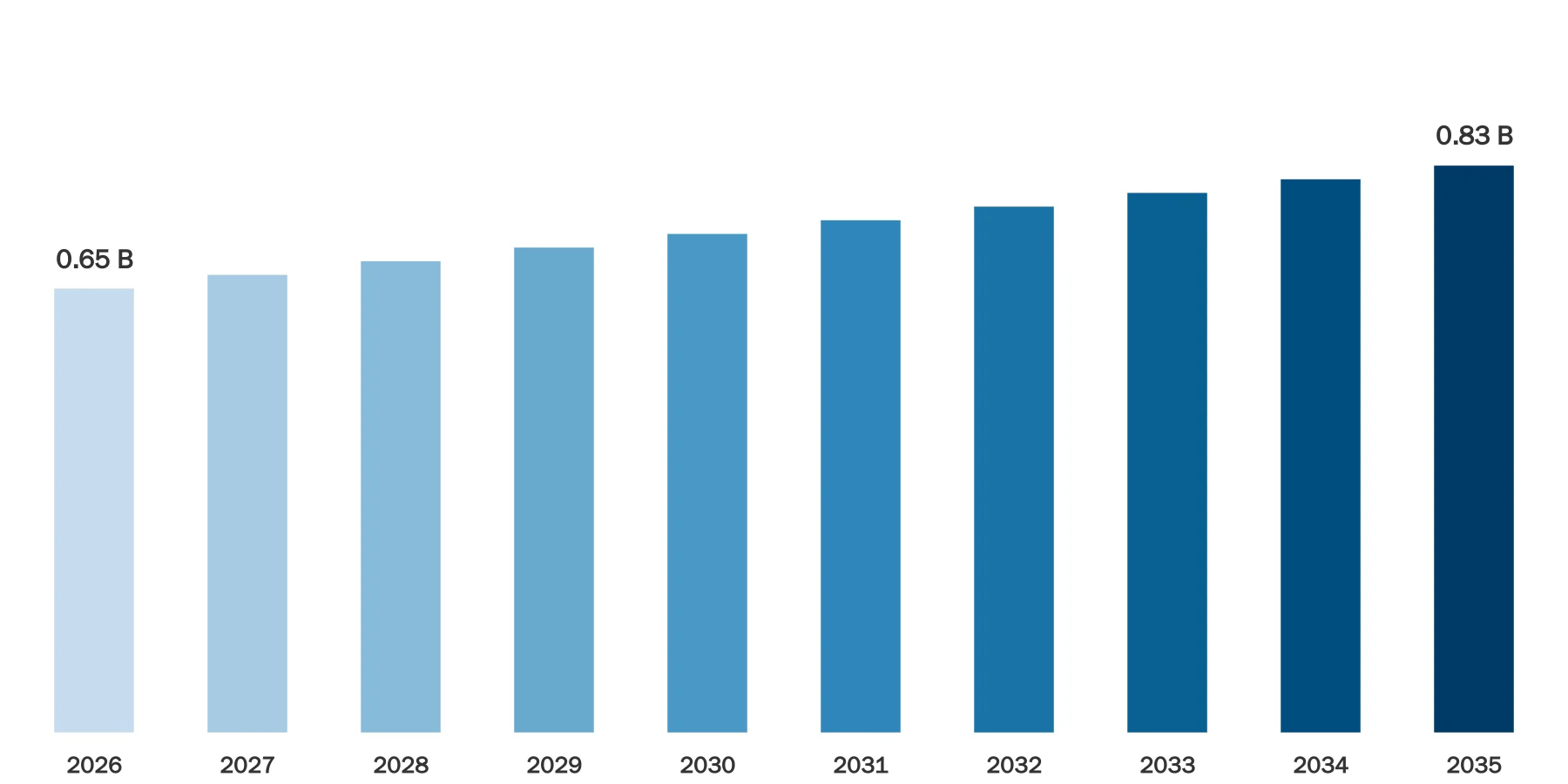
Source: Econ Market Research
Due to its effectiveness in separating solids from liquids and classifying/sorting particles according to size and density, hydrocyclones are causing a considerable increase in the market. Hydrocyclones are widely used in processing wastewater, mining, oil and gas, and agriculture. They have several benefits, including inexpensive maintenance, high throughput, and small environmental impact. Stricter environmental laws combined with rising demand for water and wastewater treatment drives market growth. Furthermore, hydrocyclones are now more versatile and perform better thanks to technological breakthroughs in design and materials. The hydrocyclone market is expected to continue growing and innovating as long as industries value sustainability and efficiency.
Hydrocyclone Dynamics
Growing industrialization fuels demand, especially in the mining, oil and gas, and wastewater treatment industries. Market expansion is driven by a growing focus on effective separation technologies in order to comply with strict environmental requirements. Hydrocyclone performance is increased and its application scope is expanded by technological improvements such as better designs and materials. Expanding markets are further encouraged by growing awareness of sustainability and water conservation. However, there are obstacles, including high initial investment costs and competition from alternative separation methods.
Hydrocyclone Drivers
Water Conservation and Sustainability Initiatives
The hydrocyclone market is driven by sustainability and water conservation programs, which emphasize the significance of effective water management. Concerns about water scarcity around the world are driving industry to look for solutions like hydrocyclones that can reduce water use and maximize resource utilization. These programs encourage businesses to invest in systems that allow for efficient solid-liquid separation while minimizing water waste, hence promoting the adoption of sustainable practices. Hydrocyclones are a good fit for water conservation and sustainability programs because of their high throughput and minimal environmental impact.
Demand for Efficient Separation Technologies
Industries seeking to minimize their environmental impact and streamline operations are driving demand for effective separation technologies like hydrocyclones. Industries are looking for solutions with high throughput, low maintenance, and small footprints due to growing production volumes and more stringent requirements. This need is satisfied by hydrocyclones, which effectively separate solids from liquids while increasing process effectiveness and consuming less resources. The need for technologies like hydrocyclones is increasing as companies place a higher priority on sustainability and efficiency, this is spurring innovation and market expansion.
Restraints:
Capital costs for equipment purchases and installation fees are included in these prices. The initial financial investment of hydrocyclones can be prohibitive for firms who are considering them as a solid-liquid separation option, especially for smaller companies or those with limited resources. Despite the long-term advantages of the technology, there are obstacles to its widespread adoption due to the requirement for auxiliary infrastructure and equipment, which raises the overall investment load.
Complexity in Operation and Maintenance
The specific expertise and training needed to operate hydrocyclones efficiently adds to their operational complexity. Operational issues are compounded by their complex design and sensitivity to operational conditions, which necessitate rigorous maintenance procedures. Companies may be hesitant to purchase hydrocyclones because of worries about the complexity of operation and possible downtime. Reducing complexity in the maintenance and operation procedures could help lift these limitations and promote a wider use of hydrocyclone technology.
Opportunities:
Technological Innovations
The incorporation of cutting-edge materials expands application possibilities by improving durability and resilience to corrosive environments. Moreover, real-time monitoring and remote control are made possible by integrating IoT (Internet of Things) capabilities, which maximize operational effectiveness and decrease downtime. Processes are streamlined via automation technologies, increasing productivity and cutting labor expenses. Manufacturers of hydrocyclones can maintain their competitiveness and satisfy changing market expectations for more dependable and efficient separation solutions by adopting technical advancements.
Customized Solutions for Specific Applications
Customized designs maximize efficiency and performance by meeting the specific needs of the industry. Through comprehension of the unique requirements of several industries, like mining, agriculture, or wastewater treatment, producers can create customized hydrocyclones that yield exceptional outcomes. Industry-specific modifications improve adaptability and application, drawing in specialized markets and cultivating enduring client relationships. Hydrocyclone enterprises may stand out in the market and take advantage of new opportunities by offering customized solutions.
Segment Overview
By Classification
Based on the classification, the global hydrocyclone market is divided into solid-liquid type, liquid-liquid type, and dense media type. The solid-liquid type category dominates the market with the largest revenue share in 2023. The main application for this kind of hydrocyclone is the removal of solid particles from liquid streams. It is used in sectors like wastewater treatment, mining, and mineral processing, where separating solids from liquids is essential for environmental compliance and process efficiency.
Immiscible liquids with varying densities are intended to be separated using liquid-liquid hydrocyclones. They are frequently employed in sectors such as the oil and gas industry, where the production, refinement, and preservation of the environment all depend on the separation of oil and water. For material separation based on density differences, especially in dense media separation procedures, dense media hydrocyclones are employed.
By End Use Industry
Based on the end use industry, the global hydrocyclone market is categorized into construction, mining, oil &, gas, energy, pharmaceuticals, and others. The construction category leads the global hydrocyclone market with the largest revenue share in 2023. Hydrocyclones are used in the construction industry to separate materials from water in procedures including digging, concrete manufacturing, and washing aggregates. They guarantee that environmental rules are followed and aid in maintaining the quality of the water utilized in building activities.
Hydrocyclones are essential in the mining sector because they separate valuable Minerals from gangue and other unwanted impurities throughout the mineral processing process. In the oil and gas sector, hydrocyclones are widely used for a number of tasks, such as producing natural gas and crude oil, managing drilling fluid, and treating produced water. Pharmaceutical production uses hydrocyclones for operations such cell separation, particle size classification, and pharmaceutical component purification.
Hydrocyclone Overview by Region
The global hydrocyclone market is categorized into North America, Europe, Asia-Pacific, and the Rest of the World. North America emerged as the leading region, capturing the largest market share in 2023. The area is home to several important businesses that heavily rely on hydrocyclone technology, including mining, oil and gas, and water treatment. Hydrocyclones and other effective separation solutions are adopted in North America in order to comply with strict environmental standards. Innovation in technology and an emphasis on sustainability support market expansion even further.
The need for effective solid-liquid separation solutions is being driven by the rapid industrialization of nations like China and India, which is affecting several industries like agriculture, water treatment, and mining. In addition, stricter laws and growing environmental concerns are driving the use of technology like hydrocyclones. With its developing infrastructure, increased expenditures in industrial sectors, and growing consciousness of sustainability, Asia-Pacific is expected to play a major role in driving the hydrocyclone market in the years to come.
Hydrocyclone Competitive Landscape
In the global hydrocyclone market, a few major players exert significant market dominance and have established a strong regional presence. These leading companies remain committed to continuous research and development endeavors and actively engage in strategic growth initiatives, including product development, launches, joint ventures, and partnerships. By pursuing these strategies, these companies aim to strengthen their market position, expand their customer base, and capture a substantial share of the market.
Hydrocyclone Market Leading Companies:
FLSmidth
Weir Minerals
KSB
Siemens
Metso
TechnipFMC
Exterran
Weihai Haiwang
Netafim
Schlumberger, and various others.
Hydrocyclone Recent Developments
In October 2023, Investigations on Creating Cyclone Coupling Methods for Non-uniform Separators with Hydrocyclone Design Optimization. Because of its straightforward design, ease of use, and excellent separation effectiveness, hydrocyclone separators are a commonly used piece of equipment in the field of liquid-solid separation. This study discusses the future development trends of hydrocyclone separators and offers a thorough review of their design optimization, application regions, operating principles, and performance evaluation.
In May 2020, Hydrocyclone technology is to be advanced through a new JKMRC initiative. A new study being conducted by scientists at the Julius Kruttschnitt Mineral Research Centre (JKMRC) of the Sustainable Minerals Institute (SMI) aims to increase productivity and efficiency in hydrocyclone separation.
Hydrocyclone Market Report Segmentation
Hydrocyclone Market Report Scope & Segmentation
| Attributes | Details |
|---|---|
Market Size (Current) | US$ 0.65 Billion in 2026 |
Market Size (Forecast) | US$ 0.83 Billion in 2035 |
Growth Rate | CAGR of 2.8% from 2026 to 2035 |
Forecast Period | 2026 – 2035 |
Base Year | 2025 |
Historical Data Available | Yes |
Regional Scope | Global |
Segments Covered | By Type
By Application
|
Frequently Asked Questions
Common questions about this report
The study period covers historical insights and forecast projections for the period 2026-2035.
About the Author
Market research expert with years of industry experience

Dipali Bhingare serves as the Market Research Director at Econ Market Research. With a focus on translating complex global economic shifts into actionable business intelligence, she oversees the strategic direction of comprehensive market studies. Her work empowers organizations to navigate volatile industries through data-driven forecasting and deep-dive competitive analysis.
Related Reports
Explore more market insights from the same category