

Minerals Market
Minerals Market Size, Share, Trends, Growth, and Industry Analysis, By Type (Ferrous Metals, Non-Ferrous Metals, Industrial Minerals, Precious Metals), By Product Form (Raw Materials, Intermediate Products), By Application (Construction, Manufacturing, Automotive, Aerospace, Energy, Others), Regional Analysis and Forecast Period 2026-2035
Minerals Market Overview
As per Econ Market Research analysis, the Global Minerals Market accounted for US$ 52.06 Billion in 2026 and is expected to surpass US$ 59.54 Billion by 2035, witnessing a CAGR of 2.6% throughout 2026–2035. The analysis is based on 2025 as the base year.
Minerals Market Size 2025-2035 (USD Billion)

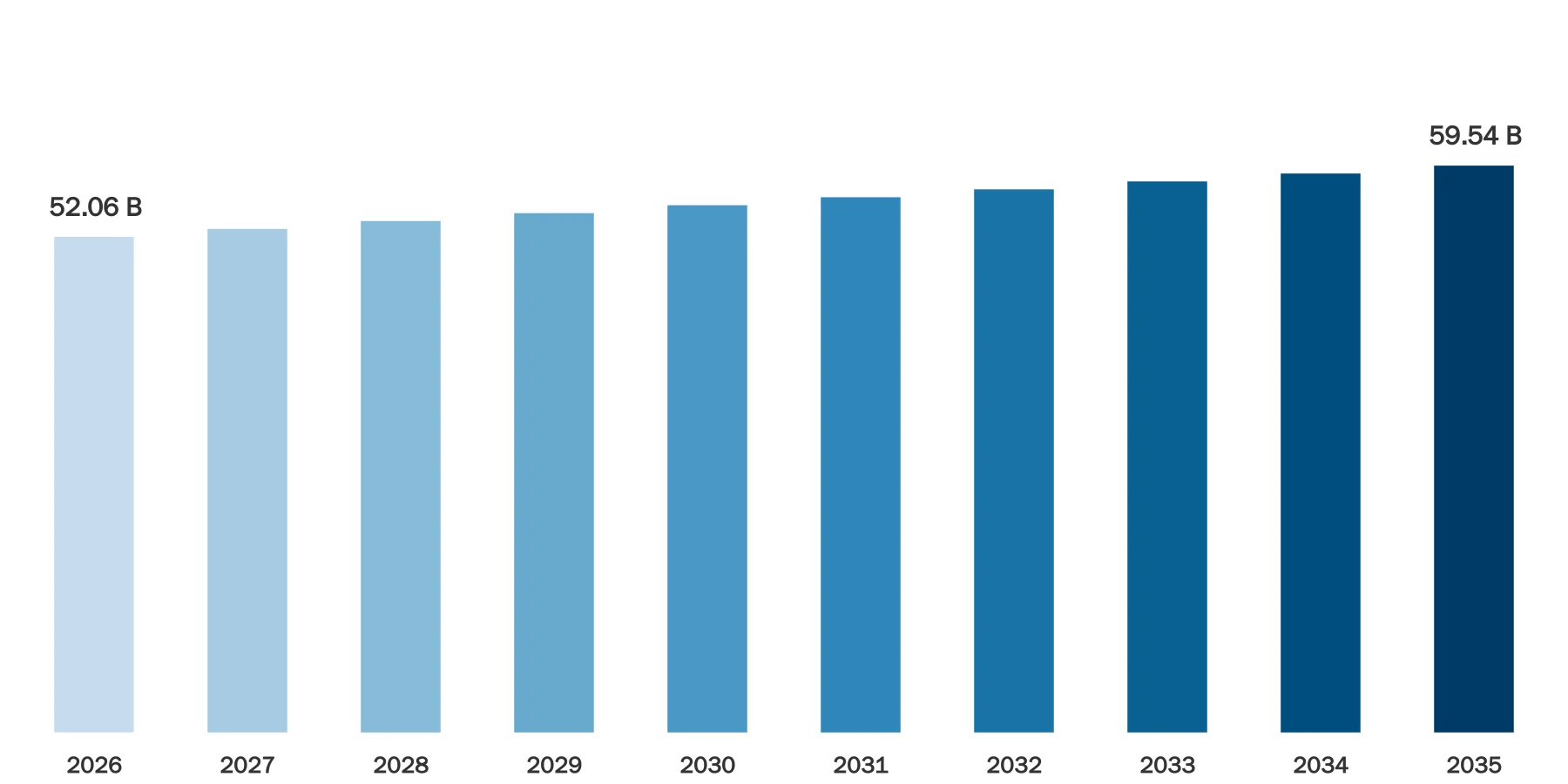
Source: Econ Market Research
Minerals are solid, naturally occurring, inorganic substances that have definite chemical compositions. They are integral in a number of sectors: construction, electronics, manufacturing, and agriculture. This market covers the gamut of minerals - metals such as iron, copper, and aluminum, industrial minerals such as clay and silica, and precious minerals such as gold and diamonds. Over the years, growth in the global minerals market has undertaken a large leap and this is owing to its growing demand from developing economies and new developments in technology.
Some of the major contributory factors include urbanization, which increases construction demands, as well as increased uses of minerals for renewable energy technologies such as Solar Panels and wind turbines. Environmental regulations and sustainability practices influence the market in such a way that companies are compelled to update their environmentally friendly extraction and processing methods. Sustainable practices and innovations will play a greater role with rising global economy growth as the minerals market is anticipated to brighten, with both threats and opportunities for all players in the industry.
Dynamic Insights
A significant driving force is the increasing demand for minerals, especially in the construction and technology sectors. Increased urbanization brings about increased demand for building materials, thus, minerals such as sand, gravel, and cement will continue to be required in greater proportions. In addition, renewable energy sources, including solar panels, batteries, and electric vehicles, require specific minerals that support market growth.
However, the market also has deterrents: environmental sustainability and pressures from regulations. This industry causes significant degradation of the environment, further forcing governments and organizations to tighten regulation and mitigate negative impacts. Companies are under greater scrutiny to hold the mantra of sustainability such as reducing carbon emissions, efficient waste disposal, and so on. Another factor is fluctuation in mineral prices caused by geopolitical tensions and a break in supply chains, which have a powerful effect on profitability and investment in the sector.
Drivers Insights
Growing Urbanization and Infrastructure Development
Rapid urbanization all over the world and in developing countries has been one of the prominent forces driving this global market for minerals. As cities are extended and populations grow, demand for construction materials increases quite a bit. Some of the key minerals used for building infrastructures such as roads, bridges, and homes are sand, gravel, and limestone. Government initiatives to improve infrastructure also benefit this trend because most investments in construction tend to increase with improvements in such efforts. The growing population within the cities and related demand for infrastructure are also key drivers of mineral growth.
Advancements in Technology and Renewable Energy
Some minerals are in high demand with this shift towards renewable sources of energy. These would be lithium, cobalt, and nickel because these minerals will be necessary to cover the use of battery technology in electric vehicles as well as for storing renewable energy. Consequently, more mineral demands lie ahead with an increase in solar system and wind farm additions. In addition, new, more productive mining and processing technologies make it possible to use minerals from more complex deposits more cheaply but at higher efficiency. The synergy between technological progress and the green agenda associated with renewables thus represents an important propulsion factor for the minerals market.
Restraints Insights
Environmental Regulations and Sustainability Concerns
Growing environmental concerns and strict regulatory measures to limit the negative impacts of mining are imposing severe restraints on the minerals market. Mining activities result in deforestation, soil erosion, and water pollution that compel governments and global authorities to strengthen environmental legislation. Statutory compliance may result in an increase in operating costs and hence may delay project approvals. Due to such investments, those companies may face fiscal stress and thus narrower profit margins. As environmental issues become a public matter of concern, there will be increased pressure on the minerals industry for environmentally sensitive practices.
Price Volatility and Supply Chain Disruptions
Uncertainty in the minerals market arises due to geopolitical tensions, natural calamities, and changes in the market demand. The price volatility matters much in profitability for mining companies and investment decisions. For example, the scenarios of demand surge or upstream blight arising from trade dispute scenarios push the prices sky high, whereas in the overproduction cases, the prices can shoot down very sharply. All these fluctuations create problems for companies in terms of financial planning and proper allocation of resources. In addition, firms might face stern challenges when acquiring reliable supply chains, which would again complicate their business operations and stability in the market.
Opportunities Insights
Innovation and Sustainable Mining Practices
There is a growing opportunity for companies to differentiate themselves through innovation and the adoption of sustainable mining practices. As the demand for eco-friendly products increases, companies that invest in green technologies and sustainable resource extraction methods can gain a competitive edge. Innovations such as automated mining operations, improved waste management systems, and recycling of minerals can reduce environmental impacts and enhance operational efficiency.
Furthermore, companies can tap into the growing market for recycled minerals, meeting consumer demand for sustainable products while contributing to resource conservation. By embracing innovation and sustainability, companies in the minerals market can unlock new growth opportunities and enhance their reputations in an increasingly environmentally conscious world.
Segment Analysis
By Type
Under the by type segment, the global minerals market has different basic categories that find critical applications in thousands of industries. Cement and concrete products are basic materials for construction as they provide structural stability and strength to buildings, bridges, and roads. The other segment is glass and glass products, which is critical for most applications, examples include windows, bottles, and packaging.
Another important category of non-metallic mineral products constitutes a broad group, incorporating talc and barite, among others. These are used in various industrial groups- from cosmetics to pharmaceuticals. Other categories include clay products and refractories, where it constitutes an important production material in the manufacturing of bricks and ceramics, most commonly used at high temperatures.
By Application
The minerals market of the world caters to several industries that consume minerals in different forms under the banner of the by application category. Chemicals manufacturing is highly dependent on minerals as a raw material, which is utilized for the manufacture of fertilizers, acids, and other chemical compounds. The metallurgy sector uses minerals for the extraction and processing of metals.
Its role in the manufacturing of alloys and metal products is also tremendous. In addition, minerals form critical components in the electricity grids infrastructure. They are applied in components that ensure efficient transmission of power. The electronics industry also makes use of specific minerals while fabricating semiconductors and capacitors among many other electronic devices. The glass products segment also requires high-quality minerals for the production of glass used in packaging and construction. The vehicles application makes use of minerals for the production of components such as batteries and structural materials.
By End User
The by end user segment of the global minerals market is primarily divided into construction and manufacturing, with each sector relying on minerals for various applications. The construction industry is a significant consumer of minerals, utilizing cement, concrete, and aggregates to build infrastructure such as homes, roads, and bridges. As urbanization continues to rise, the demand for construction materials remains robust, further driving the need for various minerals. In contrast, the manufacturing sector leverages minerals for producing a wide array of products, from ceramics and glass to electronics and machinery.
Regional Analysis
Asia-Pacific remains the largest and fastest-growing region, given the rapid industrialization and urbanization in China and India. These are major consumers of minerals in most construction, manufacturing, and infrastructure development. China',s production and consumption of minerals like iron ore, coal, and rare earth elements contribute heavily to the region',s market share. An increased demand for minerals in the Southeast Asia region has been evident because of the development of construction activities and electronics industries.
In North America, demand is helped by healthy demand from the construction, automotive, and technological sectors. The US and Canada are significant mining producers of minerals such as copper, gold, and phosphates, with an emphasis on sustainable mining in the wake of stricter environmental regulations. Europe is another key player in the global market, mainly represented by metallurgy, automotive, and renewable energy sectors. The growing thrust of the European Union towards sustainability and circular economy is ushering the region toward more efficient mineral use as well as to more extensive recycling practices.
Competitive Landscape
The main companies driving this market are Rio Tinto, BHP Group, Vale S.A., and Anglo American. These have major operations in multiple areas and also strong global presences, with huge extraction and processing facilities for ores of iron, copper, coal, and precious metals. Their competitive edge would be the vast mineral reserves, modern mining equipment, and robust supply chains that would empower them to supply resources reliably and consistently to meet global demand.
Besides, the global players, regional players are also important in the emerging markets of Africa, Latin America, and Asia-Pacific. Besides their localized experience, they have most of the mineral-rich regions, which serves as a competitive advantage for them in that region. While companies like South American copper producers Codelco of Chile and Grupo Mé,xico, lead in coal and mineral sands for African player Exxaro Resources.
List of Key Players:
Glencore PLC
Jiangxi Copper Company Limited
BHP Billiton Limited
China National Building Material Group Co. Ltd.
Compagnie de Saint-Gobain S.A.
Rio Tinto Group
Vale S.A.
Nutrien Ltd.
Anglo American PLC
LafargeHolcim Ltd.
Freeport-McMoRan Inc.
HeidelbergCement AG
Anhui Conch Cement Company Limited
Teck Resources Limited
Newmont Corporation
Barrick Gold Corporation
Southern Copper Corporation
Sibanye-Stillwater Limited
First Quantum Minerals Ltd
Recent Developments:
July 2023, Vale has signed a binding agreement with Manara Minerals, a joint venture between Ma&rsquo,aden and Saudi Arabia&rsquo,s Public Investment Fund, in which Manara Minerals will invest in Vale Base Metals Limited (VBM), the entity overseeing Vale&rsquo,s energy transition metals business. The investment is based on an implied enterprise value of US$ 26 billion for VBM.
Global Minerals Report Segmentation
Minerals Market Report Scope & Segmentation
| Attributes | Details |
|---|---|
Market Size (Current) | US$ 52.06 Billion in 2026 |
Market Size (Forecast) | US$ 59.54 Billion in 2035 |
Growth Rate | CAGR of 2.6% from 2026 to 2035 |
Forecast Period | 2026 – 2035 |
Base Year | 2025 |
Historical Data Available | Yes |
Regional Scope | Global |
Segments Covered | By Type
By Product Form
By Application
|
Frequently Asked Questions
Common questions about this report
The study period covers historical insights and forecast projections for the period 2026-2035.
About the Author
Market research expert with years of industry experience

Dipali Bhingare serves as the Market Research Director at Econ Market Research. With a focus on translating complex global economic shifts into actionable business intelligence, she oversees the strategic direction of comprehensive market studies. Her work empowers organizations to navigate volatile industries through data-driven forecasting and deep-dive competitive analysis.
Related Reports
Explore more market insights from the same category