

Energy Recovery Ventilator Market
Energy Recovery Ventilator Market Size, Share, Trends, Growth, and Industry Analysis, By Technology (Plate Heat Exchanger, Rotary Heat Exchanger, Heat Pipe Heat Exchanger, Run-Around Coil), By Application (Commercial, Residential, Industrial), Regional Analysis and Forecast Period 2026-2035
Energy Recovery Ventilator Market Overview
As per Econ Market Research analysis, the Global Energy Recovery Ventilator Market was recorded at US$ 4.8 Billion in 2026 and is projected to expand to US$ 12.6 Billion by 2035, registering a CAGR of 11.2% over the forecast period. The base year used is 2025.
Energy Recovery Ventilator Market Size 2025-2035 (USD Billion)

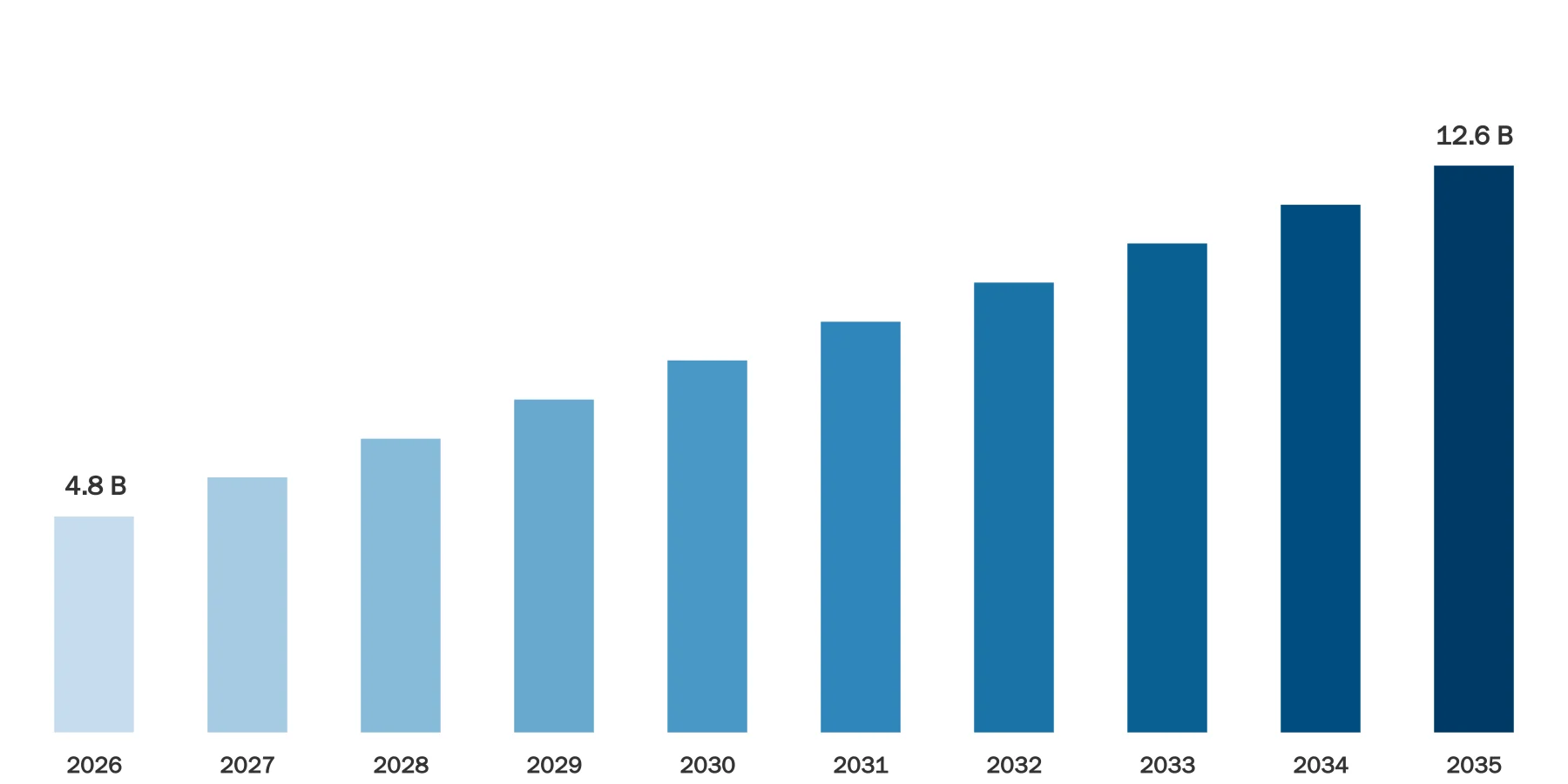
Source: Econ Market Research
ERVs play a pivotal role in enhancing ventilation systems by recovering and reusing energy from the outgoing air to precondition the incoming fresh air. This process ensures a continuous exchange of indoor and outdoor air while minimizing energy wastage. ERVs find widespread applications across residential, commercial, and industrial sectors, with the escalating awareness of the importance of healthy living and sustainable building practices.
An essential part of contemporary HVAC systems, energy recovery ventilators reduce the problems associated with heat and moisture transfer between indoor and outdoor spaces. With governments around the globe stepping up their efforts to cut back on energy use and lower carbon emissions, there will be a major increase in the need for ERVs. The market is growing because of strict building codes and regulations that require energy-efficient ventilation systems to be installed. In response to this growing demand, manufacturers are developing cutting-edge ERV solutions with higher energy recovery rates and increased efficiency.
Energy Recovery Ventilator Dynamics
Energy-efficient solutions are in high demand due to the pressing need to address climate change and environmental sustainability. This places energy recovery ventilators (ERVs) at the forefront of sustainable building practices. More market expansion is fuelled by strict building codes and regulatory frameworks that require the integration of energy recovery systems, especially in North America and Europe. The global government push to minimise carbon footprints is providing the ERV industry with a growing consumer base.
Furthermore, the dynamics of the market are influenced by the ongoing technological breakthroughs and product innovation made by major industry participants. Enhancing energy recovery rates, raising system efficiency overall, and incorporating smart technologies for improved control and monitoring are the main goals of ongoing research and development. These developments meet end users', growing demands for more advanced and flexible ERV solutions in addition to helping to comply with regulatory requirements.
Energy Recovery Ventilator Drivers
Growing Emphasis on Sustainable Building Practices
The market for energy recovery ventilators (ERVs) is significantly driven by the growing emphasis on sustainable building practices around the world. To lessen the environmental impact of construction activities, governments and regulatory bodies around the world are putting strict energy efficiency standards and green building codes into effect. ERVs are essential to fulfilling these regulatory requirements because they improve indoor air quality while using the least amount of energy.
The need for ERVs is being driven further by the growing consciousness among builders, architects, and homeowners about the long-term advantages of sustainable building practices. In places like North America and Europe, where sustainable building techniques are essential to urban planning and development, this driver is especially noticeable.
Rising Awareness of Indoor Air Quality
The growing awareness of indoor air quality (IAQ) is driving the adoption of ERVs across residential, commercial, and industrial sectors. With an increasing number of people spending significant amounts of time indoors, there is a heightened focus on maintaining healthy indoor environments. ERVs facilitate a continuous exchange of fresh outdoor air while retaining the energy from the exhaust air, thereby improving IAQ by reducing pollutants, allergens, and contaminants. As health-conscious consumers prioritize living and working spaces that promote well-being, the demand for ERVs is on the rise. This driver is expected to fuel market growth globally as the importance of IAQ gains prominence in building design and operation considerations.
Restraints:
High Initial Costs and Installation Challenges
One major obstacle to the growth of the Energy Recovery Ventilator (ERV) market is the high upfront costs involved in buying and installing these systems. Although ERVs have long-term energy savings and operational advantages, consumers and businesses on a tight budget may be put off by the initial outlay. Furthermore, installing ERV systems in existing buildings might be difficult and expensive. Modifications would be needed. To fully realise the potential of the ERV market and increase its adoption in a variety of applications, it is imperative to surmount these financial obstacles and deal with installation challenges.
Limited Consumer Awareness and Education
Limited education and awareness programs contribute to a reluctance among potential users to invest in these technologies. Manufacturers and industry stakeholders face the challenge of effectively communicating the advantages of ERVs, such as energy savings, improved ventilation, and enhanced comfort. Bridging this knowledge gap is crucial for overcoming market restraints and fostering broader acceptance of ERV systems in both residential and commercial sectors.
Opportunities:
Technological Advancements and Smart ERV Solutions
The ongoing advancements in technology present a significant opportunity for the Energy Recovery Ventilator (ERV) market. Manufacturers are investing in research and development to introduce innovative features and smart solutions that enhance the overall performance and efficiency of ERV systems. Integration with smart building technologies, advanced control systems, and the incorporation of sensors for real-time monitoring present opportunities to cater to the evolving needs of consumers. By providing more sophisticated and user-friendly ERV solutions, the market can tap into the demand for cutting-edge, technologically advanced ventilation systems.
Segment Overview
By Type
The Energy Recovery Ventilator (ERV) market is segmented by type into three categories: Ceiling-Mount, Wall-Mount, and Cabinet units. Ceiling-Mount ERVs are integrated into the ceiling infrastructure, providing a discreet and space-efficient solution for ventilation. Wall-Mount ERVs are installed on walls, offering flexibility in placement and ease of access for maintenance. Cabinet ERVs, on the other hand, are standalone units resembling cabinets, designed for straightforward installation and optimal space utilization. Each type caters to different architectural and spatial requirements, allowing for versatile applications across residential, commercial, and industrial settings.
By Technology
The technology section includes a range of techniques used in ERVs, each of which has a distinct impact on energy recovery. Heat pipe heat exchangers ensure low cross-contamination by effectively transferring heat between airstreams. Run-Around Coils provide exact control over the energy transfer process by exchanging heat through a fluid loop. Metal plates are used by plate heat exchangers to promote heat exchange while balancing compact design and efficiency. In order to transfer heat between the supply and exhaust air streams, rotary heat exchangers use rotating wheels. The other category includes novel approaches and developing technologies that add to the wide range of ERV technologies. The industry',s dedication to innovation and flexibility in meeting particular needs for maximum energy recovery is reflected in this segmentation.
By Application
ERVs are categorised in the application segment according to how they are used in various industries. Residential ERVs are designed to meet the needs of homes, optimising energy consumption and improving indoor air quality. Industrial ERVs are made to meet the specific ventilation requirements of large-scale manufacturing or processing facilities.
Commercial ERVs are used to create a comfortable and healthy indoor environment in office buildings, retail stores, and public places. Specialised applications that might not neatly fit into the primary residential, commercial, or industrial classifications are accommodated in the others category. This segmentation approach demonstrates the versatility of energy recovery ventilation across a wide range of applications by enabling ERV solutions to be customised to the unique needs of various sectors.
Energy Recovery Ventilator Overview by Region
In North America, particularly in the United States and Canada, a stringent focus on energy efficiency and sustainable construction practices propels the ERV market. Stringent building codes and environmental regulations mandate the incorporation of energy recovery systems, fostering a robust demand for ERVs across residential, commercial, and industrial sectors. The mature construction industry in North America further contributes to the market',s stability and growth.
ERV adoption is being propelled by similar emphasis on sustainable building solutions in European nations such as Germany, the UK, and France. The objectives of the ERV market are in line with the European Union',s commitment to lowering carbon emissions and encouraging energy-efficient behaviours. A favourable market environment is facilitated by the region',s well-established infrastructure and high level of environmental consciousness.
Asia-Pacific, which includes nations like China, India, and Japan, is home to a rapidly urbanising population, developing infrastructure, and rising awareness of indoor air quality, all of which contribute to a burgeoning market for ERVs. Energy-efficient ventilation solutions are in greater demand due to growing industrialization and an increase in construction activities. The adoption of ERVs is further boosted by government initiatives in these emerging economies to promote sustainable practices.
Energy Recovery Ventilator Market Competitive Landscape
Leading companies such as Daikin Industries, Ltd., Carrier Global Corporation, and Johnson Controls International plc are at the forefront of the market, offering a comprehensive range of ERV solutions for diverse applications. These industry giants leverage their established market presence, extensive research and development capabilities, and wide distribution networks to maintain a competitive edge.
By introducing specialised and niche ERV technologies, emerging players&mdash,including local and regional manufacturers like Mitsubishi Electric Corporation and Zehnder Group AG&mdash,contribute to the competitive dynamics. Through partnerships with building contractors and HVAC system integrators, these players can expand their market reach and effectively meet localised demands. Furthermore, by forming alliances with suppliers of energy management solutions, businesses can provide comprehensive solutions that support the overarching objectives of environmentally friendly and energy-efficient construction methods.
Energy Recovery Ventilator Market Leading Companies:
Carrier (United Technologies)
Johnson Controls
Daikin Industries, Ltd.
Ruskin
Trane
LG Electronics
Nortek Air Solutions, LLC
Lennox International Inc.
Mitsubishi Electric Corporation
Greenheck
Ostberg Group
UltimateAir, Inc.
Energy Recovery Ventilator Recent Developments
Aug 2021, Panasonic Corporation has officially commenced operations and shipments from its newly established First Shunde Branch Plant in the Shunde District of Foshan, Guangdong Province, China. The factory, a collaboration between Panasonic Ecology Systems Co., Ltd. (PES) and Panasonic Ecology Systems Guangdong Co., Ltd., specializes in the production of Indoor Air Quality (IAQ) devices, including energy recovery ventilator systems and air purifiers. This marks the second facility dedicated to this product category in China.
Oct 2023, Delta Electronics India, a prominent provider of IoT-based smart energy-saving solutions, partnered with ISHRAE to organize a distinguished seminar. This event served as the official platform for unveiling Delta',s latest advancements in Indoor Air Quality (IAQ) solutions. The showcased IAQ solutions encompass BLDC Motored Energy Recovery Ventilators, Fresh Air Supply Fans, and Ventilation Fans, all integrating Delta',s proprietary DC brushless motor technology. Notably, these products have garnered recognition as Green Pro products from the Indian Green Building Congress &ndash, CII, acknowledging their exceptional contributions to reducing CO2 emissions and power consumption while enhancing indoor air quality.
Energy Recovery Ventilator Report Segmentation
Energy Recovery Ventilator Market Report Scope & Segmentation
| Attributes | Details |
|---|---|
Market Size (Current) | US$ 4.8 Billion in 2026 |
Market Size (Forecast) | US$ 12.6 Billion in 2035 |
Growth Rate | CAGR of 11.2% from 2026 to 2035 |
Forecast Period | 2026 – 2035 |
Base Year | 2025 |
Historical Data Available | Yes |
Regional Scope | Global |
Segments Covered | By Technology
By Application
|
Frequently Asked Questions
Common questions about this report
The study period covers historical insights and forecast projections for the period 2026-2035.
About the Author
Market research expert with years of industry experience

Dipali Bhingare serves as the Market Research Director at Econ Market Research. With a focus on translating complex global economic shifts into actionable business intelligence, she oversees the strategic direction of comprehensive market studies. Her work empowers organizations to navigate volatile industries through data-driven forecasting and deep-dive competitive analysis.
Related Reports
Explore more market insights from the same category