


Top Machine Vision Companies Advancing AI Inspection and Smart Manufacturing
The top machine vision companies are advancing AI inspection, 3D imaging, smart cameras, edge vision, and automated quality control across global manufacturing.
Introduction
Overview of the Global Machine Vision Industry
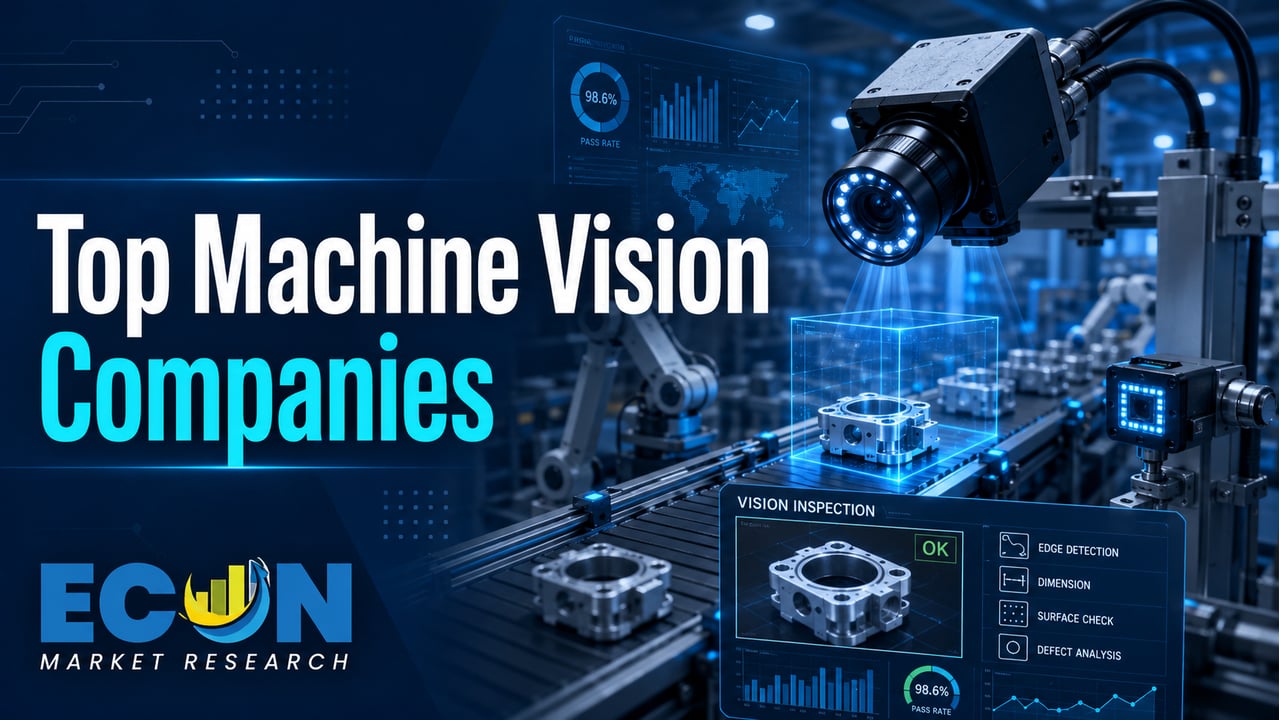
The global machine vision industry has become a core component of automated manufacturing, using cameras, optics, lighting, image sensors, processors, and software to inspect products and guide machines at production speed. Its operational footprint already reaches substantial scale: Cognex reports more than 900,000 vision-system installations, while IDS reports more than 2 million industrial cameras operating worldwide. The wider automation infrastructure supporting vision applications included 4,663,698 industrial robots in operation during 2024, with 542,076 additional robots installed during the year. Machine vision is used for defect detection, measurement, identification, OCR, positioning, robot guidance, traceability, packaging inspection, semiconductor inspection, battery manufacturing, food processing, pharmaceuticals, electronics, automotive production, and logistics.
Industry maturity is also visible in its supplier ecosystem. The VDMA Machine Vision sector group represents more than 120 companies spanning cameras, illumination, software, sensors, optics, interfaces, and complete inspection systems, while the broader VDMA Robotics + Automation organization has more than 415 members. Current industrial cameras range from compact smart sensors to systems exceeding 200 megapixels, and machine-vision interfaces now extend from USB3 and GigE to CoaXPress and 100GigE. Manufacturing industries with particularly strong vision requirements include electronics, which accounted for 24% of global robot installations in 2024, automotive at 23%, and metal and machinery at 16%, illustrating the scale of automated environments where image-based inspection and robot guidance are increasingly integrated.
Market Evolution and Growth Drivers
Machine vision has evolved from rule-based image processing and monochrome cameras into AI-assisted inspection systems capable of learning complex variations in shape, texture, color, reflectivity, and surface condition. Cognex was founded in 1981 and introduced its first industrial vision system in 1982, while KEYENCE has been developing machine-vision technology since the 1980s. Industrial adoption accelerated as CMOS sensors improved resolution and speed and factories deployed faster computing platforms. In 2026, Cognex research involving more than 500 manufacturers, integrators, and OEMs found that 57% of respondents were already using AI within machine-vision operations and another 30% planned near-term deployment, demonstrating how artificial intelligence is moving into routine inspection rather than remaining limited to specialized projects.
Production complexity is another driver. Global manufacturing robot density reached 177 robots per 10,000 manufacturing employees in 2024, while South Korea operated at 1,220, Singapore at 818, China at 567, Germany at 449, and Japan at 446. Higher automation density increases demand for automatic quality verification because faster production lines cannot depend solely on manual inspection. Vision technology is also becoming easier to deploy: OMRON's current FH controllers can connect up to 8 cameras and support AI defect-inspection functions, while smart cameras increasingly combine image acquisition and neural-network processing inside a single enclosure. Standards are evolving simultaneously, with GigE Vision 3.0 officially approved in April 2026 by 57 participating engineers and released in May 2026 to support higher-performance industrial image transmission.
Top 5 Latest Trends in the Machine Vision Industry
The 5 major current trends shaping the machine vision industry are:
AI-Based Defect Detection and Low-Training Inspection
Edge AI and Intelligent Smart Cameras
3D Machine Vision and Robot Guidance
High-Speed, High-Resolution Industrial Imaging
Hyperspectral and Multispectral Inspection
Trend 1: AI-Based Defect Detection and Low-Training Inspection
Artificial intelligence is becoming one of the strongest differentiators among the Top Companies in the Machine Vision Industry because traditional rule-based inspection can struggle when acceptable products naturally vary in appearance. A 2026 global study covering more than 500 manufacturing and automation professionals found that 57% already used AI in machine vision and 30% expected near-term deployment. Cognex launched the beta version of OneVision in June 2025, and more than 100 customers had used the collaborative AI development environment before general availability in May 2026. OMRON's FH platform similarly combines AI and conventional rule-based processing, with current controllers offering up to 32 GB of RAM and support for as many as 8 connected cameras.
Trend 2: Edge AI and Intelligent Smart Cameras
Image analysis is increasingly moving directly onto the camera rather than requiring every frame to travel to a separate industrial PC. Allied Vision launched its Alecs smart-camera platform in November 2025 using an NVIDIA Jetson Orin NX module with 16 GB of memory and an IP67 housing for edge AI processing. IDS had already introduced AI-capable IDS NXT cameras in 2018 and expanded its intelligent imaging portfolio through subsequent generations. Edge processing matters because a production line operating at dozens or hundreds of parts per minute can make inspection decisions locally and send only relevant results to supervisory systems. Removing a separate PC also reduces system footprint and can simplify installations where 1 smart camera performs classification, detection, tracking, or dimensional inspection directly at the machine.
Trend 3: 3D Machine Vision and Robot Guidance
Three-dimensional vision is expanding machine vision beyond surface appearance into depth, shape, volume, pose, and spatial measurement. Cognex currently offers the In-Sight L38 as an AI-enabled 3D vision system, while Zebra expanded its 3D capability by agreeing to acquire Photoneo in 2024 after initially forming an OEM relationship for Photoneo cameras. Industrial 3D systems are increasingly used for bin picking, robotic guidance, depalletizing, assembly verification, weld inspection, package dimensioning, and surface measurement. The transition matters because a conventional 2D image primarily measures intensity across 2 axes, whereas 3D imaging adds depth information that can identify height deviations, object pose, missing material, and geometric defects that may remain invisible under ordinary lighting.
Trend 4: High-Speed, High-Resolution Industrial Imaging
Industrial inspection is demanding substantially higher data throughput as factories inspect larger surfaces and smaller defects at faster line speeds. Allied Vision released industrial 100GigE cameras in July 2026 and a 10GigE high-speed camera capable of Full HD capture at up to 2,517 frames per second with 32 GB of onboard storage. Related portfolio developments included a 245.8-megapixel industrial camera in 2025 and a high-speed model exceeding 200,000 images per second for specialized imaging. GigE Vision 3.0, released in May 2026, added RoCEv2-based remote direct memory access to reduce processing overhead during high-bandwidth image transfer. These developments support semiconductor inspection, electronics, high-speed packaging, scientific imaging, materials testing, and multi-camera systems where conventional Gigabit Ethernet can become a bottleneck.
Trend 5: Hyperspectral and Multispectral Inspection
Machine vision is moving beyond visible RGB imaging into spectral analysis that can distinguish materials based on wavelength response rather than appearance alone. VISION 2026 identifies hyperspectral imaging alongside embedded vision and deep learning as 3 central technology themes for the machine-vision industry. Allied Vision's expanded portfolio included a multispectral allPIXA neo line-scan camera in 2025 with 4k and 6k resolution options, while industrial imaging suppliers increasingly cover visible, infrared, ultraviolet, and short-wave infrared wavelengths. Spectral inspection can help differentiate plastics, detect moisture, identify food composition, inspect agricultural products, examine semiconductor materials, and recognize coatings that look identical to ordinary cameras. This trend increases the role of machine vision in material characterization rather than conventional pass-or-fail surface inspection alone.
Top 10 Companies in the Machine Vision Industry
The following 10 companies are presented based on machine-vision specialization, installed technology, camera and sensor capabilities, software depth, geographic reach, industrial experience, AI development, and inspection applications rather than as a strict ranking.
1. Cognex Corporation
Company Overview: Cognex was founded in 1981 by Dr. Robert Shillman and introduced its first DataMan vision system in 1982. The company's installed base exceeds 900,000 systems, and 37% of its workforce is composed of engineers. Headquarters: Natick, Massachusetts, United States. Core Machine Vision Expertise: Cognex specializes in industrial vision systems, deep-learning inspection, edge learning, barcode reading, OCR, 2D inspection, 3D measurement, and factory traceability. Major Products and Services: Its portfolio includes In-Sight 3800, In-Sight 2800, In-Sight D900, In-Sight L38, DataMan readers, and OneVision AI development tools. OneVision moved to general availability in May 2026 after more than 100 customers participated following its June 2025 beta introduction.
2. KEYENCE Corporation
Company Overview: KEYENCE was founded in May 1974 and employed 12,784 people in its current corporate profile. Its network includes 250 offices in 46 countries and supports approximately 400,000 customers across 110 countries. Headquarters: Osaka, Japan. Core Machine Vision Expertise: KEYENCE integrates cameras, illumination, lenses, image processors, measurement algorithms, AI, laser profiling, code reading, and factory sensors into complete inspection platforms. Major Products and Services: The company's machine-vision portfolio includes CV-X and XG systems, smart vision sensors, 3D vision, line-scan technologies, LumiTrax illumination, and automated measurement equipment. KEYENCE entered machine vision during the 1980s and has subsequently applied imaging to surface inspection, character verification, dimensional measurement, part positioning, electronics inspection, and automated manufacturing quality control.
3. Basler AG
Company Overview: Basler was founded in 1988 and currently employs approximately 820 people across 13 locations. Its portfolio contains roughly 5,000 vision hardware and software products. Headquarters: Ahrensburg, Germany. Core Machine Vision Expertise: Basler develops industrial cameras, embedded-vision hardware, lenses, lighting, frame grabbers, software, and complete computer-vision components for factory automation and OEM systems. Major Products and Services: Its camera families include ace, ace 2, dart, boost, blaze 3D products, and additional embedded and line-scan platforms. Basler entered the digital-camera component business in 1997 after beginning with complete inspection systems, giving the company more than 25 years of industrial-camera specialization. Applications include battery inspection, electronics, logistics, medicine, transportation, semiconductor production, and general factory automation.
4. Teledyne DALSA
Company Overview: Teledyne DALSA was established in 1980 and employs approximately 1,000 people worldwide. It became part of Teledyne Technologies in 2011. Headquarters: Waterloo, Ontario, Canada. Core Machine Vision Expertise: The company develops image sensors, area-scan and line-scan cameras, 3D sensors, frame grabbers, embedded vision systems, imaging software, and semiconductor technologies. Major Products and Services: Its portfolio includes Genie Nano and Linea camera technologies, BOA smart cameras, GEVA vision systems, high-performance CMOS sensors, laser-based 3D profilers, and frame-grabber hardware. Teledyne DALSA imaging extends beyond visible wavelengths into infrared, ultraviolet, and X-ray technologies, supporting semiconductor inspection, electronics, automotive, pharmaceutical packaging, food inspection, nondestructive testing, scientific imaging, and factory automation.
5. Zebra Technologies
Company Overview: Zebra Technologies was founded in 1969 and currently employs approximately 10,700 people across 57 countries, with about 8,000 patents and patent applications worldwide. Headquarters: Lincolnshire, Illinois, United States. Core Machine Vision Expertise: Zebra combines machine vision with industrial scanning, barcode identification, 3D sensing, software development, and logistics automation. Major Products and Services: Zebra expanded its machine-vision position by acquiring Matrox Imaging in June 2022 and subsequently agreed to acquire 3D imaging specialist Photoneo in 2024. Its current portfolio includes Aurora machine-vision software, smart cameras, 3D sensors, fixed industrial scanners, frame-grabber technologies, and CV60 area-scan cameras ranging from 2.3 to 12.3 megapixels. These systems target manufacturing inspection, track-and-trace, recognition, logistics, and robotic automation.
6. SICK AG
Company Overview: SICK was founded in 1946 and has expanded from its early optoelectronic sensing work into a global automation company with more than 10,000 employees and 63 subsidiaries and equity investments. Headquarters: Waldkirch, Germany. Core Machine Vision Expertise: SICK combines 2D and 3D cameras with industrial sensors, identification systems, safety technology, and automation software. Its dedicated machine-vision competence center in Linköping, Sweden, employs approximately 55 specialists. Major Products and Services: The company's vision technologies include Inspector sensors, programmable cameras, 3D vision products, line-scan systems, and industrial inspection solutions. SICK began selling 3D machine vision in Japan in 2010, demonstrating established commercialization of depth-based inspection before the current wave of AI-enhanced 3D systems.
7. OMRON Corporation
Company Overview: OMRON was established in 1933 and employed 26,050 people as of March 31, 2026. Its products and services reach more than 130 countries. Headquarters: Kyoto, Japan. Core Machine Vision Expertise: OMRON integrates image processing with industrial controls, robots, sensors, safety products, motion systems, and manufacturing data. Major Products and Services: The FH Series supports AI defect inspection, AI fine matching, multi-camera processing, and conventional image-processing tools in a common inspection flow. Current FH configurations support up to 8 cameras, while available industrial CMOS cameras reach 20.4 million pixels. High-end FH-5552 controllers use 8 processing cores, 32 GB of RAM, and 128 GB of storage, enabling complex inspection of electronic components, automotive assemblies, adhesive beads, surfaces, packaging, and precision-manufactured parts.
8. Allied Vision Technologies
Company Overview: Allied Vision traces its machine-vision heritage to 1989 and now operates through 16 locations, with regional presence in Germany, Italy, Canada, the United States, Singapore, Japan, and China and distribution coverage exceeding 30 countries. Headquarters: Stadtroda, Germany. Core Machine Vision Expertise: Allied Vision provides area-scan cameras, line-scan cameras, smart cameras, frame grabbers, software, lenses, and high-speed industrial imaging. Major Products and Services: In 2026 the company launched industrial 100GigE cameras and a 10GigE high-speed recording camera reaching 2,517 frames per second at Full HD. Its Alecs smart camera, released in November 2025, combines an Alvium imaging platform with a 16 GB NVIDIA Jetson Orin NX module for edge AI. Its broader portfolio includes more than 1,400 camera models.
9. IDS Imaging Development Systems
Company Overview: IDS was founded in 1997 and has developed from a 2-person operation into an industrial imaging company with more than 320 employees representing 21 nationalities. Its cameras are sold in more than 70 countries, and more than 2 million IDS cameras are currently in use. Headquarters: Obersulm, Germany. Core Machine Vision Expertise: IDS specializes in 2D cameras, 3D stereo imaging, embedded AI cameras, USB and GigE industrial imaging, and monitoring systems. Major Products and Services: The company introduced its first uEye USB camera in 2004, Ensenso 3D stereo cameras in 2013, IDS NXT AI cameras in 2018, uEye Live cameras in 2024, and a new Nion 3D platform in 2025. Its portfolio contains roughly 5,000 products and serves around 11,000 customers.
10. Baumer Group
Company Overview: Baumer was founded in 1952 by Herbert Baumer in Frauenfeld, Switzerland, giving the business more than 70 years of industrial sensing experience. Headquarters: Frauenfeld, Switzerland. Core Machine Vision Expertise: Baumer develops industrial cameras, vision sensors, optical sensors, encoders, measurement technology, and factory-automation components. Major Products and Services: Its machine-vision portfolio includes GigE cameras, industrial image-processing products, integrated camera systems, and standardized GenICam-compatible technologies. The IX camera series integrates autofocus, optics, lighting, and imaging within an IP67 housing, reducing the number of separate components required in a vision station. In February 2026, Baumer strengthened its involvement in the GenICam standard working group through a vice-chair position, supporting interoperability among industrial imaging products.
Regional Outlook
North America
North America combines advanced manufacturing, semiconductor investment, logistics automation, aerospace production, automotive plants, medical-device manufacturing, pharmaceutical packaging, and a strong machine-vision software ecosystem. The United States represented 8.4% of the world's operational industrial robot stock in 2024, providing a substantial automation base for image inspection and robot guidance. Electronics production, battery manufacturing, food processing, warehouses, and automotive plants increasingly use cameras for surface defects, OCR, dimensional measurement, assembly verification, traceability, and robotic positioning. Cognex and Zebra are headquartered in the United States, Teledyne DALSA is headquartered in Canada, and Allied Vision, Basler, SICK, KEYENCE, and other international suppliers maintain North American engineering, sales, or application-support operations.
The region is also influential in standardization. GigE Vision 3.0 was officially released by the Association for Advancing Automation in May 2026 after 57 engineers approved the specification during an April standards meeting. The addition of RDMA-based data transfer is particularly relevant for North American semiconductor, electronics, research, and high-speed industrial inspection systems handling large image streams. AI adoption is similarly advanced: Cognex's 2026 survey of 500+ machine-vision professionals found that 57% already used AI. Canada has strengths in imaging hardware through companies such as Teledyne DALSA, while Mexico's manufacturing base benefits from tightly integrated automotive and electronics supply chains. The main regional challenge is integrating newer AI inspection systems with legacy factory equipment that can remain operational for 20 years or longer.
Europe
Europe maintains one of the most technically developed machine-vision ecosystems, with Germany serving as a major center for industrial cameras, optics, automation, and inspection engineering. The VDMA Machine Vision sector group represents more than 120 companies, while its broader Robotics + Automation association includes more than 415 members. European factories installed 85,000 industrial robots during 2024, providing a sizeable installed automation base requiring inspection, guidance, identification, and measurement technologies. Germany alone maintained robot density of 449 units per 10,000 manufacturing employees. Machine-vision suppliers headquartered in the region include Basler, SICK, IDS, Allied Vision, and additional European industrial-imaging specialists, while Switzerland hosts Baumer and other precision automation companies.
The region is particularly important for machine-vision interoperability and industrial standards. VISION 2026, scheduled for October 6–8, identifies embedded vision, hyperspectral imaging, and deep learning as central technology themes. European specialists are also active in the GenICam standards ecosystem, with Basler and Baumer representatives occupying leadership roles for the 2-year working-group term beginning in 2026. Regulatory requirements are becoming relevant alongside technical performance because the EU Cyber Resilience Act introduces cybersecurity obligations for connected products, while advanced inspection systems increasingly contain embedded software, network interfaces, and AI functionality. Europe's competitive advantage lies in precision engineering and specialized components, while challenges include slower capital investment in some manufacturing economies and the complexity of upgrading decades-old machinery with modern connected vision systems.
Asia-Pacific
Asia-Pacific contains the world's densest concentration of automated manufacturing, creating exceptionally strong demand for machine vision in electronics, semiconductors, displays, batteries, automotive production, precision components, and consumer goods. Asia accounted for 74% of new industrial robot installations in 2024. China installed 295,000 robots and held 43% of the world's operational robot stock, while Japan accounted for 9.7% and South Korea 8.4%. Robot density reached 1,220 units per 10,000 manufacturing employees in South Korea, 818 in Singapore, 567 in China, and 446 in Japan. Every expansion in high-speed automation increases the need for automatic inspection capable of operating at the same production rate as robotics and assembly equipment.
Japan remains important through manufacturers such as KEYENCE and OMRON, whose combined industrial portfolios span machine vision, sensors, robotics, controls, and inspection technologies. KEYENCE operates 250 offices in 46 countries and serves about 400,000 customers worldwide, while OMRON delivers products and services in more than 130 countries. Taiwan, South Korea, China, and Singapore are especially relevant to electronics and semiconductor imaging, where subcomponent inspection and high-resolution surface analysis are required at high production volumes. India is also expanding its automation base; increased electronics, automotive, pharmaceutical, and battery production provides new opportunities for machine vision. Regional supply-chain advantages include sensor manufacturing, electronics assembly, optics, and semiconductor production, although competitive pricing and rapidly changing technical requirements place pressure on suppliers to shorten product-development cycles.
Middle East & Africa
Machine-vision adoption in the Middle East is developing alongside manufacturing diversification, food processing, logistics, pharmaceuticals, packaging, metals, and smart-factory initiatives. Saudi Arabia's industrial transformation agenda includes a target to modernize 4,000 factories, while the UAE's Transform 4.0 program is structured to support 100 high-potential manufacturers over a 3-to-5-year transformation cycle. Automated inspection can contribute to these programs because vision systems provide non-contact quality control without requiring a proportionate increase in inspection labor. Applications include package verification, label inspection, barcode traceability, dimensional measurement, robotic guidance, food sorting, bottle inspection, surface analysis, and automated warehouse identification. Global suppliers such as KEYENCE already operate through networks covering 46 countries, while SICK maintains regional subsidiaries and support resources extending into Middle Eastern markets.
Africa presents a more varied adoption environment across automotive assembly, mining, food and beverage production, pharmaceuticals, agriculture, packaging, and export-oriented manufacturing. Machine vision can be particularly valuable in facilities operating 24-hour production schedules because automated inspection maintains repeatable criteria across shifts. Spectral imaging also creates opportunities for agriculture and food quality, while 3D cameras can support logistics and robotic material handling. The challenge is infrastructure: reliable lighting, stable industrial networks, clean optics, skilled system integrators, and controlled production environments are necessary for high-accuracy imaging. Smart cameras reduce some complexity because processing can be performed within 1 enclosure rather than through a separate PC, while IP67 systems such as Baumer's IX series provide additional protection for demanding production areas.
Future Opportunities in the Machine Vision Industry
Artificial intelligence will remain one of the strongest future opportunities because current adoption still leaves substantial room for expansion. The 2026 Cognex survey found 57% of respondents already using AI and 30% planning near-term adoption, implying that almost 9 in 10 surveyed organizations were either using or preparing to use the technology. Future inspection systems are likely to combine traditional geometric measurement with neural-network defect detection rather than replacing rule-based algorithms entirely. OMRON already allows AI processing and deterministic tools to exist inside the same inspection flow, while platforms such as OneVision aim to make AI models easier to deploy across multiple manufacturing sites. This hybrid architecture can improve explainability because a neural model may detect an abnormal region while conventional measurement tools quantify its dimensions or position.
Edge processing and higher-speed communications provide another major opportunity. Allied Vision's 2025 Alecs platform combines image acquisition with a 16 GB AI computing module, while the release of GigE Vision 3.0 in 2026 introduces technology capable of supporting substantially higher network performance. Industrial 100GigE cameras have already reached commercial release, demonstrating that future machine-vision systems will handle much larger data streams than traditional Gigabit-camera installations. These technologies can support multi-camera inspection, semiconductor metrology, high-speed materials analysis, robotic perception, and physical AI. At the opposite end of the architecture, compact smart cameras can make advanced inspection practical for SMEs because 1 device can perform capture, processing, communication, and pass-fail decision functions locally.
Spectral imaging and 3D perception will also expand the number of measurable product characteristics. Current industrial portfolios already include cameras operating from ultraviolet through visible wavelengths into SWIR and X-ray imaging, while multispectral line-scan systems are available at resolutions of 4k and 6k. Future food, recycling, pharmaceutical, battery, electronics, semiconductor, and materials applications can therefore inspect chemical or structural characteristics rather than surface color alone. Integration with robots adds another layer: the 4.664 million industrial robots operating globally in 2024 represent a massive installed base that can benefit from improved visual guidance. As AI-based robots become less dependent on fixed fixtures, reliable perception will become increasingly important for recognizing, locating, inspecting, and manipulating variable physical objects.
Conclusion
The machine vision industry has evolved into a foundational technology for modern automated production, supported by more than 900,000 Cognex installations, more than 2 million IDS cameras, and an industrial automation environment containing 4.664 million operational robots in 2024. The 5 major trends—AI inspection, edge intelligence, 3D vision, high-speed imaging, and spectral inspection—are expanding what cameras can measure and how quickly inspection decisions can be made. The Top Companies in the Machine Vision Industry examined here represent different parts of that ecosystem, ranging from complete AI vision systems and smart cameras to high-resolution imaging hardware, sensors, 3D technology, software libraries, industrial networking, and factory-integration platforms.
Regional manufacturing structures will continue to shape adoption. Asia accounted for 74% of global industrial robot installations in 2024, Europe installed 85,000 units, and major North American production networks continue expanding AI-based visual inspection. At the technology level, 2026 has already produced GigE Vision 3.0, commercial 100GigE industrial cameras, wider edge-AI processing, and stronger interest in hyperspectral imaging. Future competitiveness will depend on more than camera resolution alone: successful machine-vision suppliers will need to combine image quality, AI accuracy, optics, lighting, 3D perception, interoperability, cybersecurity, edge computing, and application expertise. These capabilities will determine how effectively machine vision supports increasingly autonomous factories during the remainder of the 2020s.