

Industrial Metaverse Companies Redefining Digital Manufacturing in 2026
The industrial metaverse industry features 10 key companies advancing digital twins, physical AI, spatial computing, simulation, and smart factories.
Introduction
Overview of the Global Industrial Metaverse Industry
The industrial metaverse is developing as a connected environment where digital twins, real-time 3D visualization, artificial intelligence, simulation, industrial IoT, robotics, extended reality, and cloud-edge computing represent and interact with physical operations. Industrial adoption differs from consumer metaverse applications because factories, warehouses, infrastructure assets, energy systems, and engineering programs require measurable physical accuracy. The surrounding automation base is already substantial: 542,000 industrial robots were installed globally in 2024, while the worldwide operational stock reached 4.664 million units. Asia accounted for 74% of new installations, Europe for 16%, and the Americas for 9%, creating millions of physical machines that can increasingly be represented inside simulation-ready digital environments.
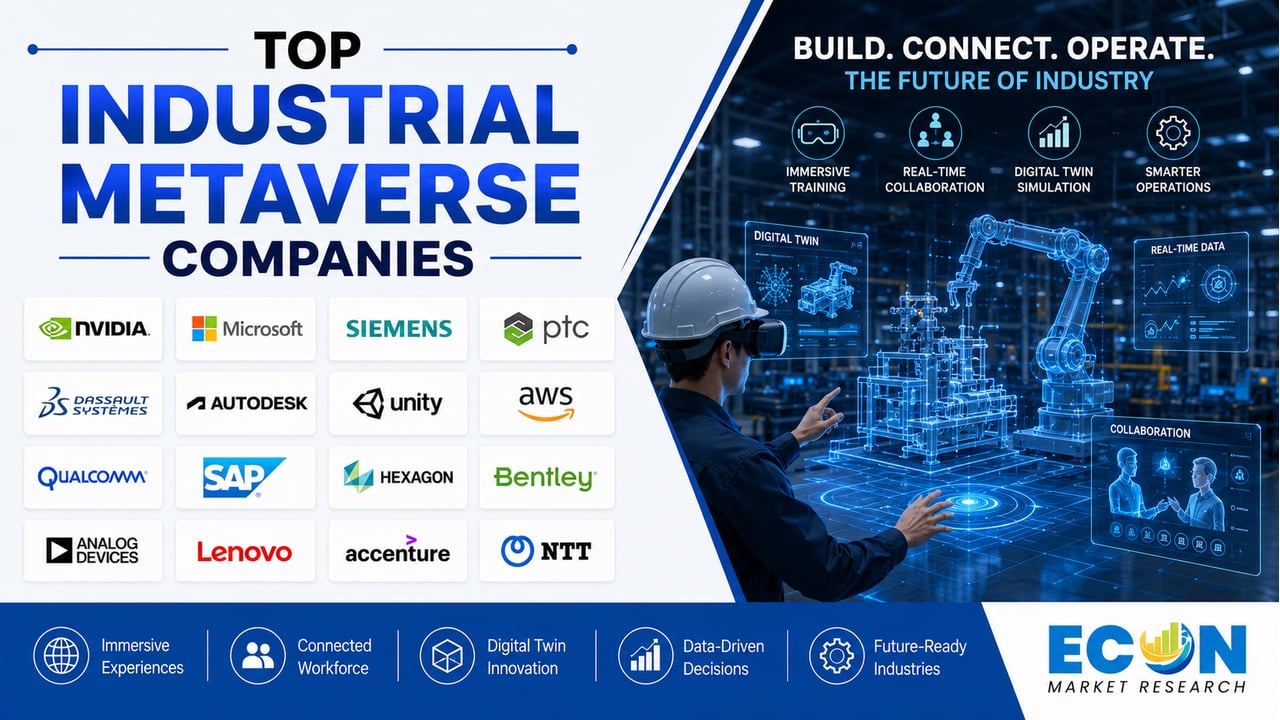
Current implementations are moving beyond individual-machine twins toward virtual replicas of complete facilities and production ecosystems. NVIDIA reported in 2025 that manufacturers including Belden, Caterpillar, Foxconn, Lucid Motors, Toyota, TSMC, and Wistron were building factory digital twins with Omniverse technologies. Siemens introduced Digital Twin Composer at CES 2026 to create industrial-metaverse environments that combine engineering models, simulation, operational information, and photorealistic visualization. The technology is being applied across automotive, electronics, semiconductors, consumer goods, logistics, energy, construction, aerospace, robotics, and data-center infrastructure, indicating that the industry is increasingly defined by interoperable platforms rather than isolated virtual-reality applications.
Market Evolution and Growth Drivers
The industrial metaverse evolved from technologies developed separately over several decades, including computer-aided design, simulation, digital manufacturing, industrial control systems, 3D visualization, IoT, and augmented reality. A major integration milestone occurred in 2022, when Siemens and NVIDIA announced plans to connect Siemens Xcelerator with NVIDIA Omniverse to create physics-based, real-time industrial digital environments. By 2026, Siemens Digital Twin Composer was combining 3D product, process, and plant models with NVIDIA visualization and simulation capabilities. This evolution matters because industrial organizations can now move from static engineering representations toward digital environments that update as products, layouts, weather conditions, operating parameters, and production configurations change.
Automation, artificial intelligence, sustainability, workforce training, and faster product development are accelerating adoption. Hexagon reported in 2025 that 49% of organizations using digital twins experienced improved efficiency, while 45% identified improved reliability and 47% reported reduced costs. AI adoption is expanding simultaneously: 19.95% of EU enterprises used at least 1 AI technology in 2025. The industrial metaverse allows these technologies to converge inside environments where engineers can test robot movements, production layouts, energy behavior, maintenance strategies, or design changes before implementation. This virtual-first approach can reduce physical experimentation while improving collaboration among engineering, operations, maintenance, automation, and supply-chain teams.
Top 5 Latest Trends in the Industrial Metaverse Industry
AI-Powered Industrial Digital Twins
Physical AI and Robotics Simulation
OpenUSD and Cross-Platform Interoperability
Spatial Computing and Immersive Industrial Workflows
Factory-Scale Simulation and Virtual Commissioning
Trend 1: AI-Powered Industrial Digital Twins
Artificial intelligence is transforming digital twins from visualization environments into systems capable of analyzing conditions, interpreting industrial data, generating scenarios, and supporting operational decisions. Siemens introduced Digital Twin Composer in January 2026, allowing industrial organizations to create virtual 3D representations of products, processes, or complete plants and examine how changes affect them over time. The platform integrates NVIDIA Omniverse technologies with Siemens' industrial engineering data. Hexagon's 2025 digital-twin analysis found measurable benefits among adopters, including 49% reporting better efficiency and 45% reporting higher reliability. AI-enhanced twins increasingly combine real-time operational data, predictive models, computer vision, generative AI, and simulation, allowing manufacturers to evaluate changes before disrupting physical production.
Trend 2: Physical AI and Robotics Simulation
Physical AI is becoming closely connected with the industrial metaverse because autonomous robots need accurate virtual environments in which to learn, test, and validate behavior. Global factories already operated 4.664 million industrial robots in 2024, creating a large addressable environment for simulation technology. NVIDIA's Omniverse supports robotics simulation, synthetic-data generation, sensor modeling, and factory-scale digital twins, while its Mega blueprint is designed for simulating physical-AI systems before real-world deployment. Rockwell Automation has integrated NVIDIA Omniverse APIs with Emulate3D to support high-fidelity production-system twins and autonomous mobile robot development. Manufacturers can therefore simulate collision avoidance, robot reach, traffic patterns, sensor behavior, and automated workflows before installing equipment on a live factory floor.
Trend 3: OpenUSD and Cross-Platform Interoperability
Interoperability is becoming essential because an industrial metaverse may combine CAD files, factory layouts, robot models, machine data, simulation results, scanned environments, and operational information from dozens of engineering systems. OpenUSD has emerged as an important framework for assembling complex 3D environments without forcing every contributor to work inside one proprietary application. Rockwell's Emulate3D Factory Test demonstrated integration with NVIDIA Omniverse and OpenUSD in 2025, while Siemens and NVIDIA continue using interoperable 3D architecture to connect engineering twins with real-time visualization. Hexagon identifies interoperability as 1 of 4 core industrial-metaverse building blocks, alongside real-time collaboration, reality capture, and data fabric. Open architectures matter because excluding a major data source can reduce the fidelity and usefulness of an enterprise-scale twin.
Trend 4: Spatial Computing and Immersive Industrial Workflows
Spatial computing is expanding industrial-metaverse use beyond engineering desktops by allowing workers to interact with digital information in a physical environment. Dassault Systèmes introduced its 3DEXPERIENCE Sense Experience capabilities in 2026, combining spatial computing, AI-driven augmented reality, and virtual-twin interaction. Unity continues developing real-time 3D technologies for manufacturing, energy, healthcare, defense, and simulation applications, with a global community that includes over 1.3 million monthly active Unity Editor users. Industrial applications include virtual design reviews, immersive maintenance instructions, safety training, remote assistance, operator education, and collaborative engineering. Unlike consumer VR, factory spatial computing must preserve scale, geometry, equipment context, and work instructions accurately enough to support real operational decisions.
Trend 5: Factory-Scale Simulation and Virtual Commissioning
Virtual commissioning is moving from individual production cells toward complete factories and logistics facilities. Rockwell Automation unveiled Emulate3D Factory Test in 2025 to support virtual control testing at factory scale, while Siemens has used comprehensive twins to model interactions between robots, automated guided vehicles, and human workers in battery-production environments. PepsiCo's collaboration with Siemens and NVIDIA announced in 2026 creates high-fidelity digital representations of factories and warehouses containing machines, conveyors, pallet flows, and operator movements. Factory-scale simulation can identify bottlenecks, control conflicts, material-flow problems, or layout errors before physical changes are implemented, making the industrial metaverse increasingly relevant to brownfield modernization as well as greenfield construction.
Top 10 Companies in the Industrial Metaverse Industry
The following 10 companies are not presented as a strict ranking. They are selected according to industrial-metaverse product capability, digital-twin technology, industrial software expertise, real-time 3D functionality, automation integration, geographic presence, ecosystem development, and active deployments.
1. Siemens AG
Company Overview: Siemens traces its history to 1847 and employed approximately 318,000 people as of September 30, 2025. Headquarters: Berlin and Munich, Germany. Core Industrial Metaverse Expertise: Siemens combines industrial automation, product lifecycle management, simulation, digital manufacturing, IoT, AI, and comprehensive digital twins through Siemens Xcelerator. Major Products and Services: Siemens and NVIDIA began their industrial-metaverse collaboration in 2022, connecting Xcelerator with Omniverse. Digital Twin Composer, unveiled in January 2026, creates interactive 3D environments for products, factories, warehouses, and processes. Siemens is also working with PepsiCo and Foxconn-related projects where digital twins model facility equipment, automation systems, material flow, and operating conditions before physical changes are executed.
2. NVIDIA Corporation
Company Overview: NVIDIA was founded by 3 engineers in 1993 and introduced the GPU in 1999. Headquarters: Santa Clara, California, United States. Core Industrial Metaverse Expertise: NVIDIA provides accelerated computing, real-time rendering, physical-AI simulation, synthetic-data generation, robotics frameworks, and industrial digital-twin development tools. Major Products and Services: NVIDIA Omniverse is a collection of libraries and microservices for building simulation-ready industrial environments. Its technologies are used for factory twins, robotics simulation, sensor simulation, autonomous-system development, and AI-factory design. By 2025, companies including Caterpillar, Foxconn, Toyota, TSMC, Lucid Motors, Belden, and Wistron were using Omniverse-based factory digital-twin workflows, illustrating direct adoption across manufacturing and technology sectors.
3. Dassault Systèmes
Company Overview: Dassault Systèmes employs approximately 25,000 people, operates 184 sites, and serves over 370,000 customers across 12 industries. Headquarters: Vélizy-Villacoublay, France. Core Industrial Metaverse Expertise: The company develops virtual-twin environments connecting product design, manufacturing simulation, scientific modeling, lifecycle management, and collaborative engineering. Major Products and Services: 3DEXPERIENCE, CATIA, DELMIA, SIMULIA, and newer 3D UNIV+RSES capabilities create continuous virtual representations covering products, factories, and enterprise systems. Dassault also introduced Sense Experience in 2026, adding spatial computing and AI-enhanced augmented reality to virtual-twin interaction. The company's global footprint includes active customers across 159 countries, supporting industrial-metaverse deployments across aerospace, automotive, industrial equipment, healthcare, and manufacturing.
4. Microsoft Corporation
Company Overview: Microsoft was founded in 1975 and employed 223,000 people worldwide as of June 30, 2026, including 102,000 outside the United States. Headquarters: Redmond, Washington, United States. Core Industrial Metaverse Expertise: Microsoft provides Azure cloud infrastructure, AI services, IoT, digital-twin technology, enterprise collaboration, and mixed-reality tools used to connect physical and virtual industrial systems. Major Products and Services: Azure Digital Twins supports modeling of connected physical environments, while Microsoft's industrial partnerships include Siemens, Rockwell Automation, Hexagon, and manufacturing-software providers. Azure also provides the cloud foundation for Hexagon's Nexus industrial platform. Microsoft's role is particularly relevant to the data, identity, AI, security, and cloud layers required when industrial-metaverse environments operate across geographically distributed facilities.
5. PTC Inc.
Company Overview: PTC was founded in 1985 and currently employs over 7,000 people while supporting more than 30,000 customers globally. Headquarters: Boston, Massachusetts, United States. Core Industrial Metaverse Expertise: PTC connects product lifecycle management, IoT, computer-aided design, service information, augmented reality, and digital-thread technologies for industrial companies. Major Products and Services: Creo supports product engineering, Windchill manages lifecycle data, ThingWorx connects industrial information, and Vuforia provides augmented-reality workflows for frontline workers. This combination allows manufacturers to connect physical equipment with digital product definitions and immersive instructions. PTC's industrial customer base gives it a practical role in environments where the industrial metaverse is used for engineering, manufacturing, service, remote assistance, training, and lifecycle collaboration.
6. Schneider Electric
Company Overview: Schneider Electric has operated for roughly 190 years and reported more than 168,000 employees in its 2023 corporate documentation. Headquarters: Rueil-Malmaison, France, within a global multi-hub structure. Core Industrial Metaverse Expertise: Schneider combines industrial automation, energy-management systems, digital twins, industrial data, process simulation, and connected operations, strengthened by its ownership of AVEVA. Major Products and Services: AVEVA provides engineering, simulation, operations control, industrial intelligence, and lifecycle digital-twin technology. Schneider has described the industrial metaverse as a convergence of industrial and energy twins, while AVEVA announced a new NVIDIA-supported lifecycle digital-twin architecture for gigawatt-scale AI factories in 2026. The combined portfolio supports industrial projects from design through continuous operations.
7. Hexagon AB
Company Overview: Hexagon was established in 1992 and employed approximately 24,500 people across 50 countries at the end of 2025. Headquarters: Stockholm, Sweden. Core Industrial Metaverse Expertise: Hexagon specializes in reality capture, metrology, geospatial sensing, digital twins, robotics, industrial software, autonomous technologies, and connected manufacturing data. Major Products and Services: Nexus provides an open digital industrial platform for manufacturers, while Hexagon's scanners, measurement systems, and software capture the physical world and connect it to simulation environments. In 2023, Hexagon partnered with NVIDIA to connect reality-capture technologies with Omniverse. Its industrial-metaverse framework identifies 4 core requirements: real-time collaboration, reality capture, data fabric, and interoperability.
8. Autodesk, Inc.
Company Overview: Autodesk was founded in 1982, is headquartered in San Francisco, California, and employed approximately 14,300 people worldwide as of January 31, 2026. Core Industrial Metaverse Expertise: Autodesk develops cloud-based design, manufacturing, construction, simulation, visualization, and digital-twin technologies used throughout the design-and-make lifecycle. Major Products and Services: Autodesk Tandem converts building and asset information into operational digital twins, while Fusion combines design and manufacturing workflows. Autodesk Workshop XR extends immersive design review, and FlexSim contributes factory and logistics simulation. The company's 2025 manufacturing training also demonstrated connections between FlexSim, Fusion Manage, and Fusion Operations, allowing organizations to model capacity and detect potential production problems before they emerge physically.
9. Unity Software Inc.
Company Overview: Unity originated in Denmark in 2004 and maintains principal corporate offices in San Francisco, California. Its platform operates through more than 45 global locations and serves over 1.3 million monthly active Unity Editor users. Core Industrial Metaverse Expertise: Unity provides real-time 3D development technology for immersive simulation, visualization, augmented reality, virtual reality, digital twins, and interactive industrial applications. Major Products and Services: Unity Industry enables organizations in manufacturing, energy, defense, healthcare, and engineering to build interactive 3D experiences. In 2026, Unity continued positioning XR, AI, and digital twins as enterprise technologies moving from pilots toward operational deployment. Its extensive real-time 3D ecosystem is particularly useful when industrial twins require customized interactive interfaces rather than conventional engineering visualization alone.
10. Rockwell Automation, Inc.
Company Overview: Rockwell Automation continues the industrial-automation business established in 1903 and employs approximately 28,000 people in more than 100 countries. Headquarters: Milwaukee, Wisconsin, United States. Core Industrial Metaverse Expertise: Rockwell combines controllers, industrial software, robotics, digital twins, manufacturing execution, and virtual commissioning. Major Products and Services: Emulate3D creates virtual models of automation systems, and its integration with NVIDIA Omniverse adds real-time collaboration, high-fidelity visualization, and OpenUSD interoperability. Rockwell unveiled Emulate3D Factory Test in 2025 for enterprise-scale virtual control testing before equipment deployment. The company also works with NVIDIA on autonomous mobile robotics, connecting physical AI with simulated factory environments.
Regional Outlook
North America
North America has a strong industrial-metaverse foundation because it combines cloud computing, GPUs, real-time 3D software, industrial automation, aerospace engineering, automotive manufacturing, and large-scale data-center infrastructure. The United States installed 34,200 industrial robots in 2024, accounting for 68% of deployments across the Americas, while Canada installed 3,800 and Mexico installed 5,600. NVIDIA, Microsoft, PTC, Autodesk, Unity, and Rockwell Automation all maintain headquarters in the United States, creating a dense technology ecosystem for simulation, AI, digital twins, XR, and virtual commissioning. Mexico's automotive sector represented 63% of its robot installations, making factory twins particularly relevant to automotive assembly and supply-chain modernization.
North American adoption is moving from visualization toward operational simulation and physical AI. Rockwell's Emulate3D Factory Test was demonstrated in 2025, while NVIDIA customers use factory twins to prepare robots and automation systems before physical deployment. Canada contributes AI research, manufacturing, mining, and energy applications, while the United States provides major cloud and computing infrastructure. The region's principal challenges include cybersecurity, integration between legacy OT and new cloud systems, and maintaining accurate virtual models after facilities change. As autonomous manufacturing expands, industrial metaverse platforms will need to synchronize data from millions of sensors, controls, machines, and robots without compromising operational reliability.
Europe
Europe has a strong position in industrial-metaverse engineering because it hosts Siemens, Dassault Systèmes, Schneider Electric, Hexagon, and major automotive, aerospace, machinery, chemical, and energy manufacturers. European factories installed 85,000 industrial robots during 2024, including 26,982 in Germany, 8,783 in Italy, 5,100 in Spain, and 4,900 in France. The region also has a substantial digital adoption base: 19.95% of EU enterprises used AI technologies in 2025, creating favorable conditions for AI-enhanced digital twins. Germany's combination of automation and engineering software makes it particularly important, while France contributes virtual-twin and industrial-energy platforms and Sweden contributes reality-capture and digital-reality technologies.
Regulation will influence how European industrial-metaverse platforms incorporate AI. The EU began enforcing additional AI Act provisions and transparency requirements on 2 August 2026, while specified high-risk AI rules apply from 2 December 2027 and rules for AI embedded in certain regulated physical products apply from 2 August 2028. Industrial-metaverse systems used only for visualization are not automatically classified as high risk, but platforms connected to machinery, critical infrastructure, safety decisions, or automated processes may require stronger traceability, documentation, cybersecurity, and human oversight. European suppliers therefore have an opportunity to differentiate through engineering validation and governance as digital twins become increasingly autonomous.
Asia-Pacific
Asia-Pacific contains the world's largest manufacturing automation base, making it a critical region for industrial-metaverse deployment. Asia represented 74% of global industrial robot installations in 2024. China installed 295,000 robots and operated more than 2 million units, while Japan installed 44,500 and South Korea installed 30,600. India's installations reached 9,100 units, with automotive manufacturing accounting for 45%. These factory networks create opportunities for digital twins, robot simulation, virtual commissioning, logistics modeling, and AI-enabled operational environments. NVIDIA, Siemens, Dassault Systèmes, Microsoft, Hexagon, and other global platforms maintain significant activities throughout China, Japan, India, Singapore, South Korea, and Southeast Asia.
Government programs are also explicitly connecting digital twins with manufacturing. Shanghai's 2025 AI + Manufacturing plan called for promoting the industrial metaverse through digital replicas of factories, warehouses, and laboratories, supporting layout optimization and autonomous logistics. Japan's advanced industrial and robotics ecosystem provides additional applications for simulation, while Singapore and Taiwan offer high-density semiconductor and electronics environments. The regional opportunity is particularly strong where high capital intensity makes physical trial-and-error costly. However, data-sovereignty requirements, cybersecurity, local cloud architectures, and interoperability between domestic and international industrial systems can influence how industrial-metaverse platforms are deployed across national boundaries.
Middle East & Africa
The Middle East is developing industrial-metaverse capabilities alongside smart-city programs, industrial diversification, energy digitalization, construction, logistics, and advanced infrastructure. Dubai's Metaverse Strategy targets support for more than 40,000 virtual jobs by 2030, demonstrating public-sector interest in immersive digital technologies. Across the 6 GCC countries, industrial digital twins can support oil and gas facilities, power systems, desalination plants, airports, logistics centers, construction projects, and emerging manufacturing clusters. Schneider Electric and AVEVA already provide lifecycle digital-twin technology for asset-intensive industries, creating a practical connection between metaverse concepts and operating infrastructure rather than limiting adoption to consumer virtual worlds.
Africa offers a more selective deployment environment, with South Africa, Egypt, Kenya, and Nigeria acting as important digital and industrial centers. Nigeria LNG has implemented an AVEVA-supported digital twin around a production organization with 22 million tonnes of annual LNG capacity, illustrating how large industrial assets can create value from connected virtual representations. Regional barriers include skills availability, connectivity, cloud infrastructure, cybersecurity capability, and the cost of capturing and maintaining accurate industrial data. These conditions make targeted digital twins—such as a plant, mine, grid, or logistics facility—more practical near-term deployments than fully interconnected enterprise metaverses across every African market.
Future Opportunities in the Industrial Metaverse Industry
The strongest future opportunity involves combining industrial digital twins with physical AI. Global factories already operated 4.664 million industrial robots in 2024, while NVIDIA, Siemens, Rockwell Automation, and Hexagon are building technologies that allow robotic systems to be simulated before deployment. Analytical expectations favor digital twins becoming persistent training and validation environments for autonomous machines rather than being used only during initial factory design. Robots, autonomous vehicles, sensors, and AI agents can be tested against thousands of virtual scenarios before changes reach live production. This approach could improve safety and reduce commissioning risk, particularly in factories where stopping production for experimental robot programming would be operationally expensive.
A second opportunity is enterprise-scale interoperability. Hexagon identifies 4 technological building blocks—real-time collaboration, reality capture, data fabric, and interoperability—that must work together for an industrial metaverse to become practical. OpenUSD, cloud APIs, industrial data platforms, and standardized semantic models can make it possible to connect equipment models from different manufacturers without rebuilding the same digital environment repeatedly. Siemens and NVIDIA's work since 2022, Rockwell's OpenUSD-enabled Emulate3D development, and Hexagon's digital-reality architecture illustrate this direction. SMEs could eventually benefit from modular platforms where existing CAD, IoT, and automation data can be assembled gradually rather than requiring a complete digital-transformation program on day 1.
Spatial computing and AI assistants provide another opportunity for workforce development. Manufacturing companies face the challenge of transferring specialized knowledge across employees, sites, and generations, while Unity operates a global real-time 3D ecosystem with more than 1.3 million monthly active editor users. Future industrial-metaverse applications can combine immersive training with AI guidance, contextual maintenance instructions, virtual equipment walkthroughs, and remote collaboration. Verified regulatory deadlines such as the EU's 2 August 2028 date for specified AI embedded in regulated physical products will also encourage vendors to build traceability, governance, cybersecurity, and validation directly into these platforms. The commercial advantage will increasingly come from trustworthy industrial intelligence rather than visual realism alone.
Conclusion
The Industrial Metaverse industry is progressing from a conceptual collection of technologies into operational environments used for engineering, manufacturing, robotics, facility design, training, asset management, and industrial AI. The physical automation foundation is already substantial, with 542,000 industrial robots installed during 2024 and 4.664 million operating worldwide. The 5 major trends—AI-powered digital twins, physical-AI simulation, OpenUSD interoperability, spatial computing, and factory-scale virtual commissioning—show that industrial metaverse platforms are becoming more connected to measurable production outcomes. Digital twins are increasingly expected to reflect actual geometry, processes, machine behavior, and live operating data rather than act only as visually realistic 3D scenes.
The Top Companies in the Industrial Metaverse Industry represent complementary layers of this ecosystem. Siemens and Rockwell Automation connect virtual environments directly with automation; NVIDIA provides accelerated simulation and physical-AI infrastructure; Dassault Systèmes and Autodesk supply engineering and lifecycle models; Microsoft provides cloud, AI, and connected-data services; PTC combines product data, IoT, and AR; Schneider Electric integrates operational and energy twins; Hexagon captures physical reality; and Unity provides real-time interactive 3D technology. With AI adoption reaching 19.95% of EU enterprises in 2025 and Asia accounting for 74% of new industrial robot installations in 2024, the next stage of competition will center on interoperability, accuracy, simulation, cybersecurity, regulatory compliance, and the ability to connect virtual decisions with safe real-world industrial execution.