


Top Industrial Digital Twin Companies Transforming Global Manufacturing in 2026
The top Industrial Digital Twin companies are advancing AI, simulation, automation, virtual commissioning, and smart manufacturing across global industries.
Introduction
Overview of the Global Industrial Digital Twin Industry
The global Industrial Digital Twin industry has moved from isolated engineering simulation toward connected representations of machines, production lines, factories, utilities, and industrial infrastructure. This shift is occurring alongside a manufacturing base that operated 4,664,000 industrial robots in 2024, up 9% from the previous year. Manufacturers installed 542,000 new industrial robots during 2024, while annual installations remained above 500,000 units for the fourth consecutive year. Digital twins increasingly connect these automated assets with sensor streams, control systems, engineering models, maintenance records, production schedules, and AI analytics, giving operators a synchronized representation of industrial conditions rather than a static 3D model.
Industrial Digital Twin deployment is particularly relevant in automotive production, electronics, machinery, energy, chemicals, mining, aerospace, logistics, buildings, and process industries. Asia accounted for 74% of new industrial robot deployments in 2024, compared with 16% in Europe and 9% in the Americas, illustrating the geographic concentration of automation infrastructure that can feed factory digital twins. Cloud platforms are also expanding the accessible data layer: AWS reported that hundreds of millions of devices were connecting to its IoT services daily by the end of 2025. Industrial Digital Twin systems now range from individual pumps and machining centers to factory-scale models integrating thousands of physical and digital components.
Market Evolution and Growth Drivers
Industrial Digital Twin technology has evolved through several technical generations. Computer-aided design established digital product representations decades ago, while Industrial IoT, cloud computing, machine learning, physics simulation, knowledge graphs, and real-time visualization added continuous synchronization. AWS introduced IoT TwinMaker in preview during 2021 and made the service generally available in April 2022, enabling operational twins to combine equipment models, sensor data, video, enterprise information, and 3D scenes. Siemens has used its comprehensive digital twin approach since 2017, linking product, production, and performance twins through industrial software and automation environments.
Automation intensity is another major adoption driver. The 542,000 industrial robots installed globally in 2024 represented more than double the 221,000 units installed 10 years earlier. Manufacturers are therefore managing a much larger population of programmable equipment whose behavior can be simulated before physical changes are made. At the same time, standards remain a limiting factor: NIST identified interoperability, common vocabulary, verification, validation, trustworthiness, and uncertainty quantification as core requirements for scalable manufacturing digital twins. Its Digital Twin Laboratory, described in 2025, specifically targets broader implementation by smaller manufacturers that lack the engineering resources of global industrial groups.
Top 5 Latest Trends in the Industrial Digital Twin Industry
The 5 most important current trends shaping the Industrial Digital Twin industry are:
AI and Physical AI Integration
Factory-Scale Digital Twins for Robotics and Virtual Commissioning
Real-Time ET, OT, and IT Data Convergence
Open Standards, Ontologies, and Interoperability
Cloud, Edge, and Composable Digital Twin Architectures
Trend 1: AI and Physical AI Integration
Artificial intelligence has become increasingly embedded inside industrial twins rather than operating as a separate analytics layer. In March 2025, NVIDIA announced Omniverse integrations involving industrial software and automation participants including Siemens, Schneider Electric, SAP, Hexagon-linked workflows, and other technology providers, while manufacturers including General Motors, Hyundai Motor Group, Mercedes-Benz, Foxconn, Pegatron, and Schaeffler were identified as industrial adopters. AI-enabled digital twins can use synthetic data, anomaly detection, generative engineering assistance, and physics-aware simulation to predict behavior before a change reaches the factory. By January 2026, AVEVA had also introduced a new generation of AI tools for Unified Engineering, including industrial AI, generative design assistance, predictive design functionality, and intelligent point-cloud capabilities.
Trend 2: Factory-Scale Digital Twins for Robotics and Virtual Commissioning
The Industrial Digital Twin industry is expanding from individual machine models to complete virtual factories. NVIDIA reported in 2025 that manufacturers including Toyota, TSMC, Caterpillar, Foxconn, Lucid Motors, Belden, and Wistron were using Omniverse technologies for factory digital twins. Rockwell Automation has similarly extended Emulate3D toward factory-scale virtual controls testing through Emulate3D Factory Test, integrating NVIDIA Omniverse APIs and OpenUSD. Virtual commissioning is commercially important because software logic, material movement, robotic sequences, and failure conditions can be tested before physical production starts. In one documented Rockwell Automation application, Emulate3D reduced installation and commissioning time by up to 50%, illustrating why virtual commissioning is moving from specialized projects toward standard automation engineering workflows.
Trend 3: Real-Time ET, OT, and IT Data Convergence
Engineering technology, operational technology, and enterprise IT are increasingly being connected through a common industrial data model. AVEVA's Industrial Digital Twin approach combines engineering information, process models, real-time operational data, analytics, and visualization, while its CONNECT platform is designed to unify these traditionally separate domains. A 2025 survey covering 400 C-suite executives in manufacturing, power, oil and gas, and chemicals identified data connectivity, outdated information, manual processes, and limited operational visibility as continuing industrial problems. The strategic change is that a modern twin must remain synchronized after commissioning instead of becoming an archived engineering model. That requirement makes historians, MES platforms, SCADA environments, maintenance systems, sensor networks, and engineering databases part of the same lifecycle architecture.
Trend 4: Open Standards, Ontologies, and Interoperability
Interoperability is becoming a competitive requirement because industrial facilities typically combine equipment and software from dozens of suppliers. Microsoft Azure Digital Twins supports Digital Twin Definition Language versions 2 and 3, with version 3 recommended for expanded modeling capabilities such as arrays and increased inheritance limits. DTDL uses JSON-LD and can describe properties, components, and relationships across interconnected assets. Manufacturing standards work is also advancing around frameworks such as ISO 23247, while NIST is developing reference architectures and verification, validation, and uncertainty-quantification methods for manufacturing twins. The trend reduces dependence on one-off integration projects and makes it easier for engineering models, IoT data, simulations, and operational systems to exchange contextual information throughout the asset lifecycle.
Trend 5: Cloud, Edge, and Composable Digital Twin Architectures
Industrial Digital Twin deployments are increasingly designed as modular systems that can run across cloud, plant, and edge environments. AWS IoT TwinMaker supports knowledge graphs, connectors, 3D scene composition, and integration with operational information without requiring every data source to be moved into one repository. AWS infrastructure was operating 36 Regions and 114 Availability Zones by March 2025, creating geographic options for industrial organizations managing latency, resilience, and data-location requirements. Composable architectures are especially relevant for brownfield plants because manufacturers can connect existing historians, IoT platforms, databases, cameras, CAD models, and analytics incrementally rather than replacing an entire technology stack. This approach also lowers the technical barrier for smaller manufacturers entering the Industrial Digital Twin industry.
Top 10 Companies in the Industrial Digital Twin Industry
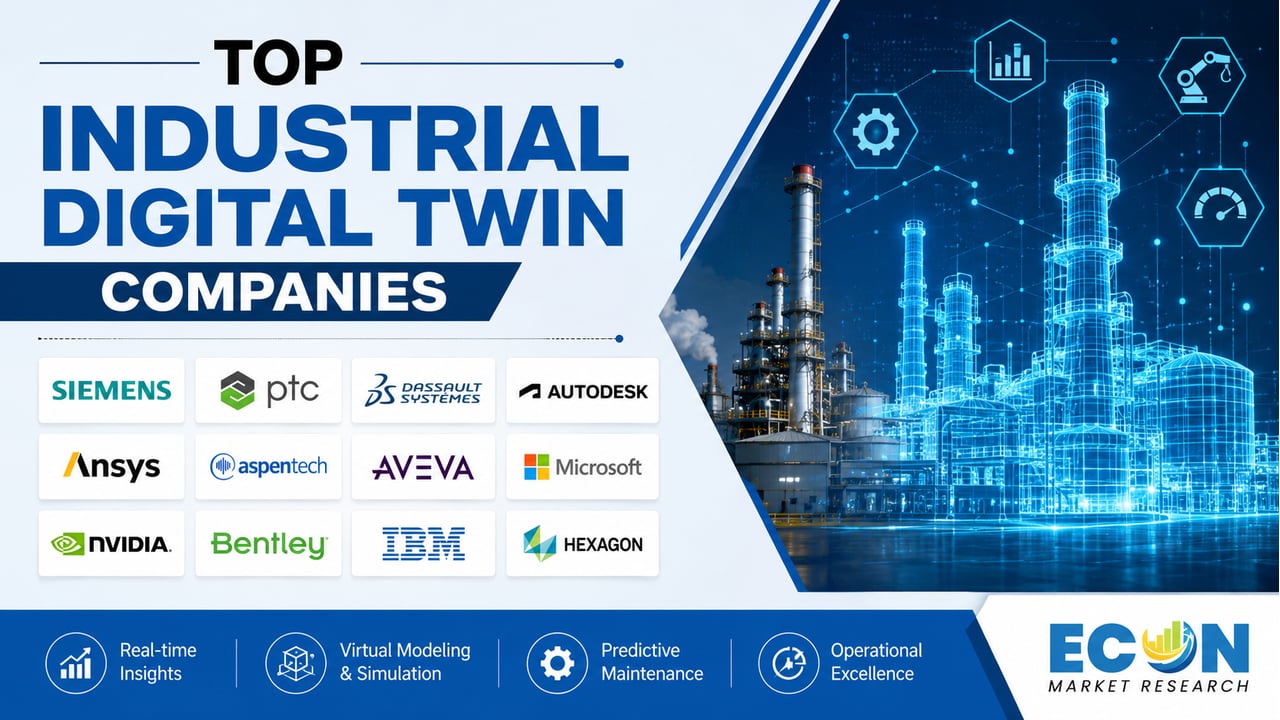
The following 10 companies are presented based on industrial relevance, digital twin capabilities, engineering expertise, operational deployment, software depth, automation integration, and geographic reach rather than as a strict ranking.
1. Siemens
Company Overview: Siemens traces its industrial history to 1847 and reported 318,000 employees worldwide for fiscal 2025, giving the company a large engineering and automation base for industrial digitalization. Headquarters: Munich, Germany. Core Industrial Digital Twin Expertise: Siemens integrates product, production, and performance twins through Siemens Xcelerator, combining CAD, PLM, simulation, automation, manufacturing planning, industrial IoT, and AI. Major Products and Services: Its portfolio includes Teamcenter, NX, Simcenter, Tecnomatix, Process Simulate, SINUMERIK, automation systems, and Xcelerator services. A machining digital twin developed with DMG MORI has demonstrated up to 40% faster production ramp-up and reductions of unproductive machine time of up to 75%, showing the operational value of connecting virtual machining, controller logic, workpieces, and physical equipment.
2. Dassault Systèmes
Company Overview: Dassault Systèmes was founded in 1981 and supports 370,000+ enterprise customers across 12 industries. The company reports 25,000 employees, 184 sites, and active customers in 159 countries. Headquarters: Vélizy-Villacoublay, France. Core Industrial Digital Twin Expertise: Its 3DEXPERIENCE platform develops what the company calls virtual twins, linking product design, manufacturing engineering, simulation, materials, lifecycle data, and operational collaboration. Major Products and Services: CATIA, DELMIA, SIMULIA, ENOVIA, and the broader 3DEXPERIENCE environment support aerospace, automotive, industrial equipment, life sciences, and manufacturing applications. The company began with 3D aerospace design in 1981 and has acquired 90+ businesses since its formation, progressively expanding from CAD into simulation, lifecycle management, manufacturing operations, and virtual twin technology.
3. PTC
Company Overview: PTC Inc. was founded on May 15, 1985 and reported a workforce of 7,500+ employees in its corporate facts. Headquarters: Boston, Massachusetts, United States. Core Industrial Digital Twin Expertise: PTC connects engineering, product lifecycle management, Industrial IoT, service information, and augmented reality, enabling digital twins that link product definitions to operational asset data. Major Products and Services: Creo provides CAD, Windchill manages PLM information, and ThingWorx provides industrial IoT connectivity and applications. ThingWorx 10.0 was introduced in June 2025 with greater emphasis on performance, security, intelligence, and industrial-scale deployment across aerospace, automotive, MedTech, electronics, and industrial manufacturing. This combination allows manufacturers to create a digital thread from engineering definition through production, connected operation, service, and asset performance.
4. Hexagon
Company Overview: Hexagon operates with 24,500 employees across 50 countries as reported in its 2025 year-end information. Headquarters: Stockholm, Sweden. Core Industrial Digital Twin Expertise: The company combines measurement technologies, laser scanning, metrology, reality capture, engineering information, geospatial systems, autonomous technologies, and industrial software to build data-rich digital representations of physical assets. Major Products and Services: Hexagon's industrial portfolio supports manufacturing, construction, mining, aerospace, autonomous systems, energy, and process plants. Reality capture and precision measurement are particularly relevant because high-fidelity industrial twins require accurate geometry and continuously updated asset information. A 2025 Hexagon survey included 400 global C-suite executives, reflecting its focus on connected industrial data and operational visibility across manufacturing and asset-intensive industries.
5. AVEVA
Company Overview: AVEVA began in 1967 as CADCentre and has accumulated 50+ years of industrial software experience. It became part of Schneider Electric after the acquisition was completed, while continuing to operate as the AVEVA industrial software business. Headquarters: Cambridge, United Kingdom, where a new global headquarters and R&D hub planned for 2027 is designed to bring together 500+ roles. Core Industrial Digital Twin Expertise: AVEVA specializes in process plants and asset-intensive industries by integrating engineering, real-time operational information, process simulation, asset information, and industrial analytics. Major Products and Services: CONNECT, PI Data Infrastructure, Unified Engineering, E3D capabilities, Process Simulation, Asset Information Management, and Predictive Analytics can form a continuously updated industrial twin. Unified Engineering combines 1D, 2D, and 3D engineering data in a common environment.
6. Microsoft
Company Overview: Microsoft was founded in 1975 and employed 228,000 full-time people as of June 30, 2025, including 80,000 employees in research and development. Headquarters: Redmond, Washington, United States. Core Industrial Digital Twin Expertise: Microsoft provides cloud infrastructure, IoT services, digital twin graph modeling, AI, analytics, security, and manufacturing solutions through Azure. Major Products and Services: Azure Digital Twins enables digital models of factories, buildings, energy networks, rail systems, farms, and other connected environments. Digital Twin Definition Language versions 2 and 3 support model-based descriptions of physical entities and relationships, while Azure manufacturing solutions combine factory data from sensors, PLCs, machines, enterprise applications, and IoT environments. This positions Microsoft primarily as a scalable platform and integration provider rather than a specialized mechanical engineering software vendor.
7. Amazon Web Services
Company Overview: AWS has operated commercial cloud infrastructure since 2006 and had expanded to 36 geographic Regions and 114 Availability Zones by March 2025. Headquarters: Seattle, Washington, United States, within Amazon's global organization. Core Industrial Digital Twin Expertise: AWS focuses on cloud-based operational twins connecting industrial data that may remain distributed across existing systems. Major Products and Services: AWS IoT TwinMaker provides entity-component modeling, knowledge graphs, connectors, 3D scene composition, and Grafana integration, while AWS IoT SiteWise supports industrial equipment data. TwinMaker was announced in 2021 and became generally available in April 2022. Its architecture allows manufacturers to combine sensor measurements, camera streams, enterprise data, CAD-derived 3D assets, and analytics into applications for monitoring factories, buildings, production systems, and industrial plants.
8. NVIDIA
Company Overview: NVIDIA was founded in 1993, employed 42,000+ people across 38 countries in its 2026 corporate profile, and reported 9,800+ granted and pending patent applications worldwide. Headquarters: Santa Clara, California, United States. Core Industrial Digital Twin Expertise: NVIDIA supplies accelerated computing, OpenUSD-based simulation technology, AI infrastructure, robotics simulation, synthetic-data generation, and physically based visualization through Omniverse. Major Products and Services: Omniverse, Isaac Sim, Cosmos-related physical AI tools, RTX technologies, and accelerated computing infrastructure support factory twins and robotics development. BMW previously identified plans to simulate all 31 factories in its production network using Omniverse-linked workflows, while NVIDIA's 2025 industrial announcements identified manufacturers such as Foxconn, General Motors, Hyundai Motor Group, Mercedes-Benz, and Schaeffler as adopters of Omniverse technologies.
9. Honeywell Technologies
Company Overview: Honeywell's industrial heritage spans more than 100 years, and its 2026 operating structure identifies Honeywell Technologies as a major industrial automation and technology organization. Its connected ecosystem included 32,000+ customers, 324,000+ sites, and roughly 6.4 million connected assets as of March 2026. Headquarters: Charlotte, North Carolina, United States. Core Industrial Digital Twin Expertise: Honeywell concentrates on process digital twins, plant optimization, automation, industrial controls, asset intelligence, and mission-critical operations. Major Products and Services: Honeywell Process Digital Twin uses the UniSim Design simulation engine, operational connectors, process models, soft sensors, and near-real-time plant information. Applications include refining, LNG, petrochemicals, pharmaceuticals, semiconductors, renewable fuels, mining, and gigafactories. Honeywell also reports 25,000+ patents and 7,000+ engineers supporting its industrial technology portfolio.
10. Rockwell Automation
Company Overview: Rockwell Automation is headquartered in Milwaukee, Wisconsin and has 26,000+ employees worldwide. Its automation heritage includes Allen-Bradley hardware and FactoryTalk industrial software. Headquarters: Milwaukee, Wisconsin, United States. Core Industrial Digital Twin Expertise: Rockwell connects control engineering, programmable automation, manufacturing software, simulation, virtual commissioning, material-flow analysis, and operator training. Major Products and Services: Emulate3D creates physics-based dynamic models that can connect directly to real control logic such as PLC programs. Rockwell acquired Emulate3D in 2019 and has since integrated it into broader FactoryTalk digital engineering workflows. Current Emulate3D Factory Test capabilities include multi-model orchestration, automated testing, fault simulation, full-factory visualization, NVIDIA Omniverse APIs, and OpenUSD integration, extending digital twin usage from machine-level testing to enterprise-scale factory commissioning.
Regional Outlook
North America
North America combines advanced manufacturing, industrial software development, cloud infrastructure, engineering services, and large automotive, aerospace, electronics, energy, and process-industry installations. Preliminary data for 2025 showed 38,000 industrial robots installed in the United States, an 11% increase from the previous year. U.S. manufacturing robot density reached 307 units per 10,000 manufacturing employees, creating a sizable automated equipment base for simulation, virtual commissioning, predictive maintenance, and production digital twins. The automotive sector accounted for 13,500 U.S. robot installations during 2025, while food-industry adoption increased by 30%, indicating that connected factory technologies are expanding beyond their traditional automotive concentration.
Canada and Mexico provide different digitalization opportunities. Canada installed 3,800 industrial robots in 2024, with automotive manufacturing accounting for 47% of deployments. Mexico installed 5,600 units, and its automotive industry represented 63% of installations. U.S. standards activity also supports digital-twin maturity: NIST operates a dedicated advanced-manufacturing digital twin program focused on architectures, interoperability, verification, validation, and uncertainty quantification. These conditions make North America particularly strong in virtual commissioning, industrial AI, asset-performance applications, automotive manufacturing, semiconductor projects, aerospace engineering, energy infrastructure, and cloud-hosted operational twins.
Europe
Europe installed 85,000 industrial robots in 2024, with 67,800 units installed inside the European Union. Germany accounted for 26,982 installations and 32% of the European total, while Italy installed 8,783 units, Spain 5,100, and France 4,900. This highly automated manufacturing base supports Digital Twin applications across automotive assembly, machine tools, chemicals, aerospace, pharmaceuticals, energy equipment, and industrial engineering. European technology suppliers such as Siemens, Dassault Systèmes, AVEVA, and Hexagon also provide engineering and industrial data platforms used globally, strengthening the region's influence on digital twin design practices even when deployment occurs outside Europe.
Regulatory policy is creating another data-driven use case. Regulation (EU) 2024/1781 established the framework for ecodesign requirements and Digital Product Passports, and a harmonized-standards implementing decision for Digital Product Passports was issued in July 2026. Although a Digital Product Passport is not itself an Industrial Digital Twin, both technologies depend on structured, persistent product data and lifecycle traceability. European manufacturers can therefore reuse digital-thread information across engineering, compliance, maintenance, circularity, and product documentation. The regional challenge is integrating legacy manufacturing equipment and nationally fragmented industrial systems while meeting increasingly demanding requirements for cybersecurity, data governance, product transparency, and sustainability reporting.
Asia-Pacific
Asia-Pacific is the world's most automation-intensive growth area by annual deployment volume, accounting for 74% of industrial robot installations in 2024. China alone installed 295,000 robots and represented 54% of worldwide deployments, while its operational stock surpassed 2 million units. Japan installed 44,500 robots and operated 450,500 units, and South Korea installed 30,600 units. These installed bases provide extensive opportunities for factory digital twins involving robotic programming, production simulation, predictive maintenance, machine vision, logistics, semiconductor manufacturing, battery production, electronics assembly, and automotive engineering. The scale of regional manufacturing also makes simulation valuable before changes are replicated across multiple factories.
India installed a record 9,100 industrial robots in 2024, with automotive applications representing 45% of installations. Government programs are also expanding smart-manufacturing capability: India's SAMARTH Udyog Bharat 4.0 framework includes 4 Smart Advanced Manufacturing and Rapid Transformation hubs and approval for 10 additional Industry 4.0 experience centers. Across the wider region, cloud infrastructure, electronics manufacturing, robotics, IoT systems, and high-volume production create favorable conditions for Industrial Digital Twin deployment. The principal challenges remain uneven SME digitization, incompatible machine interfaces, cybersecurity, shortages of industrial-data specialists, and the need to connect older equipment with modern data platforms without interrupting production.
Middle East & Africa
Industrial digitalization in the Middle East is being driven by national manufacturing-diversification programs, energy-sector automation, smart infrastructure, and new production facilities. Saudi Arabia's Future Factories Program targets the transformation of 4,000 factories toward smart operation, automation, and advanced industrial technologies. The program directly supports production-data connectivity, IoT, MES, MOM, SCADA, digital planning, and automated material handling, which are foundational technologies for operational digital twins. Saudi programs also identify SMEs as a priority, while small and medium-sized industrial establishments represent 92% of the country's industrial facilities according to the ministry's current program information.
The United Arab Emirates launched its Industrial Technology Transformation Index in February 2023 and introduced Transform 4.0 in 2024 to support 100 high-potential manufacturers over a 3-to-5-year transformation period. The program combines digital maturity assessment, sustainable manufacturing, Industry 4.0 technology, and factory lighthouse development. Participants in the UAE's ITTI certification activity have included professionals from Saudi Arabia, Oman, Qatar, Kuwait, Egypt, Rwanda, India, Malaysia, East Timor, Azerbaijan, Turkey, Ireland, and Romania, illustrating the potential for industrial technology practices developed in the Gulf to influence a broader regional ecosystem. African adoption remains more concentrated in energy, mining, utilities, infrastructure, and globally integrated manufacturing sites where industrial connectivity is already available.
Future Opportunities in the Industrial Digital Twin Industry
The strongest future opportunity is the progression from descriptive twins to predictive and increasingly autonomous industrial systems. NVIDIA's March 2026 Omniverse DSX Blueprint extended digital-twin methods into large-scale AI factory design, with participants including Siemens, Dassault Systèmes, PTC, Schneider Electric, Eaton, Vertiv, and other infrastructure and engineering suppliers. Industrial twins can increasingly combine engineering equations, AI models, live process data, robotics simulation, synthetic environments, and optimization algorithms. This creates opportunities in autonomous production planning, robot validation, energy optimization, maintenance scheduling, process control, AI factories, semiconductor facilities, battery plants, warehouses, renewable energy, mining, and high-complexity process manufacturing.
SME adoption represents another opportunity because digital twin deployment remains less mature among smaller manufacturers than among global industrial groups. NIST's Digital Twin Laboratory was established specifically to support research, standards, implementations, and SME digitization. Cloud and composable architectures can reduce entry barriers because a company can begin with 1 production line or critical machine rather than model an entire factory. Regulatory data requirements will add another incentive: EU Digital Product Passport standardization advanced again in July 2026, reinforcing the need for structured product and lifecycle information. The most credible future direction is therefore not one universal digital twin platform, but interoperable ecosystems connecting engineering, manufacturing, operational, sustainability, maintenance, and compliance information through standardized models.
Workforce development will determine how quickly these opportunities become operational. Digital twins increasingly require expertise spanning mechanical engineering, controls, simulation, AI, cybersecurity, cloud architecture, industrial networking, data engineering, and operations. Japan's Ministry of Economy, Trade and Industry published a Society 5.0 digital-skills workforce report in May 2025, while India's Industry 4.0 program operates 4 SAMARTH centers and is expanding through 10 additional experience centers. These programs illustrate a broader need for engineers who can translate domain knowledge into models rather than treating digital twins solely as IT projects. Suppliers that simplify model creation, automate data contextualization, support open standards, and preserve engineering traceability will be better positioned as deployment moves beyond early-adopter factories.
Conclusion
The Industrial Digital Twin industry is entering a stage in which scale, synchronization, and operational integration matter more than visual sophistication alone. Global factories operated 4,664,000 industrial robots in 2024 and installed another 542,000 during the year, giving manufacturers a rapidly expanding population of automated assets that can be modeled, simulated, monitored, and optimized digitally. The 5 major trends—AI integration, factory-scale simulation, ET/OT/IT convergence, interoperability, and cloud-edge architectures—show how digital twins are evolving from engineering tools into industrial decision systems. Siemens, Dassault Systèmes, PTC, Hexagon, AVEVA, Microsoft, AWS, NVIDIA, Honeywell Technologies, and Rockwell Automation approach this opportunity from different combinations of engineering software, automation, cloud, industrial data, simulation, and AI.
Regional development will remain uneven. Asia accounted for 74% of new robot installations in 2024, Europe represented 16%, and the Americas accounted for 9%, while Saudi Arabia is targeting digital transformation across 4,000 factories and the UAE's Transform 4.0 program is supporting 100 manufacturers. These differences create distinct priorities: factory-scale automation in Asia, engineering and regulatory integration in Europe, AI and software-platform development in North America, and industrial modernization in the Middle East and Africa. For the Top Companies in the Industrial Digital Twin Industry, long-term competitiveness will depend on reliable real-time data, physically accurate models, open interoperability, cybersecurity, AI integration, measurable operational outcomes, and the ability to deploy digital twins across both modern and brownfield industrial environments.