

Geospatial Market
Geospatial Market Size, Share, Trends, Growth, and Industry Analysis, By Technology (GIS, GNSS, Remote Sensing, 3D Scanning), By Application (Surveying andamp; Mapping, Navigation andamp; Positioning, Urban Planning), Regional Analysis and Forecast Period 2026-2035
Market Overview
As per Econ Market Research analysis, the Global Geospatial Market size amounted to US$ 125.1 Billion in 2026 and is anticipated to grow to US$ 274.41 Billion by 2035, recording a CAGR of 9.12% during 2026–2035. The base year taken for analysis is 2025.
Geospatial Market Size 2025-2035 (USD Billion)

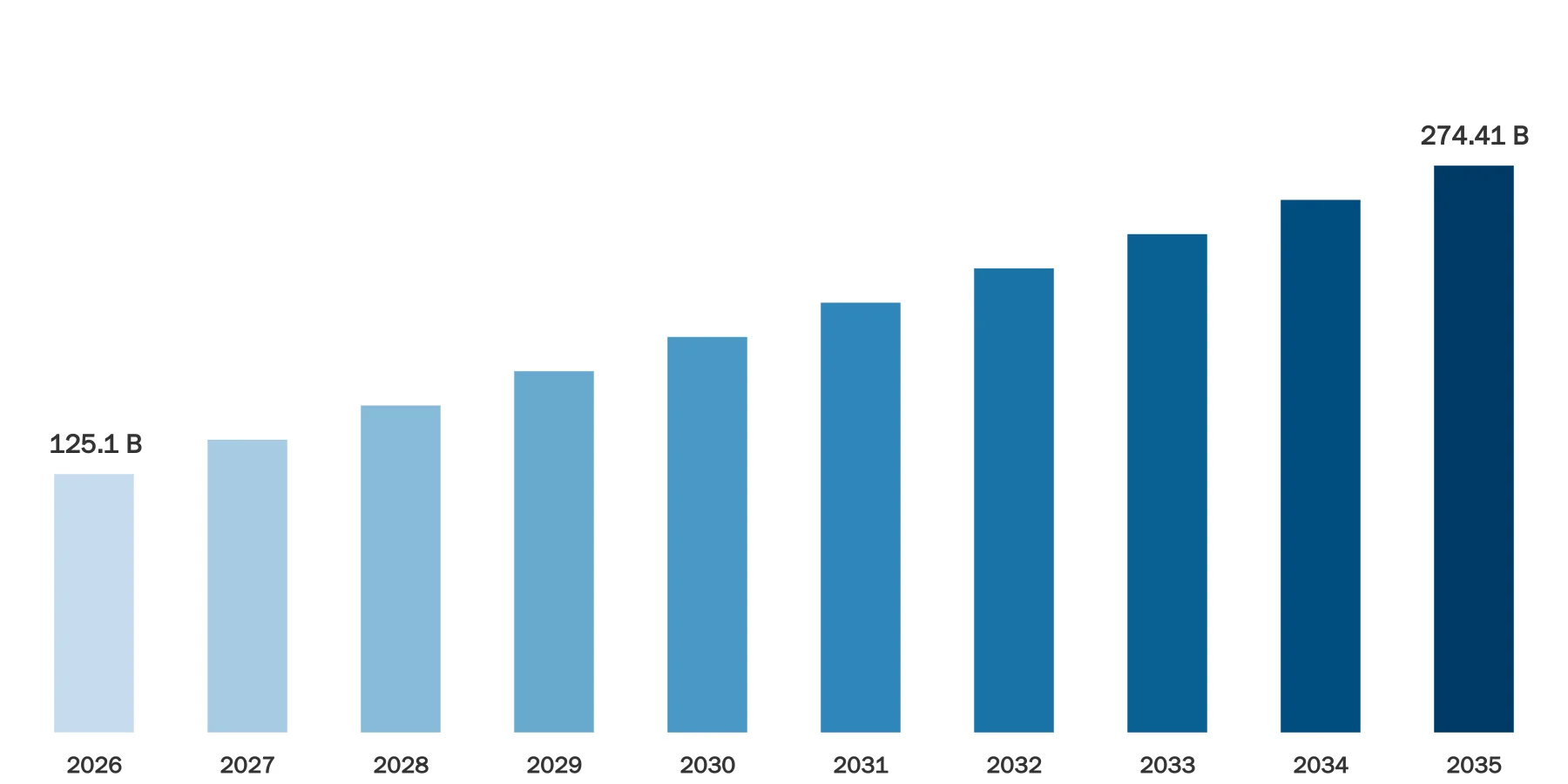
Source: Econ Market Research
Geospatial Solutions encompass various technologies like satellite imagery, GPS, GIS, and mapping software. These tools allow users to access and analyse location-related data. They have transformed industries like agriculture, urban design, transportation, and environmental protection. Artificial Intelligence and machine learning advancements are boosting the geospatial market, leading to advancements and increased efficiency in multiple sectors. As businesses and governments increasingly recognize the value of spatial data in decision-making processes, the demand for geospatial products and services continues to soar globally, fostering collaborations and partnerships to harness the full potential of Location Intelligence.
Geospatial Dynamics
As satellite technology, GPS systems, and data analysis improve, the demand for geospatial solutions is skyrocketing, mirroring the surge in traffic during the morning rush hour. This demand stems from the increasing need for location-based insights in various industries. Geospatial solutions are driven by our innate desire to comprehend and navigate our surroundings, from enhancing agricultural practices to feed a growing population to designing safer and more efficient transportation networks that connect communities. Moreover, the increasing availability of user-friendly mapping applications and consumer GPS devices makes location-based services more accessible than ever, resembling the convenience of finding your way with a trusted friend guiding you through unfamiliar streets.
However, just as cities face challenges like congestion and urban sprawl, the geospatial market encounters hurdles such as data privacy concerns and interoperability issues. Yet, like a community coming together to address common challenges, industry stakeholders collaborate to overcome these obstacles, fostering innovation and ensuring that the benefits of geospatial technology are realized by all. As the geospatial landscape continues to evolve, driven by human curiosity and ingenuity, it remains an exciting journey where every turn offers new opportunities for exploration and growth.
Geospatial Drivers
Technological Advancements
Technological advancements, particularly the incorporation of AI and ML into geospatial solutions, are fuelling market growth. AI and ML improve data analysis, leading to more precise predictions and insights from geospatial data. These technologies can, for example, analyse satellite images to detect crop health patterns, aiding farmers in optimizing irrigation and fertilization. Moreover, enhanced satellite imagery resolution and the widespread availability of high-resolution drone cameras are broadening the range of geospatial data applications, driving demand across various industries.
Government Initiatives and Policies
Government support for geospatial technologies is boosting their market growth. Governments understand the value of geospatial data for projects like building infrastructure, handling disasters, and designing cities. For instance, programs like the EU',s Copernicus offer free satellite data for environmental monitoring and responding to emergencies. Similarly, government mandates requiring the integration of geospatial information in public projects, such as transportation infrastructure and smart city initiatives, create a steady demand for geospatial solutions. These policies not only stimulate market growth but also foster collaboration between public and private sectors, driving innovation and technological advancements.
Restraints:
Data Privacy and Security Concerns
Protecting the privacy and security of data is a major concern for the geospatial industry. As location-based services grow and collect more data, keeping this information safe from unauthorized access and misuse is essential. Laws like the European Union',s General Data Protection Regulation (GDPR) set strict rules for collecting, storing, and using location data, adding to the challenges faced by businesses in this field. Addressing these concerns requires robust security measures, transparent data policies, and adherence to regulatory frameworks to ensure trust and confidence among users.
Interoperability Challenges
Differences between systems and platforms in how they handle geospatial data make it hard for them to work together. Incompatible formats, standards, and protocols create barriers that make geospatial information less accessible and useful. For example, it can be hard to connect GIS data with ERP systems or sensor networks in smart infrastructure projects. To solve these problems, the industry needs to work together to create standard data formats and protocols, as well as software that can work together. Additionally, investments in interoperability infrastructure and tools are needed to facilitate data sharing and integration across diverse applications and stakeholders.
Opportunities:
Emerging Applications in Autonomous Vehicles
The rise of autonomous vehicles presents lucrative opportunities for the geospatial market. Geospatial technologies, including high-precision GPS, LiDAR, and HD mapping, play a crucial role in enabling the navigation and decision-making capabilities of autonomous vehicles. These technologies provide real-time location data, environmental mapping, and obstacle detection, enhancing the safety and efficiency of autonomous transportation systems. Moreover, the integration of geospatial analytics enables predictive modelling for route optimization, traffic management, and dynamic re-routing, unlocking new possibilities for intelligent mobility solutions.
Segment Overview
By End-user
By end-user, the market caters to a wide array of sectors including Defense &, Internal Security, Government, Banking, Financial Services, Healthcare &, Life Sciences, and Others. Defense &, Internal Security relies on geospatial solutions for situational awareness, intelligence gathering, and mission planning. Governments utilize geospatial technology for urban planning, land management, and environmental monitoring.
Banking and Financial Services leverage location intelligence for risk assessment, fraud detection, and customer analytics. Healthcare &, Life Sciences benefit from geospatial data for disease mapping, epidemiological studies, and patient care optimization. Other industries, such as retail, utilities, and transportation, also utilize geospatial solutions for various applications.
By Enterprise
Segmentation by enterprise type distinguishes between Large Enterprises and Small and Medium Enterprises (SMEs). Large enterprises often have complex geospatial requirements and invest in comprehensive solutions for spatial analysis, reporting, and visualization. On the other hand, SMEs may opt for more streamlined geospatial solutions tailored to their specific needs and budget constraints.
By Solution
The market also categorizes solutions into different categories including Data Integration and ETL (Extract, Transform, Load), Geocoding and Reverse Geocoding, Thematic Mapping &, Spatial Analysis, Reporting &, Visualization, and Others. Data Integration and ETL tools facilitate the seamless integration of geospatial data from multiple sources, ensuring data consistency and accuracy.
Geocoding and Reverse Geocoding solutions convert addresses into geographic coordinates and vice versa, enabling precise location-based queries and analysis. Thematic Mapping &, Spatial Analysis tools enable users to visualize and analyse spatial patterns and relationships in geospatial data. Reporting &, Visualization solutions offer intuitive interfaces and customizable dashboards for presenting geospatial insights to stakeholders.
By Deployment
Deployment options include On-Premises and Cloud-based solutions, providing flexibility in infrastructure management and scalability. On-Premises deployments offer greater control over data security and customization, while Cloud-based deployments offer scalability, accessibility, and cost-effectiveness.
By Application
Applications such as Disaster Management &, Risk Reduction and Public Safety utilize geospatial technology for emergency response planning, hazard mapping, and situational awareness. These applications leverage real-time spatial data to mitigate risks, coordinate response efforts, and ensure the safety and well-being of communities.
Geospatial Overview by Region
North America, with its robust technological infrastructure and early adoption of geospatial solutions, leads the market, driven by demand from sectors like defense, government, and technology. Europe follows closely, leveraging initiatives like the European Union',s Copernicus program to promote geospatial innovation and sustainability. In Asia-Pacific, rapid urbanization and infrastructure development fuel the demand for geospatial technologies, particularly in emerging economies like China and India.
Moreover, the region',s growing awareness of climate change and natural disasters drives investments in geospatial solutions for disaster management and environmental monitoring. In Latin America and the Middle East &, Africa, governments are increasingly recognizing the importance of geospatial data in addressing socio-economic challenges and fostering sustainable development. However, factors such as limited infrastructure and regulatory barriers pose challenges to market growth in these regions.
Geospatial Market Competitive Landscape
Established players like Esri, Google, and Trimble vie for dominance, leveraging their extensive expertise and robust product portfolios to cater to diverse customer needs. These industry giants continuously invest in research and development to enhance their offerings, staying ahead of the curve in areas such as AI-powered analytics, cloud-based solutions, and mobile applications. Meanwhile, a plethora of nimble startups and niche players inject dynamism into the market, disrupting traditional paradigms with specialized solutions tailored to specific industries or use cases.
Innovative companies are using agile techniques to solve problems in the geospatial field by thinking outside the box. Additionally, strategic partnerships between companies create a more competitive environment, which leads to more innovation and a wider market reach. Collaboration between technology and data providers, as well as other stakeholders in the industry, makes it easier to work together and speeds up the process of creating new things. This leads to a wide range of cutting-edge geospatial solutions that are useful for end-users.
Geospatial Market Leading Companies:
Hexagon AB
Trimble Inc.
Google (Alphabet Inc.)
Microsoft Corporation
Oracle Corporation
Alteryx, Inc.
Precisely
TomTom International B.V.
Maxar Technologies
Mapbox
HERE Technologies
FARO Technologies
Topcon Positioning Systems
Geospatial Recent Developments
Jan 2024, Deloitte introduced an innovative platform, the Geospatial and AI Platform for Scenario Planning and Monitoring, which seamlessly integrates Google Earth functionalities, Google Earth Engine (GEE), and cutting-edge Generative AI technology from Vertex AI. This ground-breaking platform is poised to transform the approach of organizations towards sustainability and climate initiatives.
Aug 2022, T-Hub, a business incubator headquartered in Hyderabad, revealed a partnership with Hexagon, a digital reality solutions company. Together, they aim to integrate sensor, software, and autonomous technologies to establish a Geospatial Experience Centre at T-Hub, bolstering India',s burgeoning start-up community.
June 2023, T Cyclomedia, a global frontrunner in delivering precise 360°, street-level visual data, enriched by AI-driven analytics, unveiled a substantial investment aimed at fortifying the company',s expansion and laying the groundwork for future achievements.
Geospatial Report Segmentation
Geospatial Market Report Scope & Segmentation
| Attributes | Details |
|---|---|
Market Size (Current) | US$ 125.1 Billion in 2026 |
Market Size (Forecast) | US$ 274.41 Billion in 2035 |
Growth Rate | CAGR of 9.12% from 2026 to 2035 |
Forecast Period | 2026 – 2035 |
Base Year | 2025 |
Historical Data Available | Yes |
Regional Scope | Global |
Segments Covered | By Technology
By Application
|
Frequently Asked Questions
Common questions about this report
The study period covers historical insights and forecast projections for the period 2026-2035.
About the Author
Market research expert with years of industry experience

Dipali Bhingare serves as the Market Research Director at Econ Market Research. With a focus on translating complex global economic shifts into actionable business intelligence, she oversees the strategic direction of comprehensive market studies. Her work empowers organizations to navigate volatile industries through data-driven forecasting and deep-dive competitive analysis.
Related Reports
Explore more market insights from the same category