


Top Humanoid Robot Companies Leading the Industry in 2026
The top humanoid robot companies are advancing AI, automation, mobility, and industrial robotics through innovative platforms, products, and global deployments.
Introduction
Overview of the Global Humanoid Robot Industry
The global humanoid robot industry entered a decisive commercialization phase during 2025 and 2026, moving beyond laboratory prototypes toward factory, warehouse, retail, healthcare and household deployments. Global humanoid robot shipments reached about 13,000 units in 2025, while leading manufacturers expanded production facilities capable of delivering hundreds or thousands of robots. Humanoid robots commonly stand between 1.3 meters and 1.8 meters tall, integrate 20 to 40-plus degrees of freedom and use cameras, depth sensors, force sensors and artificial intelligence models to navigate human-designed environments. Demand is particularly strong for material handling, component sequencing, inspection, repetitive assembly and hazardous workplace operations.
Market Evolution and Growth Drivers
Humanoid robot development has accelerated because of 4 major forces: labor shortages, artificial intelligence advancement, lower component costs and rising automation requirements. Global factories installed 542,076 industrial robots during 2024, marking the 4th consecutive year in which installations remained above 500,000 units. Manufacturers are now testing humanoids because these machines can potentially use stairs, tools, shelves, carts and production stations originally designed for human workers. Vision-language-action models also allow a single robot to interpret spoken commands, recognize unfamiliar objects and complete multi-step physical tasks. Improved actuators, compact batteries and simulation platforms have shortened development cycles from several years to periods of 12 to 24 months.
Top 5 Latest Trends in the Humanoid Robot Industry
1. Transition from Prototypes to Commercial Production
The most important humanoid robot trend is the transition from demonstration models to repeatable commercial production. During 2025, worldwide shipments reached about 13,000 humanoid robots, including 5,168 units shipped by 1 leading Chinese manufacturer. By June 2026, that company reported that its 15,000th robot had rolled off the production line. Another American producer delivered more than 350 third-generation humanoids and increased output from 1 robot per day to 1 robot per hour within fewer than 120 days, representing a 24-fold improvement in production throughput. These milestones indicate that humanoid robot companies are increasingly concentrating on manufacturing yield, component standardization, serviceability and fleet-level deployment rather than isolated laboratory performance.
Production scalability is also changing how humanoid robots are designed. Earlier models were built from highly customized components, but current platforms increasingly rely on modular joints, standardized battery packs, swappable hands and common computing architectures. A production robot may require between 20 and 40 electric actuators, several vision sensors and 1 centralized or distributed computing system. Manufacturers are redesigning these parts to reduce assembly time, simplify maintenance and support continuous operation. As annual production targets move from 100 units to 1,000 or even 10,000 units, supply-chain control over motors, harmonic reducers, bearings, encoders, batteries and semiconductor processors is becoming a central competitive advantage.
2. Vision-Language-Action Models and Embodied Artificial Intelligence
Vision-language-action technology is becoming the primary intelligence layer for advanced humanoid robots. Instead of programming 1 fixed movement for every task, developers are training neural networks to connect images, spoken or written instructions and physical actions. A modern humanoid can receive a command containing 10 or 20 words, identify the requested object through multiple cameras and generate coordinated movements for its arms, torso, fingers and legs. In 2025, a leading developer introduced a model capable of continuous upper-body control, including the wrists, torso, head and individual fingers. A 2026 upgrade extended the architecture to full-body walking, manipulation and balance through 1 integrated neural system.
Embodied artificial intelligence depends on physical training data rather than text alone. Developers collect thousands of hours of teleoperated movements, factory demonstrations, household activities and simulated interactions. Internet-scale video can assist with visual understanding, but robots still require real-world demonstrations to learn force, friction, object weight and collision response. Training systems increasingly combine 3 data channels: human demonstrations, simulated tasks and autonomous robot experience. This combination allows humanoid robots to improve task completion across material handling, sorting, cleaning, inspection and assembly without creating an entirely new control program for every workstation.
3. Industrial Deployment in Automotive and Logistics Facilities
Automotive manufacturing and logistics have become the first large commercial testing grounds for humanoid robot companies. One humanoid platform operated for 11 months at an American automotive plant and contributed to the production of 30,000 vehicles by performing sheet-metal handling tasks. Its third-generation successor returned to the same manufacturing complex in June 2026 for additional assembly and logistics work. Another humanoid developer entered a commercial agreement with a German vehicle manufacturer to test robots in production facilities, while a logistics provider began evaluating the same platform for warehouse operations. These deployments focus on repetitive material movement, component delivery, tote handling and ergonomically difficult jobs.
Industrial customers are applying strict performance measurements before approving broader deployment. Important indicators include task success rate, operating hours, intervention frequency, payload, walking speed and recovery time after errors. A commercially useful robot may need to operate for 16 to 22 hours per day, lift loads of 20 to 25 kilograms and complete hundreds of movements during 1 shift. Industrial pilots also evaluate safety around employees, integration with warehouse systems and the ability to switch between 2 or more tasks. This structured testing is helping companies distinguish visually impressive demonstrations from systems that can deliver reliable daily productivity.
4. Advanced Hands, Dexterity and Whole-Body Coordination
Robotic hands are becoming a major point of differentiation because human workplaces contain thousands of tools, handles, switches, containers and irregular objects. Advanced humanoid hands now incorporate between 10 and 25 degrees of freedom, approaching the human hand’s 27 degrees of freedom. These systems use tendon mechanisms, miniature motors, tactile sensors and force control to grip delicate objects without crushing them. Developers are demonstrating tasks such as inserting connectors, folding fabric, handling fruit, opening doors and sorting components. The objective is not simply to create 5 moving fingers but to coordinate the hand with the wrist, arm, torso, vision system and balance controller.
Whole-body coordination is equally important because manipulation can destabilize a bipedal machine. When a robot lifts a 10-kilogram container, pushes a loaded cart or reaches 1 meter away from its body, the control system must adjust the legs and torso within milliseconds. Current humanoid platforms typically provide 23 to 43 motorized joints, while full-size models can generate arm-joint torque of 120 newton-meters and leg-joint torque of 360 newton-meters. These improvements allow robots to combine walking and manipulation rather than stopping completely before every physical task.
5. Specialized Platforms for Factories, Homes and Service Environments
Humanoid robot companies are dividing their product portfolios into 3 principal categories: industrial robots, household assistants and research platforms. Industrial machines prioritize payload, durability and shift-length operation, while household robots require quieter actuators, safer surfaces and improved interaction around children, pets and furniture. Research models emphasize software access, modular hardware and flexible programming. Compact humanoids measuring about 1.32 meters are increasingly used by universities and development teams, while industrial models commonly approach 1.75 to 1.8 meters to reach standard shelves and workstations.
The move toward specialized platforms reflects the reality that 1 mechanical design cannot immediately optimize every use case. A warehouse robot may need to lift 25 kilograms, while a home assistant may handle objects weighing less than 5 kilograms but require greater finger precision. Retail and hospitality robots need natural-language interaction in 2 or more languages, while factory platforms must integrate with safety controllers and manufacturing execution systems. During the next 3 to 5 years, humanoid robot companies are therefore expected to offer modular combinations of hands, feet, sensors, batteries and software packages rather than relying on a single universal configuration.
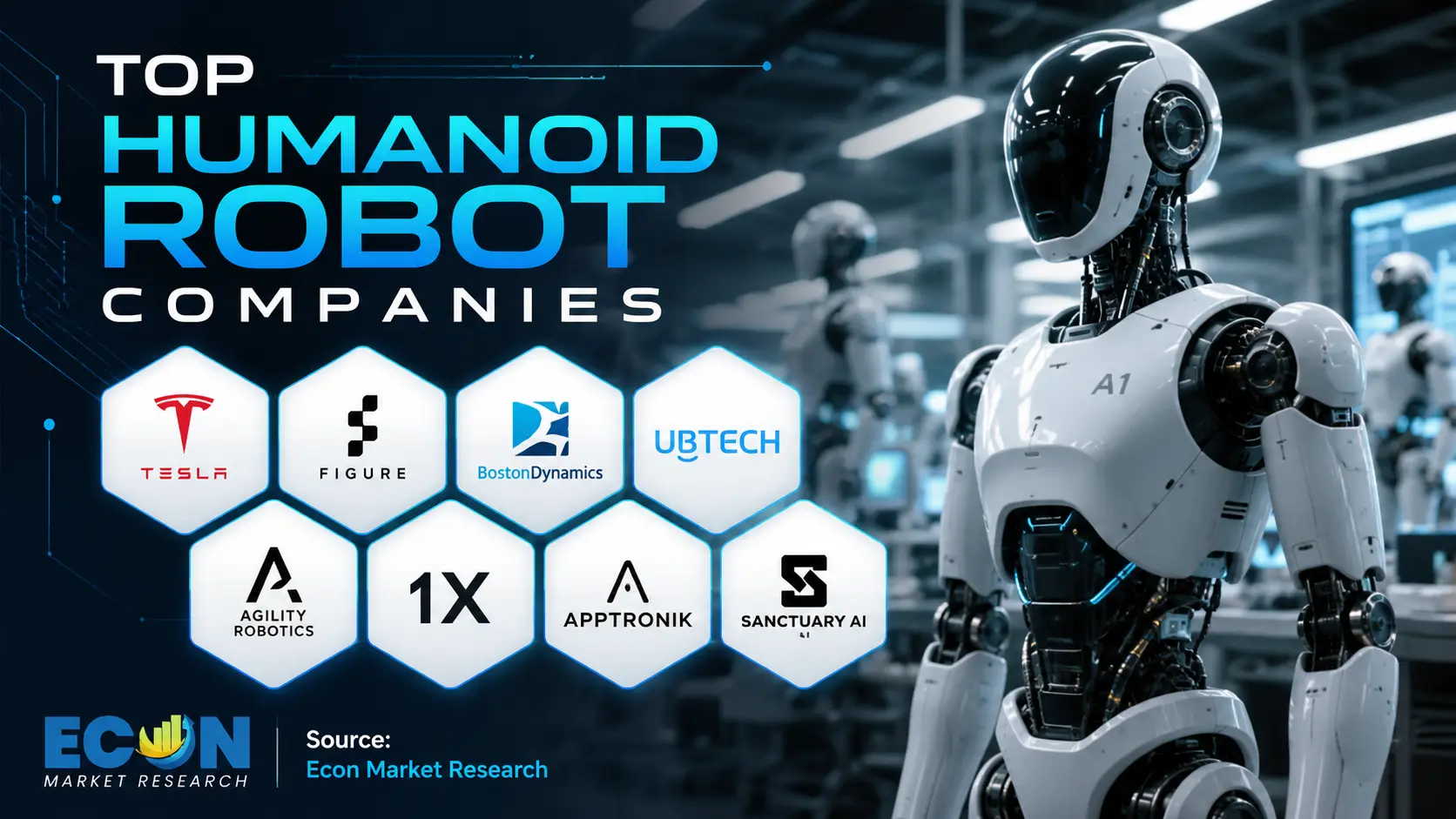
Top 5 Companies in the Humanoid Robot Industry
1. Tesla
Company overview: Tesla is an American technology and manufacturing company developing Optimus, a general-purpose autonomous humanoid robot intended for unsafe, repetitive and physically demanding activities. The Optimus project was announced in 2021, followed by early prototypes in 2022 and an improved second-generation platform incorporating redesigned hands, actuators and mobility systems. The company began installing first-generation Optimus production lines during 2026, using expertise derived from electric vehicles, batteries, artificial intelligence processors and large-scale manufacturing.
Headquarters: Austin, Texas, United States. Core humanoid robot expertise: Tesla specializes in computer vision, neural-network training, bipedal movement, actuator engineering, battery management and scalable manufacturing. Major products and services: Its principal humanoid product is Optimus, supported by artificial intelligence training infrastructure and autonomous perception software. The robot is designed to perform general physical tasks within factories and other human environments, with development centered on 2-legged mobility, object handling and autonomous task execution.
2. Figure AI
Company overview: Figure AI is an American humanoid robotics company focused on creating commercially scalable, general-purpose robots. Its Figure 02 platform completed an 11-month deployment at an automotive factory and contributed to the production of 30,000 vehicles. The company subsequently introduced Figure 03, its third-generation robot, and deployed more than 350 units while improving manufacturing throughput from 1 robot per day to 1 robot per hour.
Headquarters: San Jose, California, United States. Core humanoid robot expertise: Figure specializes in integrated robot hardware, full-body autonomy, dexterous manipulation and vision-language-action intelligence. Major products and services: Its portfolio includes Figure 02, Figure 03 and the Helix artificial intelligence system. Helix 02 uses 1 neural architecture to manage walking, balancing and manipulation directly from visual information, supporting longer task sequences in industrial and household-style environments.
3. Apptronik
Company overview: Apptronik is an American robotics company that has developed more than 10 robotic systems and concentrates its commercial strategy on the Apollo humanoid robot. Apollo stands close to 6 feet tall, can lift loads of up to 55 pounds and has been designed for operating periods reaching 22 hours per day. The robot has been tested with automotive, electronics and logistics organizations for component transport, material handling and other physically demanding operations.
Headquarters: Austin, Texas, United States. Core humanoid robot expertise: Apptronik focuses on modular actuators, human-centered mechanical design, mobile manipulation, artificial intelligence integration and collaborative workplace safety. Major products and services: Apollo is the company’s flagship commercial humanoid platform, supported by deployment engineering, application development and fleet integration services. Its design targets factories, warehouses and retail environments originally constructed around human dimensions.
4. Unitree Robotics
Company overview: Unitree Robotics is a Chinese robotics manufacturer known for quadruped and humanoid platforms that combine agile movement with comparatively accessible research and commercial configurations. Its G1 humanoid measures about 1,320 millimeters while standing and can be folded to about 690 millimeters for transportation. Depending on configuration, the G1 provides between 23 and 43 motorized joints. The company also manufactures full-size H-series robots designed for industrial research and advanced mobility.
Headquarters: Hangzhou, Zhejiang, China. Core humanoid robot expertise: Unitree specializes in high-torque joint motors, dynamic balance, compact mechanical systems, three-dimensional perception and developer-accessible robot platforms. Major products and services: Major humanoid products include G1, G1 EDU, H1, H1-2 and R1. The H1-2 stands about 178 centimeters tall, weighs about 70 kilograms, contains 27 degrees of freedom and uses 3D lidar with depth-camera sensing.
5. AGIBOT
Company overview: AGIBOT is a Chinese embodied-intelligence company developing humanoid and service robots for manufacturing, logistics, commercial operations and research. The company shipped 5,168 humanoid robots during 2025, representing a reported 39% share of worldwide shipments for that year. Its 5,000th mass-produced robot was completed in December 2025, followed by the 10,000-unit milestone in March 2026 and the 15,000-unit milestone in June 2026.
Headquarters: Shanghai, China. Core humanoid robot expertise: AGIBOT focuses on embodied artificial intelligence, full-size humanoid hardware, commercial fleet deployment, realistic task datasets and scalable production. Major products and services: Its portfolio includes the A2 full-size humanoid and several specialized robotic platforms. The A2 has been demonstrated in industrial and commercial environments, while the company’s data ecosystem supports training robots through large collections of realistic physical tasks.
Regional Outlook
North America
North America remains one of the most influential humanoid robot development regions because it combines artificial intelligence research, venture investment, semiconductor capabilities and advanced manufacturing. Regional factories recorded a robot density of 204 units per 10,000 manufacturing employees in 2024. The United States hosts at least 4 globally visible humanoid developers focused on automotive plants, logistics centers, household assistance and general-purpose physical intelligence. Commercial programs increasingly involve multi-month testing rather than 1-day demonstrations, with robots evaluated for component handling, tote movement, inspection and repetitive production tasks.
The United States also benefits from established automotive, aerospace, e-commerce and logistics industries that can support fleets of 10, 100 or eventually 1,000 humanoid robots. American developers are expanding specialized manufacturing sites, field-service teams and commercial deployment roles in states including California, Texas, Nevada and Oregon. One manufacturer increased production to 1 humanoid per hour, while another has installed initial production lines for its autonomous bipedal platform. These developments indicate that North America’s competitive strength lies not only in artificial intelligence models but also in integrating software, actuators, batteries and high-volume production systems.
North American adoption will still depend on measurable reliability and workplace safety. Industrial buyers may require robots to complete thousands of cycles, operate for more than 16 hours and recover from unexpected events without frequent technician intervention. Insurance, liability, worker training and occupational safety standards will influence deployments involving machines weighing 50 kilograms or more. Companies that provide remote supervision, predictive maintenance and documented safety performance across 6- to 12-month pilots will have stronger opportunities to secure large fleet contracts.
Europe
Europe provides a strong industrial foundation for humanoid robot adoption, particularly in automotive manufacturing, engineering, logistics and advanced machinery. Western Europe reached a record robot density of 267 robots per 10,000 manufacturing employees in 2024, exceeding North America’s 204 and Asia’s regional average of 131. This existing automation base gives European factories experience with machine safety, robot integration and production optimization. Germany, France, Italy, Spain and the United Kingdom are expected to remain important testing markets because they combine mature industries with growing demographic pressure.
European automotive companies have already participated in at least 2 major humanoid robot programs. A German manufacturer conducted an 11-month deployment in its American plant, where 1 humanoid platform supported production associated with 30,000 vehicles. Another premium vehicle producer began testing Apollo robots for manufacturing and intralogistics processes. These projects allow European engineering teams to evaluate whether humanoids can work at existing stations without expensive redesigns. Such compatibility is valuable because a conventional automated production cell may require months of engineering, guarding and commissioning.
Europe’s regulatory environment will make trustworthy artificial intelligence and worker protection central market requirements. Robotics developers will need to address risk management, cybersecurity, transparency and human oversight when their machines operate near employees. The region also expanded artificial intelligence infrastructure through 6 additional AI Factories announced in October 2025 and 13 AI Factory Antennas selected across member and partner countries. These computing resources can support robotics simulation, model training and industrial artificial intelligence development.
European opportunities will be strongest in applications where humanoids supplement aging workforces rather than simply replace existing employees. A robot capable of carrying 20 kilograms, reaching standard 1.5-meter shelves and operating across 2 shifts could reduce physical strain in warehouses, hospitals and industrial facilities. However, adoption will require clear documentation showing how robots share workspaces, stop within defined distances and communicate their intended movements to nearby employees.
Asia-Pacific
Asia-Pacific is the largest industrial robotics deployment region and a critical center for humanoid robot manufacturing. Asia accounted for 74% of new industrial robot deployments during 2024, while China alone installed 54% of the world’s newly deployed factory robots. The region benefits from concentrated supply chains for motors, precision gears, batteries, sensors, electronics and artificial intelligence hardware. These capabilities enable manufacturers to move from prototypes to production volumes of 1,000, 5,000 or 10,000 units more quickly than companies dependent on globally dispersed suppliers.
China has positioned humanoid robots as a strategic emerging industry, with government guidance previously targeting an initial innovation system and mass-production capability by 2025. During that year, more than 140 Chinese manufacturers reportedly introduced over 330 humanoid robot models. The country also produced the manufacturer responsible for 5,168 shipments and 39% of reported global volume in 2025. Industrial testing covers assembly, quality inspection, warehouse movement, commercial reception and elderly-care support, creating a broad domestic environment for collecting operational data.
Japan and South Korea add substantial expertise in motors, industrial automation, electronics and human-robot interaction. South Korea recorded one of the world’s highest levels of industrial automation, creating a strong foundation for future humanoid deployment in electronics and automotive facilities. Japan’s aging population and long-standing service-robot research support opportunities in healthcare, assisted living and public services. Across the wider Asia-Pacific region, manufacturers are likely to introduce lower-cost research platforms alongside more durable industrial models.
The region’s greatest advantage is supply-chain proximity. A humanoid requiring 30 joint systems, 5 or more perception sensors and 1 high-performance computing platform can source many essential parts within established electronics and automotive clusters. However, companies must continue improving reliability, battery duration, safety certification and software localization. Humanoid robot companies that support multiple Asian languages and operate within dense factories will be positioned for faster regional adoption.
Middle East & Africa
The Middle East and Africa humanoid robot market remains smaller than the markets of North America, Europe and Asia-Pacific, but the region is developing high-visibility opportunities in smart cities, hospitality, aviation, energy and public services. The United Arab Emirates and Saudi Arabia have invested in artificial intelligence, digital infrastructure and automated customer experiences through national programs extending to 2030 and beyond. Humanoid robots have appeared at airports, exhibitions, government events, hotels and retail locations, where they provide navigation, multilingual information and interactive demonstrations.
A full-size humanoid pilot was announced for Abu Dhabi during 2026, with potential use in malls, restaurants and public facilities. Such projects demonstrate how the region can act as a commercial showcase for robots operating outside controlled factory environments. Service robots deployed in hospitality may interact with hundreds of visitors during 1 day, requiring natural-language processing, facial or gesture recognition, safe navigation and support for 2 or more languages.
Industrial opportunities are also emerging in oil and gas, utilities, construction and logistics. These sectors contain hazardous locations involving heat, chemicals, heights and heavy equipment. A humanoid robot capable of climbing stairs, reading gauges and carrying 10 to 20 kilograms of tools could reduce worker exposure during inspections. However, high temperatures above 40 degrees Celsius, sand, dust and outdoor terrain create demanding engineering requirements for batteries, cooling systems, seals and perception sensors.
African adoption is expected to develop through universities, research laboratories, mining companies, healthcare pilots and technology hubs. Many facilities may initially use 1 to 10 robots for education, inspection or public engagement rather than deploying large industrial fleets. Affordability, maintenance availability and technical training will therefore be decisive. Regional distributors offering local repair, replacement parts and 24-hour remote support will have stronger prospects than suppliers focused only on hardware sales.
Future Opportunities in the Humanoid Robot Industry
The humanoid robot industry has significant opportunities across manufacturing, logistics, healthcare, retail, construction, agriculture, emergency response and household assistance. Global factory robot installations are expected to reach 575,000 units in 2025 and surpass 700,000 units by 2028, demonstrating that industrial organizations are prepared to increase automation when systems provide dependable productivity. Humanoid robots can expand this automation into environments where fixed robotic arms or wheeled machines cannot easily operate, including stairways, mixed-use workstations and facilities filled with human tools.
Manufacturing will remain the first major opportunity because companies can define tasks, measure output and control workplace conditions. Potential applications include component sequencing, machine tending, visual inspection, packaging and movement of loads weighing between 5 and 25 kilograms. Logistics facilities offer similar opportunities through tote handling, shelf replenishment, trailer unloading and order consolidation. Developers that achieve operation for 16 to 22 hours per day with low intervention rates could support 2-shift or 3-shift facilities.
Healthcare and assisted living represent longer-term opportunities driven by aging populations and staff shortages. Humanoids could transport supplies, collect laundry, deliver meals and assist with non-clinical tasks, allowing trained professionals to spend more time with patients. A healthcare robot operating across 20 rooms would need strict privacy safeguards, force-limited movement and reliable navigation around beds, wheelchairs and medical equipment. Clinical activities will require substantially higher validation than warehouse work, making support tasks the more realistic entry point.
Household robots may eventually become the largest application category, but homes present thousands of unpredictable objects and layouts. A useful home humanoid must safely handle glassware, clothing, appliances, pets and stairs while learning the preferences of 1 household. Progress in 20- to 25-degree-of-freedom robotic hands, full-body artificial intelligence and quieter actuators will help address these requirements. Manufacturers are likely to begin with 3 to 5 repeatable activities, such as tidying, laundry handling and object retrieval, before offering broader capabilities.
Another opportunity lies in robotics-as-a-service models. Instead of purchasing 1 robot outright, customers could pay according to operating hours, completed tasks or monthly fleet access. This model would transfer maintenance and software risks to the supplier while helping customers evaluate results over 6- or 12-month deployments. Fleet-management platforms, remote human assistance, predictive maintenance and task-training services could become as important as the physical robot itself.
Conclusion
The humanoid robot industry reached an important turning point during 2025 and 2026 as leading companies moved from prototypes to commercial fleets. Global shipments reached about 13,000 units in 2025, while individual manufacturers achieved milestones of 5,000, 10,000 and 15,000 produced robots. Platforms now offer 20 to 43 motorized joints, full-body artificial intelligence and payload capacities reaching about 25 kilograms, making them increasingly relevant to real industrial tasks.
Tesla, Figure AI, Apptronik, Unitree Robotics and AGIBOT represent 5 different competitive approaches. Tesla combines artificial intelligence with mass manufacturing, Figure integrates full-body autonomy with industrial deployment, Apptronik emphasizes human-centered workplace collaboration, Unitree provides agile research and commercial platforms, and AGIBOT demonstrates large-scale production. Their progress shows that success will depend on more than creating a robot that can walk during a controlled demonstration.
Commercial leadership will require reliable operation across thousands of task cycles, affordable maintenance, safe interaction and measurable productivity. North America contributes artificial intelligence and startup innovation, Europe provides advanced factories and safety expertise, Asia-Pacific supplies production scale and integrated components, and the Middle East and Africa offer service, infrastructure and hazardous-work applications. During the next 3 to 5 years, humanoid robot companies that combine dependable hardware, adaptable intelligence and strong deployment services will be best positioned to convert industry enthusiasm into sustainable real-world adoption.