


Top GPU Server Companies Driving AI Infrastructure in 2026
The top GPU server companies are advancing AI infrastructure with high-density systems, liquid cooling, faster networking, and scalable computing solutions.
Introduction
Overview of the Global GPU Server Industry
The global GPU server industry has moved from a specialized high-performance computing segment into the core infrastructure layer for artificial intelligence, scientific simulation, digital twins, media processing, and advanced analytics. Data centers consumed about 415 terawatt-hours of electricity in 2024, equal to roughly 1.5% of global electricity demand, while updated projections indicate consumption could rise from about 485 terawatt-hours in 2025 to nearly 950 terawatt-hours by 2030. A row-level review of the June 2026 global 500-system supercomputing dataset shows that 274 systems use an accelerator or coprocessor, including 237 systems with NVIDIA technology, 32 with AMD technology, 4 with Intel technology, and 1 with another accelerator architecture. These figures demonstrate why GPU server capacity is now a strategic concern for cloud operators, enterprises, governments, laboratories, and colocation providers.
Market Evolution and Growth Drivers
GPU server market evolution is being shaped by larger AI models, higher memory requirements, faster interconnects, and denser rack designs. A modern 8-GPU system such as the DGX B200 provides 1,440 GB of total GPU memory, 64 TB/s of aggregate memory bandwidth, and 14.4 TB/s of aggregate NVLink bandwidth, while a rack-scale GB200 NVL72 configuration connects 72 Blackwell GPUs with 36 Grace CPUs through a 130 TB/s interconnect fabric. At the infrastructure level, rack power is moving beyond the traditional 20–40 kW range toward 100 kW, 300 kW, and even 1 MW designs, which is accelerating the adoption of direct-to-chip liquid cooling and high-voltage DC distribution. Demand is also broadening from centralized training clusters to enterprise inference, sovereign AI, industrial automation, healthcare imaging, cybersecurity, and edge deployments, creating a multi-layered GPU server market rather than a single hyperscale purchasing cycle.
Top 5 Latest Trends in the GPU Server
1. High-Memory GPUs and Lower-Precision AI Computing
The first major GPU server trend is the rapid transition toward high-memory accelerators and lower-precision numerical formats that can process more AI tokens per watt. The DGX B200 combines 8 Blackwell GPUs with 1,440 GB of total GPU memory and delivers up to 144 petaFLOPS of FP4 AI performance, enabling large language model training, fine-tuning, and inference within a tightly integrated node. The H200 generation provides 141 GB of HBM3e memory per GPU, while an 8-GPU server can therefore expose more than 1.1 TB of high-bandwidth accelerator memory before accounting for system RAM. This extra capacity matters because a 70-billion-parameter model can require well above 140 GB when stored at 16-bit precision, excluding key-value cache and runtime overhead. GPU server companies are consequently optimizing around FP8, FP6, FP4, sparsity, quantization, and memory pooling. Buyers should evaluate not only peak operations but also usable memory, memory bandwidth, interconnect speed, model accuracy, and sustained tokens per second across 8-GPU and 72-GPU configurations.
2. Rack-Scale Architecture and Direct Liquid Cooling
The second trend is the shift from server-level design to rack-level engineering. A GB200 NVL72 rack integrates 72 GPUs and 36 CPUs as a unified compute domain, making networking, cooling, power conversion, service access, and software orchestration part of the GPU server product itself. Traditional air cooling becomes increasingly difficult when individual accelerators approach 700 W, 1,000 W, or more and a single rack reaches 100 kW to 1 MW. Direct liquid cooling addresses this density by moving heat through cold plates, coolant distribution units, manifolds, rear-door heat exchangers, or immersion systems. One supplier states that its second-generation direct-liquid-cooling design can reduce facility power and water requirements by up to 40% and lower total ownership cost by up to 20%, although actual results depend on climate, workload, utilization, and facility design. The open data center community is also standardizing 5 cooling areas, including cold plates, coolant distribution units, immersion, door heat exchangers, and heat reuse, giving operators a clearer path for interoperable deployment.
3. Multi-Vendor Accelerator Platforms
The third trend is growing demand for GPU server platforms that support more than 1 accelerator ecosystem. Enterprise buyers want flexibility across NVIDIA, AMD, and Intel hardware because training, inference, scientific computing, and private AI workloads have different memory, networking, software, and procurement requirements. The Dell PowerEdge XE9680, for example, is available with 8 NVIDIA H100, H200, or H20 GPUs, 8 AMD Instinct MI300X accelerators with 192 GB of memory each, or 8 Intel Gaudi 3 accelerators with 128 GB each. Intel Gaudi 3 also integrates 24 ports of 200 GbE connectivity, 128 GB of HBM, approximately 3.7 TB/s of memory bandwidth, and a thermal design power of about 900 W. This multi-vendor movement does not eliminate software lock-in because libraries, compilers, kernels, model formats, and operations tools still differ. However, it encourages GPU server companies to provide validated software stacks, container images, Ethernet and InfiniBand options, lifecycle support, and benchmark evidence across at least 3 accelerator families instead of selling a chassis alone.
4. Faster Scale-Out Networking and Composable AI Fabrics
The fourth trend is the transformation of networking into a primary performance component of every large GPU server deployment. Within a GB200 NVL72 rack, 72 GPUs communicate through an aggregate 130 TB/s NVLink fabric, but multi-rack training also depends on high-speed Ethernet or InfiniBand to keep thousands of accelerators synchronized. PCI Express 6.0 doubles the transfer rate of PCI Express 5.0 from 32 GT/s to 64 GT/s and can provide up to 256 GB/s of bidirectional bandwidth on a 16-lane link. Current AI server platforms increasingly combine 400 Gb/s network adapters, multiple data-processing units, topology-aware scheduling, rail-optimized fabrics, and separate storage networks. This architecture reduces idle GPU time during collective communication, checkpointing, and distributed data loading. As cluster size expands from 8 GPUs to 72 GPUs and then to 1,000 or more accelerators, a 1% utilization loss can translate into the equivalent of 10 underused GPUs in a 1,000-GPU environment. Leading GPU server companies are therefore selling validated fabrics, reference architectures, cluster management, telemetry, and fault recovery alongside compute hardware.
5. Sovereign AI Factories and GPU-as-a-Service
The fifth trend is the emergence of national AI factories, regional GPU clouds, and GPU-as-a-service capacity. Public and private operators are building shared infrastructure so universities, startups, government agencies, and regulated industries can access advanced GPU servers without purchasing an entire 8-GPU node or 72-GPU rack. Japan’s ABCI 3.0 system includes 766 compute nodes, 6,128 H200 GPUs, 73,536 CPU cores, a 75 PB storage platform, and 400 Gb/s networking. India reported that its shared national AI compute capacity had crossed 34,000 GPUs by May 2025. Europe’s AI infrastructure program had expanded to 19 AI Factories, 13 antenna sites, and 14 supercomputers across 38 participating states by 2026. In the Middle East, one Saudi deployment announced an initial 18,000 GB300 accelerators, while a UAE project is planning a 1 GW AI cluster with the first 200 MW expected to become operational in 2026. These projects are making sovereign data control, local-language models, security certification, energy sourcing, and regional technical skills central GPU server purchasing criteria.
Top 5 Companies in the GPU Server
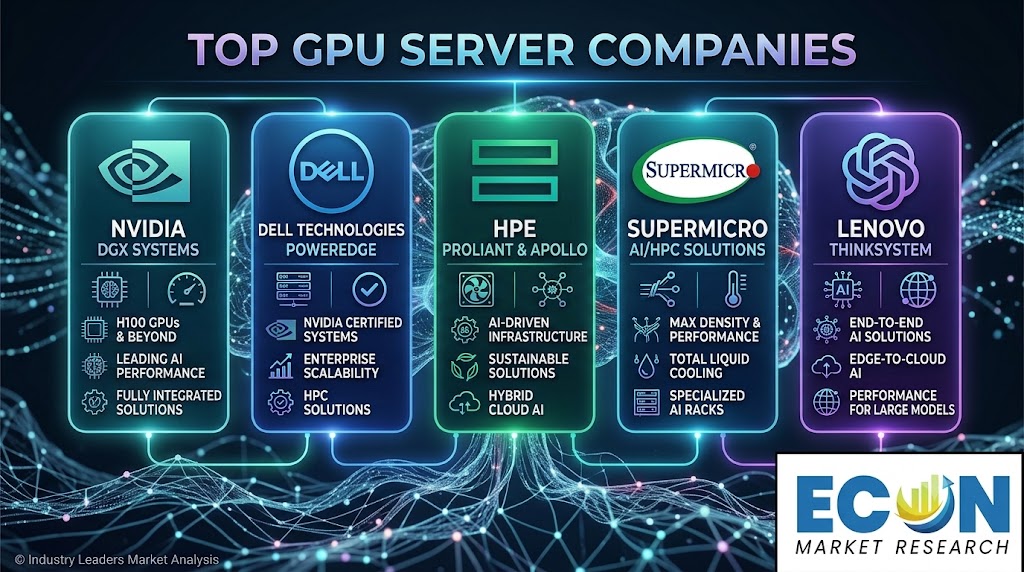
The following 5 GPU server companies were selected using 4 practical criteria: accelerator density, product breadth, rack-scale capability, and enterprise deployment support. The assessment emphasizes current systems with 8-GPU or larger configurations, memory capacity, cooling readiness, networking, validated software, and global service coverage rather than financial size. Product performance can vary materially across models, batch sizes, precision formats, data pipelines, and software versions, so buyers should request reproducible benchmark conditions rather than relying on 1 peak specification.
1. Dell Technologies
Company overview: Dell Technologies is a major enterprise infrastructure provider with roots dating to 1984 and a broad portfolio covering servers, storage, networking, services, and integrated AI systems. Headquarters: The company is headquartered at 1 Dell Way in Round Rock, Texas, USA. Core GPU server expertise: Dell specializes in high-density, multi-vendor accelerator systems for generative AI, high-performance computing, enterprise inference, digital twins, and private AI deployments. Major products and services: Its PowerEdge XE9680 supports 8 NVIDIA H100, H200, or H20 GPUs, 8 AMD Instinct MI300X accelerators, or 8 Intel Gaudi 3 accelerators. The platform offers 32 DDR5 DIMM slots, up to 4 TB of system memory, and as many as 16 E3.S NVMe drives, while alternative storage configurations can reach approximately 122.88 TB. Dell also provides rack integration, networking, storage, deployment services, support, and validated AI infrastructure stacks, making it a strong option for organizations that want a single supplier across compute, data, fabric, and lifecycle operations.
2. Hewlett Packard Enterprise
Company overview: Hewlett Packard Enterprise, operating as an independent enterprise technology company since 2015 and drawing on a computing heritage that began in 1939, serves data center, cloud, networking, and supercomputing customers. Headquarters: Its corporate headquarters is at 1701 East Mossy Oaks Road in Spring, Texas, USA. Core GPU server expertise: HPE is particularly strong in large AI clusters, exascale-class supercomputing, direct liquid cooling, high-speed fabrics, and integrated machine-learning environments. Major products and services: The HPE Cray XD670 can support 8 NVIDIA H200 GPUs, up to 32 DDR5 DIMMs, memory speeds up to 5,600 MT/s, and current-generation Intel Xeon processors. HPE also offers systems such as the Cray XD685 with choices across 8 NVIDIA or AMD accelerators, along with rack-scale configurations based on 72-GPU architectures. Its services span cluster design, factory integration, Slingshot networking, storage, software environments, support, and managed operations. The company is well suited to laboratories, governments, telecom operators, and enterprises that require clusters from 8 GPUs to several thousand GPUs.
3. Lenovo
Company overview: Lenovo is a global technology manufacturer with operations in more than 180 markets and extensive experience in enterprise servers, supercomputing, edge infrastructure, and liquid-cooled systems. Headquarters: The company maintains principal headquarters in Beijing, China, and Morrisville, North Carolina, USA, while its listed parent is incorporated in Hong Kong. Core GPU server expertise: Lenovo focuses on dense AI training platforms, Neptune liquid cooling, enterprise HPC, hybrid AI, and scalable infrastructure that can be deployed from an individual 8-GPU server to a multi-rack cluster. Major products and services: The ThinkSystem SR680a V3 is an 8U platform supporting 8 NVIDIA B200 GPUs rated at up to 1,000 W each, with 180 GB of HBM3e memory per GPU, 32 DIMM slots, and up to 4 TB of system memory. Earlier configurations support 8 H100 GPUs with 80 GB each or 8 H200 GPUs with 141 GB each, while the newer SR680a V4 combines 2 Intel Xeon 6 processors with 8 NVIDIA B300 GPUs. Lenovo also provides storage, networking, cluster management, consulting, deployment, and global support.
4. Supermicro
Company overview: Supermicro has built its position around rapid platform development, application-optimized servers, rack-scale integration, and a building-block architecture covering CPU, GPU, storage, networking, and cooling. Headquarters: The company is headquartered at 980 Rock Avenue in San Jose, California, USA. Core GPU server expertise: Supermicro is known for launching a wide range of GPU server form factors, including 1U, 2U, 4U, 5U, 8U, and 10U systems, as well as liquid-cooled rack solutions and turnkey AI clusters. Major products and services: Its 10U HGX B200 platform integrates 8 NVIDIA B200 GPUs rated at up to 1,000 W each, and the design can support up to 4 systems in a rack where facility power and cooling allow. The company’s portfolio extends to B300, GB300 NVL72, AMD accelerator systems, edge AI servers, high-capacity storage, switches, rack integration, burn-in testing, and data center deployment. Supermicro states that its second-generation direct-liquid-cooling technology can deliver up to 40% facility power and water savings and up to 20% lower total ownership cost under specified conditions.
5. NVIDIA
Company overview: NVIDIA is both a GPU technology developer and a complete AI infrastructure supplier, with an ecosystem spanning accelerators, CPUs, interconnects, network adapters, switches, software libraries, enterprise software, and reference systems. Headquarters: Its principal office is at 2788 San Tomas Expressway in Santa Clara, California, USA. Core GPU server expertise: NVIDIA’s strength lies in tightly integrated accelerated computing, including CUDA software, NVLink, NVSwitch, InfiniBand, Ethernet, AI frameworks, model deployment tools, and validated cluster designs. Major products and services: The DGX B200 integrates 8 Blackwell GPUs, 1,440 GB of total GPU memory, 64 TB/s of memory bandwidth, up to 144 petaFLOPS of FP4 performance, 2 TB of system memory configurable to 4 TB, and 112 CPU cores. At rack scale, the GB200 NVL72 connects 72 Blackwell GPUs and 36 Grace CPUs with 130 TB/s of aggregate NVLink bandwidth. NVIDIA also offers enterprise software subscriptions, cluster management, pretrained models, inference microservices, support, and certified partner systems, giving customers an end-to-end GPU server platform rather than an accelerator alone.
Regional Outlook
North America
North America remains one of the most mature GPU server regions because it combines hyperscale cloud capacity, semiconductor design, advanced research laboratories, enterprise software demand, and a large colocation ecosystem. A row-level analysis of the June 2026 global 500-system supercomputing dataset identifies 178 systems in North America, of which 82 use an accelerator or coprocessor. The United States alone accounts for 161 systems and 76 accelerated installations in that dataset. The region also operates several of the world’s most powerful machines: El Capitan reached approximately 1.809 exaFLOPS with about 11.34 million cores and a listed power figure near 29,685 kW; Frontier delivered about 1.353 exaFLOPS with 9.07 million cores and 24,607 kW; and Aurora exceeded 1.01 exaFLOPS using more than 9.26 million cores. These systems validate large-scale use of AMD and Intel accelerators alongside the extensive NVIDIA GPU server installed base.
Commercial AI infrastructure is also expanding beyond traditional cloud regions. A major US AI infrastructure program announced 5 additional data center locations alongside existing sites, taking planned capacity to nearly 7 GW. Another expansion disclosed 4.5 GW of additional capacity and an eventual requirement exceeding 2 million advanced chips. These numbers illustrate why utilities, data center developers, cooling suppliers, fiber operators, and GPU server manufacturers are coordinating earlier in the site-development cycle.
North American demand is strongest in generative AI training, search, recommendation systems, cybersecurity, drug discovery, autonomous systems, financial modeling, media generation, and enterprise copilots. However, grid interconnection queues, transformer supply, skilled labor, water constraints, and permitting can delay deployments by 12–36 months. Successful regional projects increasingly use phased 10 MW, 50 MW, and 100 MW modules, direct liquid cooling, on-site power strategies, and workload scheduling that shifts non-urgent jobs to lower-cost or lower-carbon hours.
Europe
Europe’s GPU server market is shaped by sovereign AI policy, scientific computing, industrial engineering, data protection, energy efficiency, and multilingual model development. A row-level analysis of the June 2026 global 500-system dataset identifies 160 European systems, including 93 accelerated installations. Germany has 41 listed systems, France 21, Italy 18, the United Kingdom 11, Sweden 9, Norway 8, Poland 8, and the Netherlands 7.
Europe’s flagship JUPITER system reached the 1-exaFLOP class with about 4.80 million cores and a listed power figure near 15,794 kW. Its architecture uses approximately 24,000 GH200 Superchips, direct liquid cooling, high-speed networking, and roughly 20 PB of flash storage. This combination reflects the European preference for highly efficient, research-oriented infrastructure that can support climate science, materials discovery, digital twins, engineering, language models, and public-sector AI.
The region is also building a distributed AI access model. By 2026, the European program included 19 AI Factories, 13 associated antenna sites, 14 supercomputers, and participation from 38 states. This structure gives startups, universities, research institutes, and public agencies access to GPU server capacity without requiring each organization to construct a dedicated facility. Europe’s competitive advantage is not simply the number of GPUs; it is the integration of compute with regulated data spaces, sector expertise, cybersecurity, and energy-efficient operations.
Opportunities are particularly strong in automotive engineering, aerospace, pharmaceutical research, manufacturing, telecommunications, climate modeling, and public-language models covering more than 20 major European languages. Constraints include fragmented power markets, long permitting timelines, regional data residency rules, and uneven access to 100–400 Gb/s connectivity. As a result, European GPU server buyers increasingly value modular clusters, liquid cooling, waste-heat reuse, auditable AI software, and clear energy telemetry at the server, rack, and facility levels.
Asia-Pacific
Asia-Pacific is a diverse GPU server market spanning hyperscale manufacturing hubs, national supercomputing programs, cloud regions, semiconductor ecosystems, and fast-growing digital economies. A row-level analysis of the June 2026 global 500-system dataset identifies 145 systems in Asia and 4 in Oceania, producing a combined Asia-Pacific total of 149 systems. Of these, 88 use accelerators or coprocessors. Japan has 44 listed systems, China 31, South Korea 19, Taiwan 11, India 7, Singapore 7, and Australia 4. Japan’s ABCI 3.0 demonstrates the region’s scale with 766 nodes, 6,128 H200 GPUs, 73,536 CPU cores, 400 Gb/s networking, and a 75 PB storage platform. The system provides 8 GPUs per node and is designed for generative AI, industrial research, and advanced computing services.
The region’s growth drivers differ by country. China combines domestic AI demand, large data center clusters, and accelerator localization; Japan emphasizes robotics, scientific computing, automotive systems, and national AI capacity; South Korea and Taiwan connect GPU servers with semiconductor manufacturing and electronics; Singapore acts as a regional cloud and colocation hub; Australia supports research, mining, defense, and climate workloads; and India is expanding shared access for startups and public institutions.
India reported more than 34,000 GPUs in its common AI compute capacity by May 2025, a scale intended to lower entry barriers for model training and inference. Japan is also planning a successor to its current flagship supercomputer with GPU acceleration and an operating target around 2030. Power availability remains a major factor because China represented about 25% of global data center electricity use in 2024, while several Asia-Pacific cities have introduced stricter efficiency or capacity requirements. GPU server opportunities will therefore favor high-density designs, renewable integration, warm-water cooling, regional-language AI, and managed GPU cloud services.
Middle East & Africa
The Middle East and Africa GPU server market is smaller in installed system count but is becoming strategically important because of national AI programs, abundant energy resources in selected countries, new cloud regions, and demand for Arabic and African-language models. A row-level review of the June 2026 global 500-system dataset identifies 18 systems across selected Middle Eastern and African countries, including 8 in Saudi Arabia, 5 in the United Arab Emirates, 3 in Israel, 1 in Morocco, and 1 in South Africa. Of these 18 systems, 14 use an accelerator or coprocessor. Saudi Arabia’s EYAS system, based on Dell PowerEdge XE9680 servers and H200 GPUs, appeared near rank 51 with approximately 48.83 petaFLOPS of measured performance and 68.61 petaFLOPS of peak performance. This installation shows that the region is moving from conventional enterprise infrastructure toward dense, globally competitive AI and scientific systems.
Large announced projects could reshape the regional GPU server landscape. A Saudi AI infrastructure initiative disclosed an initial deployment of 18,000 GB300 accelerators and a target of 500 MW of AI capacity over 5 years. In the UAE, a planned 1 GW AI campus expects its first 200 MW phase to become operational in 2026. Africa’s priorities are different and include shared national research infrastructure, weather forecasting, agriculture, health, mining, education, and language technology. South Africa’s planned national high-performance computing replacement specifies about 4 petaFLOPS of sustained performance, 512 compute nodes, 128 cores per node, storage throughput near 200 GB/s, and capacity to serve more than 1,500 users and 100 applications. Regional challenges include limited fiber reach outside major hubs, scarcity of advanced cooling expertise, import lead times, and unequal access to reliable electricity. Opportunities are strongest for modular GPU server clusters, sovereign cloud services, workforce training, Arabic and African-language models, and cooling systems designed for high ambient temperatures.
Future Opportunities in the GPU Server
Future opportunities in the GPU server market will emerge from the transition between 3 deployment scales: single-node enterprise systems, multi-rack AI clusters, and utility-scale AI factories. The first opportunity is enterprise inference, where organizations can deploy 2-GPU, 4-GPU, or 8-GPU servers for private copilots, search, document intelligence, video analytics, engineering, and cybersecurity. The second is rack-scale training, where 72-GPU designs reduce communication overhead for large models. The third is shared national or regional compute, where thousands of GPUs can be scheduled as a public or commercial service. Hardware vendors can differentiate through memory capacity, 400 Gb/s and 800 Gb/s fabrics, PCI Express 6.0 connectivity at 64 GT/s, direct liquid cooling, and integrated storage. Software opportunities are equally important: orchestration, observability, model optimization, checkpointing, security, chargeback, and multi-tenant isolation can improve effective utilization without adding new accelerators.
A second opportunity lies in energy-aware GPU server design. Global data center electricity demand is projected to approach 950 terawatt-hours by 2030, so future purchasing decisions will increasingly measure useful AI output per kilowatt-hour rather than peak petaFLOPS alone. High-voltage DC distribution capable of supporting rack designs from about 100 kW toward 1 MW, waste-heat reuse, warm-water cooling, and workload shifting can reduce infrastructure bottlenecks. Multi-instance GPU technology also allows a single H200-class accelerator to be divided into as many as 7 isolated instances, improving utilization for smaller inference and development jobs. Additional growth areas include healthcare imaging, computational biology, digital twins, autonomous machines, telecom network optimization, financial risk simulation, and generative design. For GPU server companies, the strongest long-term position will come from combining hardware with verified benchmarks, secure software, skilled deployment teams, component-level telemetry, 3–5 year support plans, and an upgrade path that protects existing racks, power systems, and cooling investments.
Conclusion
The GPU server market in 2026 is no longer defined by the simple question of which company offers the fastest accelerator. Competitive advantage now depends on how effectively a supplier integrates 8-GPU servers, 72-GPU racks, high-bandwidth memory, 400 Gb/s or faster networking, liquid cooling, storage, software, and lifecycle services. Dell Technologies, Hewlett Packard Enterprise, Lenovo, Supermicro, and NVIDIA each bring a different strength: multi-vendor flexibility, supercomputing experience, liquid-cooled enterprise design, rapid platform breadth, or full-stack accelerated computing. Regional demand is also becoming more balanced, with 178 systems in North America, 160 in Europe, 149 across Asia-Pacific, and at least 18 across selected Middle Eastern and African countries in the June 2026 global 500-system dataset. Buyers should compare at least 7 factors—model performance, memory capacity, networking, power, cooling, software compatibility, and support—before selecting a GPU server company. A well-designed deployment can scale from 2 or 4 accelerators to 1,000 or more, but only when the facility, data pipeline, security model, and operations team are planned together. The leading GPU server companies will be those that convert raw compute into reliable, efficient, measurable business and scientific outcomes.