


Top Digital Twin Companies Transforming Global Industries
The top digital twin companies are advancing AI, simulation, industrial automation, smart infrastructure, predictive maintenance, and digital transformation.
Introduction
Overview of the Global Digital Twin Industry
The global digital twin industry has evolved from a specialized engineering concept into a strategic technology ecosystem serving manufacturing, energy, healthcare, transportation, construction, aerospace, utilities, and smart cities. A digital twin is a continuously updated virtual representation of a physical asset, production process, facility, network, or complete operating environment. Unlike a static 3D model, a modern digital twin uses real-time sensor data, simulation, artificial intelligence, machine learning, and operational records to reproduce actual behavior. In 2026, organizations are deploying digital twins across 4 major levels: components, individual assets, interconnected systems, and enterprise-wide processes. These deployments help engineering teams test 100s of operating scenarios without interrupting physical equipment.
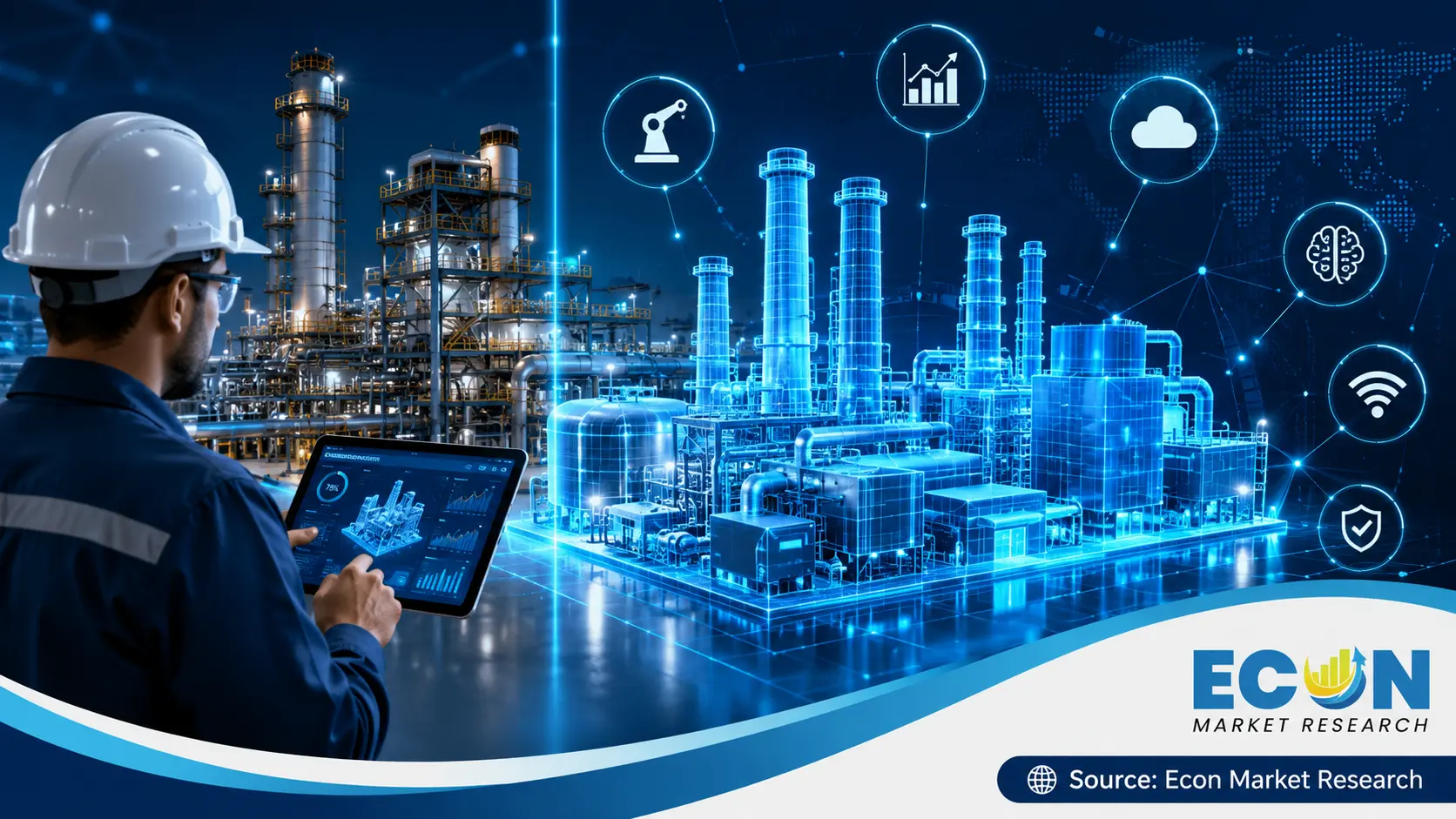
Digital twin adoption is expanding because industrial organizations must improve asset availability, energy efficiency, safety, product quality, and production flexibility. A connected digital twin can monitor thousands of sensor readings, compare actual performance with expected performance, and identify early signs of equipment degradation. In manufacturing, the technology connects product design, factory planning, production engineering, automation, and maintenance within 1 digital thread. In energy operations, digital twins represent wind turbines, power grids, substations, solar installations, and battery systems. In urban infrastructure, 3D digital twins support traffic planning, environmental analysis, emergency response, and building management. These practical applications are making digital twin platforms central to industrial digital transformation.
Market Evolution and Growth Drivers
The modern digital twin market developed through at least 3 major technology phases. The 1st phase focused on computer-aided design and static simulation, the 2nd phase connected virtual models with sensors and industrial IoT systems, and the 3rd phase introduced cloud computing, artificial intelligence, immersive visualization, and real-time operational intelligence. Today, leading digital twin companies combine mechanical engineering, electronics, software, automation, and multiphysics simulation within unified environments. Engineers can evaluate 10 or 100 design alternatives before producing a physical prototype, while operators can continuously compare real-world asset behavior with simulated performance throughout a product’s complete lifecycle.
Several structural forces are accelerating the digital twin industry. Industrial facilities are generating data through millions of connected sensors, while 5G networks and edge computing reduce delays between physical events and virtual updates. Artificial intelligence allows digital twins to identify patterns that traditional monitoring systems may overlook. Sustainability regulations are encouraging manufacturers to simulate energy use, material consumption, emissions, and waste before changing physical operations. Workforce shortages are also increasing demand for remote monitoring, automated diagnostics, and virtual training. Digital twin platforms now support decision-making across 5 critical stages: concept development, product engineering, manufacturing, operation, and retirement.
Top 5 Latest Trends in the Digital Twin Industry
1. AI-Powered and Autonomous Digital Twins
Artificial intelligence is transforming digital twins from descriptive monitoring tools into predictive and increasingly autonomous decision systems. Traditional digital twins show what is happening inside an asset, while AI-powered digital twins estimate what will happen during the next 1 hour, 1 day, or several operating cycles. Machine-learning models analyze historical sensor data, maintenance records, production conditions, and simulation results to detect abnormal behavior. Advanced systems can recommend corrective actions, modify operating parameters, and prioritize maintenance activities before failures occur. In 2026, digital twin platforms increasingly incorporate generative AI assistants, neural networks, reduced-order models, and physics-informed machine learning.
The integration of AI with physics-based simulation is particularly important because purely data-driven models can produce unreliable results when operating conditions change. Hybrid digital twins combine 2 sources of intelligence: established engineering equations and continuously updated field data. One industry survey involving 69 qualified respondents found that 30% primarily built digital twins from high-fidelity physics models, while 20% used surrogate models or reduced-order models. This hybrid approach enables faster analysis without completely sacrificing engineering accuracy. Newer platforms also use methods such as Neural Ordinary Differential Equations and Temporal Fusion Transformers to analyze time-dependent asset behavior.
2. Industrial Metaverse and Immersive Digital Twin Environments
The industrial metaverse is emerging as a major digital twin trend because it combines real-time operational data, high-fidelity 3D environments, simulation, artificial intelligence, and extended reality. Instead of viewing equipment through conventional dashboards, engineers can enter an immersive virtual factory, inspect production lines, collaborate with remote specialists, and test modifications before implementing them physically. A modern industrial metaverse environment may represent 1 machine, an entire factory, or a network of facilities located across several countries. These environments help multidisciplinary teams understand complex systems through visual interaction rather than isolated spreadsheets or engineering files.
Leading technology providers are integrating digital twin platforms with photorealistic visualization engines to create physically accurate virtual environments. These integrations connect mechanical design, production simulation, automation data, and factory information in 1 collaborative space. In 2025, major industrial technology partnerships focused on combining 3D visualization, simulation, factory data, and artificial intelligence into unified digital twin environments. In 2026, new digital twin composition tools were introduced to build industrial metaverse environments at scale. These capabilities can shorten design reviews, reduce physical commissioning activity, improve worker training, and allow 10s or 100s of specialists to collaborate on the same virtual asset.
3. Enterprise-Wide Digital Threads and Lifecycle Twins
Digital twins are expanding beyond individual machines into connected digital threads covering complete products, factories, supply chains, and service operations. A digital thread links data created during multiple lifecycle stages so that engineering, manufacturing, quality, operations, and maintenance teams work from consistent information. For example, a design change made during product development can automatically update manufacturing instructions, simulation models, quality requirements, and service documentation. This continuity eliminates isolated databases and reduces errors caused by outdated engineering information.
Enterprise digital twins can represent 5 interconnected areas: the product, production system, facility, supply network, and customer operating environment. Manufacturers use these connected models to study how a component change affects tooling, production speed, energy consumption, supplier requirements, and field performance. The comprehensive digital twin approach integrates mechanical systems, multiphysics behavior, electronics, software, and automation within the product and production lifecycle. This allows organizations to design, simulate, test, and verify products before physical execution. Digital continuity also improves traceability by preserving the relationship between requirements, design decisions, test results, operating records, and maintenance events.
4. Digital Twins for Sustainability and Energy Optimization
Sustainability has become 1 of the strongest digital twin adoption drivers across factories, buildings, transportation systems, data centers, and electrical networks. Organizations use digital twins to simulate energy consumption, emissions, water usage, thermal performance, material flows, and waste generation. Instead of testing sustainability initiatives on operating facilities, teams can compare multiple scenarios in a virtual environment. A factory twin may evaluate how 3 different production schedules affect electricity demand, while a building twin can analyze heating, ventilation, lighting, occupancy, and indoor comfort conditions.
Digital twins are also supporting renewable energy integration. Grid operators use virtual representations of substations, transformers, cables, distributed solar systems, storage units, and electric-vehicle charging loads. Singapore’s national Grid Digital Twin includes 2 primary models: an Asset Twin for equipment-health management and a Network Twin for studying the effect of new energy sources and consumers. The system uses real-time and historical data to support grid planning and resilience. Environmental digital twins are operating at an even larger scale, including Europe’s Destination Earth initiative, which creates high-accuracy models for climate, natural hazards, environmental change, and human activity.
5. Smart-City, Infrastructure, and Geospatial Digital Twins
Cities and infrastructure operators are using digital twins to manage increasingly complex physical environments. A city-scale digital twin integrates 3D geospatial information, building data, traffic movement, utility networks, environmental sensors, public infrastructure, and demographic activity. Urban planners can evaluate construction proposals, emergency routes, heat-island effects, wind patterns, noise levels, solar exposure, and mobility changes before approving physical development. These models are especially valuable because a decision affecting 1 road, building, or transit route can create consequences across several interconnected systems.
Singapore has demonstrated the value of urban digital twins through Virtual Singapore, a semantically enriched 3D model connected with dynamic information. The platform supports environmental simulations using data such as air quality, temperature, noise, and wind movement. In March 2025, Singapore also launched its 1st Maritime Digital Twin for the Port of Singapore, creating a dynamic virtual model for maritime operations and industry use cases. Smart-building platforms use similar principles at a smaller scale, connecting lifts, access systems, cameras, temperature sensors, and robots to 1 operational model. These deployments show how digital twin technology can move from a single industrial asset to an entire city or national infrastructure network.
Top 5 Companies in the Digital Twin Industry
1. Siemens
Company Overview: Siemens is 1 of the leading global digital twin companies, with extensive capabilities in industrial automation, product lifecycle management, engineering simulation, manufacturing software, smart infrastructure, and industrial artificial intelligence. The company’s digital twin strategy covers products, production systems, facilities, and operating processes. Its technology connects design data with real-time factory information so organizations can simulate decisions before applying them to physical operations.
Headquarters: Munich and Berlin, Germany.
Core Digital Twin Expertise: Siemens specializes in comprehensive digital twins that integrate mechanical engineering, electronics, software, automation, production planning, and operational data. Its approach supports continuous optimization across the entire product and production lifecycle.
Major Products and Services: Siemens Xcelerator, Teamcenter, NX, Simcenter, Tecnomatix, Industrial Edge, Insights Hub, Building X, and Digital Twin Composer are major components of its portfolio. In January 2026, Siemens introduced Digital Twin Composer for creating industrial metaverse environments at scale. The solution strengthens Siemens’ position across manufacturing, automotive, aerospace, electronics, energy, buildings, and transportation.
2. Dassault Systèmes
Company Overview: Dassault Systèmes is a major provider of virtual twin experiences, 3D design tools, simulation software, product lifecycle management, manufacturing operations systems, and scientific modeling solutions. The company’s technology is used across 11 industry groups, including aerospace, transportation, industrial equipment, life sciences, construction, consumer products, energy, and marine engineering. Its virtual twin concept extends beyond visual replication by incorporating scientific simulation, manufacturing knowledge, business processes, and lifecycle data.
Headquarters: Vélizy-Villacoublay, France.
Core Digital Twin Expertise: Dassault Systèmes focuses on virtual twin experiences for products, production systems, biological systems, cities, and business processes. Its platforms allow users to design, model, simulate, test, manufacture, and operate assets within connected 3D environments.
Major Products and Services: The company’s portfolio includes the 3DEXPERIENCE platform, CATIA, SOLIDWORKS, SIMULIA, DELMIA, ENOVIA, BIOVIA, and GEOVIA. CATIA supports engineering design, SIMULIA performs multiphysics simulation, DELMIA models manufacturing operations, and ENOVIA manages lifecycle collaboration. Together, these products create a continuous virtual environment connecting thousands of engineering and operational decisions.
3. PTC
Company Overview: PTC is a global industrial software provider known for product lifecycle management, industrial IoT, augmented reality, computer-aided design, service lifecycle management, and digital twin technology. Its platforms help manufacturers connect product information with factory and field data. PTC’s digital twin capabilities are widely applied to production equipment, connected products, service operations, quality monitoring, and remote maintenance.
Headquarters: Boston, Massachusetts, United States.
Core Digital Twin Expertise: PTC specializes in connecting physical assets with digital models through industrial IoT, product lifecycle information, connectivity software, analytics, and augmented reality. The company’s solutions help users visualize asset conditions, monitor performance, identify anomalies, and deliver work instructions to technicians.
Major Products and Services: ThingWorx, Windchill, Creo, Kepware, Vuforia, ServiceMax, and Arena form the core of PTC’s industrial portfolio. ThingWorx 10.0 strengthens industrial data management, secure IoT connectivity, and real-time operational insight. Kepware connects industrial devices and control systems, while Vuforia delivers augmented-reality experiences based on digital twin information. PTC’s 2025 initiatives also expanded connections between engineering design, AI, simulation, and immersive digital twin workflows.
4. Ansys
Company Overview: Ansys is a leading engineering simulation company with specialized digital twin software for industrial equipment, automotive systems, aerospace components, electronics, energy assets, and complex multiphysics systems. Its platforms are built around engineering accuracy, allowing companies to convert high-fidelity simulation models into computationally efficient operational twins.
Headquarters: Canonsburg, Pennsylvania, United States.
Core Digital Twin Expertise: Ansys specializes in simulation-based digital twins, reduced-order modeling, hybrid analytics, artificial intelligence, machine learning, system simulation, and multiphysics engineering. Its digital twins combine sensor data with physics-based models to monitor performance and predict behavior.
Major Products and Services: Ansys Twin Builder, Ansys TwinAI, Ansys Mechanical, Ansys Fluent, Ansys Maxwell, Ansys optiSLang, and Ansys Minerva support the company’s digital twin ecosystem. Twin Builder enables engineers to build, validate, deploy, and scale connected asset models. The platform can potentially reduce the time required to create an accurate product model by 50%. TwinAI combines real-world data with physics models, while the 2026 R1 release introduced enhanced hybrid analytics, new machine-learning methods, improved reduced-order-model creation, and Ansys CoSim.
5. IBM
Company Overview: IBM applies digital twin technology to enterprise asset management, facilities, energy systems, infrastructure, sustainability, data centers, utilities, and industrial operations. Its digital twin capabilities are closely connected to asset-health monitoring, maintenance planning, artificial intelligence, IoT data, inspection workflows, and operational risk management.
Headquarters: Armonk, New York, United States.
Core Digital Twin Expertise: IBM specializes in operational digital twins that combine asset records, real-time sensor information, maintenance histories, failure patterns, environmental conditions, and AI-based analysis. Its solutions help asset-intensive organizations understand current equipment health and simulate future operational conditions.
Major Products and Services: IBM Maximo Application Suite, Maximo Monitor, Maximo Health, Maximo Predict, Maximo Visual Inspection, IBM Environmental Intelligence, and hybrid cloud services support digital twin deployments. Maximo is used to monitor facilities, renewable-energy assets, data centers, production equipment, and infrastructure networks. In a wind-turbine application, a digital twin can process factors such as air pressure, temperature, wind direction, and turbulence intensity to support operational and maintenance decisions.
Regional Outlook
North America
North America remains a major center for digital twin development because the region combines advanced cloud infrastructure, industrial software companies, aerospace engineering, semiconductor manufacturing, automotive innovation, healthcare technology, and large-scale energy assets. The United States hosts several leading digital twin companies, including PTC, Ansys, IBM, Microsoft, Oracle, Autodesk, and major cloud providers. Digital twin adoption is especially strong across 6 sectors: aerospace and defense, automotive, manufacturing, energy, healthcare, and data centers. Manufacturers use virtual models to validate equipment configurations, improve production quality, and support predictive maintenance across geographically distributed plants.
The region’s aerospace industry represents 1 of the most technically demanding digital twin application areas. Aircraft, spacecraft, engines, avionics, and propulsion systems contain thousands of interconnected components that must perform under extreme conditions. Digital twins allow engineers to analyze temperature, vibration, stress, fatigue, pressure, airflow, and maintenance history without conducting a physical test for every scenario. Automotive companies use similar models for electric-vehicle batteries, power electronics, autonomous-driving systems, manufacturing lines, and charging infrastructure. A vehicle digital twin may connect 100s of onboard signals with design and test data.
North America is also advancing digital twins for data centers and critical infrastructure. AI computing is increasing rack density, electrical demand, thermal loads, and cooling complexity. Digital twins help operators simulate airflow, equipment placement, power distribution, cooling-system behavior, and maintenance events before modifying operating facilities. Healthcare organizations are exploring virtual models for medical devices, hospitals, clinical workflows, and patient-specific planning. The region’s strong venture-capital ecosystem, university network, industrial base, and cloud capacity will support continued innovation, although cybersecurity, interoperability, data ownership, and specialist shortages remain 4 significant implementation barriers.
Europe
Europe has a strong digital twin ecosystem supported by advanced manufacturing, automotive engineering, industrial automation, aerospace, energy, maritime industries, research institutions, and public digital programs. Germany, France, the United Kingdom, Italy, Sweden, Finland, the Netherlands, and Switzerland are important technology centers. Major European providers include Siemens and Dassault Systèmes, while numerous specialized companies offer simulation, building information modeling, geospatial analysis, industrial IoT, and infrastructure-monitoring solutions. European manufacturers use digital twins to improve energy efficiency, reduce material waste, optimize factory layouts, and manage complex equipment lifecycles.
The European automotive sector applies digital twins across vehicle design, battery engineering, production simulation, robotics, supply chains, and after-sales services. A single vehicle program may include 1,000s of design requirements and millions of engineering relationships. Digital continuity helps manufacturers coordinate mechanical, electrical, electronic, and software development. Aerospace companies use virtual twins for airframes, engines, cabin systems, production lines, and maintenance planning. European energy operators also deploy twins for offshore wind systems, grids, nuclear facilities, renewable assets, pipelines, and industrial plants.
Public initiatives provide another major adoption channel. Destination Earth is designed to create a highly accurate digital representation of Earth for monitoring environmental change, natural disasters, human activities, and climate impacts. The program uses high-performance computing, artificial intelligence, satellite observations, and scientific models. European institutions identify digital twins as relevant to at least 6 vertical areas: manufacturing, energy, smart cities, agriculture, buildings, and healthcare. In June 2026, European programs continued highlighting digital twins as tools for climate neutrality, resilient infrastructure, and industrial competitiveness. Data standards, cross-border interoperability, intellectual-property protection, and regulatory compliance will remain important priorities.
Asia-Pacific
Asia-Pacific is becoming one of the most diverse digital twin regions because it includes global manufacturing centers, rapidly expanding cities, large transportation networks, semiconductor hubs, ports, power systems, and public digitalization programs. China, Japan, South Korea, India, Singapore, and Australia are developing digital twin applications across industrial production, electronics, automotive manufacturing, infrastructure, mining, utilities, and smart cities. The region’s factories operate millions of machines, creating substantial opportunities for connected monitoring, predictive maintenance, virtual commissioning, and AI-supported quality management.
Japan and South Korea have strong capabilities in automotive engineering, robotics, electronics, shipbuilding, and factory automation. Digital twins help manufacturers simulate robot movement, production capacity, assembly sequences, and equipment failures before making physical changes. China is expanding digital factory, smart-city, electric-vehicle, renewable-energy, and infrastructure applications. India’s digital twin opportunities are linked to manufacturing modernization, metro systems, airports, roads, utilities, smart cities, energy infrastructure, and industrial corridors. Smaller manufacturers can increasingly access these tools through cloud-based subscriptions instead of building large on-premise computing environments.
Singapore provides several advanced public-sector examples. Virtual Singapore created a detailed and semantically enriched 3D national model that can incorporate real-time environmental information. The country’s Grid Digital Twin consists of an Asset Twin and a Network Twin, supporting equipment-health monitoring and analysis of new loads such as electric-vehicle charging, solar generation, and energy storage. On March 24, 2025, Singapore launched its 1st Maritime Digital Twin for the Port of Singapore. These 3 programs demonstrate how digital twins can connect land planning, energy management, and maritime operations. Across Asia-Pacific, expansion will depend on industrial connectivity, engineering skills, data governance, cybersecurity, and compatibility between local equipment and global software platforms.
Middle East & Africa
The Middle East and Africa digital twin landscape is developing through smart-city construction, energy infrastructure, utilities, transportation projects, industrial diversification, mining, ports, and climate-resilience programs. The Gulf states are among the region’s most active adopters because they are building large urban developments, renewable-energy systems, transportation networks, and digitally managed infrastructure. Saudi Arabia, the United Arab Emirates, Qatar, and Oman are using 3D modeling, IoT, artificial intelligence, and geospatial systems to improve planning and operations.
Saudi Arabia has incorporated digital twin concepts into government modernization and Vision 2030 initiatives. The country recognizes digital twin technology as a management model for connecting physical and digital components, improving decision-making, predicting failures, and coordinating disaster-response information across health, transportation, and infrastructure systems. NEOM-related initiatives also include digital twin applications, while Saudi industrial programs are exploring immersive environments, spatial computing, augmented reality, virtual reality, and industrial twins. These projects create opportunities for engineering software, cloud infrastructure, sensors, cybersecurity, systems integration, and workforce training.
The United Arab Emirates is developing digital twin capabilities for urban services, buildings, utilities, mobility, construction, and metaverse applications. Dubai’s technology strategies have promoted artificial intelligence, blockchain, IoT, 3D printing, robotics, and immersive environments. The Dubai Metaverse Strategy was introduced with a goal of supporting 40,000 virtual jobs by 2030 and building upon an ecosystem containing 1,000 companies in blockchain and metaverse fields at the time of launch. In July 2026, Dubai also announced a city-focused Digital Twin Platform initiative.
African adoption is less uniform but holds significant potential across mining, utilities, telecommunications, ports, agriculture, water systems, and urban infrastructure. Mining companies can use digital twins to track vehicle fleets, processing facilities, ventilation systems, and equipment health. Utilities can model electricity networks and water distribution systems to reduce outages and leakage. The region’s key challenges include connectivity gaps, limited industrial data, implementation costs, engineering-skill shortages, and cybersecurity readiness. Cloud delivery, modular software, and mobile connectivity could make digital twin solutions accessible to a wider range of African operators during the next 5 to 10 years.
Future Opportunities in the Digital Twin Industry
Future digital twin opportunities will extend from individual equipment models to autonomous industrial ecosystems. The largest strategic opportunity is the creation of composable digital twins that organizations can assemble from reusable models, data connectors, simulation services, and AI components. Instead of spending 12 or 24 months building a customized twin, companies may deploy standardized asset templates for pumps, motors, turbines, robots, buildings, batteries, and production lines. Open standards will allow models from multiple vendors to exchange information within 1 operational environment.
AI agents will create another major opportunity. A future digital twin may include multiple specialized agents: 1 agent monitoring equipment health, 1 optimizing energy use, 1 checking production quality, and 1 coordinating maintenance resources. These systems could evaluate 1,000s of possible operating combinations and recommend the safest or most efficient plan. Human approval will remain essential for high-risk sectors, but low-risk adjustments may become increasingly automated. Physics-informed AI will help prevent decisions that violate engineering limits.
Healthcare represents a high-potential area for digital twin innovation. Virtual models can support medical-device development, hospital capacity planning, surgical preparation, rehabilitation, and personalized treatment research. A patient-specific twin may eventually combine imaging, laboratory results, wearable-device readings, treatment history, and physiological models. Such applications will require strict privacy, clinical validation, explainable algorithms, and regulatory oversight because even 1 incorrect recommendation can create substantial risk.
Climate resilience and infrastructure modernization will also generate major opportunities. Digital twins can model floods, wildfires, heat waves, coastal risks, traffic disruption, grid instability, and water shortages. Governments can test 10s of adaptation strategies before investing in physical infrastructure. Smaller companies will gain access through cloud platforms, pay-per-use simulation, and industry-specific digital twin services. The most successful solutions will combine 5 qualities: engineering accuracy, real-time connectivity, cybersecurity, interoperability, and measurable operational value.
Conclusion
The digital twin industry is moving from isolated pilot projects toward enterprise-scale systems that connect engineering, production, operations, maintenance, sustainability, and strategic planning. Leading digital twin companies such as Siemens, Dassault Systèmes, PTC, Ansys, and IBM bring different strengths to this transformation. Siemens emphasizes comprehensive product and production twins, Dassault Systèmes develops virtual twin experiences, PTC connects industrial IoT with lifecycle information, Ansys provides physics-based simulation twins, and IBM focuses on AI-enabled asset management.
Across 4 major regions, adoption is being shaped by different priorities. North America is advancing aerospace, manufacturing, healthcare, energy, and data-center twins. Europe combines industrial leadership with environmental and public digital twin programs. Asia-Pacific is applying the technology to factories, ports, grids, cities, and transportation networks. The Middle East and Africa are creating opportunities through smart cities, energy infrastructure, industrial diversification, mining, and utility modernization.
During the next 5 to 10 years, digital twins will become more intelligent, connected, immersive, and autonomous. Organizations that establish reliable data foundations, engineering governance, cybersecurity controls, and cross-functional expertise will gain the greatest benefits. The technology’s long-term importance will not depend only on creating accurate virtual replicas. Its real value will come from helping decision-makers test alternatives, predict consequences, reduce physical risk, and continuously improve complex real-world systems.