


Remote Patient Monitoring Companies Shaping Digital Care
The top remote patient monitoring companies are advancing connected devices, AI analytics, chronic care, cardiac tracking, and hospital-at-home services.
Introduction
Overview of the Global Remote Patient Monitoring Devices Industry
The remote patient monitoring devices industry connects patients with clinicians through blood-pressure monitors, continuous glucose sensors, pulse oximeters, weight scales, electrocardiogram patches, respiratory devices, cardiac implants, wearables, and cloud-based clinical dashboards. The Top Companies in the Remote Patient Monitoring Devices Industry now support diabetes management, hypertension care, cardiac diagnostics, sleep-disorder treatment, respiratory surveillance, post-surgical recovery, and hospital-at-home programs. CMS defines remote patient monitoring as the collection of health measurements through a connected medical device that automatically transmits information to a healthcare provider. This model is increasingly important because noncommunicable diseases caused at least 43 million deaths in 2021, representing 75% of non-pandemic-related deaths worldwide.
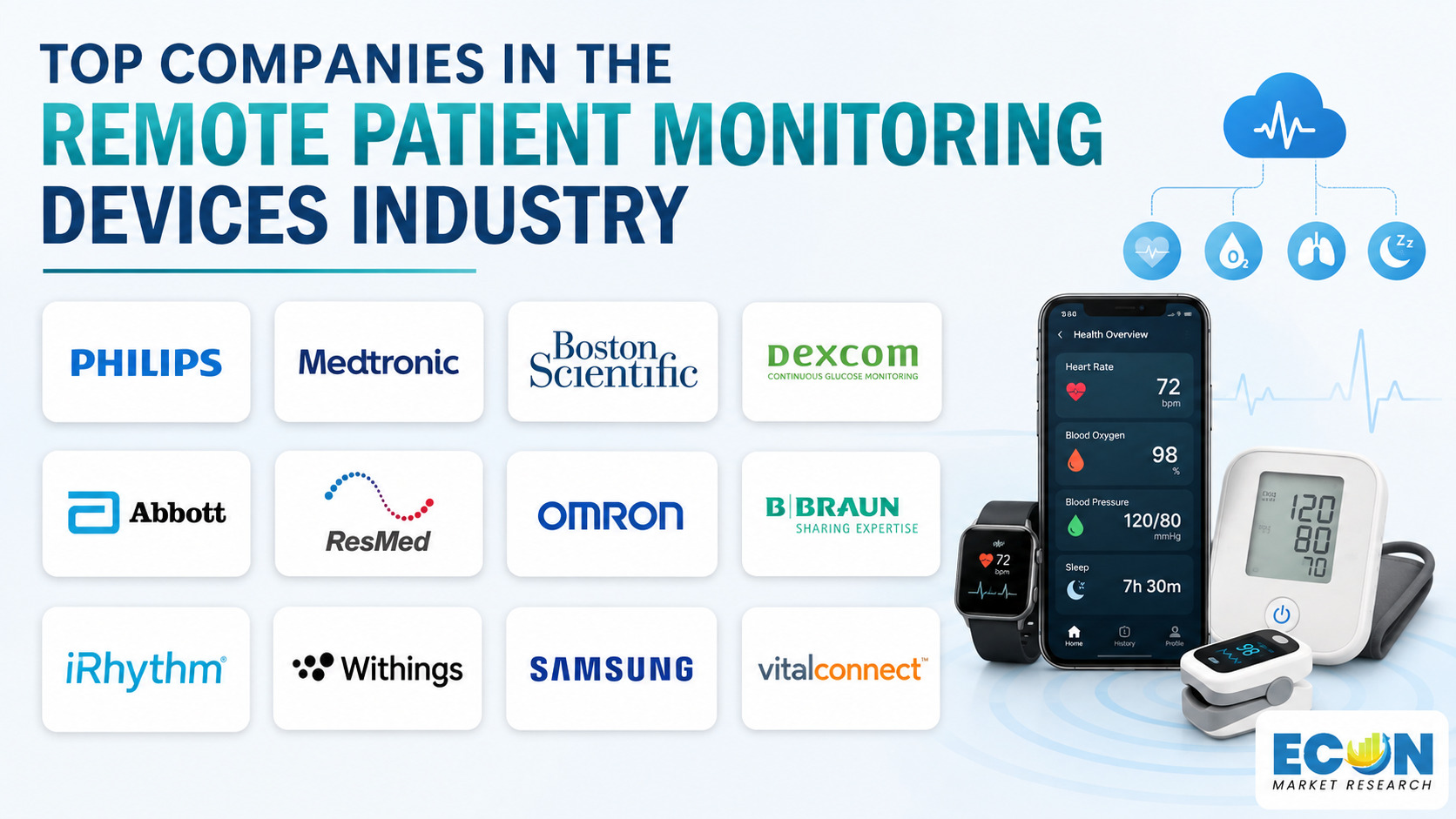
The industry has moved beyond individual home devices into connected care ecosystems capable of supporting millions of users. Abbott’s FreeStyle Libre portfolio is used by over 7 million people, iRhythm has analysed data from over 12 million patients, OMRON has sold over 350 million home blood-pressure monitors, and ResMed has placed over 10 million cloud-connectable respiratory devices into the market. Hospitals, specialist clinics, home-health providers, primary-care networks, insurers, and clinical research organisations now use monitoring data to manage patients between scheduled visits. Competitive differentiation increasingly depends on measurement accuracy, device connectivity, battery duration, clinical workflow integration, cybersecurity, regulatory clearance, patient adherence, and the ability to convert continuous data into actionable alerts.
Market Evolution and Growth Drivers
Remote monitoring initially relied on telephone reporting and manually entered readings, but Bluetooth, cellular communications, cloud computing, compact sensors, and smartphone applications have automated data transmission. U.S. Medicare use of remote patient monitoring increased by over 10 times between 2019 and 2022. Commercial development also accelerated after Medtronic launched an app-based pacemaker monitoring system in 2015, OMRON introduced its VitalSight hypertension service, and Dexcom expanded real-time glucose sharing through mobile applications. These systems allow clinicians to review blood pressure, glucose, cardiac rhythm, oxygen saturation, weight, respiratory therapy adherence, and implanted-device performance without requiring every interaction to occur inside a healthcare facility.
Policy, workforce pressure, and chronic-disease management are now major adoption drivers. Medicare generally requires physiological information to be collected for at least 16 days within a 30-day period for specified RPM device-supply services. However, a federal review found that 43% of Medicare enrollees receiving RPM did not receive all 3 expected components of the service, increasing demand for stronger workflow controls and billing oversight. Cybersecurity has become equally important because connected devices exchange sensitive information through apps, home hubs, hospital systems, and cloud platforms. FDA guidance updated in 2025 addresses secure device design, cybersecurity documentation, labeling, vulnerability management, and resilience throughout the product lifecycle.
Top 5 Latest Trends in the Remote Patient Monitoring Devices Industry
Multisensor hospital-at-home monitoring
AI-assisted detection and clinical prioritisation
Continuous chronic-disease monitoring
Smartphone-connected cardiac and respiratory devices
Interoperability, cybersecurity, and data governance
Trend 1: Multisensor Hospital-at-Home Monitoring
Hospital-at-home programs are expanding remote monitoring beyond routine chronic-care measurements into higher-acuity clinical pathways. These programs combine pulse oximetry, temperature, blood pressure, respiration, heart rate, symptom reporting, video consultations, and clinician dashboards. In 2026, a Philips-led consortium was selected to support a Stockholm regional program designed to monitor up to 15,000 patients annually under an agreement lasting as long as 8 years. The initiative serves a region containing over 2 million people and demonstrates how remote patient monitoring devices can support complex patients outside traditional wards. Multisensor programs are particularly relevant for post-surgical recovery, respiratory disease, cardiac care, oncology support, infection management, and frail older adults.
Trend 2: AI-Assisted Detection and Clinical Prioritisation
AI is increasingly used to analyse large monitoring datasets, identify abnormal patterns, and rank patients according to clinical urgency. iRhythm’s cardiac monitoring platform has processed over 3 billion hours of curated heartbeat information and generated nearly 12 million patient reports. Its service combines FDA-cleared algorithms with qualified cardiac-technician review, producing end-of-wear reports that have recorded 99% physician agreement. AI-supported RPM is also being applied to glucose-pattern analysis, heart-failure alerts, respiratory deterioration, and arrhythmia classification. The operational value comes from reducing the amount of raw data clinicians must inspect while ensuring that high-risk events are surfaced quickly enough for review and intervention.
Trend 3: Continuous Chronic-Disease Monitoring
Continuous monitoring is replacing isolated measurements in diabetes, hypertension, cardiac rhythm management, and respiratory therapy. Dexcom G7 devices send glucose readings every 5 minutes, while the G7 15 Day system provides up to 15.5 days of use and achieved an overall mean absolute relative difference of 8.0% in supporting data. Abbott’s FreeStyle Libre platform serves over 7 million users and shares glucose information through connected applications and the LibreView clinical platform. OMRON’s connected blood-pressure monitors automatically transfer home readings through mobile apps or dedicated hubs. This trend matters because continuous or high-frequency data can expose overnight events, treatment-response patterns, medication effects, and deterioration that may remain invisible during periodic office measurements.
Trend 4: Smartphone-Connected Cardiac and Respiratory Devices
Smartphones are becoming the principal gateway between monitoring hardware, patients, caregivers, and clinicians. Medtronic’s MyCareLink Heart app allows compatible implanted cardiac devices to communicate through cellular or Wi-Fi connections, while Dexcom Follow permits glucose information to be shared with up to 10 followers. ResMed’s myAir application presents daily therapy scores, and AirView gives clinicians access to sleep and ventilation data across reporting windows of 1 to 90 days. iRhythm’s MyZio app, which has recorded over 1 million downloads, supports symptom logging and patient education during ECG monitoring. Smartphone connectivity reduces reliance on dedicated receivers but increases the importance of software compatibility, mobile-data availability, and patient digital literacy.
Trend 5: Interoperability, Cybersecurity, and Data Governance
Device makers are being pushed to integrate RPM information with electronic health records while protecting it across multiple networks. The European Health Data Space Regulation entered into force on March 26, 2025, beginning a transition toward common requirements for accessing and exchanging electronic health data across the 27-member European Union. In the United States, updated FDA cybersecurity guidance addresses connected medical-device resilience, while CMS oversight is focusing more closely on who orders RPM and what physiological information is monitored. These developments influence product architecture, authentication, encryption, audit trails, application programming interfaces, consent management, and post-market surveillance. Companies that cannot demonstrate secure and interoperable data handling may struggle to win hospital and government contracts.
Top 10 Companies in the Remote Patient Monitoring Devices Industry
The following 10 companies are presented according to product capabilities, clinical relevance, technical expertise, geographic presence, connected-device scale, regulatory experience, and deployment activity. They are not arranged as a strict financial or market-share ranking.
1. Royal Philips
Company Overview: Philips was founded in 1891 and employed about 64,800 people in 2025, with sales and services operating in over 100 countries. Headquarters: Amsterdam, Netherlands. Core Remote Patient Monitoring Devices Expertise: Philips connects bedside monitoring, wearable devices, clinical informatics, telehealth workstations, and hospital-at-home workflows. Major Products and Services: Its portfolio includes IntelliVue monitoring systems, mobile clinical-access tools, central surveillance platforms, wearable biosensors, and enterprise monitoring software. In 2026, Philips participated in an advanced Stockholm hospital-at-home project designed to support up to 15,000 patients annually. Its Medical Tablet, introduced with IntelliVue XDS software in 2021, can display information from multiple connected monitors and was made available in North America, Europe, and Japan.
2. Medtronic
Company Overview: Medtronic was founded in 1949 and has over 95,000 employees across 350 global locations. Headquarters: The company’s legal headquarters are in Dublin, Ireland, while its principal operational base is in Minnesota, United States. Core Remote Patient Monitoring Devices Expertise: Medtronic specialises in monitoring implanted pacemakers, defibrillators, cardiac resynchronisation devices, insertable cardiac monitors, and connected diabetes technologies. Major Products and Services: The CareLink Network transfers cardiac-device diagnostics to clinicians, while MyCareLink Heart uses a smartphone or tablet as a monitoring gateway. MyCareLink Smart received U.S. approval in 2015 as an app-based pacemaker monitoring system. Medtronic also began distributing security updates for identified MyCareLink monitor vulnerabilities in June 2025.
3. Abbott
Company Overview: Abbott was founded in 1888 and employs 122,000 people across operations serving over 160 countries and about 2 billion people. Headquarters: Abbott Park, Illinois, United States. Core Remote Patient Monitoring Devices Expertise: Abbott combines continuous glucose monitoring, remote cardiac-implant management, mobile applications, cloud-based data review, and connected neuromodulation. Major Products and Services: The FreeStyle Libre portfolio is used by over 7 million people, while LibreView allows patients and professionals to review glucose patterns remotely. Libre sensors transmit measurements to compatible smartphones and support caregiver data sharing. Abbott’s broader remote-care portfolio also includes Merlin.net and mobile connectivity for selected implanted cardiac devices, providing alerts and device information between scheduled clinical visits.
4. Boston Scientific
Company Overview: Boston Scientific was founded in 1979 and employed over 59,000 people across 53 countries in 2025. Headquarters: Marlborough, Massachusetts, United States. Core Remote Patient Monitoring Devices Expertise: The company develops remote management systems for pacemakers, defibrillators, cardiac resynchronisation devices, insertable cardiac monitors, and heart-failure diagnostics. Major Products and Services: LATITUDE NXT combines a home communicator with a secure clinician website for wireless device interrogation. The platform supports HeartLogic, which uses multiple physiological sensors to identify patterns associated with worsening heart failure. Boston Scientific also offers LUX-Dx II and II+ insertable cardiac monitors with continuous rhythm monitoring, detection algorithms, and remote connectivity. Earlier LATITUDE deployments enrolled over 160,000 patients across 2,300 U.S. clinics.
5. GE HealthCare
Company Overview: GE HealthCare began operating as an independent public company on January 3, 2023, and now employs over 54,000 people while serving customers in more than 160 countries. Headquarters: Chicago, Illinois, United States. Core Remote Patient Monitoring Devices Expertise: GE HealthCare integrates acute-care monitors, virtual critical-care platforms, central stations, clinical analytics, cloud software, and hospital information systems. Major Products and Services: Tele-ICU 2.0 provides near-real-time monitoring and collaboration between centralised critical-care teams and bedside clinicians. Carevance supports emergency departments, intensive-care units, operating rooms, and patient transport through modular monitors and interchangeable docks. The company’s manufacturing network included 44 facilities in 2025, with 14 located in the United States and 30 in other countries.
6. Masimo
Company Overview: Masimo was founded in 1989 and employs over 7,000 people worldwide. Its SET pulse-oximetry technology is used to monitor over 200 million patients in healthcare settings each year. Headquarters: Irvine, California, United States. Core Remote Patient Monitoring Devices Expertise: Masimo develops pulse oximetry, wearable vital-sign sensors, hospital surveillance platforms, remote clinician notifications, and home-monitoring kits. Major Products and Services: Patient SafetyNet can display information from Masimo and compatible third-party devices while supporting surveillance of up to 200 patients from a central station. Masimo SafetyNet combines cloud software with Radius PPG pulse oximetry, wireless temperature sensors, the Masimo W1 medical watch, smartphone data capture, and web-based clinical dashboards.
7. Dexcom
Company Overview: Dexcom was founded in 1999 and has spent over 25 years developing continuous glucose-sensing technologies. Headquarters: San Diego, California, United States. Its manufacturing network includes operations in Mesa, Arizona, and Penang, Malaysia. Core Remote Patient Monitoring Devices Expertise: Dexcom focuses on real-time glucose biosensing, predictive alerts, caregiver sharing, patient applications, and cloud-based clinical analytics. Major Products and Services: Dexcom G7 transmits readings every 5 minutes, while Dexcom G7 15 Day provides up to 15.5 days of wear for approved adult users. Dexcom Follow supports as many as 10 remote followers, and Dexcom Clarity organises glucose trends for professional review. Stelo became the first U.S. over-the-counter glucose biosensor in August 2024.
8. ResMed
Company Overview: ResMed was founded in 1989 and had about 10,600 employees as of June 30, 2025. Its products and software support patients in 140 countries. Headquarters: San Diego, California, United States. Core Remote Patient Monitoring Devices Expertise: ResMed specialises in connected sleep-apnoea therapy, home ventilation, high-flow therapy, respiratory-data management, and patient-engagement software. Major Products and Services: AirView connects sleep, ventilation, high-flow, and home-testing devices through a secure cloud platform. Clinicians can examine ventilation information across 1-to-90-day periods and detailed 1-to-24-hour windows. The myAir application gives users daily therapy scores, while the company has deployed over 10 million fully cloud-connectable medical devices.
9. OMRON Healthcare
Company Overview: OMRON Corporation was established in 1933, and its healthcare business employs about 3,800 people. The wider group provides products and services across over 130 countries, while OMRON Healthcare has spent over 50 years developing home blood-pressure technologies. Headquarters: Kyoto, Japan. Core Remote Patient Monitoring Devices Expertise: OMRON develops connected blood-pressure monitors, electrocardiogram devices, body-composition monitors, mobile health applications, and hypertension-management services. Major Products and Services: VitalSight supplies high-risk hypertension patients with a preconfigured connected monitor and data hub that automatically shares readings with clinicians. OMRON has sold over 350 million home blood-pressure monitors worldwide and acquired remote-monitoring technology provider Luscii in April 2024.
10. iRhythm Technologies
Company Overview: iRhythm was established in 2006 and employed about 2,400 people at the end of 2025. Its cardiac-monitoring platform has analysed over 12 million patients and over 3 billion hours of curated heartbeat data. Headquarters: San Francisco, California, United States, where its corporate and clinical facility covers 117,600 square feet. Core Remote Patient Monitoring Devices Expertise: iRhythm combines wearable ECG patches, deep-learning algorithms, technician review, digital symptom capture, and electronic health-record integration. Major Products and Services: The Zio portfolio includes long-term continuous and mobile cardiac telemetry services, while ZioSuite and MyZio support clinicians and patients. The company launched nationwide availability in Japan during 2025 and manufactures Zio products at its Cypress, California facility.
Regional Outlook
North America
North America has an established RPM ecosystem supported by Medicare reimbursement, FDA-regulated connected devices, advanced hospital networks, and large populations managing chronic conditions. U.S. Medicare RPM participation was over 10 times higher in 2022 than in 2019, and one review found that 40% of assessed hospitals offered remote patient monitoring. CMS recognises both remote physiological monitoring and remote therapeutic monitoring, although billing requirements differ. The United States hosts the headquarters of Medtronic’s operational organisation, Abbott, Boston Scientific, GE HealthCare, Masimo, Dexcom, ResMed, and iRhythm, creating dense clusters of software, sensor, regulatory, and clinical expertise.
Canada is strengthening home and community care through digital connectivity and remote-monitoring infrastructure, while its research organisations support physiological monitoring and digital-health development. Mexico participates through device manufacturing, assembly, logistics, and cross-border supply chains; GE HealthCare listed Mexico among the countries containing its 30 manufacturing facilities outside the United States in 2025. Regional challenges include reimbursement complexity, cybersecurity threats, alert overload, and unequal rural access. A federal review found that 43% of monitored Medicare enrollees did not receive all 3 expected RPM components, showing that device availability alone does not guarantee complete clinical management.
Europe
Europe’s 27-member European Union is developing a more harmonised environment for electronic health-data exchange. Regulation 2025/327 establishing the European Health Data Space entered into force on March 26, 2025, with key implementing acts scheduled for adoption by March 2027. The framework is expected to influence how RPM information is accessed, exchanged, reused, and integrated with electronic health records. OECD data show that the average availability of online digital-health services reached 82% in 2024, rising from 79% in 2023 among countries with comparable information. Belgium and Estonia offered access to all measured electronic-health-record functions, while Ireland provided fewer than 30%.
Germany, the United Kingdom, France, Italy, Spain, the Netherlands, and Nordic countries are developing remote pathways for cardiac monitoring, sleep therapy, respiratory care, diabetes, and post-discharge management. OMRON acquired Netherlands-based Luscii in April 2024, iRhythm expanded into Austria, the Netherlands, Spain, and Switzerland during 2025, and Philips joined an 8-year Stockholm hospital-at-home framework. Europe also applies Medical Device Regulation 2017/745, which became fully applicable in 2021 and requires stronger clinical evaluation and lifecycle surveillance. Class IIa, IIb, and III devices require periodic safety update reporting, increasing the operational demands placed on connected-device manufacturers.
Asia-Pacific
Asia-Pacific combines large patient populations, advanced electronics manufacturing, expanding mobile connectivity, and diverse reimbursement systems. Internet use reached 77% of the region’s population in 2025, supporting app-based monitoring and cloud data transmission. WHO’s Western Pacific digital-health framework identifies 5 implementation domains: governance, infrastructure, financing, digital solutions, and data. By January 2026, 19 Western Pacific countries covering 99% of the regional population had completed comprehensive health-information-system assessments. These foundations support RPM expansion in China, Japan, South Korea, Australia, Singapore, Taiwan, India, and Southeast Asian countries.
Japan approved iRhythm’s 14-day Zio ECG system, with national availability planned from July 2025. Singapore hosts precision medical-device manufacturing, including a BIOTRONIK site that reached production of 3 million cardiac leads after beginning operations in 2017. India and Southeast Asia offer substantial opportunities for hypertension, diabetes, cardiac, and respiratory monitoring, while Australia remains an important research and commercial base for sleep and connected-care technologies. Regional risks include uneven broadband quality, fragmented device approval processes, imported sensor dependence, and differences in digital literacy. Asia-Pacific had 66% internet penetration across 2018–2024 under one regional dataset, illustrating that measurement methods and subregional access levels remain uneven.
Middle East & Africa
Remote patient monitoring adoption across the Middle East and Africa reflects a substantial connectivity divide. Internet use reached 70% in the Arab States during 2025 but only 36% in Africa. Gulf Cooperation Council countries, particularly Saudi Arabia, the United Arab Emirates, Qatar, and Oman, are expanding connected hospitals, virtual care, diabetes monitoring, and cardiac services. Oman’s digital health-information system supported over 85% of healthcare institutions in 2025, although interoperability, governance, workforce development, and cybersecurity remained identified challenges. WHO’s Eastern Mediterranean digital-health strategy covers the 2023–2027 period and promotes digital access in rural, remote, migrant, and emergency settings.
African RPM programs are commonly built around mobile communications, hypertension monitoring, maternal care, infectious-disease management, and post-discharge follow-up. WHO and ITU initiatives in Zambia connect remote patients with professionals for monitoring NCD risk factors such as obesity and elevated blood pressure. South Africa, Egypt, Kenya, and Nigeria have growing private digital-health ecosystems, but expansion is constrained by equipment availability, limited specialist workforces, electricity reliability, and low broadband access. The contrast between 70% internet use in Arab States and 36% in Africa means vendors require different product models, including low-bandwidth applications, offline data storage, longer battery life, multilingual interfaces, and equipment that can operate through cellular hubs rather than patient-owned smartphones.
Future Opportunities in the Remote Patient Monitoring Devices Industry
Future opportunities will centre on smaller sensors, longer operating life, multimodal monitoring, automated patient enrolment, and AI-assisted clinical decision support. Global 5G networks covered 55% of the population in 2025, while coverage reached 84% in high-income countries but only 4% in low-income economies. This gap creates opportunities for both high-bandwidth continuous systems and simpler devices designed for intermittent cellular transmission. Analytical expectations include wider use of edge computing to process data locally, improved battery efficiency, and greater integration between blood pressure, glucose, ECG, oxygen saturation, sleep, weight, and activity measurements. Verified regulatory targets include European Health Data Space implementation work continuing through March 2027.
AI will create value when it reduces false alerts, identifies meaningful deterioration, and remains clinically explainable. FDA initiated work in 2025 on methods for evaluating the real-world performance of AI-enabled medical devices, including the detection and mitigation of performance changes over time. The WHO Global Strategy on Digital Health, originally adopted in 2020, has been extended through 2027, while consultations are contributing to a subsequent 2028–2033 strategy. Opportunities for the Top Companies in the Remote Patient Monitoring Devices Industry include hospital-at-home partnerships, subscription-based clinical support, device-as-a-service programs, local manufacturing, interoperable APIs, patient training, multilingual applications, and specialised solutions for small clinics. Future adoption will depend on demonstrating clinical benefit rather than simply generating larger quantities of data.
Conclusion
The remote patient monitoring devices industry has progressed from manually reported home measurements into connected ecosystems supporting continuous physiological tracking, cloud analytics, mobile applications, implant surveillance, and hospital-at-home services. Current operating scale includes over 7 million FreeStyle Libre users, 12 million patients analysed by iRhythm, 350 million OMRON blood-pressure monitors sold, 10 million ResMed cloud-connectable devices, and 200 million patients monitored annually through Masimo SET technologies. The 5 central trends—multisensor care, AI-assisted prioritisation, continuous chronic-disease monitoring, smartphone connectivity, and secure interoperability—are influencing product engineering and clinical purchasing decisions.
The 10 selected companies compete through distinct capabilities: Philips and GE HealthCare connect hospital infrastructure; Medtronic, Abbott, and Boston Scientific manage implant and chronic-care data; Masimo supports continuous vital-sign surveillance; Dexcom specialises in glucose biosensing; ResMed connects respiratory therapy; OMRON focuses on cardiovascular home monitoring; and iRhythm applies AI to ambulatory ECG analysis. North America benefits from established reimbursement, Europe is developing a 27-country health-data framework, Asia-Pacific combines 77% internet use with advanced manufacturing, and Africa remains constrained by 36% connectivity. The strongest future opportunities will depend on accurate sensors, measurable clinical outcomes, cybersecurity, interoperability, equitable access, and reliable long-term support.