


Hospital Automation Companies Reshaping Modern Healthcare
The hospital automation industry is advancing through surgical robotics, smart pharmacies, AI command centers, connected monitoring, and autonomous logistics.
Introduction
Overview of the Global Hospital Automation Industry
The global hospital automation industry integrates robotics, artificial intelligence, laboratory systems, pharmacy dispensing, patient monitoring, surgical platforms, command centers and digital workflow software into daily clinical operations. Automation now supports sample preparation, medication storage, bed allocation, sterile supply movement, clinical documentation, operating-room coordination and patient surveillance. The United States alone has 6,100 hospitals, 907,216 staffed beds and over 35.6 million annual admissions, creating a large operational base for automated technologies. Global suppliers also operate at substantial scale: Siemens Healthineers is active in over 180 countries, GE HealthCare serves customers in more than 160 countries and Philips provides sales and services in over 100 countries.
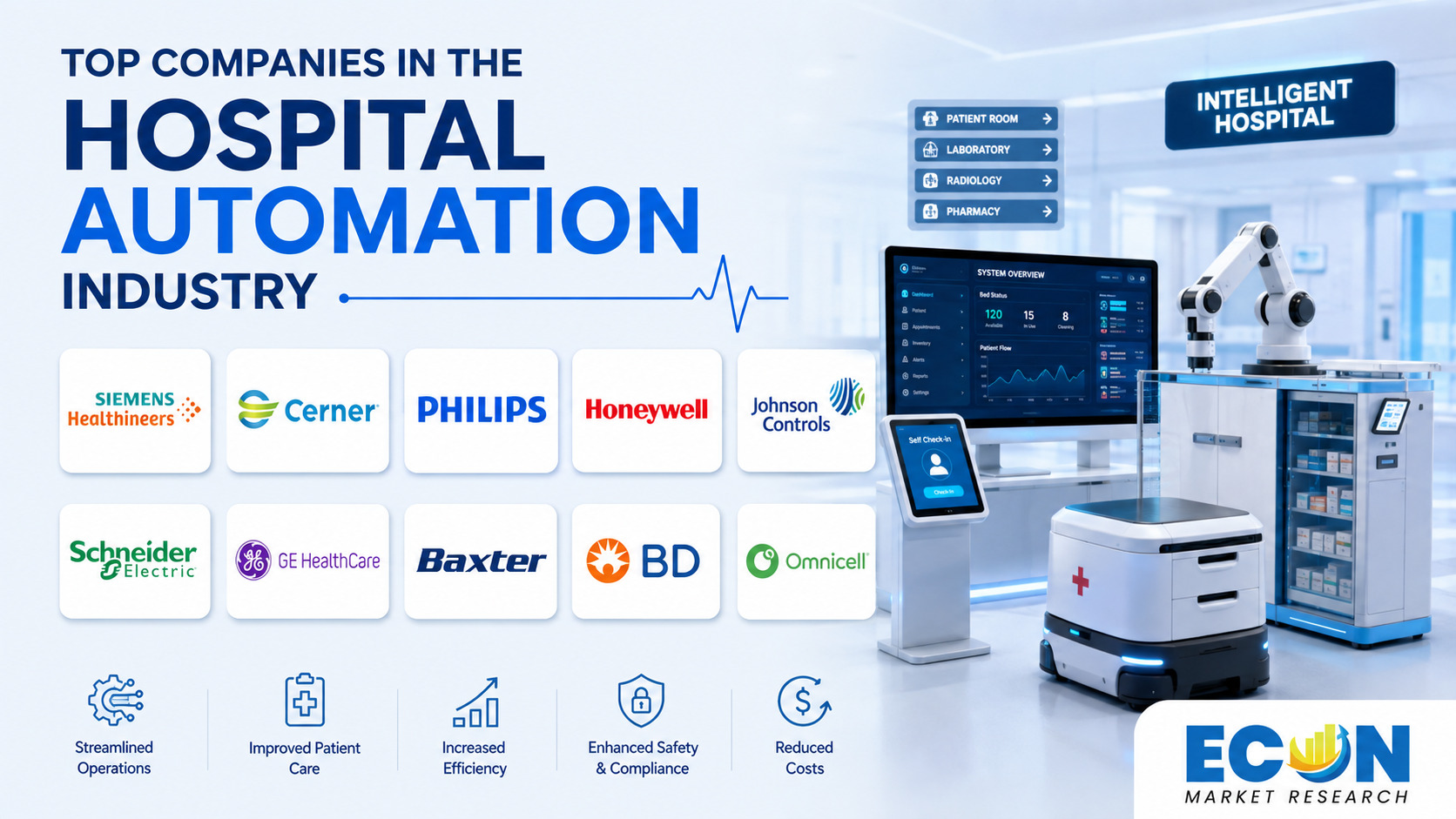
Hospital automation includes both physical and software-driven systems. Pharmacy robots can store up to 50,000 medication items, surgical platforms have completed millions of procedures and centralized monitoring systems can supervise up to 200 patients from one station. Laboratory automation can consolidate 25 manual tasks and reduce workflow steps by 75%, while hospital command centers use predictive models with accuracy above 90% for census, bed demand and staffing requirements. The competitive structure includes diversified medical-technology groups, specialist medication-management companies, robotic-surgery manufacturers and healthcare software providers. Hospitals increasingly evaluate these technologies according to clinical safety, interoperability, cybersecurity, uptime, staff acceptance and measurable reductions in repetitive work.
Market Evolution and Growth Drivers
Hospital automation evolved from standalone pneumatic tubes, basic laboratory tracks and locked medication cabinets into connected platforms that coordinate activities across entire health systems. Automated dispensing cabinets became common in nursing units during the 1990s, while robotic-assisted surgery, cloud-based analytics and AI documentation gained wider clinical use after 2000. By March 2026, Intuitive’s installed base had reached 11,395 da Vinci systems, while Stryker reported over 2.5 million Mako procedures across 47 countries. Automated laboratories now combine barcode recognition, centrifugation, decapping, aliquoting, testing and archiving, enabling one sample to move through multiple stages with limited manual handling.
Workforce pressure is a primary adoption driver. The projected global health-worker shortage for 2030 has been revised to 11 million, while laboratory vacancy rates in parts of the United States range from 7% to 11% and can reach 25% in selected locations. Automation addresses these gaps by assigning machines to repetitive movement, documentation, sorting and monitoring tasks while preserving human oversight for clinical decisions. Digital infrastructure is also becoming more important: the European Health Data Space entered into force on March 26, 2025, and will require the cross-border exchange of medical images, laboratory results and hospital discharge reports by March 2031. These deadlines encourage hospitals to adopt interoperable platforms rather than isolated devices.
Top 5 Latest Trends in the Hospital Automation Industry
AI-powered hospital command centers and workflow orchestration
Autonomous pharmacy and medication-management systems
Robotic surgery and intelligent operating rooms
Autonomous transport and hospital logistics robots
Continuous monitoring and automated clinical documentation
Trend 1: AI-Powered Hospital Command Centers and Workflow Orchestration
Hospital command centers combine real-time operational information with forecasting algorithms to coordinate beds, staffing, transfers and discharge activity. GE HealthCare’s platform provides automated visibility into occupied, assigned, blocked and available beds while predicting census and staffing requirements with accuracy above 90%. These systems became commercially important as hospital networks expanded across multiple campuses and emergency-department boarding increased. Digital-twin tools also allow administrators to test workflow changes before modifying physical facilities or staffing models. Rather than replacing clinical judgment, command centers identify bottlenecks and direct human attention toward delayed discharges, capacity constraints and incoming patient demand. Their measurable value depends on timely integration with admission, discharge, transfer and electronic health-record systems.
Trend 2: Autonomous Pharmacy and Medication-Management Systems
Medication automation is progressing toward the concept of an autonomous pharmacy in which robotics, dispensing cabinets, analytics and inventory software coordinate the medication journey from central storage to the bedside. More than 7,000 healthcare facilities were already using Omnicell automation and analytics systems by 2020, while Swisslog Healthcare’s EvoTec robot can store between 5,000 and 50,000 items. Modern solutions track medication access, expiration dates, controlled substances and replenishment activity. BD’s newer Pyxis Pro configuration can secure up to 40 stock-keeping units in each additional storage tower and up to 30 units in its larger refrigerator configuration. These systems matter because medication distribution involves thousands of repetitive transactions where identification, timing and inventory errors can affect patient safety.
Trend 3: Robotic Surgery and Intelligent Operating Rooms
Robotic-assisted surgery has become one of the most visible forms of hospital automation. Intuitive reported 11,395 installed da Vinci systems by March 31, 2026, and more than 20 million patients had undergone procedures using da Vinci technology by early 2026. Stryker’s Mako systems had completed over 2.5 million procedures in 47 countries by July 2026. The latest da Vinci 5 platform provides over 10,000 times the computing power of the da Vinci Xi, supporting more advanced software, sensing and data capabilities. Hospitals adopt these systems to assist with precision, visualization, planning and instrument control, but results still depend on trained surgeons, patient selection, operating-room teams and structured credentialing.
Trend 4: Autonomous Transport and Hospital Logistics Robots
Hospital logistics automation is expanding from pneumatic tubes to autonomous mobile robots that deliver medication, laboratory samples, supplies and equipment. Swisslog Healthcare’s TranspoNet system transports materials weighing up to 1.5 kilograms between pharmacies, laboratories and patient wards. Its 2025 partnership with Diligent Robotics connected pharmacy automation with Moxi robots, which had completed over 1 million hospital deliveries, including 300,000 pharmacy-related deliveries, across more than 25 United States hospitals. These robots reduce the time nurses and pharmacy personnel spend walking between departments. Successful deployment requires mapped routes, elevator integration, secure compartments, battery management and defined procedures for congestion, infection control and emergency access.
Trend 5: Continuous Monitoring and Automated Clinical Documentation
Automated monitoring platforms collect data from bedside devices, transmit measurements to electronic records and alert clinicians when patient conditions change. Masimo Patient SafetyNet can monitor up to 200 patients from one central station and display 40 patients simultaneously. A hospital implementation reported a 65% reduction in rapid-response activations and a 48% reduction in transfers back to intensive care after continuous monitoring was introduced. Documentation automation is also moving into clinical software. Oracle reported that its Clinical AI Agent supports more than 30 medical specialties and has reduced daily physician documentation time by close to 30% among active users. These systems can reduce manual charting, but clinicians remain responsible for reviewing generated notes, alarms and recommendations.
Top 10 Companies in the Hospital Automation Industry
The following 10 companies are not presented as a strict ranking. They were selected according to their hospital automation portfolios, technical expertise, clinical deployments, geographic presence, regulatory experience and ability to automate laboratory, medication, surgical, monitoring or operational workflows.
1. Siemens Healthineers
Company Overview: Siemens Healthineers operates in more than 180 countries, maintains direct representation in over 70 and employed approximately 74,000 people during fiscal 2025. Headquarters: Erlangen, Germany. Core Hospital Automation Expertise: The company specializes in laboratory automation, imaging workflow, clinical diagnostics, radiation therapy and data-driven hospital operations. Major Products and Services: Atellica Integrated Automation consolidates 25 activities that are traditionally performed manually and has demonstrated a 75% reduction in manual laboratory workflow steps. The Atellica Solution provides over 300 customizable configurations, supports more than 200 assays and can store 60 refrigerated quality controls onboard. Sample handlers accommodate up to 440 tubes, while magnetic transport provides intelligent STAT prioritization, reruns, sealing, sorting and archiving.
2. GE HealthCare
Company Overview: GE HealthCare became an independent company in 2023, employs over 54,000 people and serves customers in more than 160 countries. Headquarters: Chicago, Illinois, United States. Core Hospital Automation Expertise: Its capabilities span hospital command centers, imaging automation, patient monitoring, digital twins and operational analytics. Major Products and Services: The Command Center platform consolidates bed capacity, patient flow and discharge information while forecasting census and staffing requirements with accuracy above 90%. Hospital Pulse, Capacity Expediter and Patient Manager provide real-time operational views, while Digital Twin software simulates changes before implementation. GE HealthCare also embeds automation in imaging systems through protocol selection, reconstruction, measurement and fleet-management tools, enabling hospitals to coordinate clinical equipment and operational data across multiple departments.
3. Royal Philips
Company Overview: Philips employed approximately 64,300 people in 2026 and provided sales and services across more than 100 countries. Headquarters: Amsterdam, Netherlands. Core Hospital Automation Expertise: Philips combines patient monitoring, enterprise informatics, imaging workflow, alarm management and image-guided therapy. Major Products and Services: Its hospital platforms automate device-data capture, remote monitoring, clinical alerts and diagnostic workflows across intensive care, emergency, operating-room and imaging environments. The company’s enterprise informatics products connect monitoring and imaging data with electronic records, while AI-enabled systems support automated measurements and workflow prioritization. Philips also works with technology partners to integrate advanced sensors and clinical algorithms into hospital devices. The company’s 2026 workforce and geographic scale provide service coverage for large multi-hospital networks implementing standardized automation.
4. Omnicell
Company Overview: Omnicell was founded in 1992 and became publicly traded in 2001. Healthcare facilities worldwide use its robotics, software and medication-management services. Headquarters: Fort Worth, Texas, United States. Core Hospital Automation Expertise: Omnicell focuses on automated pharmacy storage, dispensing, intravenous preparation, medication packaging, analytics and supply-chain control. Major Products and Services: Its portfolio supports central pharmacies, nursing units, operating rooms and post-acute settings. More than 7,000 healthcare facilities were using Omnicell automation and analytics systems by 2020. The company opened a dedicated innovation laboratory in Austin in 2025 to develop solutions for medication and hospital-supply workflows. Its autonomous-pharmacy strategy combines robotic equipment, smart cabinets, intelligent software and expert services to reduce manual picking, improve inventory visibility and strengthen medication compliance.
5. Becton, Dickinson and Company
Company Overview: BD was established in 1897, employs over 70,000 people and maintains a presence in virtually every country. Headquarters: Franklin Lakes, New Jersey, United States. Core Hospital Automation Expertise: BD develops automated medication dispensing, pharmacy inventory, infusion management, laboratory systems and clinical data platforms. Major Products and Services: The Pyxis MedStation ES supports decentralized medication distribution across hospital nursing areas, while Pyxis Logistics manages inventory levels, locations, expiration dates and replenishment activity. Pyxis Pro adds AI-powered analytics and expanded secure capacity, including storage towers capable of holding up to 40 stock-keeping units each. BD systems integrate with electronic medical records and the HealthSight platform to create enterprise medication-management environments covering pharmacies, operating rooms, wards and controlled-substance storage.
6. Swisslog Healthcare
Company Overview: Swisslog Healthcare employs approximately 1,200 people across international locations and maintains automation facilities serving customers in North America, Europe, Asia and the Middle East. Headquarters: Buchs, Switzerland. Core Hospital Automation Expertise: The company specializes in pharmacy robots, unit-dose packaging, pneumatic tubes, autonomous transport and hospital material movement. Major Products and Services: PillPick Octave automates patient-specific unit doses, while EvoTec stores between 5,000 and 50,000 medication items. AutoPack packages oral solid medications, and TranspoNet carriers move payloads of up to 1.5 kilograms between departments. In 2025, Swisslog added automated tablet counting and new packaging features while partnering with Diligent Robotics to extend automation through last-mile delivery robots. Its North American technology center covers over 80,000 square feet.
7. Stryker
Company Overview: Stryker traces its operating history to 1941 and supplies medical technologies across orthopedics, surgery, emergency care and hospital communications. Headquarters: Kalamazoo, Michigan, United States. Core Hospital Automation Expertise: Stryker combines robotic-assisted surgery, connected clinical communication and smart-hospital infrastructure. Major Products and Services: Its Mako SmartRobotics portfolio supports knee, hip, spine and shoulder procedures. By July 2026, Mako systems had supported more than 2.5 million procedures across 47 countries. The company launched its SmartHospital Platform in March 2026 to connect devices, data and care teams across hospital environments. Vocera communication products, smart beds, operating-room technologies and digital workflow systems complement surgical robotics by supporting alerts, patient transport, staff coordination and clinical documentation.
8. Intuitive Surgical
Company Overview: Intuitive was founded in 1995 and maintains its headquarters, manufacturing, research and primary training operations in Sunnyvale, California. Headquarters: Sunnyvale, California, United States. Core Hospital Automation Expertise: The company develops robotic-assisted surgical systems, instruments, imaging technologies, training platforms and procedural analytics. Major Products and Services: The installed da Vinci base reached 11,395 systems by March 31, 2026, and more than 20 million patients had undergone procedures using the technology. The da Vinci 5 system delivers over 10,000 times the computing power of the da Vinci Xi and had surpassed 1,400 global installations by mid-2026. Intuitive also develops the Ion robotic bronchoscopy platform, expanding automation from surgery into minimally invasive lung procedures and diagnostic navigation.
9. Masimo
Company Overview: Masimo was founded in 1989 and employs more than 7,000 people worldwide. Headquarters: Irvine, California, United States. Core Hospital Automation Expertise: Masimo develops connected patient monitoring, automated surveillance, alarm escalation and device-to-electronic-record integration. Major Products and Services: Patient SafetyNet can monitor up to 200 patients and show 40 patients at one central station. Its Hospital Automation platform collects information from Masimo and third-party devices, converts data into HL7 format and transfers measurements into electronic records. Halo ION combines trends from multiple parameters into one continuously updated patient score. Radius VSM and Root extend wireless monitoring to temporary care areas, while automated escalation directs unacknowledged alarms to additional clinical personnel according to hospital policies.
10. Oracle Health
Company Overview: Oracle was founded in 1977 and operates its world headquarters in Austin, Texas. Oracle Health incorporates the clinical-software business expanded through the company’s 2022 acquisition of Cerner. Headquarters: Austin, Texas, United States. Core Hospital Automation Expertise: Oracle Health develops electronic health records, clinical AI agents, scheduling, supply-chain platforms and operational workflow software. Major Products and Services: Its Clinical AI Agent supports more than 30 medical specialties and has produced a daily documentation-time reduction close to 30% among users. The platform drafts notes, summarizes patient histories, supports coding and coordinates clinical tasks through voice and screen interactions. Oracle also introduced AI-supported healthcare inventory and procurement functions in 2025, giving hospitals greater visibility into supplies and automating purchasing workflows.
Regional Outlook
North America
North America has a mature hospital automation environment supported by 6,100 United States hospitals, 907,216 staffed beds and 35.6 million annual admissions. System affiliation is important because 3,567 community hospitals belong to larger systems, allowing technology purchases to be standardized across multiple facilities. The United States hosts the headquarters of Omnicell, BD, GE HealthCare, Stryker, Intuitive, Masimo and Oracle, creating a concentrated ecosystem for medication automation, robotic surgery, monitoring and health software. Canada is expanding AI documentation and centralized health technology through provincial systems; one Canadian mental-health hospital with over 5,000 staff and 38,000 annual patients selected an AI documentation pilot in 2025.
Mexico provides automation opportunities across public institutions, private hospital groups and urban specialist centers, but adoption is more uneven than in the United States and Canada. North American hospitals are investing in pharmacy cabinets, operating-room robots, command centers, laboratory tracks and autonomous delivery systems. The region also has demanding cybersecurity, privacy, medical-device and electronic-record requirements. Hospitals must evaluate thousands of connected endpoints and maintain uptime during software updates. The strongest opportunities involve standardizing automation across multi-hospital systems, while the principal challenges include capital planning, staff training, interoperability and ensuring that automated alerts do not increase alarm fatigue.
Europe
Europe combines advanced hospital infrastructure with regulatory requirements covering 27 European Union member states. The European Health Data Space entered into force on March 26, 2025, with patient summaries and electronic prescriptions scheduled for cross-border exchange from March 2029. Medical images, laboratory results and hospital discharge reports are scheduled to follow in March 2031. These milestones support hospital automation by requiring electronic records and interoperable data exchange. Germany, the Netherlands, Switzerland and Sweden also host major automation providers, including Siemens Healthineers, Philips, Swisslog Healthcare and Sectra-related hospital technology ecosystems.
European hospitals are deploying automated laboratories, pharmacy robots, remote monitoring and robotic surgery while also addressing the European AI Act, cybersecurity obligations and medical-device rules. The United Kingdom operates separately from European Union legislation but remains an active market for hospital automation through NHS trusts. Workforce shortages and aging clinical personnel create demand for systems that reduce manual activity, while environmental targets encourage hospitals to manage energy, consumables and transport more efficiently. Regional challenges include different procurement processes across Germany, France, Italy, Spain, the Netherlands and Nordic countries. Suppliers must support multiple languages, national health-record systems and country-specific reimbursement or tendering requirements.
Asia-Pacific
Asia-Pacific includes highly automated hospitals in Japan, South Korea, Singapore, Australia and China alongside expanding digital infrastructure in India and Southeast Asia. WHO’s South-East Asia Region contains nearly 2 billion people across 11 member states, representing close to one-quarter of the world’s population. The region faces workforce shortages, geographic remoteness and rising chronic-disease burdens while operating ambitious digital-health and AI programs. The Western Pacific digital-health framework, published in 2025, encourages ethical AI, integrated information systems and national digital-health strategies. These policies support adoption of robotics, remote monitoring, laboratory automation and intelligent hospital software.
Japan and China provide manufacturing ecosystems for robotics, imaging systems and electronic components, while India supplies software, engineering and clinical-service capabilities. Australia and Singapore serve as testing and regional deployment hubs. Asia-Pacific hospitals differ widely in size and resources, creating demand for both high-throughput automation and compact systems designed for smaller laboratories. Solutions must support local languages, variable infrastructure and country-specific data rules. Supply-chain risks include dependence on imported sensors and semiconductor components, while opportunities include localized production, cloud-based fleet management and regional training centers. The strongest deployments will match automation complexity to staffing, connectivity and maintenance capacity at each hospital.
Middle East and Africa
The 6 Gulf Cooperation Council countries are investing in digital hospitals, robotic surgery, smart logistics and national health-data platforms. Saudi Arabia’s Vision 2030 health-sector program includes hospital development, digital transformation and integrated healthcare enterprises. The country recorded over 16 million virtual-health appointments during 2025, demonstrating the scale of its connected-care infrastructure. The United Arab Emirates’ Fourth Industrial Revolution Strategy specifically identifies robotic healthcare and connected care as priority applications. Gulf hospitals therefore provide opportunities for automated pharmacies, command centers, remote monitoring and surgical robots, although imported equipment and specialist-service requirements remain important operational considerations.
Africa’s automation opportunity is influenced by major workforce and infrastructure constraints. WHO now projects a regional shortage of 5.85 million health workers by 2030, while 943,000 trained workers were unemployed in 2024 because health systems could not consistently absorb them. Automation can help regional referral hospitals extend laboratory capacity, medication control and remote specialist support, but systems must tolerate power interruptions, connectivity limitations and long maintenance distances. South Africa, Egypt, Kenya, Nigeria and Morocco offer stronger hospital and engineering bases than lower-resource markets. Practical adoption is likely to begin with targeted automation such as laboratory preparation, pharmacy storage and remote monitoring rather than complete hospital-wide robotic ecosystems.
Future Opportunities in the Hospital Automation Industry
Future opportunities for the Top Companies in the Hospital Automation Industry will center on connecting currently separate systems. Hospitals may operate 10 or more automation platforms across laboratories, pharmacies, operating rooms, imaging departments and inpatient wards, but each system often maintains its own alerts and interfaces. Enterprise orchestration can unify these platforms through event-based workflows. For example, a discharge order could automatically update bed availability, initiate pharmacy reconciliation, schedule cleaning and notify transport staff. Analytical expectations indicate that hospitals will favor automation platforms that connect with existing electronic records instead of requiring complete technology replacement.
Artificial intelligence and digital twins will expand predictive automation. Current command centers forecast census and staffing demand with accuracy above 90%, while clinical AI agents have reduced documentation time by close to 30%. Future systems may predict equipment demand, medication shortages, surgical delays and patient deterioration before operational disruption occurs. These capabilities must remain transparent and auditable because an incorrect prediction can affect staffing, treatment or bed access. Verified regulatory milestones include European exchange of patient summaries in 2029 and medical images and laboratory results in 2031, creating measurable targets for interoperable hospital platforms.
Robotics will also extend beyond surgery. More than 1 million autonomous hospital deliveries and over 20 million da Vinci patient procedures demonstrate that robots can operate at substantial clinical scale. Future opportunities include sterile-supply transport, automated room preparation, rehabilitation assistance and pharmacy-to-bedside delivery. Sustainability will influence product design through reusable components, optimized packaging and energy-efficient fleets. Workforce development remains critical because WHO projects an 11 million global health-worker shortage by 2030. Automation providers that include simulation, certification, remote service and change-management support will be better positioned than vendors supplying equipment without implementation expertise.
Conclusion
The hospital automation industry now covers laboratory processing, medication dispensing, robotic surgery, logistics, monitoring, command centers and clinical documentation. The 5 major trends—AI orchestration, autonomous pharmacy, surgical robotics, transport robots and automated monitoring—are shifting hospital automation from isolated equipment toward connected operational ecosystems. The 10 selected companies contribute distinct capabilities, from Siemens Healthineers’ 25-task laboratory automation and GE HealthCare’s above-90% forecasting to Swisslog’s 50,000-item pharmacy storage, Intuitive’s 11,395-system installed base and Masimo’s 200-patient monitoring capacity.
Regional adoption reflects different healthcare priorities. North America operates 6,100 hospitals and supports mature enterprise deployments, Europe is preparing for cross-border health-data milestones in 2029 and 2031, Asia-Pacific serves nearly 2 billion people in the South-East Asia Region alone, and Africa faces a projected 5.85 million health-worker shortage by 2030. The strongest future opportunities involve interoperable platforms, predictive AI, autonomous logistics and structured workforce support. The Top Companies in the Hospital Automation Industry will be differentiated by their ability to improve safety, reliability, cybersecurity and workflow performance while keeping trained clinical professionals responsible for final care decisions.