

Pharmacy Automation Market
Pharmacy Automation Market Size, Share, Trends, Growth, and Industry Analysis, By Product Type (Automated Medication Dispensing Systems, Robotic Sterile Compounding Systems, Automated Packaging andamp; Labeling, Automated Tablet Counters), By End-User (Hospital Pharmacies, Retail andamp; Chain Pharmacies, Mail-order/ePharmacies), Regional Analysis and Forecast Period 2026-2035
Pharmacy Automation Market Overview
As per Econ Market Research analysis, the Global Pharmacy Automation Market was valued at US$ 7.62 Billion in 2026 and is expected to reach US$ 17.75 Billion by 2035, registering a CAGR of 9.86% during the forecast period 2026–2035. The base year considered is 2025.
Pharmacy Automation Market Size 2025-2035 (USD Billion)

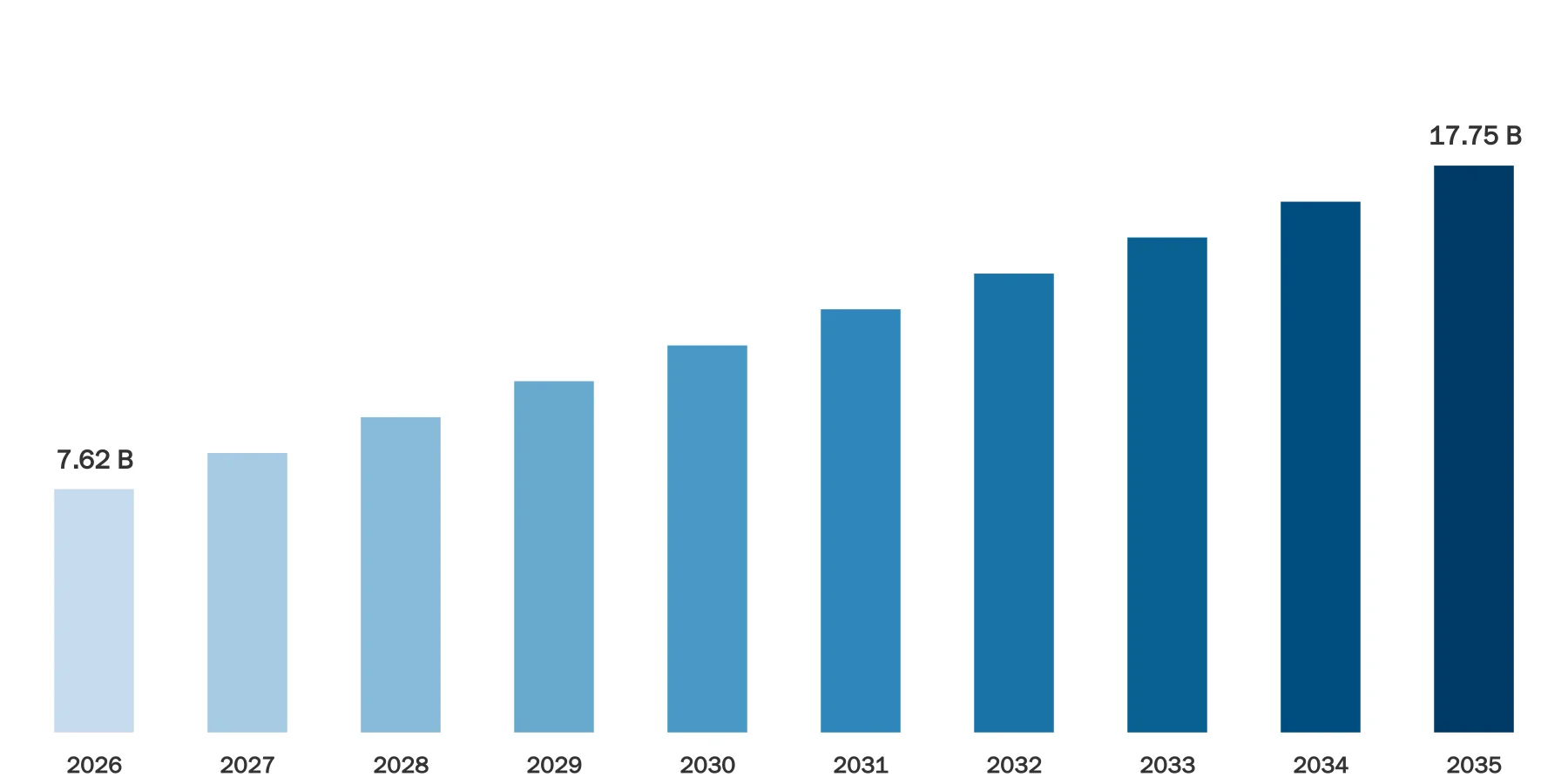
Source: Econ Market Research
Pharmacy automation market refers to the use of technology and automated systems in pharmacies with the aim of streamlining operations such as prescription management, drug dispensing as well as packing and inventory control. As a result, these systems are able to reduce human errors, enhance efficiency and above all ensure patient safety. This is achieved through carrying out repetitive processes in an automated manner that will lead to accurate medication dispensing and better management of stocks.
Therefore, some demands for healthcare services, need for cost reduction and overall desire for patient safety or regulatory compliance have been contributing factors to why pharmacy automation is becoming more important each day. Additionally, the rapid growth of this market is brought about by increased use of automation technology within hospitals and other health facilities improved technology, increase in use cases where clients seek better pharmacy operations that are devoid of mistakes among other product. However, there is a potential hindrance towards its growth due to initial high costs associated with automation systems and their integration into established workflows.
Dynamic Insights
The global pharmacy automation market is influenced by a number of key factors, the most important being escalating need for speedy and accurate delivery of drugs, increasing complexity in medication regimens and reduction of human error instances. In modern healthcare environments, automation systems are incredibly valuable as they increase precision, simplify logistical operations in pharmacies and offer patient&rsquo,s safety benefits. Furthermore, adoption of advanced technology within health care facilities together with demands for better compliance with regulations are having positive effects on the market growth.
However, the sale of such devices has been inhibited by their high cost at first purchase and difficulty in harmonizing them with current pharmacy practices. Nevertheless, there are ample growth prospects for automated pharmacy solutions because of ongoing pressing concerns about efficiency and safety within hospitals including continuing improvements in technologies used. With pharmacies striving to enhance their services to customers and improve patient outcomes through different means automated systems will become increasingly popular thereby facilitating further market expansion.
Drivers Insights
Increased Demand for Efficiency and Accuracy
A major contributor to the Global Pharmacy Automation Market is the increasing need for efficient and accurate medication dispensing. By cutting down on the time taken to process prescriptions and reducing human blunders, automated systems help simplify pharmacy operations. These systems improve drug dispensing accuracy, which is essential in avoiding medication errors that could have negative consequences on patients&rsquo, health.
The adoption of pharmacy automation technologies is further spurred by the rise in the number of prescriptions received by pharmacies as well as intricacies related to dispensing them that require speedier services devoid of mistakes. In this way, pharmacies will be able to serve larger amounts of prescriptions precisely and quickly as they automate mundane chores meanwhile catering to an ever-growing patient population.
Technological Advancements
The pharmacy automation market is being driven by continuous strides in technology. Innovations in these areas, including advanced robotics, automated dispensing systems, and sophisticated inventory management software, have changed the face of pharmacy practice. These technologies not only make pharmacy operations more efficient but also enhance control over stock levels, limit out-of-stock situations and assure safe dispensing of medicines. Furthermore, the integration of AI and ML into pharmacy automation systems aids in making better decisions while predicting future demand for medications hence improving supply chain management. Additionally, more sophisticated automation systems have been developed with robust capabilities resulting in greater profitability for the industry due to relentless technology improvements.
Restraints Insights
High Initial Investment
A significant barrier that affects the Global Pharmacy Automation Market is the massive start-up cost when buying and installing automated systems. The price of sophisticated automation gadgets such as robotic dispensers or automated storage can reach very high levels making them unaffordable for smaller pharmacies or low budget ones to embrace those solutions. There are also additional expenses for integrating these systems consistently, offering training sessions and maintaining them which make effects worse. It can happen that big amounts of money do not appeal to some chemists preventing their entry into a computerized world thus hindering its advancement while putting restrictions on its adoption at a large scale.
Integration Challenges
A different hurdle that comes into play is merging automatic systems with already set up drugstore processes. Different pharmaceutical institutions have their own modes of operation already started and the introduction of new kinds of automation can be strenuous and disturbing. The incompatibility of present software can arise, the personnel can need training as well as state of affairs can call for a while before they go back to normal. Because of these obstacles, it is vital for pharmacy owners to think ahead and allocate resources accordingly in order to come up with a seamless integration that does not negatively affect the productivity rate or use appropriate funding in this case, thus deterring them from getting access to automated examples.
Opportunities Insights
Growing Focus on Patient Safety
An opportunity for the pharmacy automation market comes from the growing focus on patient safety. With a desire to improve patient care and reduce medication errors, healthcare providers have turned to automation systems for solutions. Automated dispensing and management systems help the safe administration of drugs by ensuring accuracy which is part of the larger aim of ensuring patient safety in health. Investing in automation technologies allows a pharmacy to enhance not only an operational efficiency but also be recognized as a market leader in terms of patient safety, thus gaining competitiveness against other firms.
Segment Analysis
By Pharmacy Type
By Pharmacy Type, the market is segmented into Independent, Chain, and Federal. Independent pharmacies are individually owned and operated, often categorized by a personalized approach to customer service and a focus on community relationships. To increase efficiency and improve patient safety, pharmacies can adopt automation, although they can face issues regarding high initial investment costs.
However, chain pharmacies run several locations under one brand or organization. Because of their huge operations, such pharmacies are more likely to utilize automation systems on a broad base with the aim of standardizing activities across different sites and ensuring service quality uniformity. Federal pharmacies are government-run facilities that cater to particular groups such as veterans or military staff. In doing so, these pharmacies emphasize better operation effectiveness and compliance with heavy regulations. The differing characteristics and operational sizes of various types of pharmacies create diverse options for automated solutions.
By Product
By product, the pharmacy automation market is segmented into systems, software, and services. Regulatory systems include prescription, inventory management, integrative software&rsquo,s that are used to manage prescription data and automated dispensers. The automation in pharmacy helps to avoid manual mistakes and get the right medicine faster. It enables pharmacy operation optimization through provision of up-to-date information on stock balance, real time parameters and regulatory regulations. Automation system services cover installation, commissioning as well as maintenance to keep it operating effectively. By these services, any hardware or software failures are detected whilst staff receive necessary qualification for them to conduct their work professionally and effectively in a drugstore.
By Application
By application, the market is segmented into drug storage, drug dispensing and packaging, and inventory management. Medicines are stored in automated systems intended to keep them safe in controlled environments for their perfect maintenance and easy availability. Moreover, they help prevent contamination or loss. The automation of drug dispensing and packaging involves the precise preparation of medication for patients, packaging it properly so that there is minimum human interference with it, hence reducing any opportunity of error due to manual handling and increasing the amount produced. This application is very important for ensuring accurate prescription filling. In addition, inventory management automation refers to mechanisms that update drug stocks, a procedure that orders new ones and prevents either a shortage or a surplus. Consequently, through these applications&rsquo, automation, pharmacies can improve their operations&rsquo, efficiency accuracy as well as guaranteeing the presence of medicines at all times.
By Pharmacy Size
By Pharmacy Size, the market is segmented into small, medium, and large size pharmacies. Unlike larger pharmacies, smaller size pharmacies have few employees, limited activities, thus the need for automation systems to increase their efficacy as well as keep track of a smaller stock. Medium size pharmacies involve bigger scales of operation thus requiring more elaborate automating solutions that will serve to handle higher amounts of recipes and stocks. Buying comprehensive systems is the point of focus for these categories of random drug stores with an interest in improving their service delivery and the efficiency of their operations.
On a wider scale, large-size pharmacies are often identify by multiple branches or expansive premises with very high-volume sales. In large pharmacies, automatic systems help in managing huge amounts of prescriptions, fulfilling varying inventory requirements and maintaining consistent quality throughout all processes. Different demands according to this pharmacy classification create various options for levels and types of automated devices needed.
By End User
By End User, the market is segmented into outpatient pharmacies, retail pharmacies, online pharmacies, inpatient pharmacies, central fill/mail order pharmacies, pharmacy benefit management organizations (PBMs), and others. The outpatient pharmacies serve patients who visit the pharmacy to fill prescriptions and can use automation for fast and accurate service. The retail pharmacies are in commercial surroundings, where high prescription volumes are managed through automation to make operations smooth. Online pharmacies experience unique challenges with orders fulfilment and inventory management hence, automation is crucial for managing large order volumes while ensuring timely delivery.
Inpatient pharmacies located within hospitals or other health facilities employ automation to manage medications for patients admitted in these places, hence dispensing them right on time and accurately. Central filling/mail order pharmacies deal with large-scale prescription fulfilling and distribution, in this way automation makes it possible to process quickly and send out orders. Pharmacy Benefit Management Organizations (PBMs), which manage prescription benefits, need automated means to effectively process claims and formularies so as to meet their best practice standards in managing pharmacy benefits.
Regional Analysis
The Global Pharmacy Automation Market undergoes differential regional dynamics, with North America leading because it has the developed infrastructure regarding health care as well as large usage rates regarding automation technologies. In particular, the U.S and Canada mostly use a variety of intricate systems that work together towards greater convenience and efficiency for pharmacies. In addition, Europe comes next due to rising levels of investment in health care facilities coupled with legislative focus on patient safety, especially in Western Europe.
China or India serves as examples of emergent markets where there is increasingly aggressive human medical computerization fuelled by the need for more hospitals built or upgraded towards supporting technology integration. Whereas Latin America and the Middle East have seen some growths, this has been at a slower pace because of increasing healthcare investments and upgrading their infrastructure across many nations in those regions.
Competitive Landscape
Major industry leaders such as Omnicell, Inc., BD (Becton, Dickinson and Company), Swisslog Healthcare, and ARxIUM dominate the market with comprehensive portfolios that include advanced automated dispensing systems, robotic technologies, and integrated software solutions. These firms exploit their vast R&,D talents, international reach and long-standing customer bases to retain a competitive advantage. Likewise, McKesson Corporation and ScriptPro LLC are dominant players due to their solid automation solutions as well as considerable impact on pharmacy industry.
Additionally, emerging companies and startups are also making efforts to penetrate into the market through introduction of novel technologies and niche solutions that solve certain operational problems. The industry witness&rsquo,s different strategic partnerships, mergers and acquisitions in order to expand their product lines and coverage. Moreover, constant advancements in technology, regulatory changes and shifting market needs have further affected competition, leading to constant innovations within firms so as to stay relevant in the industry.
List of Key Players:
Omnicell, Inc.
BD (Becton, Dickinson and Company)
Swisslog Healthcare
ARxIUM
McKesson Corporation
ScriptPro LLC
Cerner Corporation
Siemens Healthineers
Asteres, Inc.
Kirby Lester, LLC
Recent Developments:
June 2022, Becton, Dickinson and Company, and Frazier Healthcare Partners, have entered into a definitive agreement where BD will acquire Parata Systems for USD 1.525 billion, it is an innovative company that provides pharmacy automation solutions. This is so because Parata has been able to not only provide affordable pharmaceutical services but also ensure high quality in terms of safety and delivery.
May 2022, Deenova has introduced its innovative Pay-Per-Dose unit dose pharmacy automation service into the UK market. The new solution that has been designed for Pay-Per-Dose is firstly available at the end of 2022 for NHS or private hospitals within Greater London.
Global Pharmacy Automation Report Segmentation
Pharmacy Automation Market Report Scope & Segmentation
| Attributes | Details |
|---|---|
Market Size (Current) | US$ 7.62 Billion in 2026 |
Market Size (Forecast) | US$ 17.75 Billion in 2035 |
Growth Rate | CAGR of 9.86% from 2026 to 2035 |
Forecast Period | 2026 – 2035 |
Base Year | 2025 |
Historical Data Available | Yes |
Regional Scope | Global |
Segments Covered | By Product Type
By End-User
|
Frequently Asked Questions
Common questions about this report
The study period covers historical insights and forecast projections for the period 2026-2035.
About the Author
Market research expert with years of industry experience

Related Reports
Explore more market insights from the same category