


Top Small Language Model Companies Shaping Enterprise AI
The top small language model companies are advancing efficient, secure AI for edge devices, enterprise automation, multimodal tasks, and private deployment.
Introduction
Overview of the Global Small Language Model Industry
The global small language model industry is becoming a central part of enterprise artificial intelligence as organizations shift from extremely large models toward compact systems containing between 1 billion and 14 billion parameters. Small language models are designed to perform focused tasks such as document summarization, customer-service automation, code generation, translation, classification, and information extraction. Current portfolios include 1B, 2B, 3B, 4B, 7B, 8B, 12B, and 14B configurations, allowing organizations to match model capacity with specific hardware limitations. Several modern small language models also support context windows ranging from 32,000 to 256,000 tokens, enabling compact systems to process long reports, technical manuals, conversations, and enterprise records.
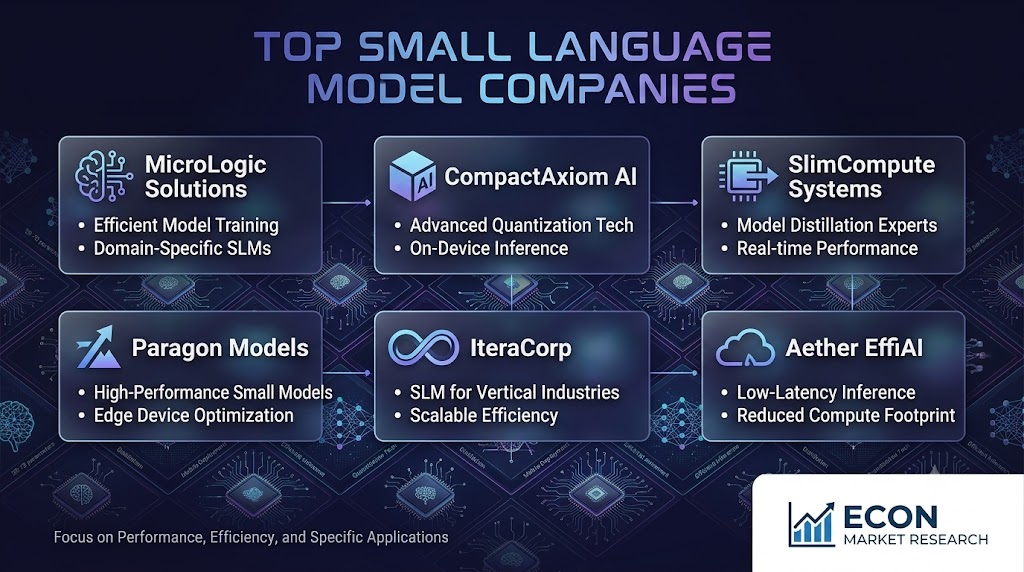
The Top Companies in the Small Language Model sector are competing through model efficiency, specialized training, multilingual coverage, multimodal processing, and deployment flexibility. Unlike models containing 70B, 405B, or higher parameter counts, a small language model can operate on laptops, smartphones, industrial computers, local servers, and edge devices. This capability helps businesses reduce network dependency, protect sensitive information, and generate responses with lower latency. Modern offerings such as Llama 3.2 at 1B and 3B, Phi-4-mini at 3.8B, Granite 4.1 at 3B and 8B, and Ministral 3 at 3B and 8B demonstrate how the industry is prioritizing intelligence per parameter instead of model size alone.
Market Evolution and Growth Drivers
The small language model industry evolved rapidly between 2023 and 2026 as developers improved training-data quality, quantization, knowledge distillation, grouped-query attention, mixture-of-experts routing, and synthetic-data generation. In 2023, 7B models were widely treated as compact alternatives to larger systems, while releases in 2024 introduced capable 1B and 3B models for mobile and edge deployments. By 2026, portfolios included models with 3B active parameters, 256K-token context windows, multimodal inputs, function calling, and specialized reasoning modes. This evolution demonstrates that parameter count is no longer the only measurement of model capability, particularly when domain-specific training and retrieval systems are used.
Growth is being driven by at least 5 operational requirements: lower inference latency, reduced memory use, offline availability, stronger data privacy, and task-specific accuracy. An organization may not require a 70B model to classify 10 document types, summarize 20-page reports, route customer requests, or answer questions from an internal knowledge base. A 3B or 8B small language model can be fine-tuned for these workflows and deployed closer to the user. Hardware manufacturers are also integrating neural processing units into computers and mobile devices, making 4-bit and 8-bit models increasingly practical for local execution. These factors are expanding small language model adoption across healthcare, banking, manufacturing, retail, telecommunications, education, and public administration.
Top 5 Latest Trends in the Small Language Model
1. On-Device and Edge AI Deployment
On-device processing is one of the most important small language model trends because it allows artificial intelligence workloads to run without continuously transmitting information to external infrastructure. Llama 3.2 provides 1B and 3B text models with context support of 128K tokens, while Gemma 3n offers a 4B active memory footprint with a nested 2B active submodel. Ministral 3 includes 3B, 8B, and 14B variants, and its 3B configuration supports a 256K-token context window. These models are suitable for smartphones, factory systems, vehicle interfaces, laptops, point-of-sale terminals, and connected equipment where response speed and offline availability are important.
Edge deployment also improves operational continuity in locations with unstable connectivity. A field engineer can use a 3B model to search equipment instructions, while a healthcare worker can operate a local assistant without uploading every patient interaction. Quantized 4-bit or 8-bit versions reduce the storage and memory requirements further, making models deployable across a wider range of processors. Meta released quantized versions of its 1B and 3B models to improve speed and reduce memory requirements, while Falcon 3 supports GGUF, AWQ, GPTQ, int4, int8, and 1.58-bit configurations.
2. Multimodal Small Language Models
Small language models are moving beyond text-only processing by integrating images, audio, video, and structured information. Phi-4-multimodal supports text, audio, and vision inputs with a 200,000-word vocabulary covering more than 20 languages. Gemma 4 includes multimodal capabilities across several model sizes, with audio support available in its E2B, E4B, and 12B configurations. Ministral 3 models are offered in 3 sizes and include vision capabilities in Base, Instruct, and Reasoning variants.
Multimodal small language model systems can inspect 1 product image, interpret 1 technical chart, process 1 voice instruction, and generate 1 text response within a unified workflow. This architecture supports quality inspection, document digitization, medical-image assistance, visual customer support, transcription, accessibility, and equipment maintenance. A compact multimodal model can also work as the first processing layer before escalating complex cases to a larger system. The result is a tiered architecture in which a 3B or 4B model handles frequent tasks while a larger model is activated only for cases requiring deeper reasoning.
3. Longer Context Windows in Compact Models
Context capacity has become a key competitive factor in the small language model industry. Earlier compact models frequently supported 4K, 8K, or 32K tokens, but current systems can process 128K or 256K tokens. Llama 3.2 models at 1B and 3B support 128K tokens, while Gemma 3 provides 128K capacity for its 4B, 12B, and 27B versions. Gemma 4 extends its architecture to context windows of up to 256K tokens, and Ministral 3 3B also supports 256K tokens.
A 128K-token window allows a small language model to analyze multiple contracts, support tickets, policy documents, transcripts, or code files during 1 interaction. Longer context capacity also improves retrieval-augmented generation because the system can include additional retrieved passages without discarding earlier instructions. However, enterprises must evaluate accuracy across the full context instead of assuming that a model uses all 128K or 256K tokens equally well. Testing should include at least 3 conditions: information located near the beginning, information placed in the middle, and evidence positioned near the end of the prompt.
4. Specialized Reasoning, Agents, and Function Calling
Small language model developers are increasingly creating specialized variants for reasoning, tool use, coding, and agentic workflows. Phi-4-mini is a 3.8B model with built-in function calling and a 200,000-word vocabulary, while Phi-4-mini-reasoning applies the same 3.8B scale to mathematics and logical problem-solving. Ministral 3 is available in Base, Instruct, and Reasoning editions across 3B, 8B, and 14B sizes. Granite 4.1 focuses on instruction following and tool calling through 3B, 8B, and 30B configurations.
Function calling enables a small language model to complete multi-step operations instead of generating text alone. For example, a 4-step service agent can identify a customer request, search an internal database, call an approved business function, and summarize the result. A small language model is particularly suitable for repetitive agent roles such as routing, extraction, validation, scheduling, and policy checking. Enterprises can also deploy multiple specialized models, with 1 model classifying intent, 1 retrieving evidence, and 1 formatting the final answer.
5. Quantization, Governance, and Enterprise-Grade Transparency
Quantization is accelerating small language model adoption by representing model weights with fewer bits. A model converted from 16-bit precision to 8-bit or 4-bit precision requires less memory, although accuracy must be evaluated after conversion. Quantized Llama 3.2 models were introduced to reduce memory footprint and improve local inference, while Falcon 3 provides int4, int8, and 1.58-bit options. Granite 4.1 also offers optional FP8 variants across its 3B, 8B, and 30B model sizes.
Governance is developing alongside compression technology. Granite 4.0 introduced a hybrid Mamba-2 and transformer design that delivers over 70% lower memory requirements and 2 times faster inference in selected long-context and multi-session scenarios. The family also received ISO 42001 certification for its artificial-intelligence management system, while released Granite checkpoints began receiving cryptographic signatures in 2026. These controls help organizations verify model origin, document deployment decisions, and create traceable approval processes for regulated environments.
Top 5 Companies in the Small Language Model
1. Microsoft
Company overview: Microsoft is a major small language model company through its Phi model family, which emphasizes high-quality training data, reasoning, multilingual support, and local deployment. Phi-4-mini contains 3.8 billion parameters and has demonstrated competitive mathematics and coding capabilities against models containing up to 2 times its parameter count. Its compact structure supports enterprise assistants, educational applications, embedded AI, code support, information extraction, and connected-device workloads.
Headquarters: Microsoft is headquartered in Redmond, Washington, United States. Its main campus covers 500 acres and contains more than 125 buildings, giving the organization access to extensive research, engineering, cloud, software, and hardware operations within 1 corporate ecosystem.
Core small language model expertise: The company specializes in compact reasoning models, synthetic-data training, multilingual tokenization, function calling, multimodal processing, and model optimization. Phi-4-mini uses a vocabulary of 200,000 words, while Phi-4-multimodal supports text, audio, and visual inputs across more than 20 languages.
Major products and services: The portfolio includes Phi-3-mini, Phi-3-small, Phi-3-medium, Phi-4, Phi-4-mini, Phi-4-mini-reasoning, and Phi-4-multimodal. Model sizes range from 3.8B to 14B across these releases, with selected versions supporting context windows of up to 128K tokens and deployment through cloud, local, and edge environments.
2. Google
Company overview: Google has built one of the broadest small language model ecosystems through the Gemma family. The portfolio includes general-purpose, multimodal, medical, translation, safety, encoder-decoder, and on-device variants. Gemma 4 offers 5 configurations—E2B, E4B, 12B, 31B, and 26B A4B—while Gemma 3n provides a 4B active footprint with a nested 2B active submodel for mobile devices.
Headquarters: Google is headquartered in Mountain View, California, United States. The company’s name was inspired by the mathematical idea of the number 1 followed by 100 zeros, and its main headquarters remains located in Mountain View after the organization outgrew its original operating location.
Core small language model expertise: Google specializes in multimodal intelligence, multilingual processing, mobile AI, model safety, task specialization, and intelligence-per-parameter optimization. Gemma 4 supports a context window of up to 256K tokens and multilingual operation across more than 140 languages, creating opportunities for local translation, document analysis, coding, and agentic workflows.
Major products and services: Its model portfolio includes Gemma 3, Gemma 3n, Gemma 4, MedGemma, TranslateGemma, ShieldGemma 2, T5Gemma, PaliGemma 2, and DiffusionGemma. Gemma 3 has been released in 1B, 4B, 12B, and 27B sizes, while Gemma 4 extends the family into both compact and advanced local-computing configurations.
3. Meta
Company overview: Meta is a leading small language model company because its Llama family has encouraged broad adoption of open-weight AI. Llama 3.2 introduced 1B and 3B text models for on-device summarization, rewriting, instruction following, and lightweight agent applications. These models provide a practical starting point for developers that require local processing without operating a much larger 70B or 405B system.
Headquarters: Meta is headquartered in Menlo Park, California, United States, with its principal corporate location associated with 1 Meta Way. The headquarters supports the company’s social-platform, infrastructure, virtual-reality, artificial-intelligence, and research operations within 1 integrated technology organization.
Core small language model expertise: Meta focuses on open-weight models, multilingual generation, edge deployment, quantization, processor optimization, and community-driven adaptation. Llama 3.2 1B and 3B models support 128K-token context windows and were optimized for Arm processors as well as hardware from major mobile-chip manufacturers.
Major products and services: Meta’s relevant portfolio includes Llama 3.2 1B, Llama 3.2 3B, quantized Llama 3.2 editions, Llama Guard, and larger Llama models that can serve as teacher systems during distillation. The quantized 1B and 3B versions reduce storage and memory demands, supporting assistants that operate on mobile, embedded, and edge hardware.
4. Mistral AI
Company overview: Mistral AI has become a prominent European small language model company by focusing on efficient open models and enterprise deployment. The Ministral 3 family contains 3B, 8B, and 14B configurations, and each size is available in Base, Instruct, and Reasoning variants. This 3-by-3 portfolio gives developers 9 primary combinations for pretraining, conversational applications, and complex problem-solving.
Headquarters: Mistral AI is headquartered at 15 Rue des Halles, 75001 Paris, France. The company was incorporated in Paris under registration number 952 418 325, reinforcing its position as a European developer of language models and enterprise artificial-intelligence systems.
Core small language model expertise: Mistral AI specializes in dense compact models, long-context inference, multilingual processing, reasoning, function calling, vision understanding, and edge deployment. Ministral 3 3B supports a 256K-token context window, while the earlier Ministral 3B and 8B generation supported up to 128K tokens.
Major products and services: Important offerings include Mistral 7B, Ministral 3B, Ministral 8B, Ministral 3 3B, Ministral 3 8B, Ministral 3 14B, Mistral NeMo 12B, and Mistral Small 4. Mistral Small 4 uses 8B parameters for selected layers and supports a 256K-token context window for document analysis and extended interactions.
5. IBM
Company overview: IBM is a major small language model company focused on enterprise governance, transparent training, tool use, coding, and deployment efficiency. Granite 4.1 offers dense language models in 3B, 8B, and 30B sizes, with both base and instruction-tuned configurations. The 8B instruct version can match or outperform the earlier Granite 4.0 32B mixture-of-experts model on selected enterprise evaluations.
Headquarters: IBM is headquartered at 1 New Orchard Road, Armonk, New York 10504, United States. The company was incorporated in New York on June 16, 1911, giving it more than 100 years of experience across computing, enterprise software, research, infrastructure, and data-management technologies.
Core small language model expertise: IBM specializes in enterprise language models, hybrid Mamba-2 architectures, function calling, instruction following, governance, coding, retrieval, model security, and efficient inference. Granite 4.1 was trained using 15 trillion tokens across multiple phases, with later stages emphasizing technical, mathematical, scientific, and instruction-focused data.
Major products and services: IBM’s portfolio includes Granite 4.0 Micro 3B, Granite 4.0 Tiny with 7B total and 1B active parameters, Granite 4.0 Small with 32B total and 9B active parameters, and Granite 4.1 models at 3B, 8B, and 30B. Related services include Granite Guardian, Granite Vision, Granite Speech, embedding models, and enterprise model-governance capabilities.
Regional Outlook
North America
North America is a major center of the small language model industry because 4 of the 5 companies examined in this article—Microsoft, Google, Meta, and IBM—are headquartered in the United States. The region contains extensive semiconductor design capabilities, cloud infrastructure, enterprise software providers, research universities, and mobile-computing ecosystems. North American companies have introduced compact models ranging from Meta’s 1B model to IBM’s 8B enterprise model and Microsoft’s 3.8B Phi-4-mini. These configurations support different deployment environments, including smartphones, Windows computers, local servers, cloud platforms, and industrial systems.
Enterprise adoption in North America is likely to prioritize 4 areas: private document processing, customer-service automation, coding assistance, and agentic workflow execution. Organizations handling medical, financial, legal, government, or intellectual-property data can deploy a 3B or 8B model within controlled infrastructure. Small language models also allow companies to create multi-model architectures in which a compact system handles routine requests and a larger model processes exceptional cases. This design can improve system responsiveness while reducing the number of tasks sent to high-compute models.
Government strategy is also supporting artificial-intelligence infrastructure and deployment. The United States AI Action Plan announced in July 2025 is organized around 3 pillars: accelerating innovation, building national AI infrastructure, and strengthening international AI leadership. The strategy includes actions covering data centers, semiconductor facilities, workforce development, model exports, and standards. These initiatives create favorable conditions for compact AI systems because small language models can extend advanced capabilities from centralized infrastructure to millions of local devices.
North American vendors will continue competing on benchmark accuracy, latency, safety, context capacity, and developer accessibility. Models with 128K or 256K context windows can process substantial enterprise documents, but successful deployment requires at least 4 evaluation categories: factual accuracy, task completion, security behavior, and response consistency. Businesses are therefore moving beyond general benchmark scores and creating internal tests based on real documents, approved actions, representative users, and measurable failure conditions.
Europe
Europe is developing a distinct small language model ecosystem centered on efficient architecture, multilingual support, data protection, and regulatory accountability. The European Union contains 27 member countries, while its institutions operate across 24 official languages. This linguistic diversity creates demand for compact models that can be tuned for French, German, Spanish, Italian, Dutch, Polish, Swedish, and other regional languages without requiring 1 universal model for every application.
Mistral AI gives Europe a major position within the global small language model industry. Its Ministral 3 portfolio provides 3B, 8B, and 14B models in 3 functional variants, while its compact systems support vision processing and context windows reaching 256K tokens. The company’s Paris headquarters also places core model development within the European regulatory environment. European organizations can use these models for public administration, manufacturing, telecommunications, banking, research, and multilingual customer communication.
Small language models align well with Europe’s emphasis on data minimization and controlled processing. A 3B or 8B model can be hosted within a company’s own infrastructure, allowing sensitive records to remain within defined geographic or organizational boundaries. Local models are particularly relevant to 4 sectors with strict information controls: healthcare, financial services, government, and critical infrastructure. Organizations can combine a compact model with retrieval systems, access controls, audit records, and human review to build accountable AI applications.
European buyers are also likely to place greater emphasis on documentation and risk assessment. A responsible deployment program should include at least 6 elements: training-data information, intended-use boundaries, prohibited uses, benchmark results, cybersecurity testing, and post-deployment monitoring. Small language model companies that provide model cards, signed checkpoints, transparent licenses, and reproducible evaluations will have stronger positioning in Europe than vendors offering performance claims without technical documentation.
The regional opportunity extends beyond 1 general-purpose assistant. Companies can develop separate small language models for contract review, industrial maintenance, translation, regulatory reporting, research summarization, and customer support. A portfolio of 5 specialized 3B models may provide better operational control than 1 much larger model if each compact system is evaluated against a clearly defined workflow.
Asia-Pacific
Asia-Pacific represents a high-potential small language model region because it combines large mobile-device populations, major semiconductor ecosystems, extensive linguistic diversity, and rapidly expanding AI infrastructure. India alone recognizes 22 scheduled languages, while countries such as Japan, South Korea, Indonesia, Malaysia, Thailand, Vietnam, and the Philippines create additional multilingual requirements. Compact models are well suited to this environment because they can be adapted to individual languages and deployed on consumer devices with limited continuous connectivity.
India’s public AI infrastructure demonstrates the scale of regional development. By February 2026, the country reported an existing compute capacity of 38,000 GPUs and announced plans to add another 20,000 GPUs. The IndiaAI Mission is organized through 7 key pillars, covering compute infrastructure, foundational models, datasets, applications, skills, startup support, and safe artificial intelligence. Although these systems can train larger models, the resulting language technology can also be distilled into 1B, 3B, 7B, or 8B models for local deployment.
The regional market is likely to prioritize mobile assistants, translation, digital government, education, agriculture, healthcare, and financial inclusion. An on-device 2B or 4B model can support speech transcription, translation, form completion, or question answering without transferring every interaction to external infrastructure. Gemma 3n illustrates this direction through a 4B active footprint and nested 2B submodel capable of processing text, images, audio, and video on phones, tablets, and laptops.
Local-language support is a major growth factor. An international telecommunications initiative has reported that 9 out of every 10 new internet users in India were expected to speak at least 1 local language. Small language models can be fine-tuned with regional vocabulary, code-switching patterns, pronunciation data, and culturally relevant instructions. This localization can improve access to digital information for users who do not primarily interact in English.
Asia-Pacific also contains major device and processor manufacturers, giving the region an important role in optimizing small language models for edge hardware. Developers must test at least 5 operational metrics: tokens generated per second, memory consumption, battery impact, first-token latency, and thermal performance. The companies that jointly optimize models, runtimes, and processors will be better positioned than vendors that treat the model as an isolated software component.
Middle East and Africa
The Middle East and Africa region is emerging as an important center for sovereign, multilingual, and resource-efficient small language models. The United Arab Emirates has developed Falcon 3 in 1B, 3B, 7B, and 10B configurations, giving users 4 deployment options for devices with different memory and processing limits. These models support widely used integration formats and can be quantized through int4, int8, and 1.58-bit methods for resource-constrained environments.
Arabic-language development is a major regional opportunity because Arabic is used across more than 20 countries and includes multiple written and spoken varieties. Falcon-H1-Arabic was released in 3B, 7B, and 34B variants. The 3B version recorded an average score of 61.87% on the cited Arabic-language evaluation, while the 7B model recorded 71.47%. These results indicate that specialized language training can allow compact models to compete against systems with larger parameter counts.
Africa presents a different but equally significant opportunity. The continent has an estimated 2,000 spoken languages, while many languages have limited representation in digital training data. South Africa has 11 official languages, yet earlier research found that 10 non-English official languages represented only 0.1% of online content examined in that assessment. Compact models trained for selected language groups can support translation, public information, education, healthcare, agriculture, and cultural preservation.
Small language models are especially valuable in African locations where internet connectivity, server capacity, or electricity availability may be inconsistent. A quantized 1B or 3B model can be distributed through schools, community centers, clinics, agricultural offices, and mobile devices. Local processing enables essential functionality even when the system cannot maintain 24-hour connectivity. Regional developers can also use federated or controlled data-collection methods to improve language coverage without centralizing every sensitive interaction.
The Middle East and Africa small language model market will benefit from sovereign-AI programs that maintain local control over training data, model weights, deployment infrastructure, and safety policies. A practical sovereign architecture may include 5 layers: national compute resources, approved datasets, a base model, sector-specific small models, and monitored public applications. This approach can create local-language AI systems while reducing dependence on 1 external provider.
Future Opportunities in the Small Language Model
Future opportunities in the small language model industry will be concentrated in specialized enterprise systems rather than generic chatbots alone. A company may deploy 1 model for intent classification, 1 for information extraction, 1 for retrieval, 1 for policy checking, and 1 for response generation. This 5-model design allows each component to be measured independently and replaced without rebuilding the entire application. Models containing 1B to 8B parameters are well suited to these modular architectures because they can be fine-tuned, quantized, and operated with predictable resource requirements.
Industrial edge AI represents another significant opportunity. A 3B model integrated into factory equipment can interpret maintenance logs, guide technicians through 10-step procedures, classify warning messages, and summarize machine history. Similar applications can be developed for energy facilities, warehouses, vehicles, telecommunications equipment, and medical devices. When combined with sensor systems and retrieval databases, small language models can convert raw operational information into natural-language instructions without continuously relying on remote processing.
Healthcare and regulated services will create demand for domain-specific models with strict limitations. Instead of answering every possible question, a healthcare small language model may be authorized to perform only 4 tasks: summarize notes, extract medical entities, prepare structured documentation, and retrieve approved guidelines. A financial model may be limited to 3 functions: document classification, compliance checking, and internal policy retrieval. Narrow scope improves testability because developers can create defined success criteria and known failure conditions.
Personalization is another major opportunity. A compact model can be tuned for 1 organization, 1 department, or 1 device while preserving a consistent base architecture. Local deployment allows personalization data to remain on the user’s hardware rather than being transferred during every interaction. Small language models can therefore support private writing assistants, personalized accessibility tools, offline tutors, device-control agents, and professional copilots.
The next generation of small language model systems will combine 4 technologies: retrieval-augmented generation, tool calling, structured outputs, and multimodal input. A user could capture 1 image of a damaged component, ask a spoken question, retrieve an approved repair manual, and receive a structured 6-step response from a locally deployed model. Companies that deliver this complete workflow will create greater enterprise value than those offering a standalone text-generation model.
Conclusion
The Top Companies in the Small Language Model industry are reshaping artificial intelligence by proving that useful capability does not always require 70B, 405B, or trillion-scale parameter counts. Microsoft, Google, Meta, Mistral AI, and IBM have created compact portfolios spanning 1B, 2B, 3B, 4B, 8B, 12B, and 14B configurations, with selected models offering context windows of 128K or 256K tokens. These systems support on-device processing, multimodal understanding, multilingual communication, function calling, coding, document analysis, reasoning, and enterprise automation.
The small language model market is moving toward specialized, distributed, and measurable AI. North America leads through major model developers and infrastructure providers, Europe emphasizes multilingual and accountable deployments, Asia-Pacific combines mobile scale with extensive linguistic demand, and the Middle East and Africa are advancing sovereign and local-language models. Across all 4 regions, the strongest use cases involve clearly defined tasks rather than unlimited conversational scope.
Organizations evaluating a small language model should compare at least 7 factors: task accuracy, parameter count, context length, memory requirements, inference speed, licensing conditions, and safety documentation. A successful model is not necessarily the largest option; it is the system that performs the required workflow consistently within the available hardware, privacy, latency, and governance constraints. As compact architectures continue improving through quantization, distillation, multimodal training, synthetic data, and advanced attention mechanisms, small language models will become a foundational layer of enterprise and edge artificial intelligence.