Encoder Market Overview
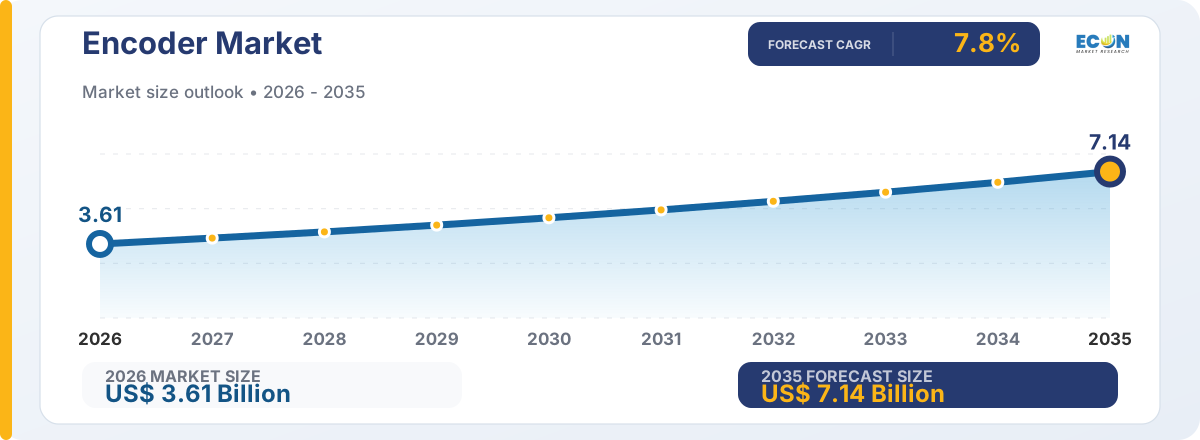
As per Econ Market Research analysis, the Global Encoder Market size amounted to US$ 3.61 Billion in 2026 and is anticipated to grow to US$ 7.14 Billion by 2035, recording a CAGR of 7.8% during 2026–2035. The base year taken for analysis is 2025.
An encoder is a type of electronic device or sensor that transfers mechanical motion into electrical signals. It is frequently used in a variety of applications to deliver accurate information on the movement, location, speed, or direction of a mechanical component or item. An encoder',s main function is to measure and track the position of any moving component of a system, including a rotating shaft, linear motion, and other moving parts. Control systems, automation, robotics, and several other applications require accurate motion control, positioning, and monitoring.
Encoder Market Dynamics
Encoder technology is continually improving, leading to higher resolution encoders, better accuracy, and more compact designs, which have broadened the spectrum of uses for encoders. Encoders' intelligence and communication skills allowed for their use in more advanced control systems. For applications like robotics, machine tools, and motion control systems that demand exact position and motion detection, encoders are important. The increase in demand for these applications made the encoder industry rise in the upcoming years.
Encoder Market Drivers
Encoders were widely used in the automotive industry for a variety of purposes, including electronic stability control, power steering, and anti-lock brake systems. The automobile industry',s expansion had a favorable influence on the encoder market. The encoders market has been significantly impacted by the growing usage of automation across various industries. Encoders are essential for producing accurate feedback and control in robots, automated manufacturing processes, and other industrial applications.
Growing Demand for High-Precision Applications
Industries that demand high-precision applications rely on encoders to ensure that every movement, adjustment, or measurement is executed with impeccable accuracy. The applications for such precision are diverse and impactful. In the aerospace sector, for instance, where safety and performance are paramount, encoders are employed in critical components like aircraft controls, ensuring that maneuvers are executed with pinpoint precision and response. In medical devices and healthcare, encoders play a pivotal role in imaging equipment, robotic surgery systems, and prosthetics. Encoders enable real-time feedback and control, allowing surgeons to perform intricate procedures with unparalleled accuracy and enhancing patient outcomes.
Restraints
High-quality encoders became more expensive as the demand for greater accuracy and more advanced functions was built. For both manufacturers and end-users, finding a balance between performance and cost-effectiveness became difficult. Since they have more functions and a greater resolution, High quality encoders are costly by default, so it&rsquo,s inaccurate to say that they may be pricey.
Complex Integration and Maintenance
Integrating encoders effectively requires a combination of technical expertise in both hardware and software domains. The process involves aligning the encoder',s output signals with the control system's inputs, ensuring accurate communication and synchronization. This integration may necessitate modifications to the existing infrastructure, including mechanical adaptations to accommodate the encoder',s physical presence and adjustments to control algorithms to interpret encoder data correctly.
For industries lacking the necessary technical resources or expertise, the prospect of dealing with intricate integration and ongoing maintenance can act as a deterrent. It may lead to concerns about increased costs, potential downtime during installation and maintenance procedures, and the need for continuous support from skilled professionals.
Opportunities
Rising Adoption of Robots
Encoders benefited from the increasing popularity of robots and autonomous systems in a variety of industries, including manufacturing, logistics, healthcare, and agriculture. High-performance encoders are needed in robotic applications since these systems needed accurate motion control and feedback. The healthcare industry is increasingly adopting robotics for surgical procedures, diagnostics, and patient care. Encoders are essential components in robotic surgery systems, enabling precise and steady movements during procedures.
Advancements in Miniaturization and Microtechnology
The opportunity for advancements in miniaturization and microtechnology involves the development of miniature encoders to meet the demand for precise motion control in compact spaces. These tiny encoders find applications in electronics, aerospace, and medical devices, enabling precise movements and enhancing efficiency in small-scale devices. As technology continues to shrink, the need for these micro encoders grows, paving the way for innovation in various industries.
Segment Overview
By Encoder Type
Based on the encoder type, the global encoder market is divided into rotary and linear segments. With the highest revenue share, the rotary category rules the global encoder market. These rotary encoders maintain records of a shaft',s rotational motion. The primary components of these devices are a disc that spins with patterns or slots and a sensor that analyses how the patterns change as the shaft revolves. The sensor generates electrical pulses in time with a rotational motion that can be used to calculate the position, speed, and direction of the rotating shaft.
By Signal Type
Based on the signal type, the global encoder market is segmented into incremental and absolute segments. The incremental segment dominates the global encoder market. Simple incremental encoders consist of a revolving disc or strip and a sensor that produces pulses as the disc rotates. They are flexible, dependable, and simple to deploy in a variety of applications, including manufacturing, automation, robotics, automotive, consumer electronics, and more due to their simplicity. They are frequently used for position control, speed measurement, and monitoring of rotary or linear motion.
By Technology
Based on technology, the global encoder market is classified into optical, photoelectric, magnetic, and others. The magnetic segment dominates the global encoder market with the largest revenue share. Magnetic encoders can be used in both rotary and linear motion applications also magnetic encoders are relatively easy to install and integrate into existing systems so it helps in reducing installation time and costs.
By Application
Based on application, the global encoder market is divided into industrial, healthcare, consumer electronics, automotive, power, aerospace, printing, and textile. In the global encoder market, the Industrial segment dominates with the largest revenue share.
Encoder Market Overview by Region
The global encoder market is categorized into North America, Europe, Asia-Pacific, and the Rest of the World. Asia Pacific emerged as the leading region, capturing approximately 9.14% of the CAGR during 2022-2031. The dominance of the Asia-Pacific region in the encoder market is a result of its rapid economic development, industrialization, and technical enhancement. Several countries in the Asia-Pacific area, including China, Japan, South Korea, and Taiwan, have thriving manufacturing sectors that depend significantly on encoders for accurate monitoring and motion sensing in a variety of production processes.
Competitive Landscape
In the global encoder market, a few major players exert significant market dominance and have established a strong regional presence. These leading companies remain committed to continuous research and development endeavors and actively engage in strategic growth initiatives, including product development, launches, joint ventures, and partnerships. By pursuing these strategies, these companies aim to strengthen their market position, expand their customer base, and capture a substantial share of the market.
Key Players
HEIDENHAIN Corporation
Broadcom Inc.
Rockwell Automation, Inc.
ELCO Holding
Alps Alpine Co., Ltd.
TE Connectivity Ltd.
Schneider Electric SE
FRABA B.V. (POSITAL & UBITO)
CUI Devices
Panasonic Corporation
Sensata Technologies, Inc.
Omron Corporation
TT Electronics plc
Grayhill, Inc.
Encoder Market Recent Developments
In July 2022, Sensata Technologies Completes the Acquisition of Dynapower. Dynapower provides energy storage and power conversion solutions including inverters, converters, rectifiers and custom transformers for renewable energy generation, green hydrogen production, Electric Vehicle charging stations, and microgrid applications, as well as industrial and defense applications. A broad product portfolio, strong track record in the field, and commitment to customers makes Dynapower a trusted global name in power conversion solutions.
In March 2022, the explosion-proof IXARC rotary encoders from POSITAL were approved to meet the requirements of the ATEX/IECEx guidelines for Category 3 Electrical Equipment. These tools are perfect for oil and gas installations, chemical plants, woodworking activities, and grain handling facilities, as they used in Zone 2 and Zone 22 conditions (possible exposure to dangerous quantities of explosive gases and combustible dust)
Encoder Market Report Scope & Segmentation
| Attributes | Details |
|---|---|
| Market Size (Current)Current market valuation | US$ 3.61 Billion in 2026 |
| Market Size (Forecast)Projected market valuation | US$ 7.14 Billion in 2035 |
| Growth RateCompound Annual Growth Rate | CAGR of 7.8% from 2026 to 2035 |
| Forecast PeriodAnalysis timeline | 2026 – 2035 |
| Base YearReference year for analysis | 2025 |
| Historical Data AvailablePast market data availability | Yes |
| Regional ScopeGeographical coverage | Global |
| Segments CoveredMarket segments analyzed | By Type
By Technology
By Industry Vertical
|
Leading companies covered in this report
- Sensata Technologies
- Mitutoyo
- Fortive
- HEIDENHAIN
- Renishaw
- Maxon
- Balluff
- Pepperl+Fuchs
- Omron
- Honeywell
- Rockwell Automation
Frequently Asked Questions
Common questions about this report
The study period covers historical insights and forecast projections for the period 2026-2035.
About the Author
Market research expert with years of industry experience

Dipali Bhingare serves as the Market Research Director at Econ Market Research. With a focus on translating complex global economic shifts into actionable business intelligence, she oversees the strategic direction of comprehensive market studies. Her work empowers organizations to navigate volatile industries through data-driven forecasting and deep-dive competitive analysis.