

Volumetric Display Market
Volumetric Display Market Size, Share, Trends, Growth, and Industry Analysis, By Display Type (Static Volume Display, Swept Volume Display, Multi-planar Volumetric Display), By End-User (Medical, Aerospace andamp; Defense, Media andamp; Entertainment, Education, Others), Regional Analysis and Forecast Period 2026-2035
Market Overview
As per Econ Market Research analysis, the Global Volumetric Display Market was recorded at US$ 0.68 Billion in 2026 and is projected to expand to US$ 7.01 Billion by 2035, registering a CAGR of 29.64% over the forecast period. The base year used is 2025.
Volumetric Display Market Size 2025-2035 (USD Billion)

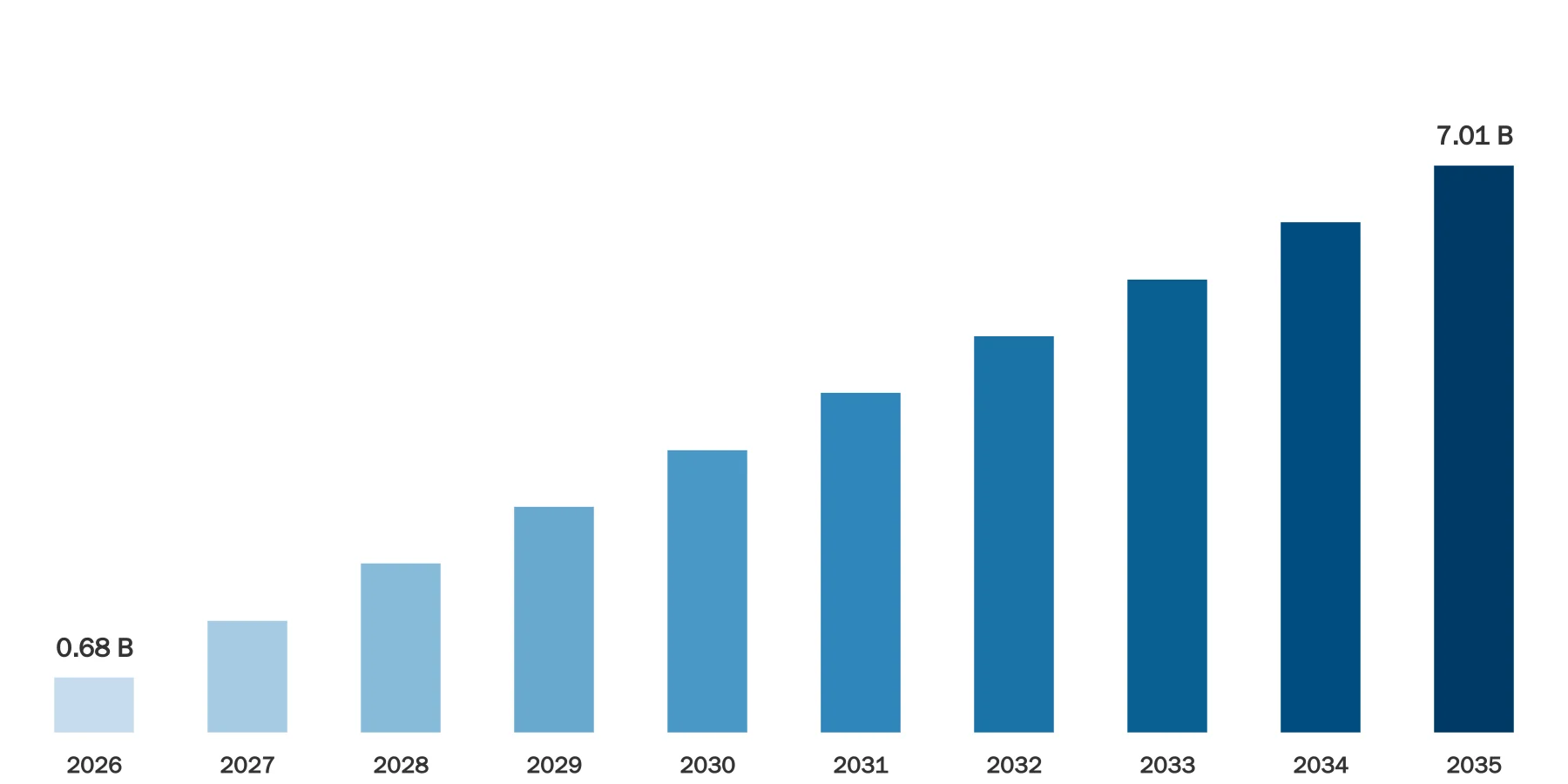
Source: Econ Market Research
Innovative three-dimensional visual technologies are introduced by the volumetric display market, transforming user experiences in a variety of industries. Volumetric displays, as opposed to conventional flat screens, show pictures or objects in actual three-dimensional space, giving viewers a sensation of depth and immersion without the need for special glasses. These displays produce holographic-like images by using projection, light scattering, or laser-based processes. The volumetric display industry promises to transform the way information is displayed and consumed, boosting demand for enhanced display solutions in the digital age. Applications range from medical imaging and design prototyping to entertainment and advertising.
Volumetric Display Dynamics
Rapid technology breakthroughs, rising demand for immersive user experiences, and expanding applications across a variety of sectors define the volumetric display industry. The increasing use of virtual and Augmented Reality solutions, increased R&,D spending, and the introduction of new display technology are some of the major motivators. A few other variables that impact market dynamics are the decreasing costs of display components, the growing demands of consumers for interactive visual content, and the incorporation of volumetric displays into wearables and smart gadgets. In addition, the market environment and innovation are greatly influenced by manufacturer competition, regulatory standards, and changing consumer preferences.
Volumetric Display Drivers
Augmented and Virtual Reality Integration
By improving immersion and interaction in digital experiences, the industry is driven by the integration of volumetric displays with augmented and virtual reality technologies. Users can engage with virtual items as if they were real by projecting three-dimensional holographic projections onto physical locations. With this connection, AR and VR applications can do even more, providing users with an immersive and lifelike experience for training, education, gaming, and other industrial uses. Volumetric display technologies have a growing chance of success as the demand for immersive experiences increases.
Technological Advancements in Display Technologies
The performance, quality, and usefulness of three-dimensional visual solutions are continuously improved by technological developments in display technologies, which drives the volumetric display market. Realistic and immersive viewing experiences are made possible by innovations including improved color accuracy, better refresh rates, and increasing pixel density. Furthermore, improvements in manufacturing techniques and materials enable volumetric displays to be produced in a more economical and scalable manner, opening up new markets and uses for them. These developments fuel demand and encourage additional field research and development.
Restraints:
Limited Content Creation and Compatibility
The market for volumetric displays is hampered by the limitations on content generation and interoperability, which make it difficult to offer a variety of captivating visual experiences. The limited availability of technologies and compatible content for producing volumetric imaging hinders the widespread adoption of these displays in a variety of applications. Moreover, content providers face challenges because to the intricacy of transforming pre-existing 2D and 3D content into forms appropriate for volumetric displays. This restriction hinders commercial expansion and prevents the technology from reaching its full potential.
Potential adopters of these cutting-edge visual solutions are discouraged from engaging in the volumetric display market by the high initial investment prices. Volumetric displays require complex technologies and materials to create and produce, which drives up manufacturing costs. Additionally, the small production scale drives up unit costs even more. Despite the exciting potential of volumetric displays, these large upfront costs provide financial obstacles for companies and organizations, especially smaller ones. This prevents widespread adoption and slows down market growth.
Opportunities:
Integration with Emerging Technologies
Volumetric displays present a chance to unlock new capabilities and applications through integration with emerging technologies like Artificial Intelligence (AI) and the Internet of Things (IoT). Delivering tailored and interactive content can improve user engagement and immersion by fusing volumetric displays with AI algorithms. Complex information can be visualized in real time by integrating with IoT devices, which also allows for easy connectivity and data interchange. The possibility for creative solutions in industries such as healthcare, Industrial Automation, and smart cities is created by this confluence, which propels market expansion.
Adoption in Healthcare for Advanced Imaging
The use of volumetric displays for advanced imaging in healthcare presents a huge opportunity since they provide improved visualization capabilities that have the potential to completely transform medical education, diagnosis, and treatment planning. By allowing medical practitioners to see intricate three-dimensional models of patients', anatomy, volumetric displays help improve the precision of surgical diagnoses and treatments. Furthermore, through realistic instructional experiences, these displays improve patient understanding. Volumetric display adoption in healthcare offers a compelling opportunity for innovation and improvement in medical imaging technology, with the potential to improve patient outcomes and expedite operations.
Segment Overview
By Display Type
Based on display type, the global volumetric display market is divided into swept volume and static volume. The static volume category dominates the market with the largest revenue share in 2023. Three-dimensional images are produced using static volume displays within of a fixed or static volume of space. They produce the appearance of depth without the need of moving elements. Rather, they use different methods like light scattering, projection mapping, or holography to create three-dimensional images in a preset area. Volumetric scanners, another name for swept volume displays, work by projecting light or other stimuli into a specific area of space. They quickly sweep through a physical volume using mechanical or electrical methods, lighting certain locations to provide the appearance of three-dimensional objects.
By End Use
Based on the end use, the global volumetric display market is categorized into medical, aerospace &, defense, automotive, media, communication &, entertainment, education &, training, and others. The medical category leads the global volumetric display market with the largest revenue share in 2023. In medical imaging, volumetric displays are used for surgical planning, medical teaching, and diagnostic imaging, among other uses. Healthcare workers can see intricate anatomical components in three dimensions thanks to these displays, which improves diagnosis and treatment outcomes.
Volumetric displays are used in the aerospace and defense sectors for tasks like mission planning, situational awareness, and flight simulation. In automobile applications, volumetric displays are utilized for driver assistance systems, augmented reality dashboards, and heads-up displays (HUDs). Applications for volumetric displays in media, communication, and entertainment include virtual concerts, holographic advertising, and immersive gaming.
Volumetric Display Overview by Region
The global volumetric display market is categorized into North America, Europe, Asia-Pacific, and the Rest of the World. North America emerged as the leading region, capturing the largest market share in 2023. Due to the region',s advanced technological infrastructure and concentration of significant industry players, innovation and market expansion are fostered.
Furthermore, immersive entertainment experiences are in high demand in North America, especially in media, gaming, and advertising industries where volumetric displays are being used more and more. North America',s significance in developing and adopting volumetric display technologies is further attributed to encouraging government regulations, active R&,D, and a culture of technological innovation, all of which strengthen the region',s leadership position in the market. Throughout the forecast period, Asia-Pacific is anticipated to post a significant CAGR.
Numerous causes, such as the fast-paced economic growth, technological breakthroughs, and the growing ubiquity of advanced display technology across a range of industries, are responsible for this prediction. With Asia-Pacific leading the way in innovation and production, particularly in China, Japan, and South Korea, there is great potential for the volumetric display market to grow. The region',s high population density, increasing standard of living, and expanding desire for immersive entertainment experiences all contribute to the volumetric display market',s predicted growth trajectory in Asia-Pacific.
Volumetric Display Competitive Landscape
In the global volumetric display market, a few major players exert significant market dominance and have established a strong regional presence. These leading companies remain committed to continuous research and development endeavors and actively engage in strategic growth initiatives, including product development, launches, joint ventures, and partnerships. By pursuing these strategies, these companies aim to strengthen their market position, expand their customer base, and capture a substantial share of the market.
Volumetric Display Market Leading Companies:
The Coretec Group
Lightspace Labs
Voxon Photonics
Holografikakft
Holoxica Ltd
Leia Inc.
SeeReal Technologies S.A.
Looking Glass
Alioscopy, and various others.
Volumetric Display Recent Developments
In May 2023, the holographic startup Looking Glass just unveiled Looking Glass Liteforms, its newest offering. This cutting-edge platform transforms the way we engage with digital avatars by bringing talking holographic characters to life. Users can have lifelike interactions with interactive holographic figures using Looking Glass Liteforms, creating new avenues for entertainment and communication.
In December 2022, the fourth quarter of LightSpace Technologies, Ltd. and EUROLCDS, Ltd.',s collaborative initiative to create a multi-plane volumetric display screen is now complete. Through creative application of polymer interlayer lamination, this joint endeavor seeks to improve the optical performance of the display technology.
Volumetric Display Market Report Segmentation
Volumetric Display Market Report Scope & Segmentation
| Attributes | Details |
|---|---|
Market Size (Current) | US$ 0.68 Billion in 2026 |
Market Size (Forecast) | US$ 7.01 Billion in 2035 |
Growth Rate | CAGR of 29.64% from 2026 to 2035 |
Forecast Period | 2026 – 2035 |
Base Year | 2025 |
Historical Data Available | Yes |
Regional Scope | Global |
Segments Covered | By Display Type
By End-User
|
Frequently Asked Questions
Common questions about this report
The study period covers historical insights and forecast projections for the period 2026-2035.
About the Author
Market research expert with years of industry experience

Dipali Bhingare serves as the Market Research Director at Econ Market Research. With a focus on translating complex global economic shifts into actionable business intelligence, she oversees the strategic direction of comprehensive market studies. Her work empowers organizations to navigate volatile industries through data-driven forecasting and deep-dive competitive analysis.
Related Reports
Explore more market insights from the same category