

Auxiliary Contactor Market
Auxiliary Contactor Market Size, Share, Trends, Growth, and Industry Analysis, By Current Rating (Up to 16 A, 16 A to 32 A, Above 32 A), By Voltage (Low Voltage, Medium Voltage, High Voltage), By Application (Motor Control, Lighting Control, Others), Regional Analysis and Forecast Period 2026-2035
Market Overview
As per Econ Market Research analysis, the Global Auxiliary Contactor Market was valued at US$ 6.34 Billion in 2026 and is expected to reach US$ 8.61 Billion by 2035, registering a CAGR of 3.5% during the forecast period 2026–2035. The base year considered is 2025.
Auxiliary Contactor Market Size 2025-2035 (USD Billion)

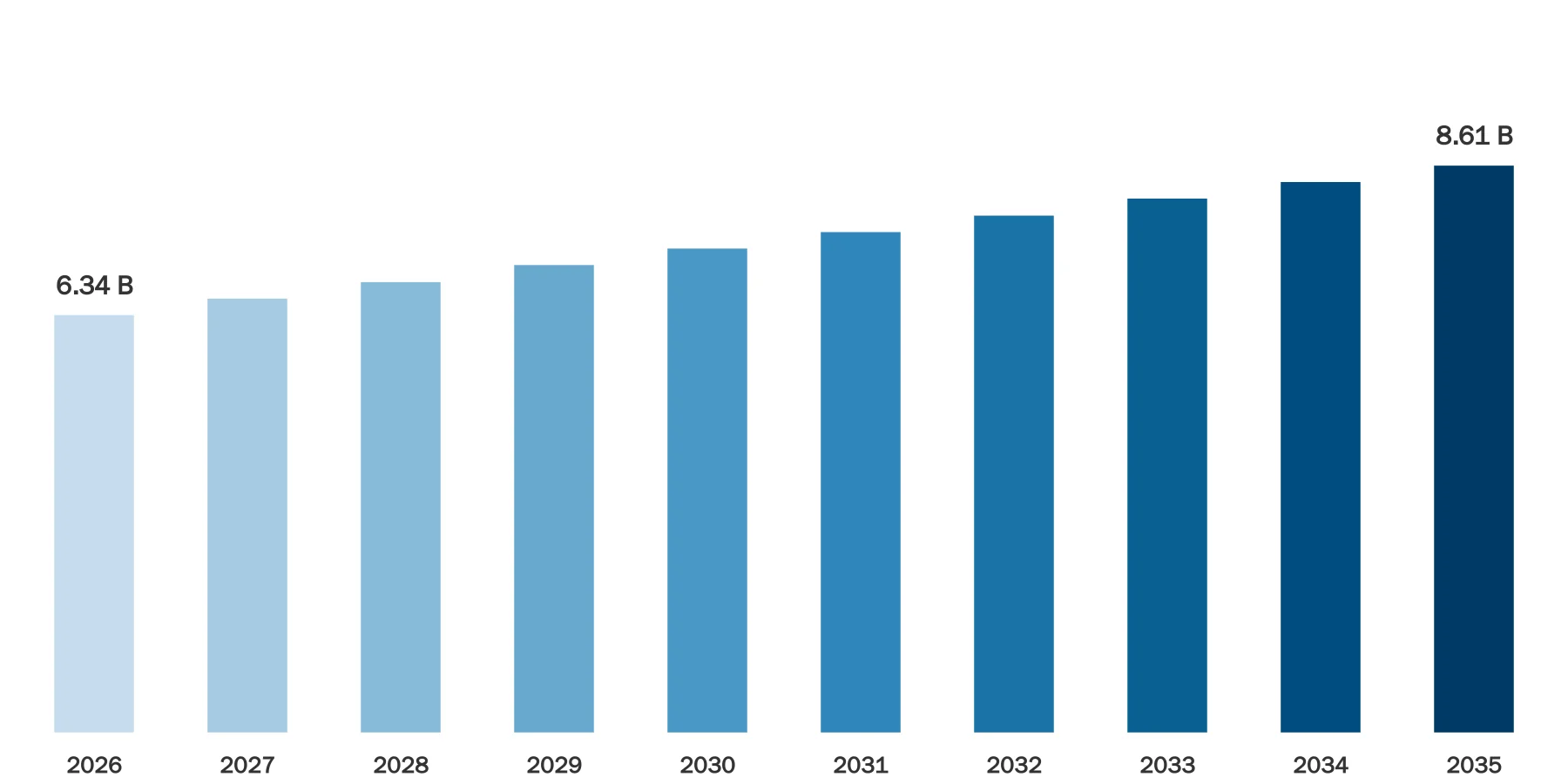
Source: Econ Market Research
Auxiliary contactors serve as essential components within larger electrical systems, enabling the remote control and monitoring of electrical loads, such as motors, heaters, lighting systems, and other devices. These contactors feature auxiliary contacts that are integrated into the main switching mechanism, allowing for the transmission of control signals and feedback between the primary control circuit and external devices. With advancements in technology and automation, the demand for auxiliary contactors has surged across multiple sectors, including manufacturing, energy, construction, transportation, and utilities, driving market growth and innovation.
The market for auxiliary contactors is distinguished by a wide array of products designed to satisfy particular demands related to voltage, current, and operation, serving a wide range of industrial and commercial uses. Prominent industry participants consistently allocate resources towards research and development endeavours aimed at augmenting product efficacy, dependability, and efficiency, these endeavours capitalise on breakthroughs in materials science, electronics, and design engineering. Furthermore, strict safety regulations and standards governing electrical installations and equipment have highlighted the significance of certification and compliance in the auxiliary contactor market, forcing manufacturers to give priority to the testing, validation, and quality assurance of their products.
Auxiliary Contactor Dynamics
One primary driver is the ongoing industrialization and infrastructure development across emerging economies, which fuels the need for reliable electrical control solutions in sectors such as manufacturing, construction, transportation, and utilities. Additionally, the rising adoption of automation, robotics, and smart technologies in industrial processes and commercial facilities drives the demand for advanced auxiliary contactors capable of integrating seamlessly with digital control systems and IoT platforms.
Furthermore, the safety regulations and laws governing electrical installations and equipment have a significant impact on market dynamics. To guarantee product quality, dependability, and safety, manufacturers must abide by strict compliance requirements and certification standards, this forces them to invest in R&,D and quality assurance programmes. Additionally, as consumer preferences shift in favour of sustainable and energy-efficient solutions, manufacturers are concentrating on creating auxiliary contactors that maximise power consumption, minimise environmental impact, and improve operational efficiency.
Auxiliary Contactor Drivers
Industrial Automation and IoT Integration:
The market for auxiliary contactors is being driven by the growing use of industrial automation and the integration of IoT technologies across a range of industries. Auxiliary contactors with advanced monitoring, control, and communication capabilities are becoming more and more in demand as industries strive for increased productivity, efficiency, and operational optimisation.
The seamless integration of digital control systems, IoT platforms, and smart devices is made possible by these contactors, which are essential for enabling real-time monitoring, remote operation, and predictive maintenance of vital electrical assets. Additionally, IoT-enabled auxiliary contactors provide improved diagnostic features that facilitate proactive fault detection, troubleshooting, and performance optimisation. As a result, a wide range of industrial and commercial applications are adopting these contactors.
Rising Demand for Energy-Efficient Solutions:
The need for energy-efficient electrical control solutions, such as auxiliary contactors, is being driven by the increased focus on sustainability, energy efficiency, and environmental conservation. Businesses are under increasing pressure to cut back on energy use, lower carbon emissions, and abide by strict environmental regulations. Advanced energy-saving features like intelligent load management, high efficiency, and low power consumption are making auxiliary contactors more popular among different end-user segments. These contactors are essential parts of contemporary electrical installations and industrial processes because they maximise energy efficiency, lower operating costs, and improve overall system reliability and performance.
Restraints:
The high initial investment costs linked to the acquisition, setup, and integration of advanced contactor systems are one of the main obstacles facing the auxiliary contactor market. High-quality auxiliary contactors, as well as related equipment, control panels, and wiring infrastructure, can come with a hefty upfront capital cost that can be prohibitive for end users, particularly small and medium-sized businesses (SMEs) and sectors with tight budgets. The overall cost of ownership is further increased by the expenses related to system design, engineering, commissioning, and maintenance, which restricts market penetration and adoption rates, especially in price-sensitive markets and developing economies.
Complexity of Integration and Compatibility Issues:
Another key restraint facing the auxiliary contactor market is the complexity of integration and compatibility issues with existing electrical systems, control architectures, and automation platforms. Integrating auxiliary contactors with legacy equipment, disparate control protocols, and heterogeneous networks often presents technical challenges and interoperability issues, requiring specialized expertise, customization, and retrofitting solutions. Moreover, the lack of standardized interfaces, communication protocols, and interoperability standards across different brands and product lines complicates the integration process, leading to potential system downtime, performance degradation, and operational inefficiencies for end-users.
Opportunities:
Expansion of Renewable Energy Infrastructure:
The global transition towards renewable energy sources, such as solar, wind, and hydroelectric power, presents significant opportunities for the auxiliary contactor market. As governments, utilities, and industries invest in renewable energy infrastructure and grid modernization initiatives, the demand for auxiliary contactors for applications such as power generation, energy storage, and distribution systems is expected to escalate.
Auxiliary contactors play a vital role in enabling the reliable operation, control, and protection of renewable energy assets, facilitating seamless integration with the electrical grid, energy management systems, and energy storage solutions. Moreover, the proliferation of distributed energy resources (DERs), microgrids, and smart grid technologies further amplifies the demand for advanced auxiliary contactors with grid-tie and islanding capabilities, creating new avenues for market growth and innovation.
Segment Overview
By Current Type
Segmentation by current type categorizes auxiliary contactors based on their rated current capacity, which includes 6A, 16A, and 20A variants. The selection of auxiliary contactors with appropriate current ratings depends on the specific electrical load requirements and operational characteristics of the equipment or system they are intended to control. Contactors rated at 6A are typically suitable for low-power applications, while 16A and 20A variants are capable of handling higher current levels, catering to a broader range of industrial and commercial applications.
By Voltage
In terms of voltage type segmentation, auxiliary contactors are classified into low, medium, and high voltage categories, reflecting the voltage levels at which they are designed to operate. Low-voltage auxiliary contactors are commonly employed in control circuits and equipment operating at voltages up to 1000V AC or 1500V DC. Medium-voltage contactors are engineered to handle voltage levels ranging from 1000V to 15kV, suitable for medium-power distribution and switching applications. High-voltage auxiliary contactors are designed for voltages exceeding 15kV, typically utilized in high-power transmission, distribution, and industrial installations.
By Application
The segmentation by application identifies the diverse range of functions and usage scenarios for auxiliary contactors across various industries and sectors. Motor applications constitute a significant portion of the market, where auxiliary contactors are employed for starting, stopping, and controlling the operation of electric motors in industrial machinery, pumps, conveyors, and other mechanical systems.
Power switching applications encompass a broad spectrum of functions, including circuit protection, load switching, and isolation, where auxiliary contactors serve as integral components in electrical distribution panels, switchgear, and control cabinets. The others category encompasses specialized applications and niche markets where auxiliary contactors are utilized for specific purposes such as lighting control, heating systems, HVAC equipment, and renewable energy installations.
Auxiliary Contactor Overview by Region
Developed regions such as North America and Europe represent mature markets for auxiliary contactors, driven by robust industrial infrastructure, stringent regulatory standards, and high adoption rates of automation and smart technologies. These regions witness steady demand for auxiliary contactors across a wide range of applications in manufacturing, energy, transportation, and utilities sectors, supported by sustained investments in infrastructure modernization and capacity expansion initiatives.
In Asia-Pacific, rapid industrialization, urbanization, and infrastructure development activities drive significant growth opportunities for the auxiliary contactor market. Emerging economies such as China, India, and Southeast Asian countries exhibit strong demand for auxiliary contactors, fueled by expanding manufacturing sectors, increasing investments in industrial automation, and rising deployment of smart grid and renewable energy projects. Moreover, favorable government initiatives, incentives, and policies aimed at promoting energy efficiency, electrification, and sustainable development further stimulate market growth and adoption of auxiliary contactors across the region.
Latin America and the Middle East &, Africa regions present promising growth prospects for the auxiliary contactor market, driven by infrastructure development projects, urbanization trends, and investments in key sectors such as construction, oil &, gas, mining, and utilities. However, market dynamics in these regions are influenced by geopolitical factors, economic volatility, and regulatory challenges, which may impact the pace of market expansion and investment decisions by stakeholders. Nevertheless, increasing emphasis on industrial automation, energy conservation, and electrification initiatives bode well for the long-term growth trajectory of the auxiliary contactor market in these regions.
Auxiliary Contactor Market Competitive Landscape
The competitive landscape of the global auxiliary contactor market is characterized by intense competition among key players, including Schneider Electric SE, ABB Ltd., Siemens AG, Eaton Corporation PLC, and Rockwell Automation, Inc., among others. These industry leaders leverage their extensive product portfolios, technological expertise, and global presence to maintain market dominance and drive innovation. Moreover, strategic initiatives such as mergers, acquisitions, partnerships, and collaborations are prevalent in the market, enabling companies to expand their market reach, diversify product offerings, and enhance competitive positioning.
Additionally, investments in research and development (R&,D) activities play a pivotal role in fostering product innovation, performance optimization, and differentiation strategies, catering to evolving customer needs and market trends. Furthermore, emphasis on quality assurance, regulatory compliance, and customer-centric approaches underscores the commitment of market players to delivering reliable, high-performance auxiliary contactor solutions that meet the stringent requirements of diverse industries and applications.
Auxiliary Contactor Market Leading Companies:
ABB
Eaton Corporation
Schneider Electric
Danfoss Industrial Automation
Toshiba
Omron Corporation
General Electric (GE)
AMETEK Inc.
Furukawa Electric Co. Ltd.
HIMEL Hong Kong Ltd.
Hubbell Inc.
Kohler Co.
Legrand SA
LOVATO Electric Spa
LS ELECTRIC Co. Ltd.
Mitsubishi Electric Corporation
Rockwell Automation Inc.
Sassin International Electric Shanghai Co. Ltd.
Schaltbau Holding AG
Siemens AG
TE Connectivity
Auxiliary Contactor Recent Developments
Sep 2021, C&,S Electric has indeed introduced a new DX series of contactors featuring Busbar termination capabilities. These contactors are available in the three-pole configuration, offering enhanced functionality and flexibility in various electrical applications.
Global Auxiliary Contactor Report Segmentation
Auxiliary Contactor Market Report Scope & Segmentation
| Attributes | Details |
|---|---|
Market Size (Current) | US$ 6.34 Billion in 2026 |
Market Size (Forecast) | US$ 8.61 Billion in 2035 |
Growth Rate | CAGR of 3.5% from 2026 to 2035 |
Forecast Period | 2026 – 2035 |
Base Year | 2025 |
Historical Data Available | Yes |
Regional Scope | Global |
Segments Covered | By Current Rating
By Voltage
By Application
|
Frequently Asked Questions
Common questions about this report
The study period covers historical insights and forecast projections for the period 2026-2035.
About the Author
Market research expert with years of industry experience

Dipali Bhingare serves as the Market Research Director at Econ Market Research. With a focus on translating complex global economic shifts into actionable business intelligence, she oversees the strategic direction of comprehensive market studies. Her work empowers organizations to navigate volatile industries through data-driven forecasting and deep-dive competitive analysis.
Related Reports
Explore more market insights from the same category